


Everyone Wants Salesforce AI. But Not Everyone's Ready.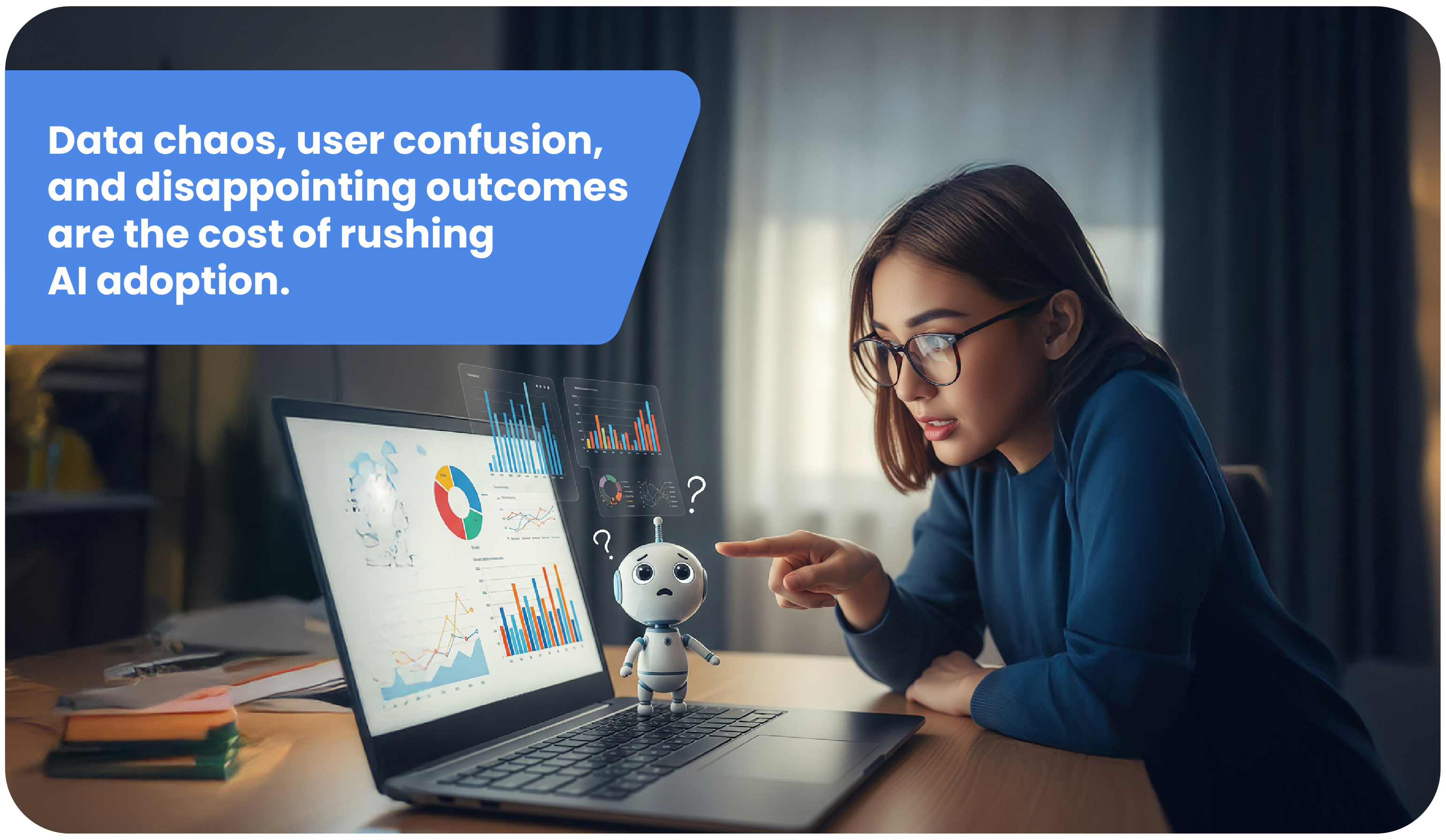
The excitement around Salesforce AI is undeniable. Einstein Copilot, Agentforce, GPT integrations, Data Cloud copilots, and predictive insights promise to revolutionize how organizations operate. From automating repetitive tasks to predicting customer behavior, Salesforce AI capabilities seem like the silver bullet every organization has been waiting for.
But here's the reality check: Salesforce AI is exciting, but it's definitely not plug-and-play.
Too many organizations rush headfirst into AI implementation without a solid readiness plan, only to face a cascade of issues. Data chaos where AI models produce unreliable predictions because the underlying information is inconsistent or incomplete. User confusion as teams struggle to interpret AI-generated insights or recommendations. Disappointing outcomes that fall far short of the transformative promises that initially sparked the investment.
The pattern is frustratingly common. Organizations activate AI features with high expectations, only to discover weeks or months later that their foundation wasn't strong enough to support meaningful results. The technology is powerful, but the organizational ecosystem around it simply wasn't prepared.
Before you activate any AI-related features, whether it’s Einstein Copilot, GPT-powered assistants, or Data Cloud models in your Salesforce org, you need to honestly assess whether your organization is truly ready across five core areas. This comprehensive Salesforce AI readiness checklist will help you evaluate your preparedness and identify potential gaps before they become costly problems.
Why You Need a Readiness Checklist
Most content about Salesforce AI focuses on the exciting possibilities: Automated sales processes (Einstein Bots), predictive lead scoring (Einstein), or generative content suggestions (GPT copilots) that anticipate customer needs, and personalized marketing campaigns that drive engagement. These capabilities are genuinely transformative when implemented correctly.
However, the real value from AI only emerges when your organizational foundation is rock solid. You need clean, well-structured data that AI models can actually use. Your teams need the skills and knowledge to interpret AI-driven recommendations responsibly. Your organization needs robust governance frameworks to ensure ethical AI usage. You need change management processes that help people embrace AI as a collaborative tool rather than a threat. And critically, you need strategic clarity about how AI aligns with your actual business objectives.
Without these foundational elements, even the most sophisticated AI tools become expensive disappointments.
The gap between AI potential and AI reality often comes down to organizational readiness, not technological limitations.
What's missing from most discussions is a practical way for organizations to step back and comprehensively assess their total readiness for AI adoption. That's exactly what this Salesforce AI readiness checklist provides: a structured framework to evaluate whether your organization is prepared to extract genuine value from AI investments.
The 5-Part Salesforce AI Readiness Checklist
1. Data & Integration Readiness
Your data quality directly determines AI success. Before any AI model can generate meaningful insights, it needs access to accurate, consistent, and well-structured information.
Key Questions:
- Are your Salesforce records accurate, complete, and consistently formatted across all objects and fields?
- Do your integrated systems (CRM, marketing automation, customer service platforms, financial systems) sync cleanly without data conflicts or gaps?
- Can your current data actually support the AI predictions or insights you want to generate?
- Do you have standardized data entry processes that maintain quality over time?
- Are duplicate records, incomplete fields, and inconsistent formatting under control?
Poor data quality is the fastest way to undermine AI effectiveness. If your contact records have inconsistent naming conventions, missing key information, or duplicate entries, AI models will struggle to identify meaningful patterns. When your marketing automation platform and Salesforce don't sync properly, AI recommendations become unreliable because they're based on incomplete customer pictures.
Data integration readiness goes beyond just technical connections. You need consistent data governance practices that ensure information remains clean and usable as it flows between systems. This includes regular data audits, standardized entry protocols, and clear ownership of data quality across different departments.
2. Team Skills & AI Literacy
Salesforce AI tools are only as effective as the people using them. Your teams need more than basic technical training; they need genuine AI literacy that enables them to collaborate effectively with AI systems.
Key Questions:
- Do your Salesforce administrators and end users understand how to interpret AI suggestions and recommendations responsibly?
- Is comprehensive training in place for understanding AI-driven scoring, predictions, and automated actions?
- Are your teams prepared to collaborate with AI rather than simply react to its outputs?
- Do people understand the limitations of AI and when human judgment should override AI recommendations?
- Are there clear protocols for when and how to act on AI-generated insights?
AI literacy involves understanding both the capabilities and limitations of AI systems. When Einstein Lead Scoring suggests a particular prospect is high-priority, your sales team needs to understand what factors contributed to that score and how to validate the recommendation against their own expertise. When AI suggests automating a particular customer service response, your support team needs to know when that automation is appropriate and when human intervention is necessary.
This isn't about replacing human expertise with AI; it's about augmenting human capabilities with AI insights. The most successful AI implementations happen when people understand how to combine their domain knowledge with AI-generated recommendations to make better decisions than either could make alone.
3. Governance, Compliance & Trust
AI systems make decisions and recommendations that can significantly impact your customers, employees, and business outcomes. Without proper governance frameworks, these systems can introduce bias, generate inappropriate recommendations, or violate compliance requirements.
Key Questions:
- Do you have clear policies governing the ethical use of AI within your Salesforce environment?
- Is someone specifically accountable for monitoring AI usage, outputs, and potential issues?
- How will your organization identify and address AI bias, hallucinations, or transparency concerns?
- Are there approval processes for implementing new AI features or expanding AI usage?
- Do your AI governance policies align with industry regulations and compliance requirements?
AI governance isn't just about preventing problems; it's about building trust in AI systems across your organization. When people understand that there are clear policies, accountability structures, and monitoring processes around AI usage, they're more likely to embrace AI tools confidently.
This includes establishing clear guidelines about when AI recommendations should be followed, when they should be questioned, and when human oversight is mandatory. It means having processes to regularly audit AI outputs for bias or accuracy issues. And it means ensuring that your AI usage complies with relevant regulations, whether that's data privacy laws, industry-specific compliance requirements, or emerging AI governance standards.
4. Change Management & Culture
AI adoption represents a significant organizational change that affects how people work, make decisions, and interact with technology. Your organization's cultural readiness for AI is just as important as its technical readiness.
Key Questions:
- How comfortable is your organization with automation and AI-led decision recommendations?
- Do you have internal AI champions who can advocate for adoption and help address concerns?
- Is there a clear communication plan for AI rollout that addresses both benefits and concerns?
- How have past technology changes (including previous Salesforce implementations) been received by your teams?
- Are there processes in place to gather feedback and iterate on AI implementations based on user experience?
Cultural readiness varies dramatically between organizations. Some embrace new technology enthusiastically, while others approach change with skepticism or resistance. Understanding your organization's change management history provides valuable insights into how AI adoption is likely to proceed.
Successful AI adoption requires clear communication about what AI will and won't do, how it will affect daily workflows, and what support will be available during the transition. It means identifying and empowering internal champions who can help colleagues navigate the change. And it means creating feedback loops that allow you to adjust your AI implementation based on real user experiences.
5. Business Strategy Alignment
AI should be a strategic capability that advances specific business objectives, not just an exciting technology experiment. Without clear alignment between AI capabilities and business goals, even successful AI implementations may not deliver meaningful value.
Key Questions:
- Are your proposed AI use cases directly mapped to concrete business goals like shorter sales cycles, improved customer experience, or operational efficiency gains?
- Are you approaching AI as a strategic capability that supports business objectives, or as an interesting technology to experiment with?
- Is your leadership team aligned on the specific business outcomes you expect from AI investments?
- Do you have metrics and success criteria that will allow you to measure AI impact on business performance?
- Have you prioritized AI use cases based on potential business impact rather than technical novelty?
Strategic alignment means moving beyond "AI sounds cool" to "AI will help us achieve specific business outcomes." This might mean using predictive analytics to identify at-risk customers before they churn, automating routine customer service inquiries to free up human agents for complex issues, or using AI-powered lead scoring to help sales teams prioritize their efforts more effectively.
The most successful Salesforce AI implementations start with clear business objectives and then identify AI capabilities that can help achieve those objectives. This approach ensures that AI investments generate measurable business value rather than just impressive technical demonstrations.
Red Flags: How to Know You're Not Ready (Yet)
Certain organizational characteristics strongly indicate that AI implementation should be delayed until foundational issues are addressed. Recognizing these red flags can save you from costly implementation failures.
Critical Warning Signs:
- Essential business data lives in disconnected silos, personal spreadsheets, or systems that don't integrate with Salesforce
- Your organization has no AI governance policies, ethical guidelines, or a clear accountability structure for AI decisions
- Users are skeptical about AI, uninformed about its capabilities, or actively resistant to AI-assisted workflows
- There are no clear metrics, success criteria, or business goals tied to your proposed AI implementations
- You're already using some AI features, but aren't seeing meaningful improvements in business outcomes or operational efficiency
If multiple red flags apply to your organization, don't panic. These issues are addressable with focused effort and proper planning. The key is acknowledging these gaps honestly rather than hoping they won't matter once AI is activated.
Data silos are particularly problematic because AI models need comprehensive, consistent information to generate reliable insights. If customer information exists in multiple disconnected systems, AI recommendations will be based on incomplete pictures of customer relationships and behaviours.
Similarly, user skepticism or resistance can undermine even technically successful AI implementations. If your teams don't trust AI recommendations or don't understand how to use them effectively, the technology won't deliver its potential value regardless of how well it functions.
If You're Not Ready: What to Do Next
Discovering readiness gaps doesn't mean indefinitely postponing AI adoption. Instead, it means starting smart with focused preparation that addresses your specific organizational needs.
Recommended First Steps:
Conduct a comprehensive data audit to identify quality issues, integration gaps, and governance weaknesses that could undermine AI effectiveness. This includes reviewing data accuracy, completeness, consistency, and accessibility across all systems that would feed into AI models.
Choose one or two high-impact AI use cases that align clearly with business objectives and don't require perfect data or extensive organizational change. Starting small allows you to build confidence, demonstrate value, and learn from experience before expanding AI usage.
Build internal awareness and AI literacy through targeted training programs that help people understand AI capabilities, limitations, and best practices. This isn't just technical training; it's about helping people understand how to collaborate effectively with AI systems.
Establish basic governance policies and accountability structures that provide clear guidelines for AI usage, decision-making, and problem resolution. These don't need to be complex initially, but they need to exist and be clearly communicated.
The goal isn't perfection before starting; it's sufficient readiness to ensure success with your initial AI implementations. You can then build on those successes to expand AI usage as your organizational readiness improves.
If You’re Ready for AI, Make It Work For You
Salesforce AI represents a genuinely powerful opportunity to transform how organizations operate, engage with customers, and achieve their missions. The technology capabilities are impressive and continue to evolve rapidly. But AI's power only translates into real business value when organizations are properly prepared to harness it.
This Salesforce AI readiness checklist isn't designed to be a barrier to AI adoption. Instead, it's your launchpad for AI success. By honestly assessing your readiness across data quality, team skills, governance frameworks, change management, and strategic alignment, you position your organization to extract maximum value from AI investments.
The organizations that will gain the greatest competitive advantage from AI aren't necessarily those with the most advanced technology. They're the organizations that combine AI capabilities with strong foundational readiness across people, processes, and strategic clarity.
Take the time to work through this readiness assessment thoroughly. Address the gaps you identify. Build the foundation that will support AI success. When you do activate Salesforce AI features, you'll do so with confidence that your organization is prepared to turn AI potential into meaningful business results.
Not sure where to begin with your Salesforce AI readiness checklist assessment? Talk to us at CUBE84. We help organizations prepare for Salesforce AI implementation the right way, ensuring you have the foundation needed for genuine AI success.

