It is frustrating when you’re at the edge of possibility, ready to grow your impact, but weighed down by systems that don’t quite keep pace! Argh! One too many spreadsheets that make you lose track, data records living in different places and teams spending too much time figuring it all out rather than nurturing relationships. Sounds like your nonprofit? Well, the right CRM can address all that. But in a marketplace crowded with platforms, the choice can feel less like strategy and more like guesswork.
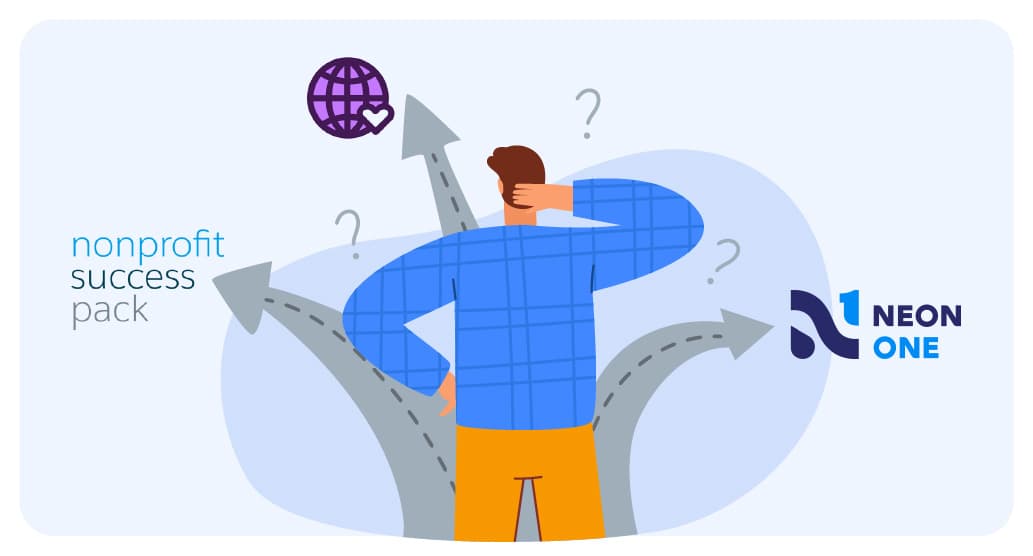
Your CRM becomes the unseen infrastructure of your mission; the way you track generosity, manage trust, and prove impact. Choosing the right one involves a close evaluation of the features that can address your pain points and picking a tool that fits your organization’s vision, size, and capacity. That’s why we’re taking a closer look at three very different paths CharityEngine and Salesforce for Nonprofits solutions - Salesforce NPSP, and Salesforce Nonprofit Cloud. In this blog, we will guide you through your decision-making with a clear nonprofit CRM comparison and find the system that aligns with where you are and where you want to go.
CharityEngine CRM
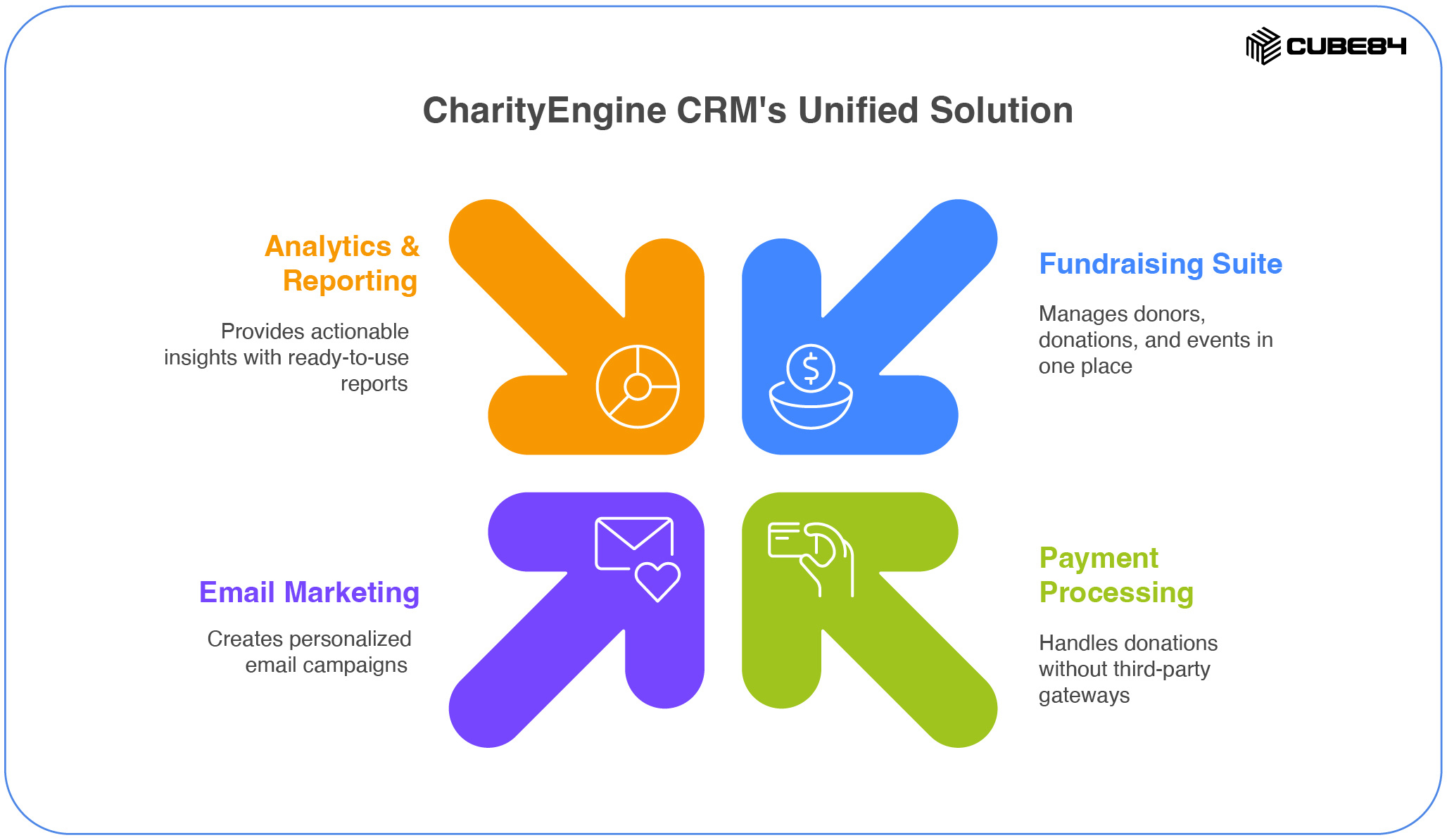
For a mid-sized nonprofit looking to avoid juggling multiple systems, CharityEngine CRM delivers simplicity without sacrificing depth. It is a nonprofit CRM that brings together fundraising, payment processing, email marketing, and event management in one unified tool. Its unified dashboards make it a strong choice for nonprofits seeking reliable donor management software for nonprofits.
Its all-in-one design means you also get complete donor management and campaign tracking out-of-the-box, with an intuitive interface that teams find easy to adopt. In essence, this platform is built for organizations that want robust fundraising capabilities bundled in a single, user-friendly package, allowing staff to spend less time on tech and more on mission. Want more info? Read on -
- Comprehensive Fundraising Suite: Manages donors, donations, events, memberships and more in one place, eliminating data silos. All core functions (from online donation forms to event registrations) are natively included, no patchwork integrations needed. Its unified dashboards make it a strong choice for nonprofits seeking reliable
- Built-in Payment Processing: Includes in-house payment processing for donations, so you can accept gifts (credit cards, ACH, etc.) without third-party gateways. This integrated approach simplifies support and ensures one point of contact for resolving any transaction issues.
- Email & Marketing Automation: Features advanced email marketing and multichannel communication tools. Nonprofits can design personalized email campaigns and automated donor “journey” workflows to deepen engagement, all within the CRM. (For example, CharityEngine provides out-of-the-box email workflows for donation thank-yous or event follow-ups, saving staff time.)
- Analytics & Reporting Depth: Offers 200+ ready-to-use reports and dashboards for actionable insights. Users praise the platform’s powerful query builder and custom reporting, which help even data-heavy organizations get exactly the metrics they need. This means mid-sized nonprofits gain a 360° view of donor interactions and campaign performance without needing a data analyst.
In CharityEngine CRM’s Customer Success Stories, Dana Bunke from Easterseals shares why “her first task at a new nonprofit is to hire CharityEngine” due to its empowering role in fueling mission-oriented work.
Salesforce NPSP (Nonprofit Success Pack)
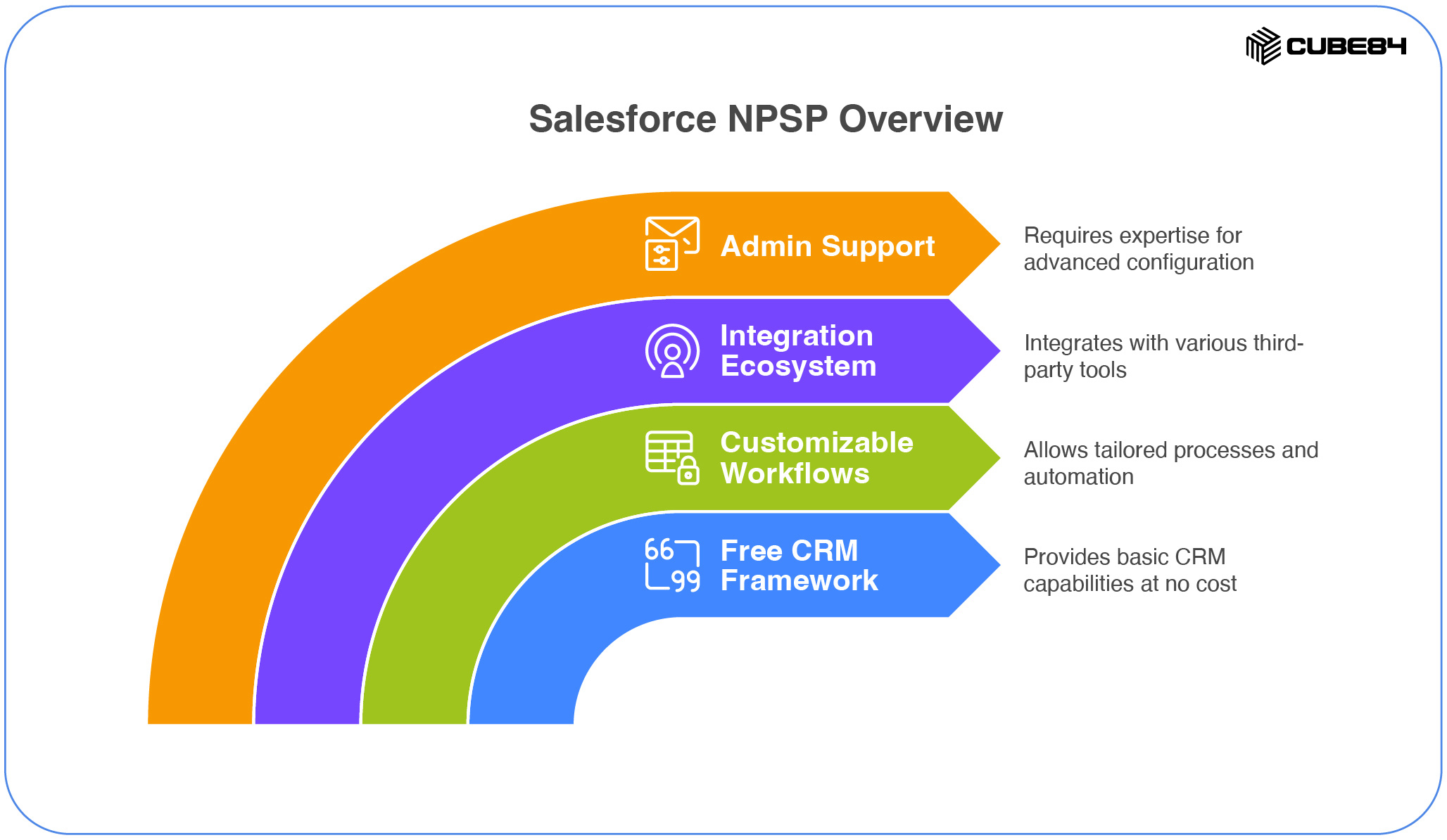
Salesforce NPSP is the free nonprofit layer on the Salesforce platform essentially a donated, open-source CRM package tailored for nonprofits. It provides a flexible foundation (donor and household accounts, donations, basic campaigns) upon which nonprofits can build exactly what they need. NPSP is highly customizable: organizations can extend it with custom fields, automated workflows, and countless AppExchange integrations to fit their unique processes. As donor management software for nonprofits, NPSP stands out because of its custom objects and flexible workflows.
This makes it a great fit for growing nonprofits that have the technical resources (an in-house Salesforce admin or a consulting partner) to support it. With the right expertise, NPSP transforms into a custom solution aligned with your mission, but it does require that capacity to configure and maintain. Here’s some more helpful information-
Free & Flexible CRM Framework: NPSP is provided at no cost through Salesforce for Nonprofits’ Power of Us program (up to 10 free licenses for qualified nonprofits), dramatically lowering the barrier to entry. You get Salesforce’s core CRM capabilities like contacts, fundraising (Opportunities), basic reports etc., pre-configured for nonprofit use, and you can expand from there.
Customizable Workflows and Data Model: Because it sits on Salesforce, NPSP lets you deeply customize how you track and engage constituents. Nonprofits can add custom fields/objects, build automated workflows (e.g. drip email campaigns, task reminders), and adjust the data model to mirror their operations. This flexibility means NPSP can adapt as your organization grows, ensuring the CRM always fits your evolving programs and donor strategies.
Ecosystem of Integrations & Add-ons: NPSP plays well with others! It integrates easily with countless third-party tools for online giving, events, accounting, and more. Additionally, Salesforce’s nonprofit community offers add-on packages (for volunteer management, grant management, etc.) to fill gaps. In practice, you can connect NPSP to email platforms (Mailchimp), fundraising apps (Classy), or install extension packages, building a tailored tech ecosystem around a single source of truth.
Requires Admin Support for Advanced Use: To unlock NPSP’s full potential, nonprofits typically need someone with Salesforce expertise. Configuring custom workflows, maintaining data integrity, and implementing new features often calls for either a trained in-house admin or a consulting partner. The upside is unlimited configurability; the trade-off is ensuring you have the know-how (or help) to use that toolkit effectively for your organization’s benefit.
Customer Success: ANAD
Salesforce Nonprofit Cloud
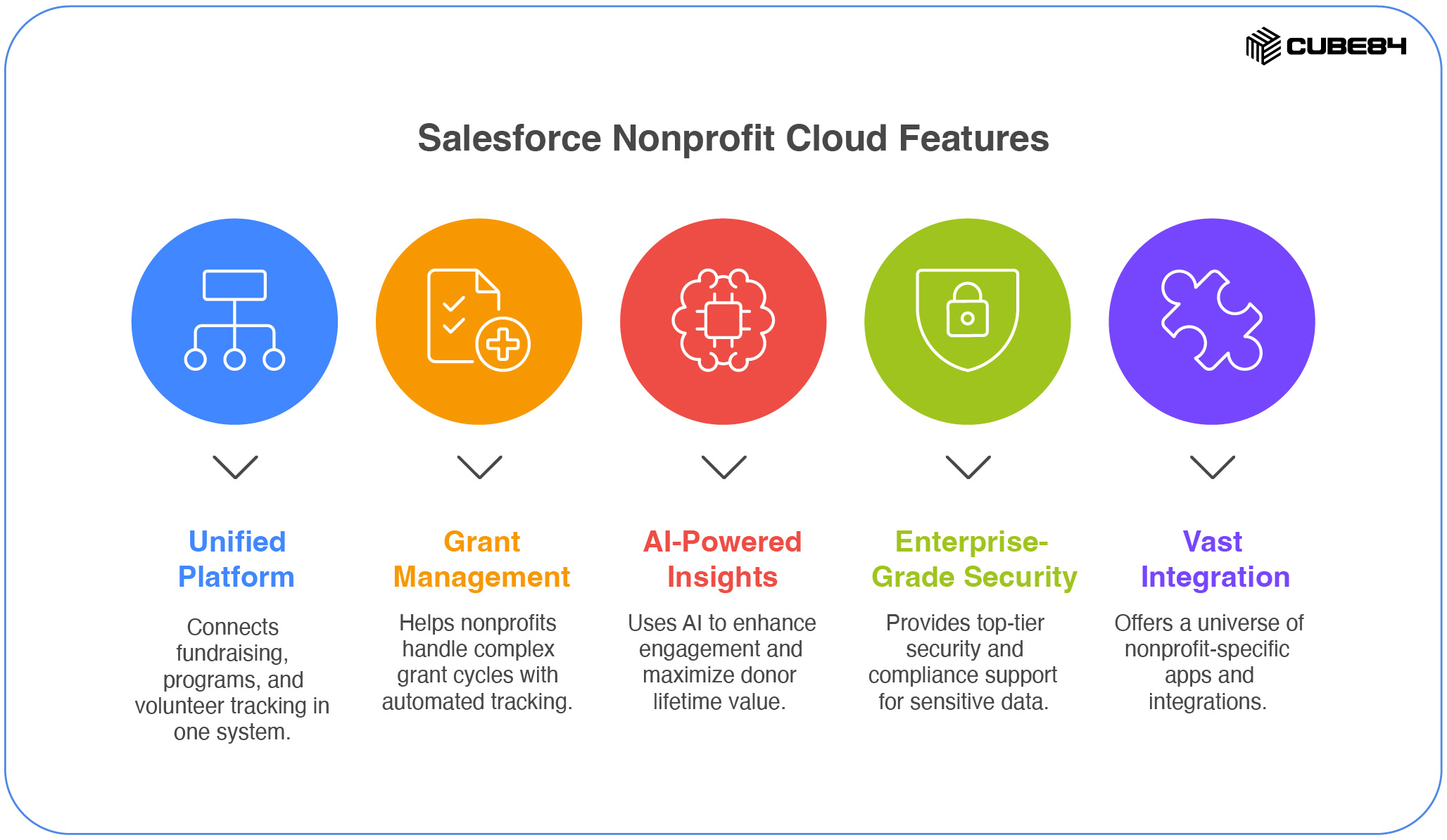
Salesforce Nonprofit Cloud is the all-in-one CRM powerhouse geared for enterprise-level nonprofits and global NGOs. Think of it as Salesforce’s complete nonprofit ecosystem: it builds on the platform’s CRM core with modules for fundraising, program management, grantmaking, marketing engagement, and more, all under one roof. This solution is designed to meet the complex needs of large organizations i.e. the ones managing multi-year grants, nationwide programs, and strict compliance requirements. Nonprofit Cloud comes with sophisticated features like AI-driven insights (Salesforce Einstein) to guide donor outreach, and robust security/compliance measures to protect sensitive data. It’s essentially Salesforce “out-of-the-box” for nonprofits at scale, reducing the need for many third-party add-ons by providing a comprehensive suite natively.
- Unified Platform for Fundraising & Programs: Nonprofit Cloud natively connects all key operations from donor management and fundraising to program delivery and volunteer tracking, in a single system. For example, a nonprofit can manage constituent donations and also track how those funds are used in programs or services, all in Salesforce. This holistic approach is built for organizations juggling multiple initiatives and wanting a 360-degree view of impact (linking donations to outcomes).
- Grant Management & Compliance Tools: A dedicated grant management module helps large nonprofits and foundations handle complex grant cycles. Users can track applications, payments, and outcomes for each grant, with automated milestone reminders and one-click compliance reports to satisfy funder requirements. These features reduce administrative burden and ensure accountability, which is crucial for organizations managing government grants or multi-million-dollar awards.
- AI-Powered Insights and Journeys: Salesforce Nonprofit Cloud leverages Einstein AI to enhance engagement. The platform can analyze donor data to predict who might become a major donor or which supporters are at risk of lapsing. It then helps staff take action with AI-driven guidance; for instance, recommending the next best outreach or optimal communication channel. Paired with Salesforce’s Journey Builder, nonprofits can automate personalized donor journeys across email, SMS, and social media, creating tailored touchpoints at scale. In short, the technology works behind the scenes to maximize donor lifetime value and mission impact.
- Enterprise-Grade Security & Compliance: As an enterprise solution, Nonprofit Cloud comes with top-tier security and compliance support. It’s built on Salesforce’s robust infrastructure (with certifications like SOC 2, ISO 27001, HIPAA-ready data models, and GDPR compliance) to protect sensitive constituent data. Fine-grained permission controls and audit logs are included, helping larger nonprofits meet stringent regulatory and reporting standards. Trust and transparency are at the core, so even the most data-conscious organizations can confidently adopt the system.
- Vast Integration Ecosystem: Nonprofit Cloud is extensible via the Salesforce AppExchange, offering a universe of nonprofit-specific apps and integrations. Need peer-to-peer fundraising tools, an online auction platform, or a sophisticated volunteer management portal? Chances are, there’s an app for that which plugs directly into Nonprofit Cloud. This ecosystem means the platform can evolve with your needs, leveraging pre-built solutions (often from trusted Salesforce partners) instead of requiring everything to be custom-built. The result is a highly scalable system that can be tailored with far less effort than building from scratch.
Each of these platforms serves a unique niche in the nonprofit sector. If your mind is a bit boggled, don’t worry - we’ll take you through what you need to know and consider before making your decision. At the end of the day, picking a CRM isn’t about chasing the newest features. It’s about finding a system that actually makes your mission easier to deliver. When nonprofit leaders talk about what really matters, the list usually sounds a lot like this:
Fundraising & Donor Engagement
Does it make it easier for people to give, and for you to keep those relationships warm?
Automation & Workflows
Will it take care of the routine stuff so your team can focus on the work only they can do?
Reporting & Analytics
Does it turn raw data into clear insight that guides your next move? Can you actually see what’s working, and get answers you can act on?
Compliance & Data Security
Will it keep sensitive donor and program data safe, so trust is never at risk?
Integration Options
Can it connect seamlessly with the tools you already use to run programs and campaigns?
Licensing & Total Cost
Beyond the sticker price, is it something you can sustain year after year?
Ease of Use & Support
Will your team actually use it, and will you have help when you need it?
Long-term Scalability
As your mission grows, can this system stretch with you rather than hold you back?
Side-By-Side CRM Feature Comparison Table: Which One Fits Your Mission?
So now you know what each of these tools offers. It is equally important to consider their pros and cons on a more detailed level so you’re sure of the decision you’re making. We’ll also help you evaluate based on your mission’s goals. Let’s jump right into it -
Deep-dive into the Pros and Cons of Each CRM
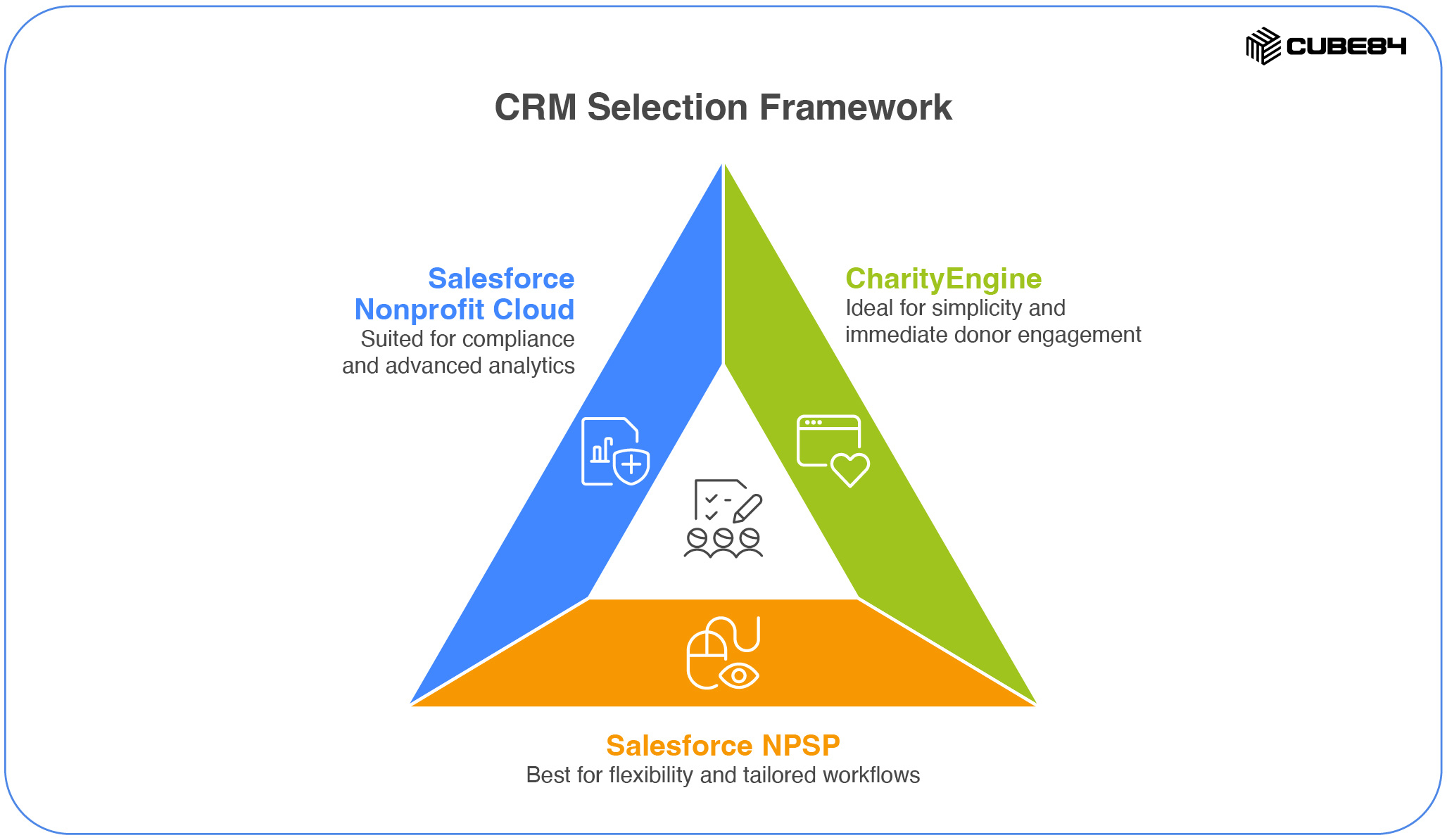
1. CharityEngine
What It Does Well
- Everything in one place: Forms, payments, email, and events live under one roof.
- Built for nonprofits: The platform is purpose-built for the sector, so the support team truly understands fundraising language and nonprofit workflows.
- Immediate visibility: Donor lifecycle tools paired with clean dashboards help staff see where relationships stand without needing a data analyst.
Where It May Fall Short
- Limited partner ecosystem: While the core platform is strong, the ecosystem of extensions and third-party integrations is smaller compared to Salesforce.
- Reporting depth: Reports are solid for day-to-day needs but not as advanced as enterprise-grade analytics tools like Tableau.
- Customization: CharityEngine favors simplicity. That means less room to tailor data models or workflows compared to highly configurable systems.
2. Salesforce NPSP (Nonprofit Success Pack)
What It Does Well
- Highly configurable, free to start: NPSP is a powerful entry point with no licensing cost for the first 10 users and it scales with you as your needs grow.
- Integrations galore: Plays well with fundraising tools like Classy, marketing platforms like Mailchimp, and form builders like FormAssembly.
- Enterprise-grade foundation: Built on the Salesforce platform, offering security, scalability, and long-term flexibility for organizations that want to grow into the system.
Where It May Fall Short
- Technical lift required: To make use of NPSP’s full potential, nonprofits often need an in-house admin or a trusted partner. Without that, the system risks being underused.
- Ongoing oversight: Customization and maintenance require ongoing attention — it’s not a “set it and forget it” solution.
- Fundraising gaps: Out-of-the-box fundraising tools are limited, often requiring third-party apps to round out functionality.
3. Salesforce Nonprofit Cloud
What It Does Well
- Purpose-built modules: Grants management, program tracking, and AI-powered workflows are native, helping complex nonprofits connect funding directly to outcomes.
- Analytics at scale: Tableau dashboards and Slack integration deliver real-time collaboration and insights that leadership teams can act on quickly.
- Compliance strength: With Shield, HIPAA-ready models, and enterprise security certifications, it’s designed for organizations under heavy audit or regulatory scrutiny.
Where It May Fall Short
- Cost and complexity: Licenses and implementation fees are significant, and the setup journey often spans months rather than weeks.
- Partner reliance: To get the most out of it, large nonprofits usually need an implementation partner for configuration, training, and governance.
- Potential overkill: For smaller nonprofits, the sheer breadth of functionality may feel like more ‘system’ than they need, creating a lot of complexity.
For many nonprofits, the real decision comes down to NPSP vs Nonprofit Cloud.
If you’d like to see a detailed comparison of Salesforce NPSP vs NPC, be sure to read our comparison blog!
How to Choose Based on Your Goals
With so many strengths and a few trade-offs across these platforms, the decision is not based on which CRM is the most powerful, but which one aligns best with your nonprofit’s goals and capacity. The right choice is the one that helps your team spend less time wrestling with systems and more time driving impact.
Choose CharityEngine if…
- You want the ease of a single, all-in-one platform.
- Heavy customization or complex analytics aren’t on your immediate roadmap.
- Out-of-the-box donor journeys and responsive support matter most.
Choose Salesforce NPSP if…
- You’re curious about technology and eager to build your own tailored workflows.
- Flexibility and control from day one feel important.
- You have an internal Salesforce admin or a trusted partner who can support your growth.
Choose Salesforce Nonprofit Cloud if…
- You manage programs, grants, or operate in environments that demand audit-grade compliance.
- AI-driven workflows, deep analytics, and enterprise dashboards are mission-critical.
- You’re prepared to invest in a consulting partner to guide configuration, training, and adoption.
If you’re still weighing NPSP vs Nonprofit Cloud, think about whether flexibility or enterprise-scale compliance matters more to your team.
No matter which path you choose, the best CRM is the one that amplifies your mission, not complicates it. The right fit should free your staff to focus on relationships, sharpen your visibility into impact, and give your nonprofit the confidence to grow without losing sight of why you began.
It is also pertinent to assess if your nonprofit is ready to adopt a CRM.
Nonprofit Data Risk Assessment
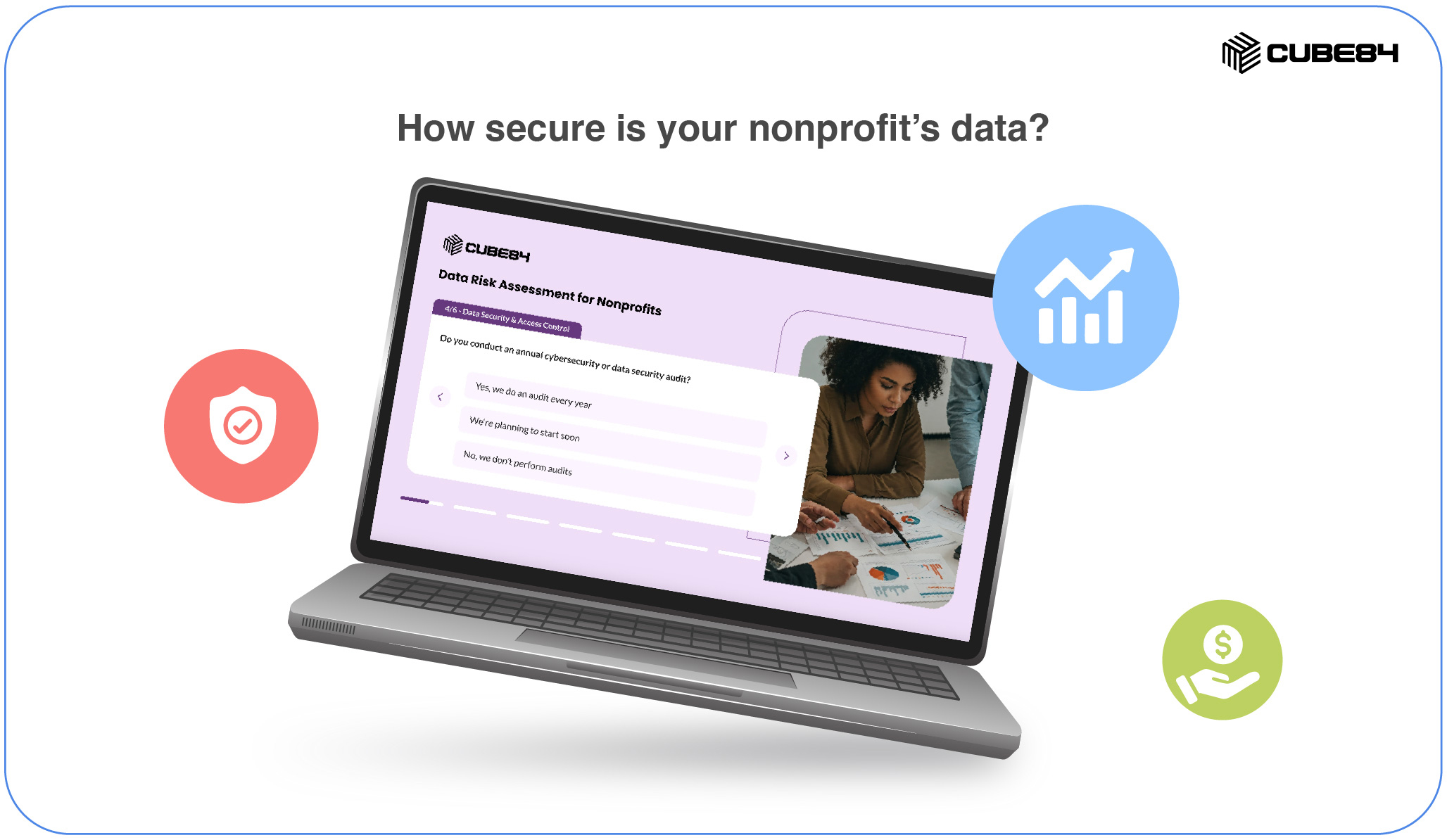
Before you commit to any CRM, it’s worth asking a bigger question: Is your donor and program data truly secure?
Data is the lifeblood of every nonprofit, but without proper governance, even the best CRM can leave you exposed. From unencrypted spreadsheets to misconfigured permissions, risks creep in quietly and can erode the trust your supporters place in you.
That’s why we created the Nonprofit Data Risk Assessment. It’s a simple, practical tool to help you uncover vulnerabilities in your current systems and understand the steps you can take to safeguard sensitive data.
Take up the Nonprofit Data Risk Assessment
Use it to spot gaps, strengthen your data practices, and walk into any CRM decision with clarity and confidence.
Conclusion
At the beginning, we asked you to think beyond features and focus on fit, because technology should never distract from your mission; it should accelerate it. Whether you choose the simplicity of CharityEngine, the flexibility of Salesforce NPSP, or the enterprise power of Nonprofit Cloud, the goal is the same: more time with people, clearer visibility into impact, and stronger confidence in the future.
Every CRM has strengths, every option has trade-offs. But the wisest choice is the one that makes your organization feel lighter, clearer, and better equipped to serve. In the end, the right CRM is not the one that does the most, but the one that helps you do what matters most.