
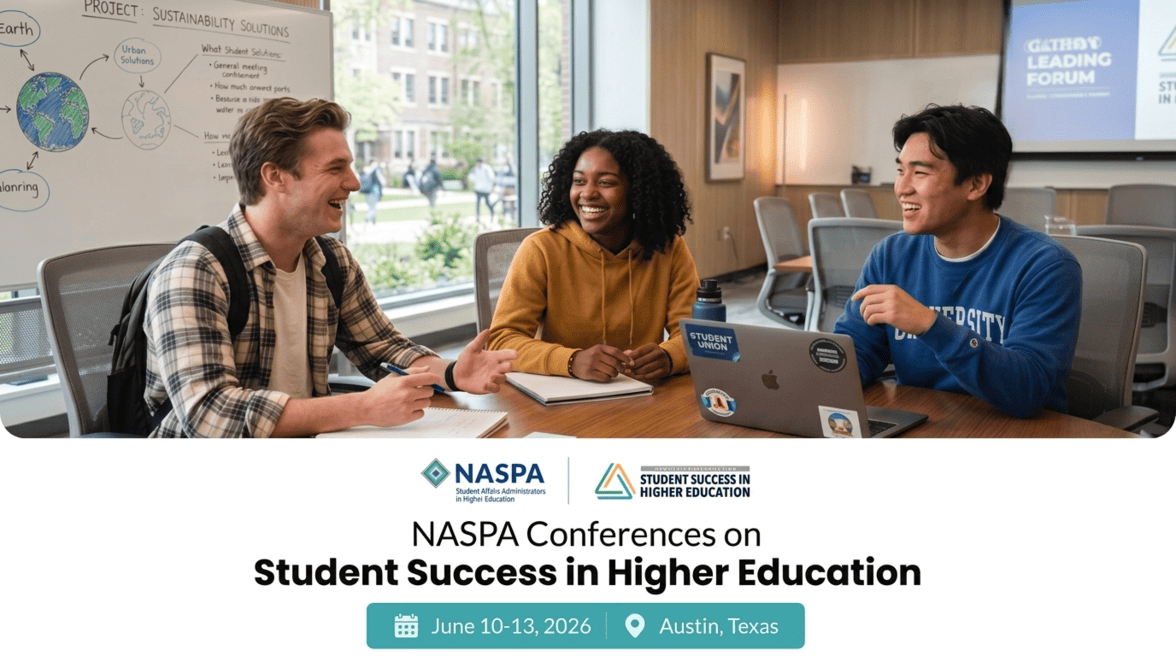

The plenary panel at NASPA SSHE 2026 was called "From Insight to Impact."
It featured four practitioners — VPs and Associate VPs of Student Affairs from Texas A&M, Metropolitan State University of Denver, UNC Wilmington, and the University of North Florida talking candidly about the distance between what institutions know about their students and what they're actually able to do with that knowledge.
That distance has a cost. And everyone in the room knew it.
NASPA's Conferences on Student Success in Higher Education sold out this year. More than a thousand student affairs professionals, advisors, researchers, and campus leaders flew to Austin, Texas, for four days of sessions organized around three urgent tracks: data-driven decision-making, first-generation student success, and dismantling systemic barriers to student achievement. The energy in the JW Marriott was not the usual conference optimism. It was something closer to resolving.
CUBE84 was there as a Silver sponsor, running Booth 27. Over four days, we had hundreds of conversations. Three themes came up in nearly all of them.
1. The gap is not the data. It's the distance between the data and the decision.
Dr. Amelia Parnell, NASPA President, opened the conference with a call toward community and shared accountability. Dr. John O'Brien of EDUCAUSE followed with a focus on the institutional infrastructure required to act on what institutions know. Together, they set a tone that carried through every session: the technology exists, the data exists, the question is whether it's reaching the right person at the right moment.
This played out on the floor in specific, practical ways. Advisors described opening five different systems just to piece together one student's picture before a meeting. Case managers described manually reconciling spreadsheets each week to understand which students had disengaged from campus life. Directors described early alert tools that fired notifications too late for a meaningful intervention.
The research that underpins these conversations is stark. Roughly 1 in 3 students at four-year institutions do not complete their degree within six years. First-generation students face a 41% dropout rate. With WICHE projecting a 13% decline in traditional college-age students through 2041, institutions are running out of runway to treat attrition as an acceptable loss.
The insight exists. The impact is still missing.
2. First-generation students are the canary in the coal mine.
The first-gen track ran all four days, and it was packed. Sessions like "First and Foremost: Using Storytelling and Data to Strengthen First-Generation Student Success" and "Building and Sustaining First-Gen Initiatives" reflected an increasingly urgent recognition: if your systems can't support first-generation students, they can't adequately support any student navigating complexity.
What the field has learned is that first-gen students don't fail for lack of ability or motivation. They disengage because institutions are difficult to navigate, support is hard to find, and the signals they send reduce co-curricular participation, pulling back from peer groups, quietly stopping attendance at organization meetings go unnoticed until a grade drops.
By then, the intervention window has closed. What these students need is earlier contact, with enough context for that contact to be meaningful.
3. AI is not the answer to a broken architecture.
One of the most honest session titles of the conference was "Assessment and AI: Make the Robots Work for You, but Make Sure to Say Thank You." The room laughed. Then it got real.
Because the question behind the title is one the field hasn't answered yet: how do you layer AI onto student success work responsibly, when most institutions are still running 8 to 12 disconnected systems that don't share data? The answer most practitioners landed on, and that we heard repeatedly at our booth, is that you can't personalize at scale on a fragmented foundation. The architecture has to be fixed first.
This played out in one conversation we had on the floor. A student success leader described their stack: a student engagement app, a Salesforce environment, an advising platform, and spreadsheets doing the connective work between all of them. Their advisors weren't failing. Their infrastructure was.
What "From Insight to Impact" actually requires
The plenary panel's title wasn't just a theme; it was a diagnosis. Institutions have invested heavily in generating insight. The gap is in translating that insight into action before the moment passes.
This means getting co-curricular engagement data into the same view as academic data. It means surfacing behavioural signals, attendance trends, participation shifts, and early withdrawals from campus life weeks before academic flags appear. And it means doing this within the workflows advisors already use, not as one more system to open.
At Booth 27, one moment captured this better than any slide could. During a session, Jeff Doyle, Executive Director for Student Success at the University of Texas at Austin, mentioned CUBE84 by name as an example of a company building for leading indicators, not lagging ones.
The recognition came from a practitioner in the room, without prompting.
That's the bar this field sets. And it's the right one.
Download our guide on closing the Engagement Gap
https://cube84.com/student-retention-guide-to-closing-the-engagement-gap-ebook
Book time with our team