


Why Agentic AI Matters for Nonprofits in 2025
Picture a small nonprofit wrapping up its annual fundraiser. The team is exhausted but proud. Donations came in steadily, and new supporters signed up. Then reality hits: thank-you emails still need to be sent, a few major donors haven’t received follow-ups, and the finance team is struggling to match payments with campaign records.
This is where AI for nonprofits can make a difference. For years, predictive and generative AI tools have helped with donor segmentation, email writing, and analytics. But they’ve mostly been assistants, not teammates. They could suggest what to do but not actually do it.
That’s changing with Agentic AI, a new generation of systems that can plan, decide, and act on behalf of your team. Instead of just analyzing donor data, they can respond to it—automatically sending messages, scheduling reminders, and updating reports.
In this blog, we will explore how Agentic AI can transform Salesforce nonprofit fundraising and donor engagement. We will look at what makes it different from traditional AI, how nonprofits can use it responsibly, and what the future might look like when people and AI start working side by side for impact.
What Is Agentic AI? (And How It’s Different from Other AI)
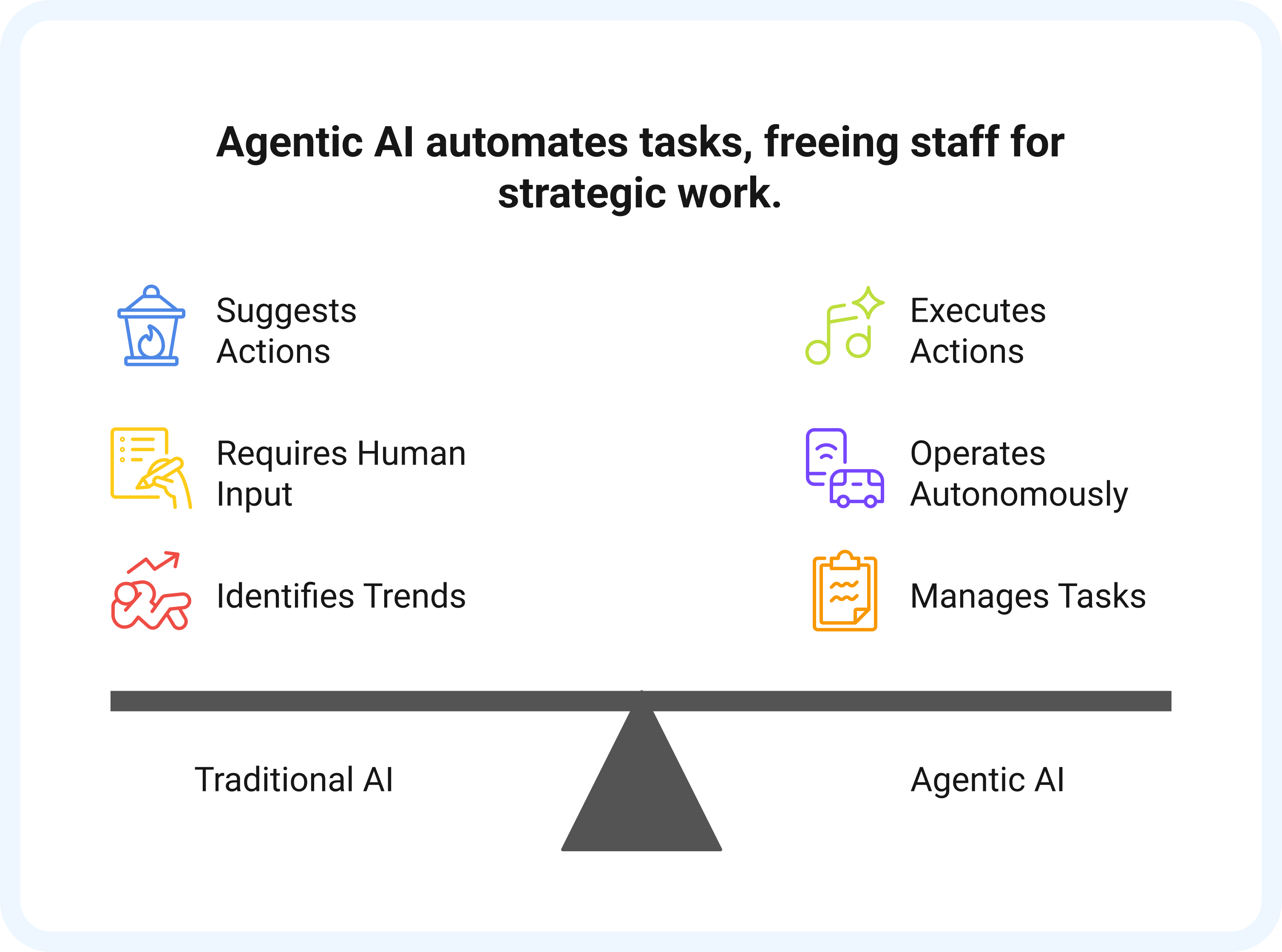
For years, AI has been a suggestion engine. Predictive tools flagged trends. Generative tools drafted emails. But humans still had to decide whether to act, and then execute.
Agentic AI inverts this model. It plans, decides, and acts. You set the guardrails. The system runs the playbook
Here’s the difference in simple terms:
Traditional AI can tell you what to do. Agentic AI can actually do it.
Predictive AI can identify and highlight donors who have not extended their support to the org in a given period like a quarter or six months. Agentic AI, on the other hand, can schedule a personalized message, add that donor to a re-engagement campaign, and even assign a follow-up task to a fundraiser automatically.
Think of it like this: traditional AI is a GPS that gives you directions. Agentic AI is the self-driving car that gets you to your destination safely and efficiently.
Early results show how Agentic AI can handle routine donor communication, follow-ups, and reporting, freeing staff to focus on creativity, stewardship, and mission-driven work.
For a closer look at how nonprofits are rethinking AI, explore our blog Why AI Isn’t Working for Nonprofits (And What Salesforce Is Getting Right).
Fundraising Use Cases for Agentic AI
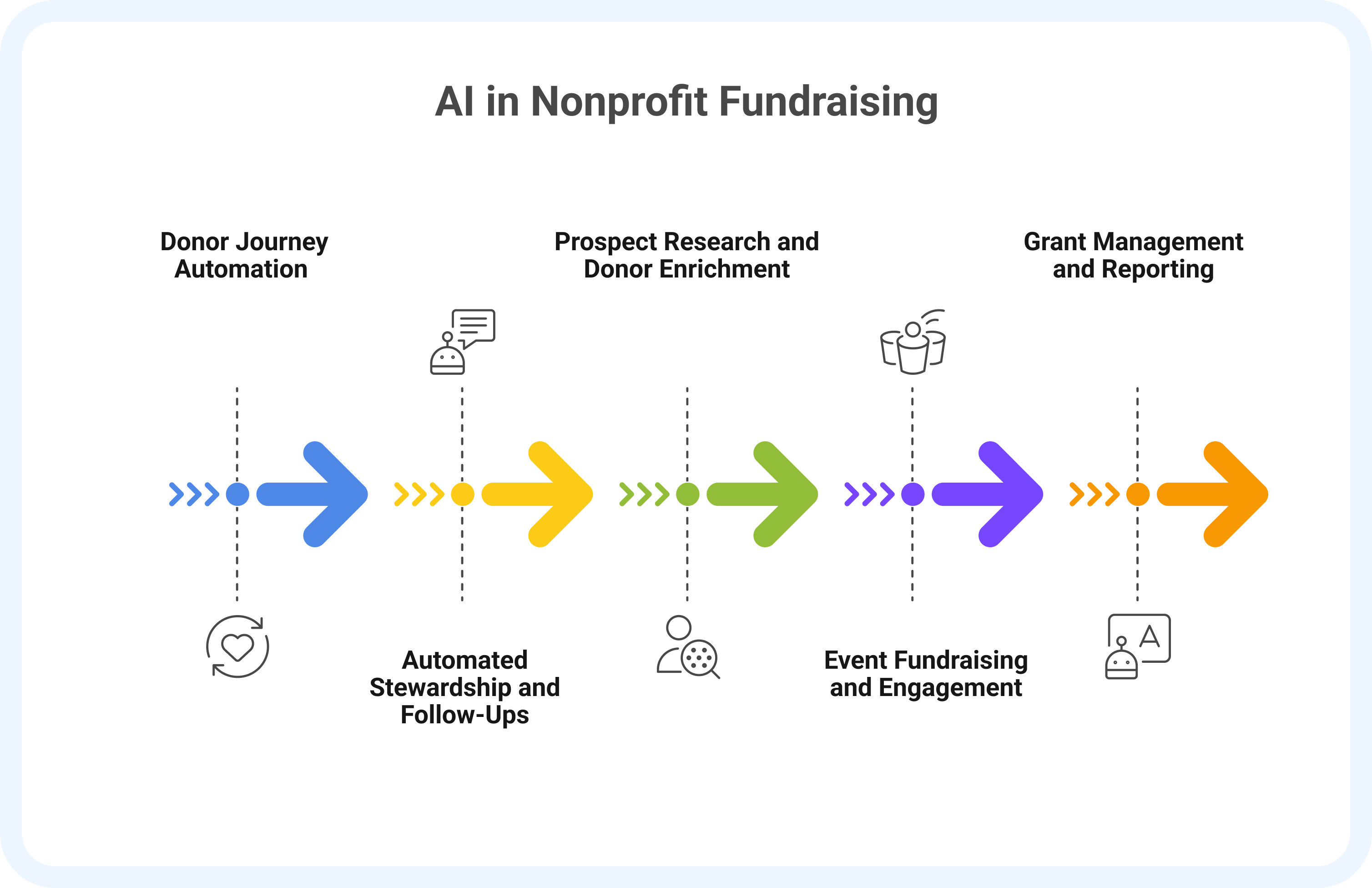
For most nonprofits, fundraising is where Agentic AI will create the biggest transformation. Instead of waiting for staff to act on data, AI agents can now take initiative, automating outreach, organizing tasks, and keeping donors engaged throughout their journey.
1. Donor Journey Automation
Every donor has a story, but tracking each one manually can be difficult. Agentic AI continuously monitors donor activity and responds when patterns change.
Example: When an AI agent notices that a supporter has not donated for six months, it sends a personalized message, adds them to a re-engagement campaign, and schedules a reminder for a fundraiser to follow up.
2. Automated Stewardship and Follow-Ups
Thank-you notes, tax receipts, and reminders often take time to prepare. Agentic AI can create and send them instantly, ensuring that no donor is overlooked.
Example: After receiving a $1,000 donation, an AI agent generates a thank-you letter, updates the donor record, and assigns a follow-up task to a team member for a personal call.
3. Prospect Research and Donor Enrichment
Finding potential major donors often requires hours of research. Agentic AI can scan public databases, social platforms, and internal records to identify new opportunities.
Example: The system spots that a mid-tier donor recently joined a new company and flags them as a potential corporate sponsor, notifying the fundraising manager automatically.
4. Event Fundraising and Engagement
Managing RSVPs, reminders, and post-event follow-ups can stretch small teams. Agentic AI keeps track of these details behind the scenes.
Example: Before a gala, the AI agent sees that key donors have not confirmed attendance and sends personalized reminders to encourage participation.
5. Grant Management and Reporting
Grant applications and compliance reports can take weeks of staff time. Agentic AI can fill out templates using stored data and prepare draft reports for review.
Example: A nonprofit focused on education uses an AI agent to generate quarterly grant reports from Salesforce, reducing manual effort while improving accuracy.
With these capabilities, AI for nonprofits moves from being a tool for insight to becoming an active partner in fundraising. The technology takes care of the repetitive work so that people can focus on building meaningful relationships with supporters.
And that’s where the next wave of impact begins. Once fundraising operations run smoothly, Agentic AI can help nonprofits go beyond transactions and focus on deeper, lasting engagement.
Donor Engagement Use Cases for Agentic AI
Beyond fundraising, Agentic AI has the potential to reshape how nonprofits build and sustain relationships. Instead of reacting to donor activity after it happens, these intelligent systems can keep conversations alive, anticipate needs, and personalize every interaction.
1. Hyper-Personalized Outreach
Every donor connects with a cause for different reasons. Agentic AI can tailor communications to reflect that individuality by using data from past giving, event participation, and expressed interests.
Example: One long-time supporter receives updates about program impact, while a newer donor gets stories about the people their contribution helped. Both experiences feel personal and timely, without extra manual effort.
2. Multi-Channel Coordination
Many nonprofits struggle to maintain consistent messaging across email, social media, and SMS. Agentic AI ensures these channels work together, not in silos.
Example: When a donor clicks on a social media post about a campaign, the AI automatically follows up with an email containing a donation link and a thank-you note once the gift is received.
3. Predictive Volunteer and Donor Engagement
Re-engaging past supporters often takes intuition and luck. Agentic AI can identify when a volunteer or lapsed donor might return, based on behaviour patterns and previous interactions.
Example: A volunteer who has not signed up for events in three months receives an automated message with opportunities that match their past interests, reigniting involvement before enthusiasm fades.
4. Mission-Based Storytelling at Scale
Nonprofits often want to share stories that inspire, but staff time limits how often they can do it. Agentic AI can compile updates, photos, and metrics from existing systems to create content that connects donors with the mission.
Example: By using AI, a global health organization was able to send curated impact updates to donors using photos and summaries of progress.
By combining these capabilities, AI for nonprofits shifts engagement from being occasional and reactive to being continuous and intentional. It helps teams stay connected with donors year-round while maintaining the human warmth that drives long-term loyalty.
Benefits for Nonprofits
For most organizations, the promise of Agentic AI lies in doing more with what they already have. The same data, the same systems, and often the same staff can now achieve more through smarter connections and automation.
1. Efficiency at Scale
Routine tasks such as sending thank-you emails, segmenting donor lists, or updating campaign reports can happen automatically. This allows teams to spend less time on administration and more time on strategy.
2. Continuous Responsiveness
Agents can respond instantly to donor behaviour, whether it is a first-time gift, an event registration, or a lapsed supporter. This consistent engagement helps build trust and loyalty over time.
3. Consistency Across Channels
Every donor receives acknowledgment and follow-up at the right time. No one is missed because the AI quietly manages communication in the background.
4. Proactive Fundraising
Instead of waiting for reports to reveal trends, Agentic AI identifies them early and recommends actions such as re-engaging inactive donors or refocusing a campaign.
5. Reduced Administrative Burden
Tasks like grant reporting, campaign summaries, and donor outreach require less manual work. Staff can redirect their time toward relationships and mission-driven impact.
Challenges and Ethical Risks
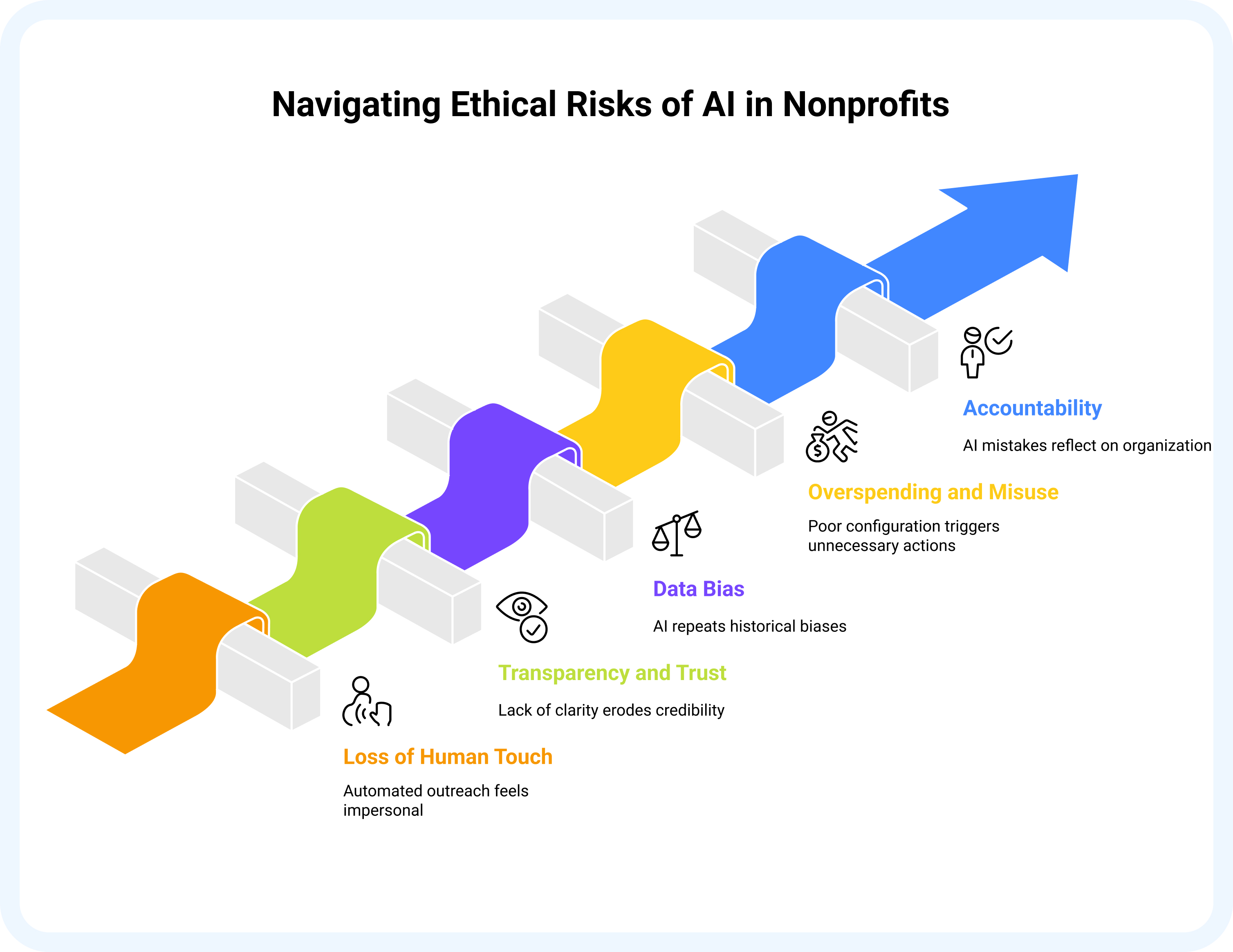
As Agentic AI takes on more responsibility, nonprofits must adopt it with care. The same systems that save time can also introduce new risks if not guided by the right policies.
1. Loss of Human Touch:
Donor interactions can feel less personal if outreach becomes too automated. Keeping a layer of human review ensures empathy stays at the center of communication.
2. Transparency and Trust:
Donors appreciate honesty. Being clear about when AI is used in communication helps protect credibility and trust.
3. Data Bias:
If historical donor data reflects bias, the AI may unintentionally repeat it. Regular audits and diverse datasets keep systems fair and inclusive.
4. Overspending and Misuse:
Poorly configured agents can trigger unnecessary actions or overuse credits. Setting clear budget and approval limits prevents waste.
5. Accountability:
When AI makes a mistake, responsibility still lies with the organization. Defined approval workflows and monitoring keep oversight in human hands.
Used thoughtfully, AI for nonprofits can remain both powerful and ethical. The key is to balance automation with transparency, empathy, and sound governance.
How Nonprofits Can Get Started Safely with Agentic AI
Before nonprofits can unlock the benefits of Agentic AI, they need a strong foundation. Responsible adoption is not just about technology; it’s about preparation, testing, and clear boundaries.
Here’s a practical roadmap to begin safely:
Clean and centralize data first:
AI is only as effective as the information it learns from. Consolidate donor and program data across systems so agents can make accurate and ethical decisions.
Start small with pilot use cases:
Begin with simple automations, such as thank-you letters or lapsed donor reminders. This helps teams understand AI behavior before scaling to more complex tasks.
Keep humans in the loop:
Set clear checkpoints where staff review or approve AI actions. This maintains accountability and ensures messages stay consistent with your organization’s tone.
Define clear boundaries:
Outline what agents are allowed to do. For example, they might draft emails but not send them without approval. Guardrails protect both your data and your donors.
Monitor outcomes closely:
Track how AI decisions impact donor engagement, campaign accuracy, and staff workload. Use these insights to refine rules and reduce risk.
Iterate and expand gradually:
Once early use cases perform well, apply AI to broader areas such as segmentation, volunteer management, or grant reporting.
The goal is not speed but sustainability. Build a system that evolves with your mission and strengthens the work your team already does.
Want to make your adoption smoother? Our blog 5 Costly Mistakes Organizations Make When Using Salesforce Agentic AI (And How to Fix Them in the Agentic AI Era) highlights what leading teams have learned and how you can apply those insights from day one.
Future Outlook: What’s Next for Agentic AI in Nonprofits
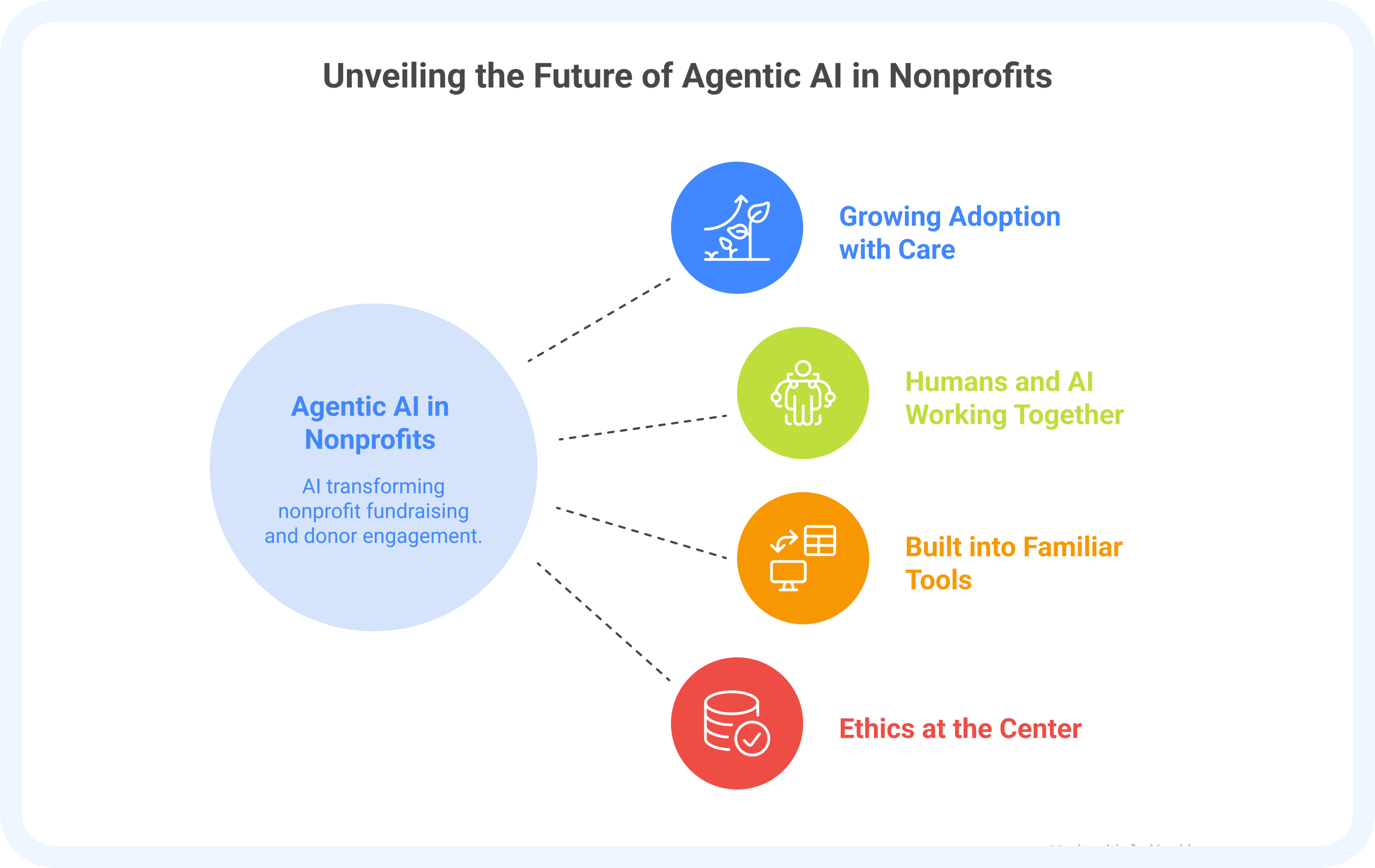
Agentic AI is still in its early days, but it is already changing how nonprofits think about fundraising and donor engagement. The next few years will show how this technology can truly support mission-driven work.
Growing adoption with care:
Adoption is expected to rise quickly, though some early projects may pause as organizations learn what works best. The most successful nonprofits will be those that balance innovation with transparency and strong data practices.
Humans and AI working together:
The future is not about replacing staff. It is about creating hybrid teams where AI handles the repetitive tasks, and people focus on creativity, storytelling, and building meaningful relationships.
Built into familiar tools:
Platforms like Salesforce nonprofit fundraising are already moving in this direction through Agentforce. For nonprofits using Salesforce, this will make adoption smoother and collaboration across teams easier.
Ethics at the center:
As AI becomes more capable, questions around data and responsibility will matter more than ever. Every nonprofit will need clear rules for how data is used, stored, and monitored to maintain donor trust.
Looking ahead, the nonprofits that stand out will not be the ones that automate everything. They will be the ones that use AI to deepen empathy, expand their impact, and make every donor feel personally valued.
Conclusion: A New Chapter in Nonprofit Fundraising
AI for nonprofits is not about replacing people. It is about giving small teams the power to think bigger, act faster, and build deeper relationships at scale. With the right governance and data foundations, Agentic AI can free up time for what truly matters: advancing missions, nurturing trust, and creating meaningful change.
Early adopters are already exploring how AI agents can manage outreach, personalize communication, and anticipate donor needs before they arise. As these systems mature, they will become partners in every part of the fundraising journey, supporting humans rather than sidelining them.
The nonprofits that prepare today will lead tomorrow. Start small, learn as you go, and keep people at the heart of every innovation. The future of fundraising will belong to organizations that combine empathy with intelligence and use technology to bring their mission closer to every supporter.
Talk to our experts at CUBE84 to explore how Agentic AI can help your nonprofit build stronger donor connections and scale its impact responsibly.