


Alumni engagement has grown in scale and complexity across higher education. Your institution now supports larger and more global alumni communities, but staff capacity has not grown at the same pace. Much of the work is still manual and time consuming, which makes it difficult to offer personal and timely communication to every alum.
By embedding AI into your workflows, your advancement team can focus attention where it matters most: building relationships. AI can track alumni activity, prepare content and communications for staff to review, and surface timely opportunities for outreach before interest fades.
This guide is helpful for leaders who are planning to improve or modernize their alumni engagement. You will get an understanding of what AI can help you do today, the data foundation needed for reliable results, and the governance required to use these tools in a responsible way. The aim is to help your institution build stronger alumni relationships at scale while maintaining trust and consistency.
Why AI Is Now a Strategic Priority for Your Institution
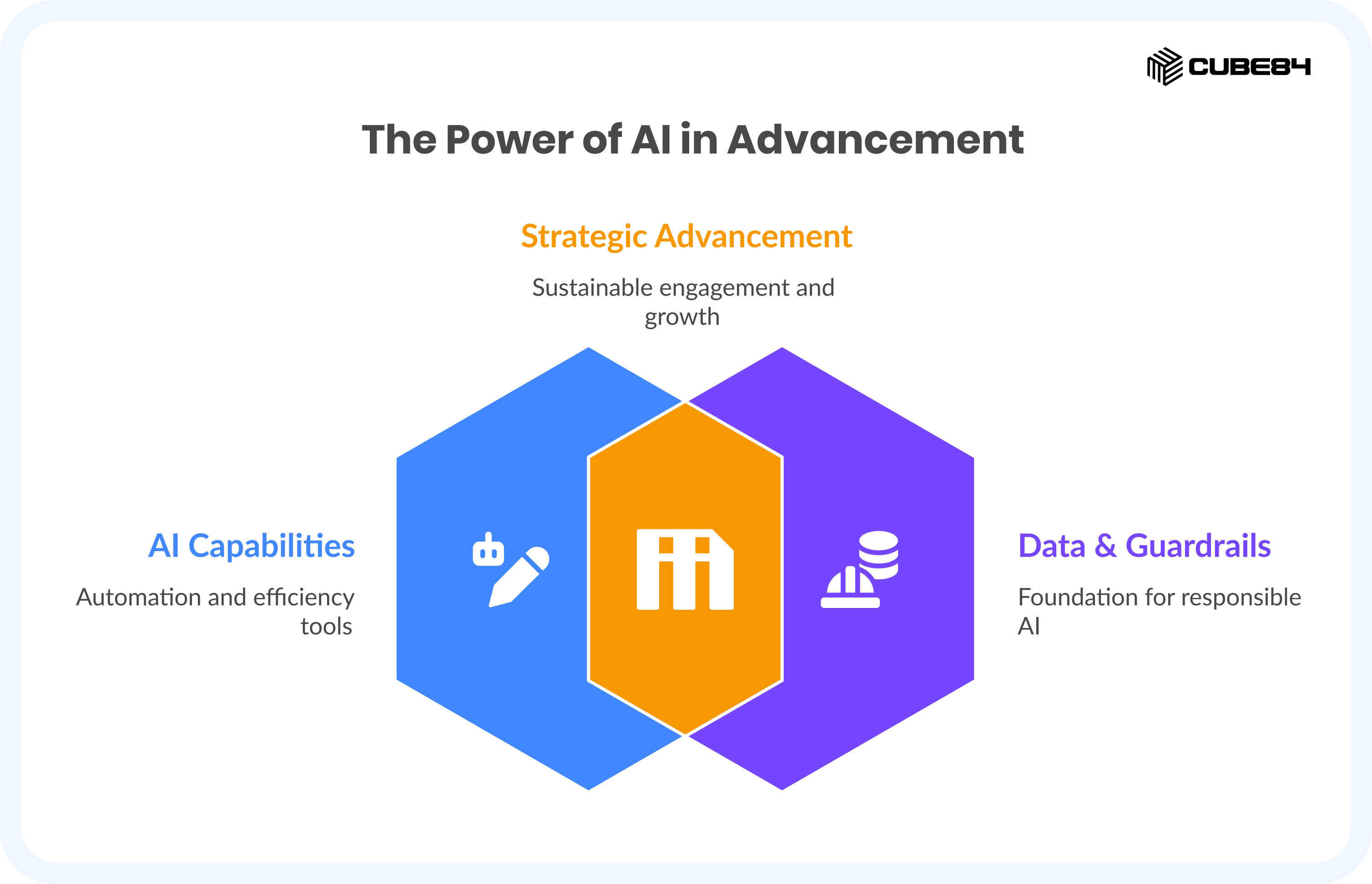
Advancement teams are facing higher expectations from alumni, donors, and campus leaders, but resources haven’t grown to match. To keep relationships strong and continue growing engagement and giving, institutions need a long-term plan. AI can help by making work faster and more consistent, but it only succeeds when the right data and guardrails are in place.
A Shift in the Advancement Landscape
Alumni now engage through many digital channels and expect institutions to recognize their history and interests consistently. Peer institutions are beginning to unify data and introduce early-stage predictive and drafting tools. According to a report by Forrester, despite higher gift volume, 81% of institutions saw a decline in donor count, highlighting a growing need for more consistent engagement throughout the alumni lifecycle.
As these models improve, institutions that begin this work now will widen their advantage over peers who delay, because data quality, model performance, and team readiness improve cumulatively over time.
The Risk of Slower Adoption
If institutions keep grouping alumni into large, generic categories and continue doing outreach manually, their communication becomes less relevant and too slow.
When outreach isn’t tailored, alumni get messages that don’t match what they care about. They stop responding and get tired of the communication. Waiting too long to improve systems also makes the work more expensive later, because data problems grow bigger over time. Starting with small steps now spreads the effort and prepares the institution for bigger improvements. Schools that adopt AI-supported workflows sooner will raise the bar for personalization
What Boards and Presidents Expect to See
Leadership teams want proof that using AI in engagement will improve outreach, build stronger alumni relationships, and ease staff workload — all while protecting privacy and fairness.. They also expect clear guardrails that show how data will be managed and how staff will remain in control of high-stakes decisions. Presenting a roadmap that includes these safeguards helps demonstrate that AI is not a short-term experiment but a structured plan that protects institutional reputation.
Planning for a Multi-Year Transition
Introducing AI supported workflows requires time. Institutions benefit most when adoption moves in stages, starting with a reliable Customer Data Platform (CPD), followed by small pilots, then more advanced predictive and orchestration work. This gives teams room to learn, refine governance, and build confidence. Treating AI as part of a multi-year strategy, rather than as a quick fix, sets the foundation for stronger alumni relationships in the long term.
Why Your Institution Needs to Scale Personal Engagement
Your institution now needs engagement that feels personal to each alum, even as your alumni base continues to grow. This requires a level of relevance that manual segmentation cannot support. Hyper-personalization at scale depends on systems that can read activity, unify data from multiple sources, and recommend the next step in a way that matches the alum’s current behavior. This is the point where traditional outreach models reach their limit.
According to a Forrester study titled Total Economic Impact™ Spotlight Commissioned By Salesforce, alumni are more likely to participate when they see programs that reflect their identity and interests. This reinforces the need for engagement that adapts to each alum’s current relationship with your institution.
AI as the Force Multiplier
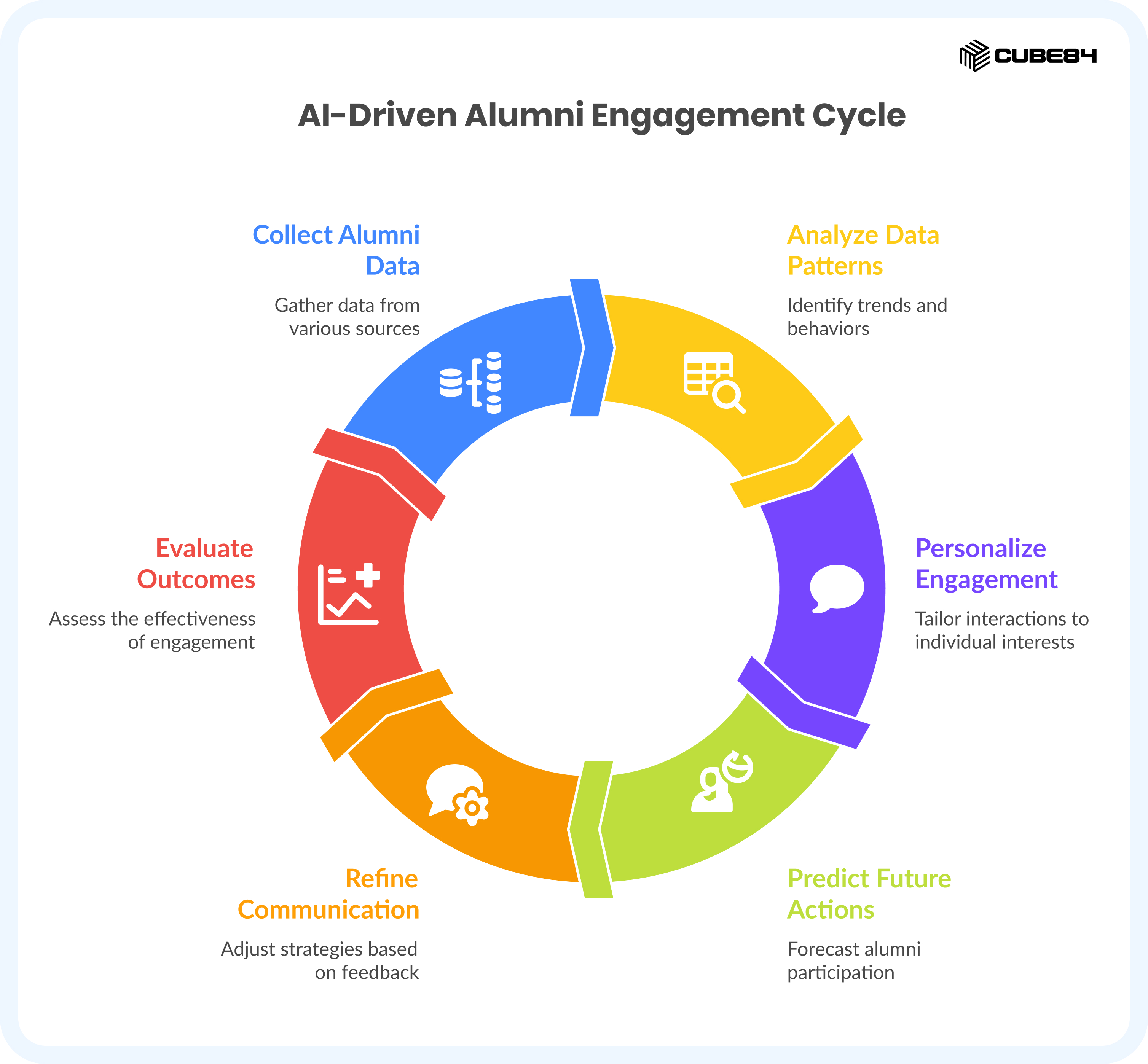
AI supports this need by helping your team see patterns across large datasets and by preparing options for the next interaction. Predictive models can highlight alumni who may be ready to attend an event, volunteer, or consider a first or renewed gift. Large Language Models (LLMs) prepare drafts that your staff refine. Intelligent models adjust communication as interests change.
The Investment Justification
AI is becoming a necessary component of your long-term advancement strategy. Alumni expect communication that reflects their relationship with your institution and the way they currently engage with digital content. Meeting this expectation helps deepen engagement among alumni who are already active and strengthens the long-term value of those relationships. To reach this standard, your institution needs a reliable data foundation. A Customer Data Platform (CDP) unifies alumni information across your CRM, events, email, and digital interactions so your models can work with accurate and timely data. You also need clear governance practices, including Human-in-the-Loop review for sensitive outputs and checks to reduce Algorithmic Bias. When these elements are in place, AI helps your staff sustain high-touch relationships at a scale that manual work cannot support.
The Key Challenges Limiting Your Alumni Engagement Strategy
Your institution faces several challenges that limit the reach and quality of alumni engagement. These issues shape staff workload, weaken data quality, and reduce your ability to plan the right interaction for each alum. Understanding these constraints helps set the foundation for a stronger engagement model.
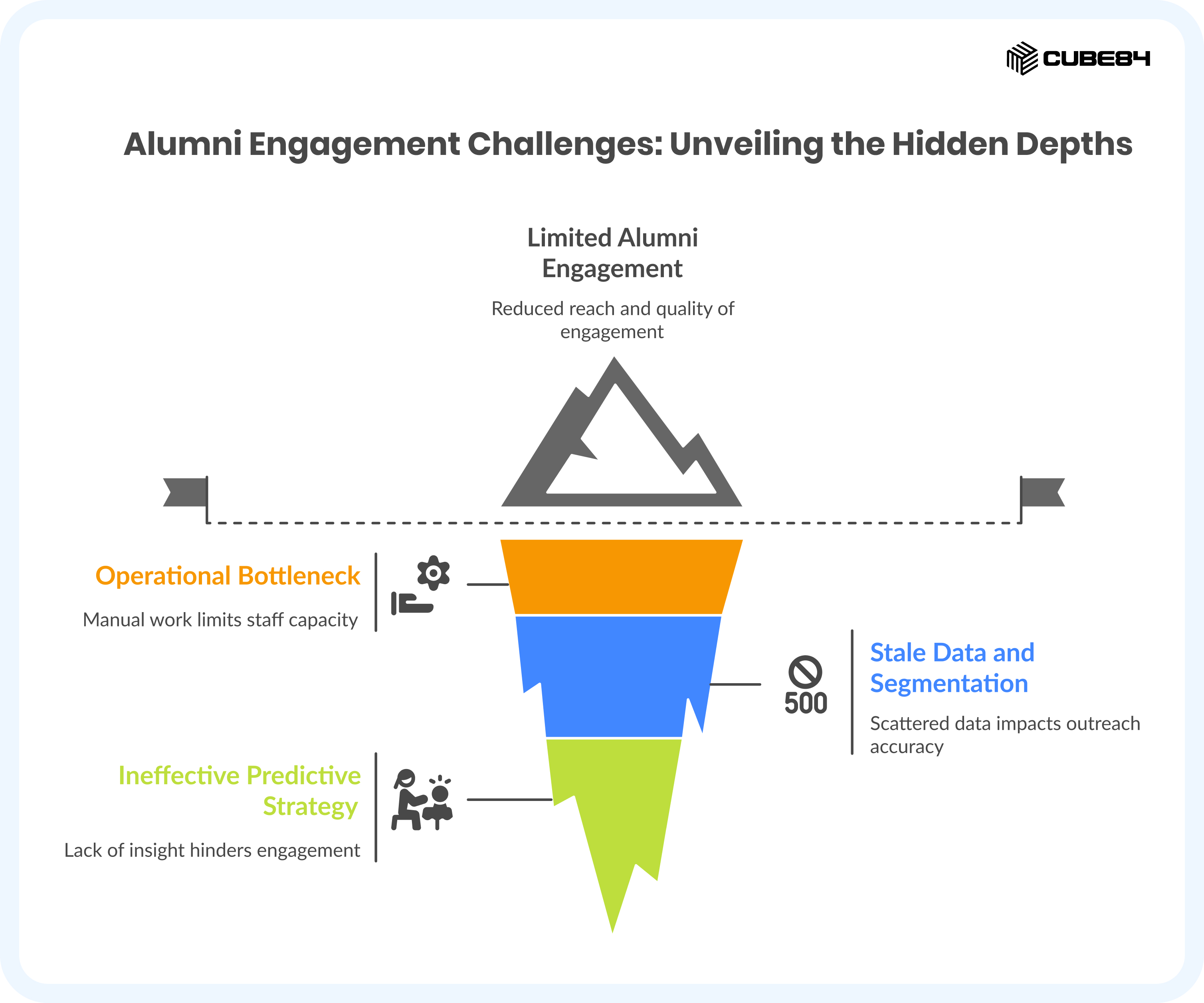
The Operational Bottleneck
This challenge reflects the limits of manual work and the pressure it creates on staff capacity.
Staff Capacity Saturation
Your relationship managers spend many hours on routine tasks such as reviewing records, answering simple Tier 1 questions, and preparing schedules. This reduces the time available for thoughtful outreach and weakens the number of meaningful interactions your team can support.
Response Latency
Alumni expect timely and relevant responses. Manual processes make it difficult to deliver this level of service, especially across multiple time zones. Slow or generic replies create frustration and weaken the alumni experience.
Stale Data and Segmentation
This challenge reflects the impact of scattered data and fixed segments on the accuracy of your outreach.
Data Fragmentation
Your alumni information sits in separate systems, including your CRM, event platforms, career services tools, financial and gift systems, and email systems. When these sources are not unified, staff do not have a complete view of each alum. Decisions that rely on partial information limit the relevance of communication. This gap also hinders your institution’s readiness for AI, because predictive and generative tools require consistent and unified data to produce reliable results. For advancement teams in the US, the gift and fund-management system is especially important, since donor intent and fund restrictions must align with any AI supported recommendations.
Static Journeys
Many communication paths follow fixed rules that do not change as alumni behavior changes. These static journeys cannot respond to real-time signals such as recent website visits, new interests, or event participation. As a result, the message often does not match the alum’s current needs.
Ineffective Predictive Strategy
This challenge reflects the lack of clear insight into which alumni are ready to engage and how their interests are changing.
Engagement Blind Spots
Without reliable predictive insight, it is difficult to identify alumni who may be ready to attend an event, volunteer, mentor a student, or consider a gift. This leads to missed opportunities and outreach that does not match the alum’s level of readiness. Addressing these gaps early helps your institution plan which predictive models to introduce and how to govern their use.
Alumni Fatigue
When communication feels generic or out of sync, alumni lose interest. Low open and response rates often reflect this fatigue. Over time, this reduces overall engagement and lowers the value of each communication effort.
Together, these challenges show why your institution needs unified data, adaptive communication paths, and reliable predictive insight before you begin planning for large-scale personalization.
The Foundational AI Capabilities Your Institution Can Use Today
Your institution can begin strengthening alumni engagement with three practical AI capabilities. These tools reduce manual work, improve response time, and support more focused outreach. All of them depend on accurate, unified data from a Customer Data Platform (CDP).
Predictive Modeling | Generative AI (LLMs) | Intelligent Triage |
Predictive models help your team understand which alumni may be ready for specific opportunities such as events, mentoring, or giving. | Large Language Models (LLMs) prepare first drafts of routine communication, such as reminders, updates, and short briefs. Staff refine each draft to maintain accuracy and institutional tone. This reduces time spent writing repetitive messages and helps keep communication consistent. | Triage tools classify incoming inquiries and route them to the right path. Routine questions move to self-service resources, and complex questions go directly to staff with the relevant context. This helps teams maintain response quality during high-volume periods. |
Together, these capabilities help teams work faster and keep alumni communication timely and relevant, without adding pressure to staff capacity.
What Your Institution Must Have in Place Before Introducing AI
AI supported engagement works only when your institution has the right data structure, skilled staff, clear processes, and strong governance in place. These standards ensure that every model, score, or drafted message remains reliable and aligned with your institutional values.
Readiness Standards Your Institution Must Meet
Standard | What Your Institution Must Do |
Unified Data Layer | Consider whether your information is complete, consistent, and up to date before moving forward with AI supported workflows. |
Customer Data Platform (CDP) | Use a CDP to bring together information from CRM, event systems, volunteer records, career services, and digital engagement tools. The CDP must unify, cleanse, and manage real-time behavioral data such as clicks, page views, and event responses.It also helps your institution apply consistent data policies across the full ecosystem so that information is governed, updated, and used in a reliable way. |
CRM as the Transaction System | Keep the CRM as the system for transactional updates. Allow the CDP to serve as the analytical layer for predictive and generative tools. |
Clear Separation of Data Responsibilities | Reduce gaps and duplication by placing behavioral data in the CDP and transactional updates in the CRM. |
Shifting Staff Roles | Begin planning how staff responsibilities will shift toward more strategic review as manual work decreases. Focus on interpreting predictive scores, reviewing AI prepared drafts, and shaping alumni communication. Over time, this moves roles such as Gift Officers and Relationship Managers from routine processing toward more strategic relationship planning. |
Skill Development for Relationship Managers | Train Relationship Managers to review model outputs, refine drafts prepared by tools powered by Large Language Models, and use simple prompt refinement where needed. Clear training milestones and time to practice with these tools will help staff build familiarity at a comfortable pace. |
Defined Operating Process | You may benefit from beginning with one high volume, low risk workflow. Set clear review steps, escalation paths, and quality checks. Expand only when teams show confidence in reviewing AI supported outputs. |
Governance to Protect Alumni and Staff | Define clear internal guidelines for how data is collected, reviewed, and used. Ensure staff understand these rules and follow them consistently. |
Managing Algorithmic Bias | Recognize that predictive models may underscore certain groups, such as new graduates or female donors. Use Human in the Loop review for all high stakes outputs. |
Avoiding Intrusive Personalization | Define acceptable use of behavioral data so communication does not become overly precise or intrusive. |
AI Ethics Review Board | Form a review group with leaders from Legal, Advancement, and Alumni Relations. The board should review all new data sources and predictive models before deployment. |
Ongoing Oversight | Conduct periodic checks for fairness, accuracy, and clarity of communication as AI supported workflows expand. |
These readiness standards group into four pillars that form the foundation for responsible AI adoption
Pillars of AI Readiness
DATA | PEOPLE | PROCESS | GOVERNANCE |
• Unified data layer • CDP for behavioral data • CRM for transactions • Clean, reliable inputs •Consistent data policies across systems | • Shift to strategic review • Skills to read predictive scores • Confidence reviewing LLM drafts • Basic prompt refinement | • Start with one low-risk workflow | • Clear rules for data use • Regular fairness checks • Human in the Loop for high-stakes work • Ethics Review Board for models and data |
A note on staff readiness:
Most advancement teams begin by giving staff simple, low-risk ways to use the new tools. This often includes reading predictive scores, reviewing AI-prepared drafts, and making small edits to improve tone or accuracy. These early exercises help staff understand how the tools support their work rather than replace it. Short training sessions and room for questions help build familiarity at a steady pace. When staff understand how the tools support their work, adoption moves smoothly and the quality of alumni relationships remains strong.
Once these readiness standards are in place, your institution should establish the governance framework that will oversee data use, model review, and communication standards.
What Your Institution Needs for Governance and Risk Management
AI supported engagement works only when your institution has clear rules for how data is used, how models are reviewed, and how staff make decisions. A strong approach protects alumni trust, supports consistent work across teams, and helps leadership feel confident about adopting new tools. The aim is not to restrict progress but to create steady guardrails so that your institution can move forward with clarity.
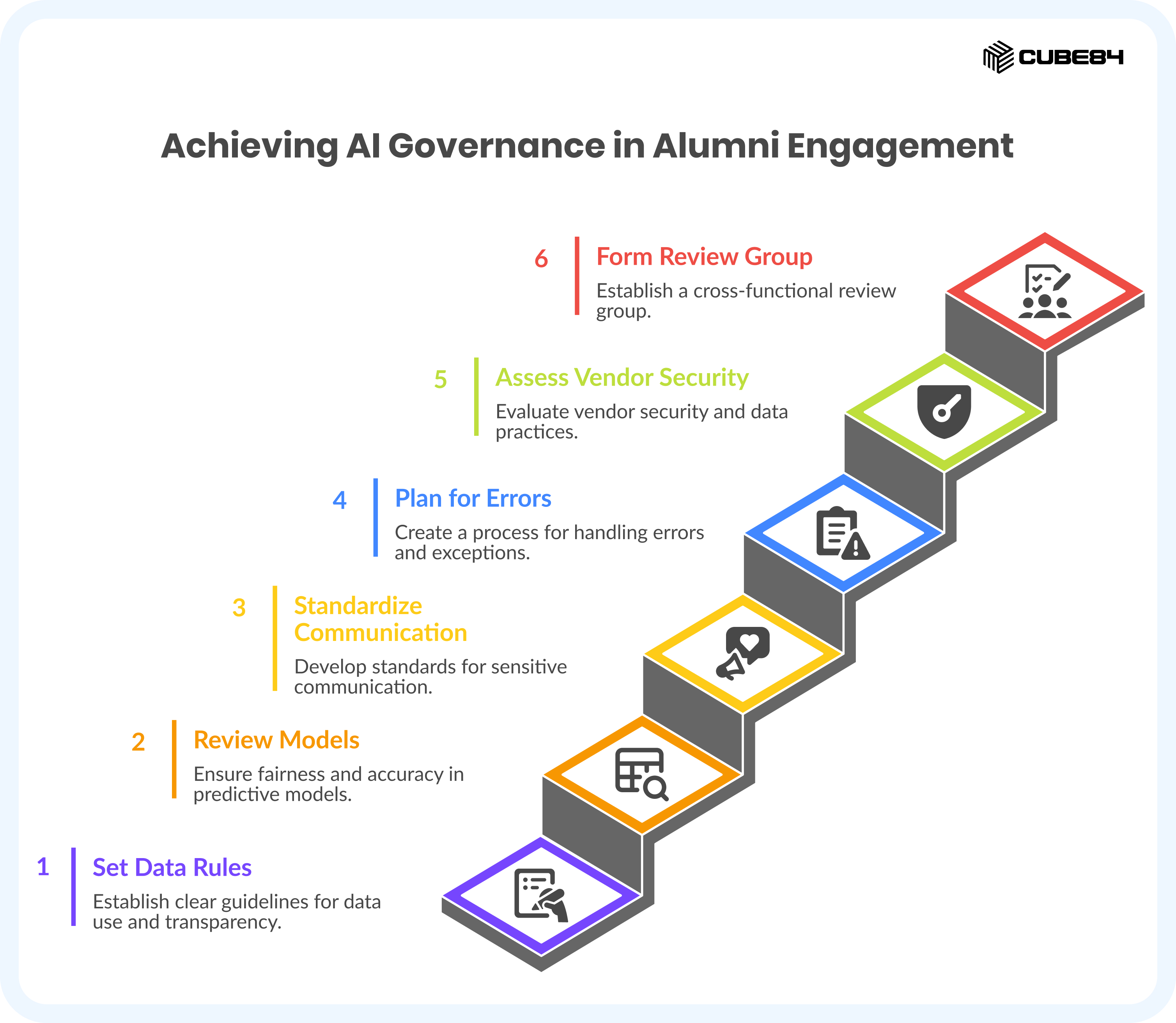
Set Clear Rules for Data Use and Transparency
Your institution will need guidelines that explain which data informs engagement, how it is reviewed, and who has access to it. This includes understanding which data types may fall under FERPA or GDPR, and where additional disclosure or consent may be needed. Your governance framework should also align with your institution’s internal donor privacy and stewardship policies, which often include rules on contact permissions, channel preferences, and the use of gift information for engagement. Clear boundaries help staff avoid misuse of behavioral signals and support open communication with alumni about how their information is used.
Review Predictive Models for Fairness and Accuracy
Predictive tools can surface patterns that may influence how different alumni groups are viewed. Your institution will need a process to review these patterns, identify unexpected trends, and decide when human judgment should guide final decisions. Regular reviews that involve Advancement, Data Governance, and Legal help maintain fairness and transparency.
Create Standards for Sensitive Communication
Some messages require more care than others. Your teams will need to agree on which communication types must be drafted or reviewed by staff, which can follow routine workflows, and which should not be generated by automated tools at all. Clear standards help protect tone, accuracy, and relationship quality, especially in situations that carry emotional or reputational risk.
Plan for Errors and Exceptions
Even well designed systems may produce results that do not match expectations. Staff need a simple way to raise concerns, log issues, and request review. An agreed escalation plan helps teams act quickly, understand what went wrong, and decide whether a model or workflow needs adjustment. This approach reduces confusion and protects the alumni experience.
Assess Vendor Security and Data Practices
AI supported engagement depends on external platforms such as CDPs, predictive tools, and content generation systems. Your institution will need a method to review each vendor’s security posture and data handling standards. Common checks include SOC 2 reports, encryption practices, breach response processes, and clarity on where data is stored. This helps protect sensitive information and supports informed decision making.
Use a Cross-Functional Review Group
A standing review group helps your institution maintain consistency as capabilities grow. This group often includes leaders from Legal, Advancement, IT, Alumni Relations, and Data Governance. Their role is to review new data sources, approve predictive models, and provide guidance when fairness, tone, or personalization questions arise. The group also supports staff when decisions are unclear, which strengthens confidence across teams.
Once your institution has the right safeguards and oversight in place, you can begin shaping AI supported workflows that improve responsiveness and relevance across alumni journeys.
How AI Supports More Responsive Alumni Engagement
AI helps your institution shift from broad, fixed communication paths to experiences that adjust to what each alum is doing now. Instead of sending the same message to everyone in a segment, your team can focus on signals that show current interest and readiness.
The Segment-of-One Difference
Most alumni journeys still follow preset rules based on graduation year or region. These rules do not update when interests change. AI supported workflows read real-time behavior and help your institution respond with more timely and relevant communication.
The Forrester study found that well-governed hyper-personalization leads to stronger engagement, as alumni respond more often when communication reflects their current interests.
Traditional Journeys vs Adaptive Experiences
Feature | Traditional Journey | Adaptive Experience |
Segmentation | Fixed groups based on static traits | Updated continuously based on recent behavior |
Communication | One path for all | Next step selected based on what the alum is doing now |
Impact | Messages often feel generic | Higher relevance and stronger long-term value |
An adaptive model gives staff clearer insight into where to focus their time and reduces broad outreach that does not match current interest.
Examples That Show the Difference in Practice
Dynamic Alumni Portal
Content such as events, volunteer roles, and career resources appears in an order that reflects the alum’s current activity and location. This increases return visits and helps alumni find what they need without searching.
Predictive Gift Officer Briefing
Officers receive a short briefing with giving history, recent interactions, and key interests in one place. This reduces preparation time and supports more thoughtful meetings.
Timely Career Value Alerts
Career developments are matched with helpful resources and sent through the alum’s preferred channel. This positions your institution as a steady support partner.
Adaptive Event Recommendations
Invitations reflect what the alum is exploring now rather than broad segments. This often leads to higher registration and less manual promotion.
Automated Volunteer Matching
Signals from past engagement and content viewed help surface volunteer roles that match the alum’s interests. Staff spend less time sorting lists and placements move faster.
As you consider how these capabilities support alumni engagement, the next step is to understand what leaders usually review when deciding how to invest in this work.
Building the Investment Case: What Your Board Needs to Consider
Senior leaders often start with a few practical questions when reviewing proposals for data and AI supported engagement: what will this require, what value can it create, and how it will support long-term institutional goals. This section outlines the areas they usually review and the questions that help assess scope, timing, and readiness.
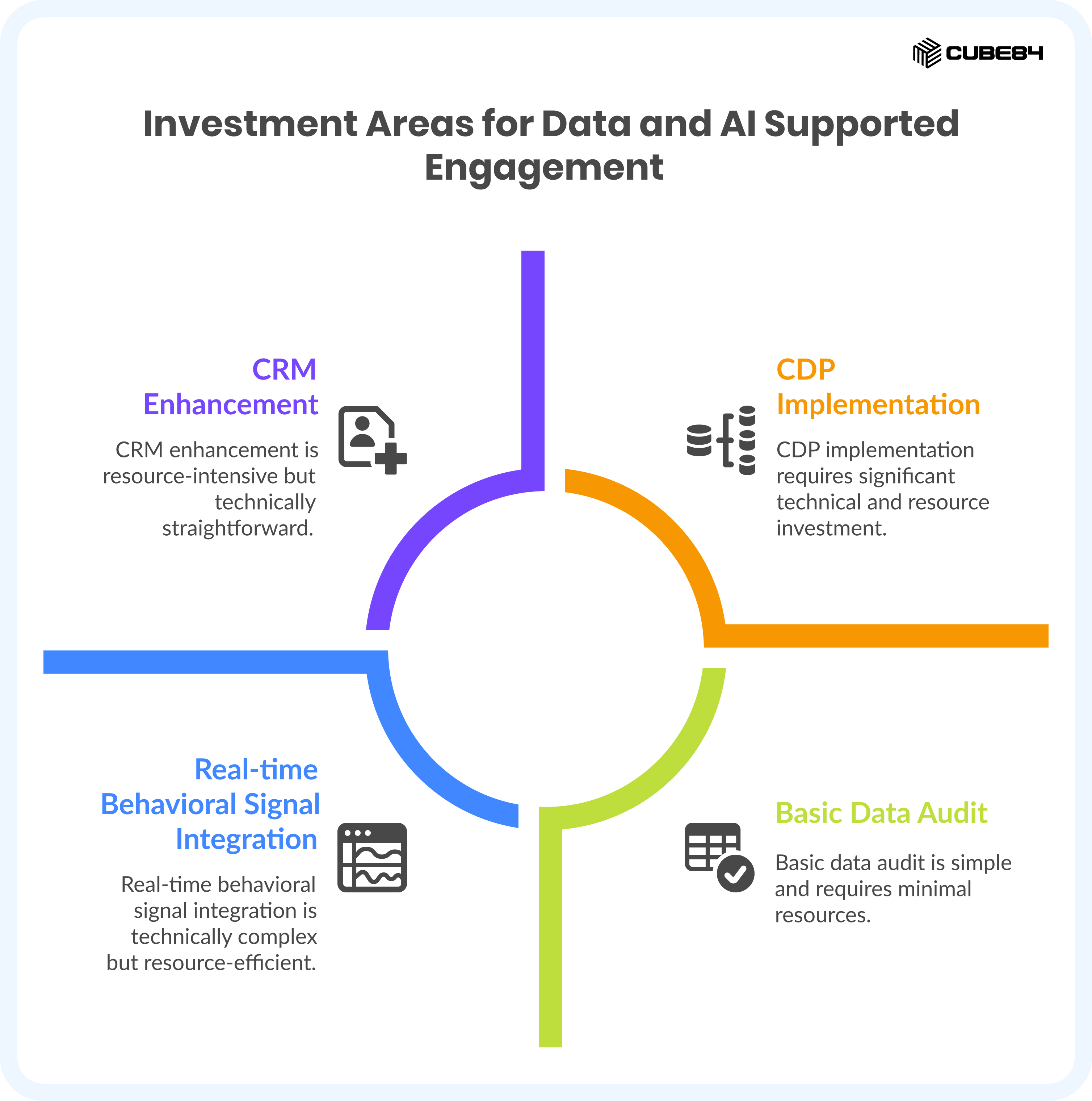
Key Investment Areas
Institutions usually plan resources across four areas. The figures vary by size and technical landscape, so these should be treated as categories, not fixed numbers.
Platform and Data Foundation
Before estimating costs, leaders often review the current state of alumni data. Helpful questions include:
1. How many systems hold alumni information today
2. Whether the CRM captures real-time behavioral signals
3. Whether a CDP is needed to unify data or if the CRM can support this work
Cost context:
CDP pricing often depends on user volume, data throughput, and the licensing model used. In Salesforce environments, Data 360 (formerly Data Cloud) typically follows a credit-based consumption model, where institutions pay for the amount of data they ingest and process. These structures help leaders understand the general categories of cost without tying estimates to specific numbers, since pricing can change over time. Institutions may review current pricing guidance on Salesforce’s website to understand how credit-based licensing applies to their context.
AI tools and model access
Institutions decide whether to use built-in models, licensed tools, or a mix. Scope becomes clearer by considering:
1. Whether your team will rely more on predictive models or generative tools
1. Whether real-time scoring is needed, or if periodic batch processing is enough
3. How much configuration control your institution requires
Common examples:
Higher education advancement teams usually work with a combination of tools. Some institutions rely on CRM-embedded or vendor-provided models, such as donor likelihood or engagement scores delivered directly into the CRM. Others use general analytics platforms such as Dataiku, Alteryx, H2O, or KNIME when they have analysts who can build and maintain custom models. Many teams also use general-purpose generative AI platforms (ChatGPT, Gemini, Claude, Copilot) wrapped with institutional prompts and governance to support drafting and summarisation. These patterns help leaders decide how much internal capability they need to support.
Implementation and integration support
The level of internal vs external support depends on team capacity and the number of systems involved. Leaders often review:
1. Whether internal teams can manage the integrations
2. How many legacy systems require cleanup
3. Whether middleware or specialized integration tools are needed
Staff training and oversight
Change management is a meaningful part of the investment. Institutions usually consider:
1. Which staff need training on predictive scores or reviewing drafted communication
2. How much time teams need to practice new workflows
3. How ongoing model oversight and governance will be supported
How Institutions Approach Return on Investment
Boards often review ROI across staff capacity, engagement outcomes, and long-term financial impact. These are not guarantees, but structured ways to think about value.
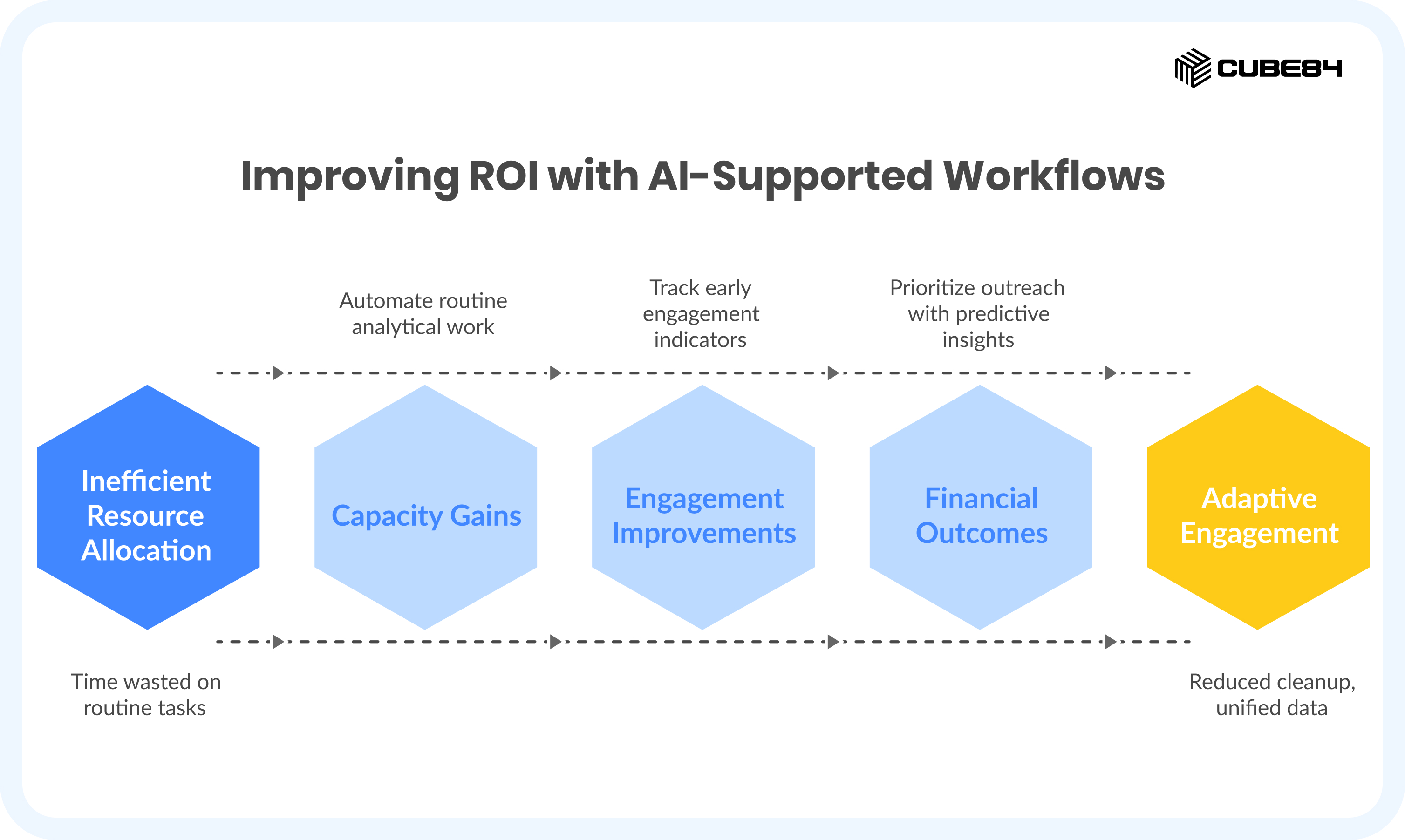
Capacity gains
A simple way to estimate improvement is to review how much time teams spend on routine preparation. Many institutions begin by assessing:
1. Time spent gathering information across systems
2. Time spent drafting standard communication
3. Hours spent on manual triage
This offers a baseline for estimating how much time the tools may return to staff.Institutions that adopt drafting and triage tools in steady use often see up to two hours of routine analytical and reporting work removed from each Relationship Manager’s weekly load, which helps redirect time toward higher-value outreach.
Engagement improvements
Institutions often track early indicators such as event responses, volunteer interest, and portal return visits by:
1. Reviewing current conversion rates
2. Tracking how often alumni return to digital content
3. Understanding how quickly alumni respond to relevant opportunities
These indicators help show whether engagement becomes more timely and relevant.
Financial outcomes
Predictive insight helps staff prioritise outreach, which strengthens long-term giving and volunteer pipelines. Institutions usually review:
1. Current solicitation conversion rates
2. Donor pipeline trends
3. Opportunities where timing may influence outcomes
Competitive and Sector Context
Many institutions are improving their data and beginning to use early AI supported workflows. Early adopters gain an advantage because behavioral data strengthens model performance over time. Leaders often compare their own progress with:
1. Whether peers have deployed a CDP
2. Whether predictive models are being piloted
3. How other institutions manage governance and oversight
This helps boards & leadership understand how delays may affect their competitive position and where their institution sits on the adoption curve.
Considering the Cost of Delay
Delaying this work extends the time needed to unify data and slows the point at which models become reliable. Leaders often review:
1. How long it will take to bring data together from today’s systems
2. How long it will take to gather enough behavioral information for predictive models
3. Whether fragmentation is increasing each year
Early steps shorten the path to more adaptive engagement and reduce long-term cleanup efforts.
Concluding Thoughts: Bringing Your AI Strategy to Life
AI gives your advancement team the structure needed to handle a growing alumni base without losing the personal connection that defines your work. With strong data and governance in place, teams can use their time to plan better interactions and respond to alumni needs with more clarity and confidence. This approach strengthens long-term relationships and helps your institution meet rising expectations in communication, career support, and stewardship.
An AI first model strengthens daily operations by making routine preparation and coordination easier for staff. Workflows become more organized, information moves more smoothly between systems, and decision points become clearer. Teams gain more time for strategy because less time is spent on background preparation and routine communication.
Next Steps
A practical place to begin is with one complete workflow. Start by validating the connection between your CDP, your AI supported models, and your drafted content. Personalized event invitation drafting is a strong first pilot because it has clear inputs, high volume, and measurable outcomes. The results will help your institution build confidence, refine governance, and prepare for larger AI supported initiatives.
Frequently Asked Questions (FAQ)
Q: What is the primary metric we expect to impact first?
A: You should see early gains in staff capacity within the first 6 to 12 months. Intelligent triage and AI supported drafting allow Relationship Managers to spend more time on high-touch engagement. Institutions commonly see up to a two times increase in available time for priority work.
Q: What is the estimated timeline for full implementation?
A: A phased plan works best:
Phase 1 (6-12 months): CDP foundation and a small generative pilot.
Phase 2 (12-24 months): Predictive models and Gift Officer Briefings.
Phase 3 (24+ months): Full orchestration, dynamic experiences, and Segment-of-One delivery.
Q: Is this a build or buy strategy?
A: It is a hybrid strategy. Your CDP, CRM, and base AI tools are purchased, but orchestration workflows and prompts must be shaped around your institution’s data, policies, and engagement model.
Q: What is the cost of not adopting AI now?
A: The main cost is lost opportunity. Without AI, outreach becomes more generic, alumni fatigue increases, and engagement rates drop. Institutions that adopt AI supported engagement earlier will see stronger lifetime value and better donor pipeline growth.
Q: How will we measure ROI across engagement and financial outcomes?
A: ROI will be measured across:
1. Engagement: Higher click through and conversion rates for events, mentoring, and volunteering.
2. Financial: Better accuracy from predictive models and stronger solicitation outcomes.
3. Efficiency: A two times increase in Relationship Manager capacity for priority work.
Q: What is the biggest technical challenge we should anticipate?
A: Data integration. Legacy systems must send clean, consistent data to the CDP in real time. This work must begin in Phase 1 because it affects every downstream model and workflow.
Q: How does this change the role of the Relationship or Gift Officer?
A: Officers shift from note taking and drafting to strategic planning. They spend more time interpreting scores, shaping high-value interactions, and managing complex donor relationships.
Q: How should staff be trained on prompt engineering?
A: Training should focus on clarity, context, and tone. Staff should learn how to give the system the right background information, how to edit drafts quickly, and how to guide outputs so they stay consistent with institutional standards.
Q: How do we ensure AI generated content maintains our institutional voice?
A: Start by documenting your tone and message standards. Use these examples to guide prompts and training data. All AI supported drafts should go through staff review to ensure accuracy and consistency. Over time, prompts can be refined to reflect your preferred style, helping the system produce more accurate drafts.
If you would like a conversation about how to begin this work at your institution, talk to us at CUBE84. We can walk you through practical steps based on your current systems.