

Introduction
Most organizations approaching a Salesforce implementation focus on one question: how do we keep costs down? It is a reasonable starting point. But it is almost never the right first question.
The more important question is: how do we keep this from needing to be done twice?
The DIY path — assigning the implementation to an internal team, a newly hired admin, or a part-time contractor — looks attractive on paper. It appears cheaper. It feels more controllable. And for a narrow set of scenarios, it actually is the right call.
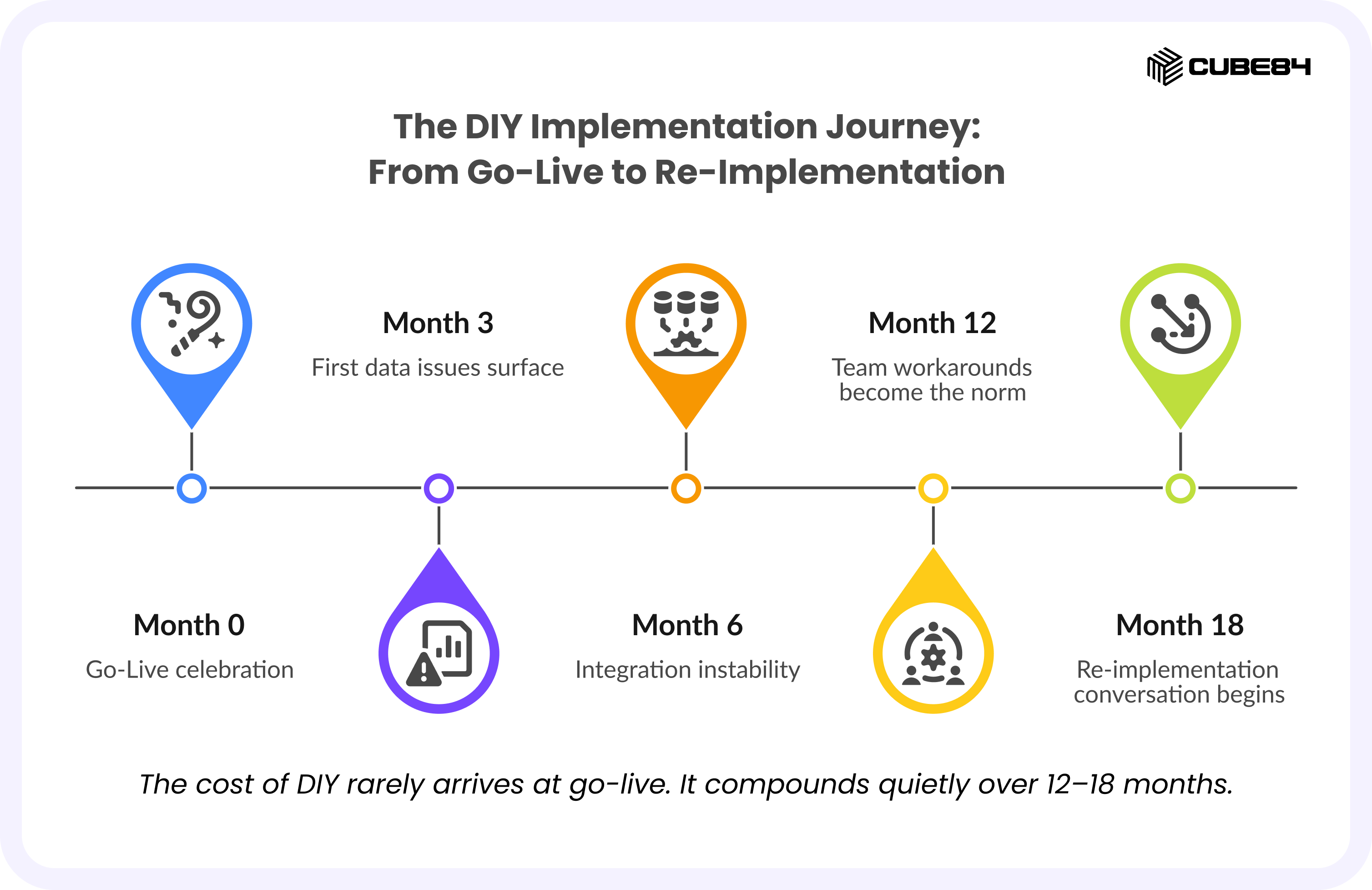
But for most mid-market organizations and growing businesses, the real cost of DIY does not show up on day one. It accumulates quietly — in technical debt, missed configurations, integration failures, and adoption gaps — and becomes fully visible somewhere between 12 and 18 months after go-live.
This guide is for Operations and Revenue leaders, Founders, and IT leads who are making this decision right now. It walks through what DIY actually costs, what a Salesforce implementation partner prevents, and a clear framework for deciding which approach fits your situation.
What 'DIY Implementation' Actually Means in Practice
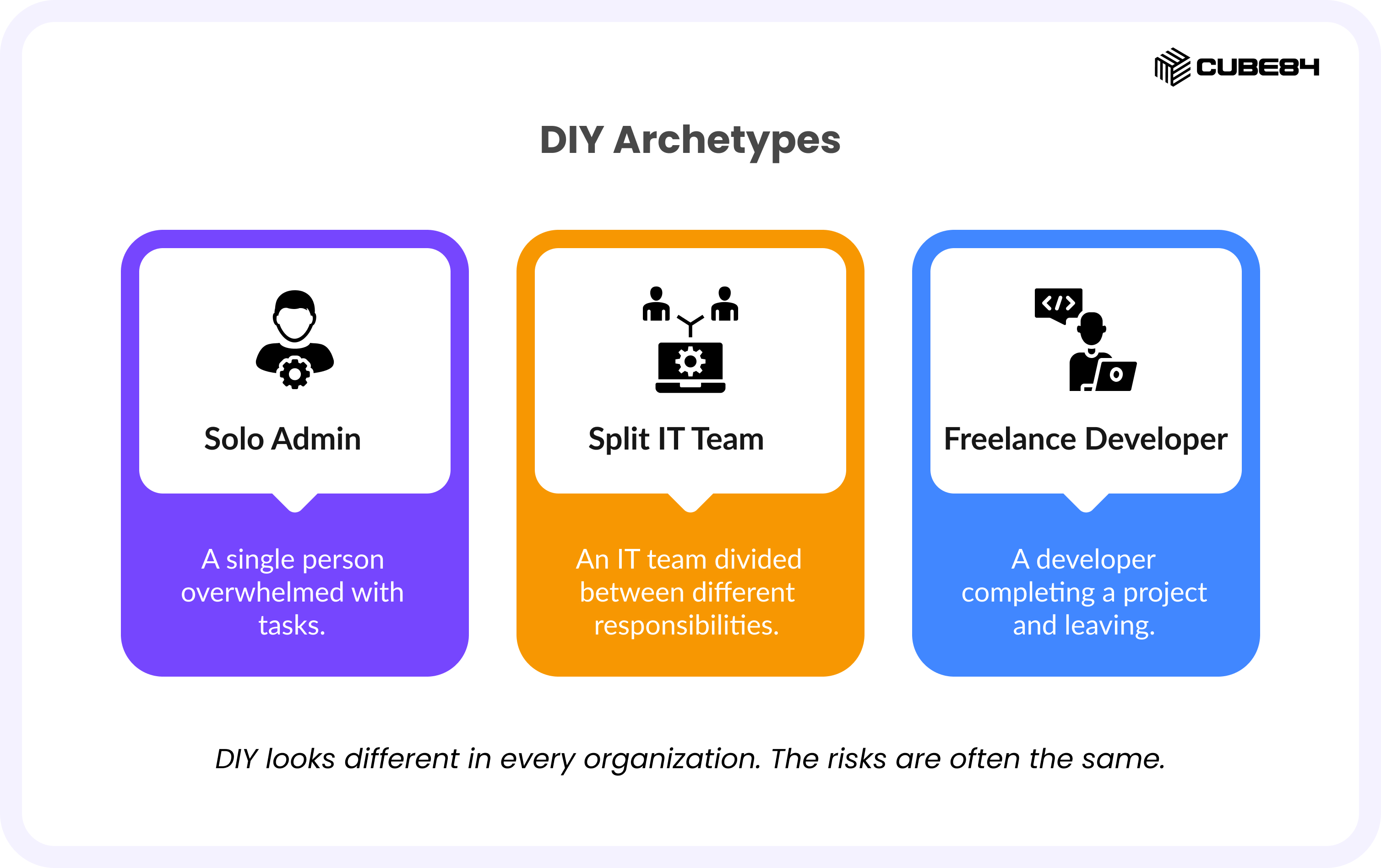
DIY does not always mean a founder clicking through setup screens on a weekend. In most organizations, it looks like one of these three scenarios:
A Salesforce Admin is hired, given the licenses, and asked to build everything from scratch.
An existing IT team takes on implementation alongside their day-to-day responsibilities.
A freelance Salesforce developer is brought in for a fixed-scope, short-term engagement.
Each of these can work — under the right conditions. The problem is that most organizations reach for DIY before they have verified that those conditions exist.
Salesforce is not a plug-and-play tool. As covered in our detailed breakdown of what Salesforce implementation actually involves, activating licenses is just the starting point. The real work — data migration, workflow configuration, integration architecture, user adoption — is where most DIY attempts run into trouble.
The True Cost of DIY: What Shows Up 12–18 Months Later
The financial case for DIY is usually built on the implementation phase alone: no partner fees, lower upfront spend, faster procurement. What it rarely accounts for is the operational cost of what gets built incorrectly — and what it costs to fix it.
Table 1 — DIY vs. Partner: Where Costs Actually Land
Cost Category | DIY (Typical Outcome) | Partner-Led (Typical Outcome) |
Upfront Implementation Cost | Lower — internal labor or freelance rate | Higher — structured engagement fee |
Data Migration Quality | Inconsistent — often discovered post go-live | Validated — migration mapped and tested before cutover |
Integration Architecture | Point-to-point, fragile at scale | Designed for scalability and failover |
User Adoption Rate | Lower — training often deprioritized | Higher — change management built into delivery |
Technical Debt at 18 Months | High — rework or re-implementation required | Low — architecture decisions documented and defensible |
Total Cost of Ownership (TCO) | Often doubles within 24 months | More predictable — structured post-go-live support |
The hidden cost driver in most DIY implementations is not a single catastrophic failure. It is the accumulation of small decisions made without enough platform knowledge — a Flow built to handle 200 records that breaks at 2,000, an integration designed for one direction that cannot handle bidirectional sync, a data model structured around today's process that cannot accommodate next year's product line.
Our guide to Salesforce implementation cost covers where budget drift typically begins. What it cannot fully capture is the opportunity cost: the revenue operations that do not scale, the reporting that cannot be trusted, the teams that work around the CRM instead of through it.
What a Salesforce Implementation Partner Actually Prevents
The most common misconception about implementation partners is that you are paying them to do work you could do yourself — just faster. That framing misses what partners actually contribute at the architectural level.
A qualified Salesforce implementation partner does not just execute your requirements. They challenge them. They map your stated requirements to platform capabilities and tell you, honestly, when what you are asking for will cause problems later. That conversation — the one where a good partner says 'here is why we should not build it this way' — is often the most valuable thing you are paying for.
What Partners Specifically Prevent
Table 2 — Common DIY Failure Points and How a Partner Addresses Each
Failure Point | Why It Happens in DIY | How a Partner Prevents It |
Governor limit violations at scale | Apex or Flows written without volume testing | Architecture reviewed for scale before build |
Duplicate and dirty data post-migration | No pre-migration cleansing or validation framework | Data audit, deduplication, and mapping before cutover |
Integration failures after launch | Point-to-point connections without error handling | Integration architecture designed with retry logic and monitoring |
Low user adoption | Training treated as a go-live afterthought | Change management and role-based training built into delivery |
Scope creep and budget overrun | Requirements not locked before build begins | SOW-driven delivery with documented change control |
Org re-architecture within 2 years | Data model built for immediate need, not future state | Architecture designed for 3-year growth trajectory |
DIY vs. Partner: The Decision Framework
The right choice is not always a partner. There are genuine scenarios where a capable internal team or a targeted freelance engagement is the appropriate and cost-effective path. The decision becomes problematic only when organizations choose DIY without honestly assessing whether the conditions for DIY success are in place.
Use the framework below to map your current situation to the right approach.
Table 3 — DIY vs. Partner: Decision Framework by Situation
Your Situation | DIY (Admin/Freelance) | Hybrid | Partner-Led |
Single Cloud, <25 users, standard config only | ✓ Strong fit | Possible | Overkill |
2+ Clouds, 25–150 users, basic integrations | Risky | ✓ Strong fit | Recommended |
Multi-Cloud with ERP integration and custom logic | Not advised | Partial only | ✓ Required |
Experience Cloud portal for external users | Not advised | Architecture only | ✓ Required |
Migration from existing CRM with 50K+ records | High risk | Possible with oversight | ✓ Strongly recommended |
Revenue Cloud / CPQ implementation | Not advised | Not advised | ✓ Required |
Ongoing governance + new feature delivery | Admin sufficient | Retainer model | Managed Services |
Two patterns appear consistently across organizations that regret DIY decisions. The first is underestimating complexity — treating a multi-Cloud, multi-integration implementation as equivalent in difficulty to a basic CRM setup. The second is overestimating internal capacity — assuming an admin or IT team can absorb implementation work on top of existing operational responsibilities.
How to Assess Whether Your Team Is Ready for DIY
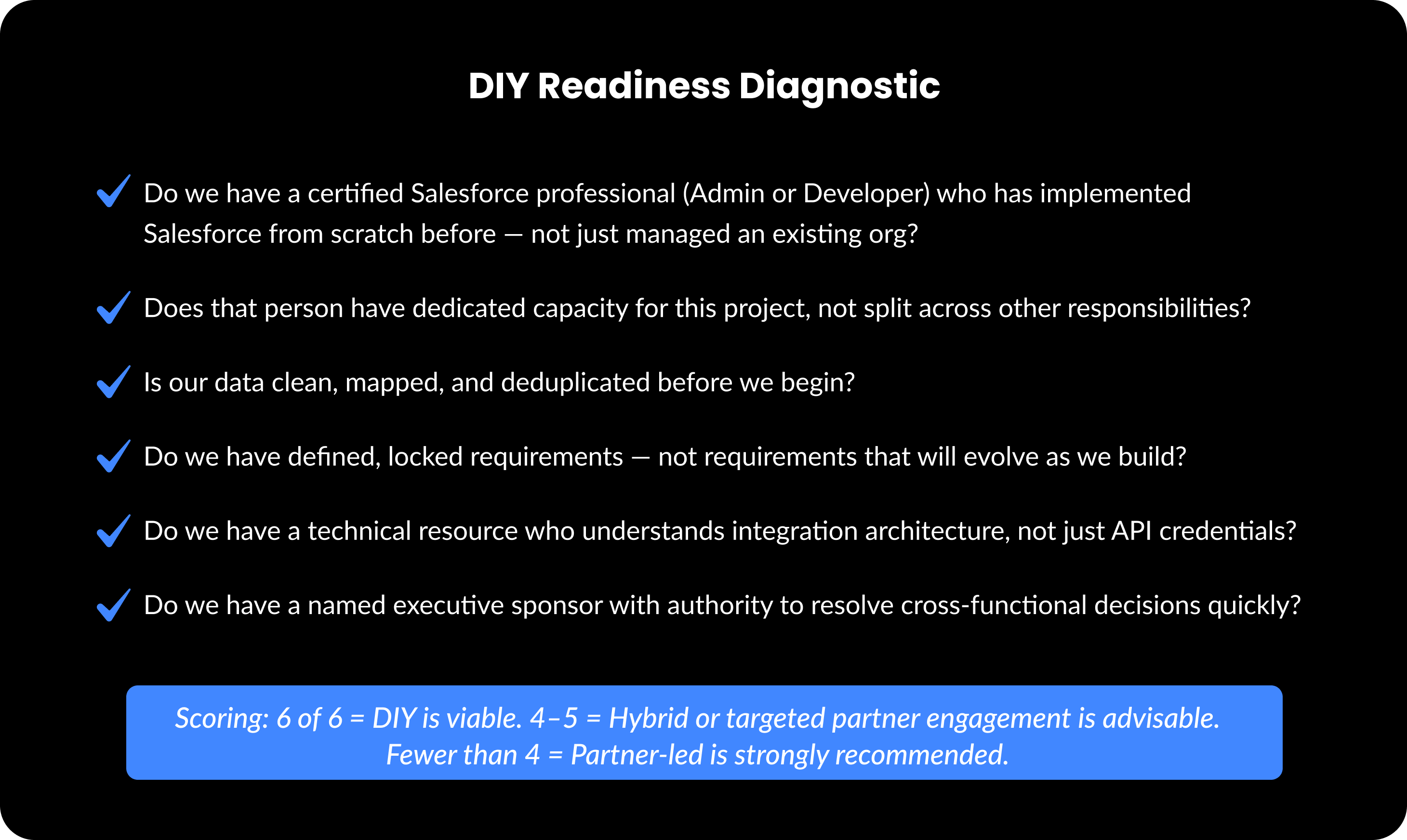
Before settling on an approach, run this diagnostic against your internal reality. Answer each question honestly — not aspirationally.
What 'Partner-Led' Does Not Mean
A common objection to engaging a partner is the assumption that it means handing over control of your Salesforce org to an outside team. That is not how a good implementation partnership works — and it is worth being direct about the distinction.
A qualified partner implements within your requirements, documents every architectural decision, trains your team to own what gets built, and structures the engagement so that at go-live, your internal team can operate and evolve the system without calling the partner for every change.
The organizations that extract the least value from implementation partnerships are the ones who are passive — who treat the partner as a vendor rather than a collaborator. The organizations that extract the most value are the ones who show up to sprint reviews, push back on decisions they do not understand, and hold partners accountable to knowledge transfer as a delivery requirement, not an afterthought.
If you are evaluating what type of partner to engage, our guide on how to find the right Salesforce development partner walks through the full vetting process, from certifications to discovery questions to engagement model structures.
One More Decision: What Kind of Support Do You Need Post-Go-Live?
The implementation decision and the post-implementation support decision are related but separate. Many organizations make the right call on implementation and then fail to plan for what happens after go-live.
Salesforce is not a static system. It evolves with your business — new automations, new integrations, new reporting requirements, new clouds. How you structure ongoing development support determines whether your Salesforce org compounds in value or begins to accumulate debt again.
Our breakdown of dedicated vs. on-demand Salesforce developer models covers this decision in detail. In brief: if your monthly Salesforce development workload is above 20 hours, you need more than ad hoc support. Below 20 hours, on-demand models are generally sufficient.
Table 4 — Post-Implementation Support: Matching Ongoing Needs to the Right Model
Ongoing Need | In-House Admin | On-Demand Support | Managed Services / Retainer |
User management, basic reports | Best fit | Viable | Overkill |
Regular automation and Flow updates | Possible | Viable | Efficient |
Integration maintenance and new APIs | Stretches most admins | Per-project | Best fit |
Ongoing feature development backlog | Not sufficient alone | High context cost | Best fit |
Strategic org evolution and architecture | Not equipped | Not equipped | Best fit with Architect |
The Question Worth Asking Before You Decide
Before finalizing your approach, there is one question that cuts through most of the noise:
"If this implementation produces the wrong architecture, what will it cost us to fix it in 18 months — and who will pay for it?" |
For organizations where Salesforce is genuinely central to revenue operations, customer experience, or operational efficiency, the answer to that question almost always points toward partner-led implementation. Not because DIY cannot work — it can, under the right conditions — but because the cost of being wrong is too high to leave to chance.
For organizations with simple requirements, bounded scope, and a genuinely capable internal team, DIY can be the right call. The key is arriving at that decision through honest assessment, not default assumption.
Build the Right Foundation. Once.
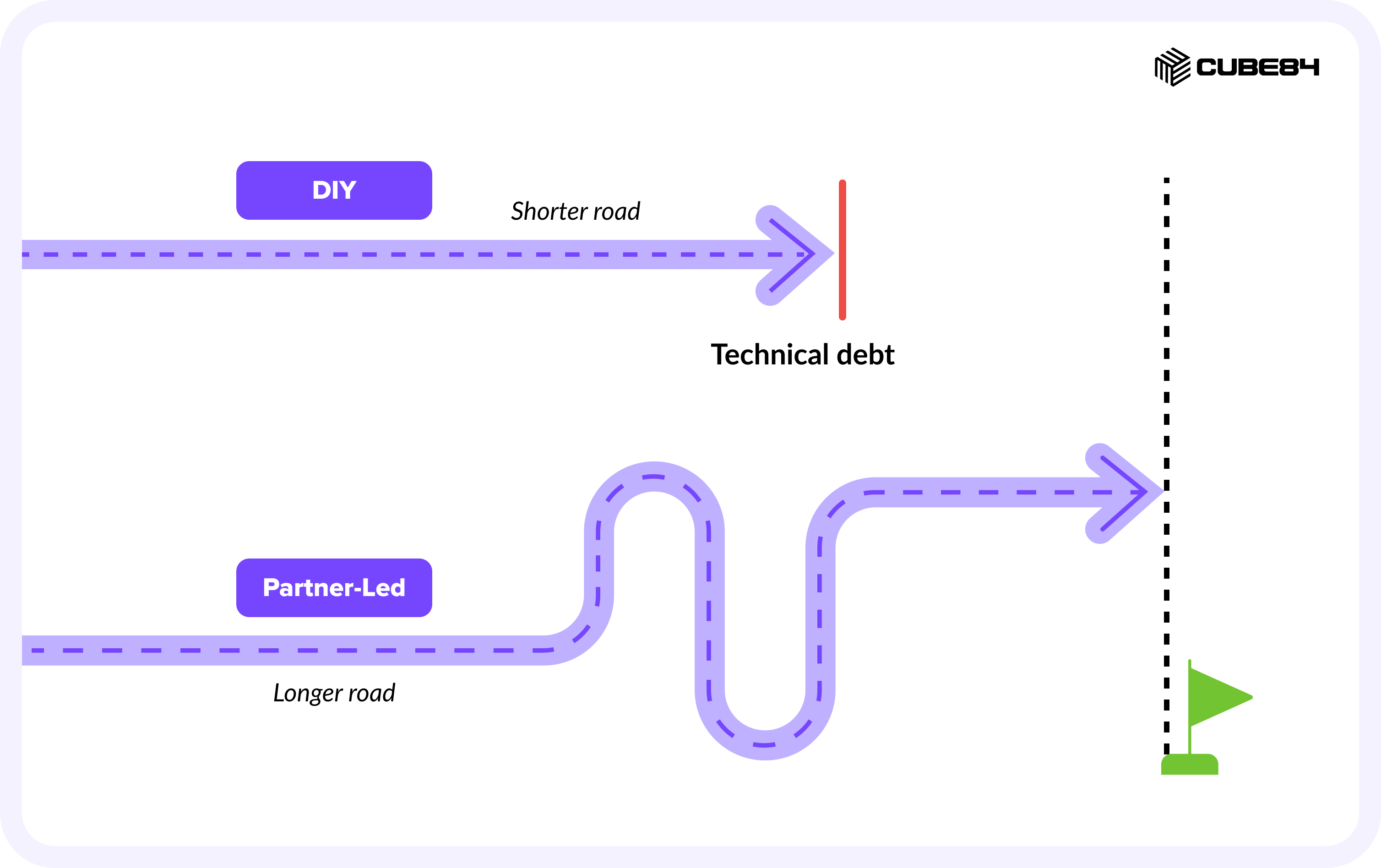
The most expensive Salesforce implementation is the one you have to do twice. Whether that second implementation comes from a failed DIY attempt, a poorly scoped partner engagement, or a system that was built for last year's business and cannot support this year's growth — the cost is real, and it is avoidable.
If you are still evaluating the full cost picture before making this decision, our Salesforce implementation cost guide and hidden fees breakdown provide the financial context you need to build a realistic business case — regardless of which path you choose.
If your org is already showing signs of a troubled implementation — adoption gaps, data inconsistencies, integrations that require manual intervention, or reporting your team cannot trust — our guide to fixing a broken Salesforce implementation without starting over covers your recovery options.
If you have run the diagnostic above and the answer points toward a partner, the next step is understanding how to choose the right one. That decision is covered in detail in our guide to finding the right Salesforce development partner.
Related Reading from CUBE84
→ Salesforce Implementation Cost 2026: Hidden Fees & ROI Estimator
cube84.com/blog/salesforce-implementation-cost-hidden-fees-roi-estimator
→ Salesforce Implementation Cost: What You Need to Know
cube84.com/blog/salesforce-implementation-cost-what-you-need-to-know
→ How to Fix a Broken Salesforce CRM Implementation Without Starting Over
cube84.com/blog/how-to-fix-a-broken-salesforce-crm-implementation-without-starting-over
→ How to Find the Right Salesforce Development Partner
cube84.com/blog/how-to-find-the-right-salesforce-development-partner
→ Dedicated vs. On-Demand Salesforce Developer: Which Model Is Right For You?
cube84.com/blog/dedicated-vs-on-demand-salesforce-developer