

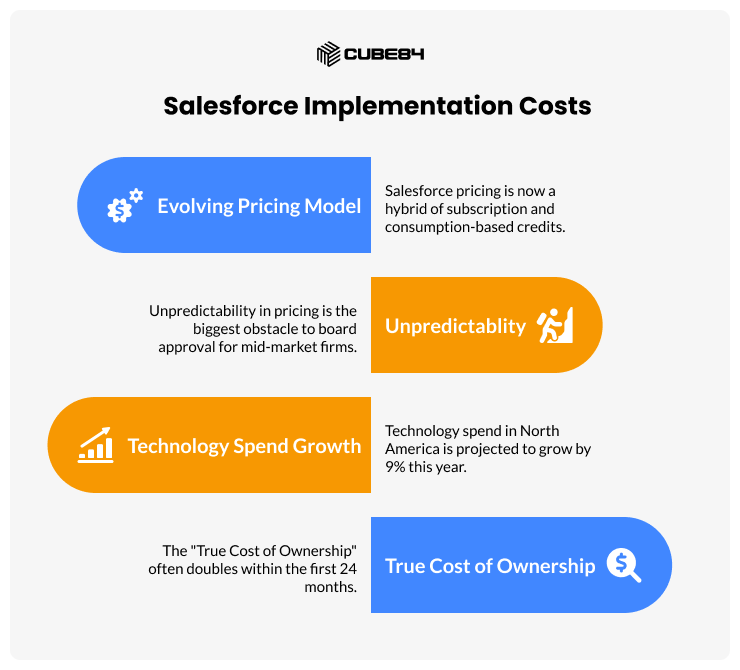
In 2026, a Salesforce implementation is no longer a simple "one-time setup." With the shift toward Agentforce and Data Cloud, the pricing model has evolved into a hybrid of subscription and consumption-based credits. For North American mid-market firms, this unpredictability is the single greatest hurdle to board approval.
According to Forrester’s 2026 Global Tech Forecast, technology spend in North America is projected to grow by 9% this year, largely driven by AI and cloud infrastructure. However, industry research shows that while a standard mid-market implementation typically ranges from $75,000 to $150,000, the "True Cost of Ownership" (TCO) often doubles within the first 24 months due to unmapped dependencies and usage spikes.
1. The 2026 Implementation Cost Matrix
The cost of your implementation is determined by your "Data Velocity" rather than just your user count.
Segment | Estimated Cost Range | Specific Scope (The "What's Included") | Integration Scope |
Small SMB | $15k – $30k | Single Cloud: (e.g., Sales Cloud or Service Cloud). Focus on "QuickStart" setup with standard objects and basic lead-to-opportunity flows. | Minimal: 1 Standard Integration (e.g., Gmail/Outlook or a basic AppExchange tool). |
Growing SMB | $30k – $75k | Multi-Cloud (Dual): Specifically Sales + Service or Sales + Marketing (Account Engagement). Full automation of sales-to-service handoff. | Standard API: Up to 2 Integrations. Example: Marketing tool (Mailchimp/HubSpot) + Accounting (QuickBooks). |
Mid-Market | $75k – $150k+ | Strategic Suite: Enterprise Edition. Includes Multi-Cloud, Data Cloud setup (1-2 data streams), and Agentforce Base Setup (1 autonomous agent). | Deep Integration: ERP Integration (e.g., NetSuite/Sage) for real-time visibility into orders/invoices. |
2. The "Hidden Fees" Every CFO Should Watch
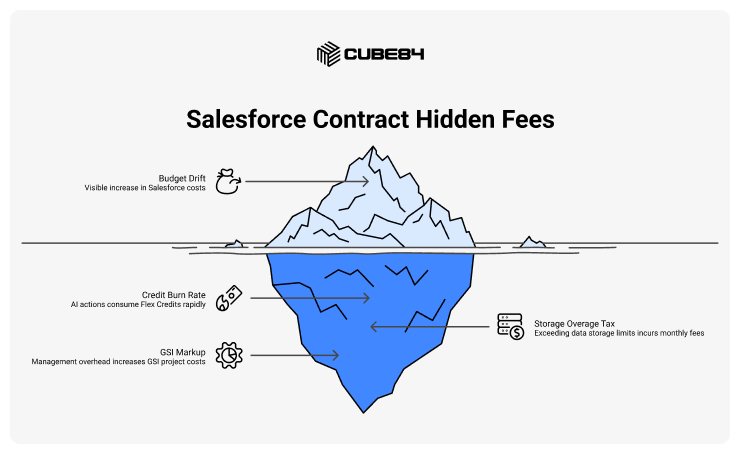
Modern Salesforce contracts contain three variables that can cause significant budget drift if not managed by an experienced architect.
A. The "Credit Burn" Rate
In 2026, Salesforce pricing has pivoted toward Flex Credits and Data 360 Credits.
The Fee: Every "action" an AI agent takes (summarizing a case, updating a lead) costs roughly 20 Flex Credits ($0.10).
The Risk: If your workflows are poorly designed, a runaway loop in an autonomous agent can drain your annual credit pool in weeks.
B. The "Storage Overage" Tax
As you ingest more unstructured data for AI, your file and data storage limits will be tested. Ongoing storage overages are billed monthly and can quietly become a five-figure annual expense.
C. The GSI "Project Management" Markup
Global Systems Integrators (GSIs) often quote a lower hourly rate but add a 30-40% "Management Overhead" for layers of project coordinators and offshore liaisons. Boutique standards eliminate these layers, ensuring 100% of your budget goes to technical architecture.
3. The ROI Estimator: Where is the Payback?
Investment in a high-tier partner isn't a cost; it’s an efficiency dividend. The Forrester Total Economic Impact studies show that a well-executed Salesforce deployment can yield a 341% ROI over three years.
The "Efficiency Dividend" Calculations:
Sales Velocity: Reducing the "Lead-to-Cash" cycle by 15% through automated AI agents.
Tech Stack Consolidation: Retiring legacy point solutions (separate marketing tools, data warehouses) can save a mid-market firm $40k – $80k annually in disparate license fees.
Hiring Avoidance: Every autonomous agent deployed via Agentforce can handle the equivalent workload of 0.5 to 1.5 full-time equivalents (FTEs) in high-volume roles like customer support or lead qualification.
Conclusion: Value-Based Budgeting
The most expensive implementation is the one you have to do twice. By 2026, the complexity of the Salesforce ecosystem means that "saving money" on a junior-led implementation partner actually creates long-term financial risk.
Modern-native partners like CUBE84 focus on "Architectural Efficiency." By spending their 10-year history perfecting "Click-over-Code" solutions and clean data migrations, they ensure your TCO remains predictable. When you invest in a partner that prioritizes your ROI as a success metric, you aren't just buying software - you’re buying a competitive advantage.