
Introduction
If you work in an Advancement or nonprofit organization, you have likely faced this question:
“How many engagements did a single donor or alum have last year across all departments?”
After implementing Salesforce, this should be easy to answer. Instead, it often becomes a technical challenge.
Salesforce can capture almost any type of data, but that data is often scattered across disconnected objects and does not reflect a single journey or source of truth. This is frequently mistaken for an admin or tooling issue. In reality, it is a data modeling problem.
This is what creates reporting paralysis.
Across North American higher education and nonprofit organizations, years of customization on legacy EDA and NPSP models have addressed immediate needs while introducing long-term reporting complexity.
At CUBE84, we see this pattern repeatedly. Institutions invest heavily in Salesforce yet still struggle to answer basic advancement and engagement questions efficiently. These systems function, but they do not scale.
The Accelerator and Nonprofit Cloud (NPC) data model represents the architectural shift required to enable fast, native reporting in Salesforce, while preserving prior investments.
I. Deconstructing the Complexity: Why Legacy Salesforce Models Create Reporting Paralysis
How complexity quietly builds over time
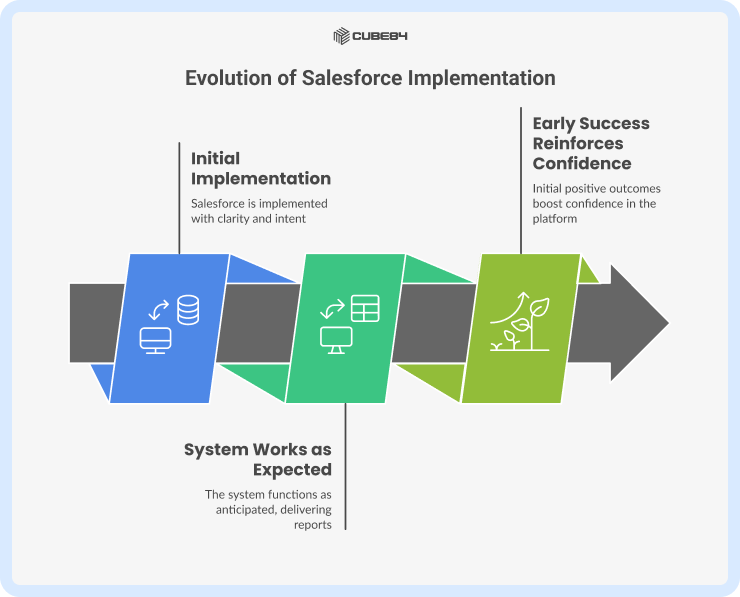
Most higher education and nonprofit organizations did not end up with complex Salesforce environments overnight. Many legacy implementations began with clarity and intent. The system worked as expected, reports were delivered, and early success reinforced confidence in the platform.
Over time, complexity crept in.
As new teams came on board, Salesforce was extended to meet immediate needs. Advancement required more detailed gift tracking. Alumni relations needed better event visibility. Career services needed a way to record employer engagement. Each requirement was valid, and each solution addressed a real business problem. The challenge is that these decisions were often made in isolation. Very few organizations paused to redesign the overall data structure as these needs accumulated.
When data exists, but the story breaks
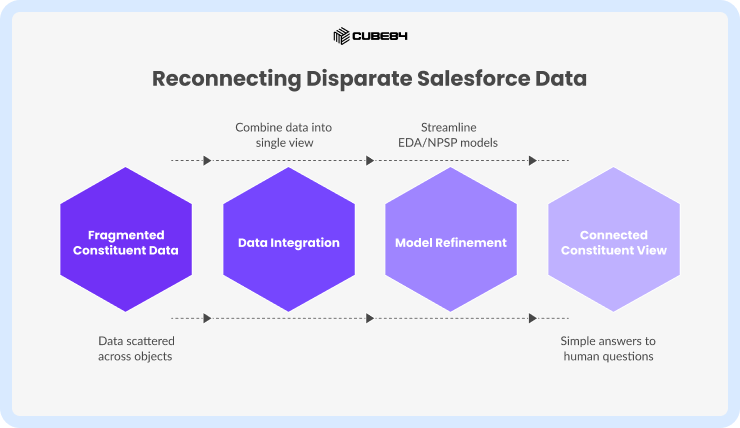
From CUBE84’s experience working with mature Salesforce orgs, this is the point where reporting issues begin to surface. The data is still there, often in large volumes, but it is no longer organized around a single, connected view of the constituent.
In heavily customized EDA or legacy NPSP models, information about the same person is spread across many objects. Gifts live in one place. Events in another. Volunteering somewhere else. Program participation or career engagement often follows its own structure entirely. Over time, Salesforce remains excellent at storing data, but increasingly poor at answering simple, human questions about it.
When leadership asks, “Show me everything this alum has done with us,” the difficulty is not the question itself. The challenge is that Salesforce now has to reconstruct that story from fragments stored across objects that were never designed to work together.
The hidden cost of joins
To compensate for this fragmentation, Salesforce relies on object joins. In theory, joins allow related records to connect across objects. In practice, they introduce friction.
One or two joins are manageable. When reports require five or six joins, they become fragile. Reports slow down. Logic becomes difficult to explain. Small changes made for one team or one purpose can quietly break reports elsewhere or alter results without warning.
Salesforce administrators usually feel this first. Reports that should be straightforward require careful construction and constant testing. As data volumes grow, performance degrades. Minor schema changes can break critical dashboards. Functional users feel it next, when reporting becomes something they need help with rather than something they can do independently.
Technical debt in disguise
Over time, this complexity becomes technical debt. Each additional join introduces another dependency to maintain, another security consideration, and another reason reporting struggles to scale.
Gartner estimates that poor data quality costs organizations an average of $12.9 million per year in lost productivity and rework.
At CUBE84, we often explain this to clients using a familiar analogy. It is like an aging building where new wiring has been added repeatedly without reworking the original blueprint. Everything still functions, but every change carries risk, and no one fully trusts what might break next. |
When Custom Report Types become a crutch
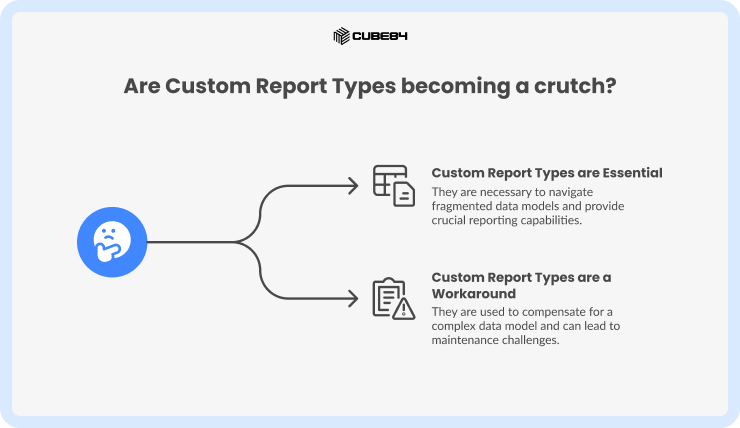
Custom Report Types are typically introduced as a workaround. They are powerful and useful tools, but in fragmented data models they often become essential infrastructure rather than optional enhancements.
Dozens of report types are created to stitch objects together. Knowledge about how they work often lives with a small number of individuals who designed the original model or have maintained it over time. Salesforce upgrades become stressful because reporting logic is tightly coupled to a complex and brittle structure.
Reporting paralysis and loss of trust
From our delivery experience, this is where reporting paralysis sets in. The organization has data. It has dashboards. But it no longer has confidence in the numbers.
Leaders wait longer for answers. Teams rely on external tools or consultants to validate results. Salesforce’s value as a decision platform begins to erode.
At this stage, it is easy to assume the limitation lies with Salesforce itself. In reality, the root cause is a data model that evolved without reporting treated as a first-class priority.
II. The Solution Blueprint: The Accelerator and NPC Data Model
Fixing the structure, not adding more tools
Once organizations recognize that reporting issues stem from structure rather than tools, the path forward becomes much clearer.
The Accelerator and NPC data model do not fix reporting by adding new features. They fix it by correcting the underlying structure that everything else in Salesforce depends on.
A simple organizing principle
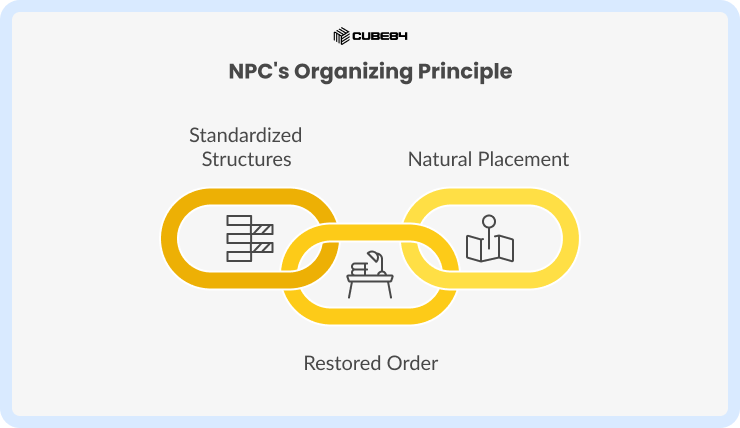
The model is built on a straightforward idea: keep related information together.
Instead of distributing a constituent’s journey across many disconnected objects, NPC organizes engagement, transactions, and relationships into a smaller number of standardized and predictable structures. This approach does not remove detail or flexibility, it restores order that has often been missing for years.
This does not remove detail or flexibility. It restores order that has been missing all along. Data that was previously scattered is now aligned in a way that Salesforce’s native reporting engine can understand, without excessive customization.
Simply put, it is similar to organizing files so related information stays together. The documents were always there. The problem was that they were spread across too many drawers, labeled differently by different teams. With NPC, you create a structure where information is placed where it naturally belongs.
What the Accelerator model actually is
The Accelerator model itself is not a separate product. It is the simplified data blueprint that underpins Nonprofit Cloud. It defines how constituent data relates, how engagement is captured, and how reporting should flow across departments. This standardization is intentional, as it replaces years of one-off decisions with a consistent architectural approach.
Why reporting starts working again
From CUBE84’s perspective, this shift is where reporting begins to unlock value again. Fewer joins, because of centralized data, mean reports that are easier to build, faster to run, and far more resilient to platform changes. You will notice that dashboards load predictably and filters behave consistently. Functional teams can answer routine questions without escalation to administrators or IT. |
Preventing complexity from returning
What is equally important here is what the model does not require. Instead of solving new needs by creating more custom objects and report types, NPC relies on standard objects and reusable patterns. This reduces redundancy and prevents the system from drifting back into complexity over time.
Governance becomes simpler by design
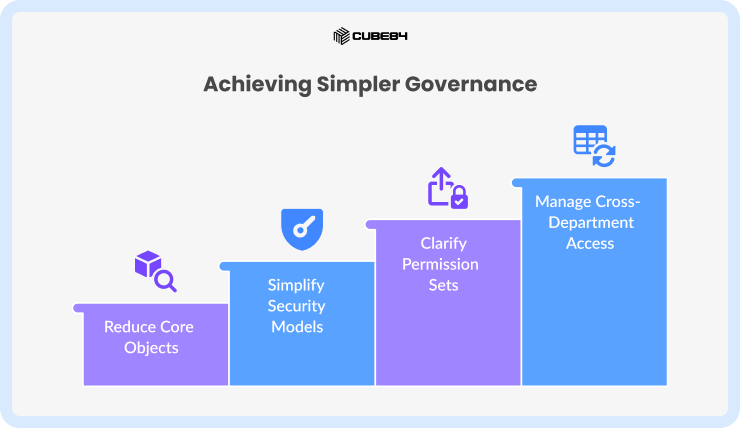
Governance also improves as a result. With fewer core objects driving reporting, security models become easier to design and maintain. Permission sets are clearer. Cross-department access can be managed intentionally rather than patched together. This is especially important for organizations balancing advancement, student success, and career services within the same CRM.
Immediate and long-term impact
In practical terms, the impact is immediate. IT teams spend less time maintaining fragile reporting infrastructure. Functional users spend less time second-guessing reports, while leadership gains faster access to dependable insights.
Most importantly, the model holds up over time. Centralized data scales better as volumes grow. It supports modern analytics, AI initiatives, and predictive modeling without requiring constant rework. Instead of continuously patching complexity, organizations begin building on a foundation designed for long-term use.
Governance becomes simpler by design Governance also improves as a result. With fewer core objects driving reporting, security models become easier to design and maintain. Permission sets are clearer. Cross-department access can be managed intentionally rather than patched together. This is especially important for organizations balancing advancement, student success, and career services within the same CRM. Immediate and long-term impact In practical terms, the impact is immediate. IT teams spend less time maintaining fragile reporting infrastructure. Functional users spend less time second-guessing reports, while leadership gains faster access to dependable insights. Most importantly, the model holds up over time. Centralized data scales better as volumes grow. It supports modern analytics, AI initiatives, and predictive modeling without requiring constant rework. Instead of continuously patching complexity, organizations begin building on a foundation designed for long-term use. |
III. The Executive Dividend: Translating Simplicity into Business Value
Why data structure becomes an executive concern
For CIOs and CTOs, data model decisions are usually about cost, risk, and talent, and extend beyond just reporting. It is also about whether the organization is building something that can last.
When Salesforce reporting becomes slow, unreliable, or dependent on external systems, the issue shifts from being operational to strategic.
The structure of the data model directly affects how much the organization spends to maintain the system, how quickly it can adapt, and how confidently leadership can rely on the insights it produces.
This is where the value of a simplified, centralized model becomes clear.
Talent acquisition and retention
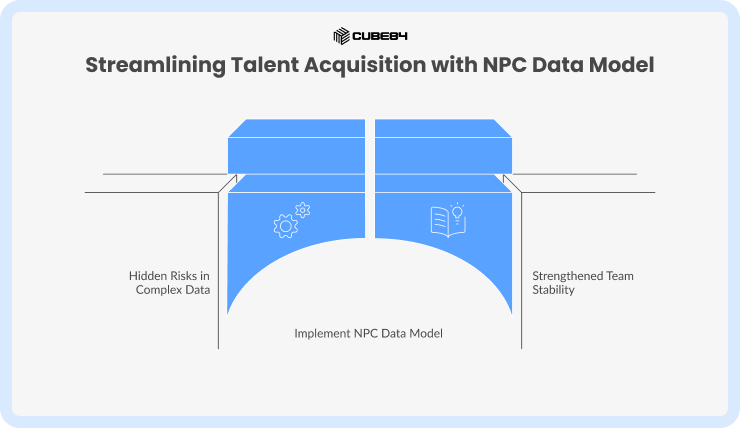
Complex data models create hidden risks tied to how people use and depend on the system.
Highly customized EDA or legacy NPSP implementations often require administrators and architects with deep, niche knowledge of the org’s unique structure. Onboarding new administrators takes longer, documentation becomes harder to maintain, and institutional knowledge concentrates in the hands of a few individuals.
With the Accelerator and NPC data model, the learning curve is significantly reduced. The structure aligns more closely with standard Salesforce patterns, making it easier to hire, train, and retain talent. Internal teams can manage the system effectively without relying heavily on expensive specialists who are often brought in simply to explain how it works.
From a leadership perspective, this reduces dependency risk and strengthens long-term team stability.
Reducing technical debt and the cost of delay
We often assume that when it’s debt, it’s only direct money, but it’s also the time wasted that could have been invested in something useful. Every year spent maintaining a fragmented data model adds to technical debt.
As Benjamin Franklin observed, “For every minute spent organizing, an hour is earned.”
Organizations often compensate for reporting complexity by introducing ETL tools, external data warehouses, or custom integrations. While these solutions provide short-term relief, they also increase cost, maintenance overhead, and system fragility.
About 50% of teams spend over 61% of their time on data integration tasks instead of core analytics work. Read more
The cost of inaction is not neutral. Delaying a structural shift guarantees continued spend on workarounds and prevents internal teams from focusing on higher-value, strategic initiatives. Instead of improving analytics or user adoption, effort is spent keeping reports functional.
A simplified data model reduces this burden. It allows Salesforce to do more of the work natively, lowering long-term operational costs and slowing the accumulation of technical debt.
Preparing for AI and advanced analytics
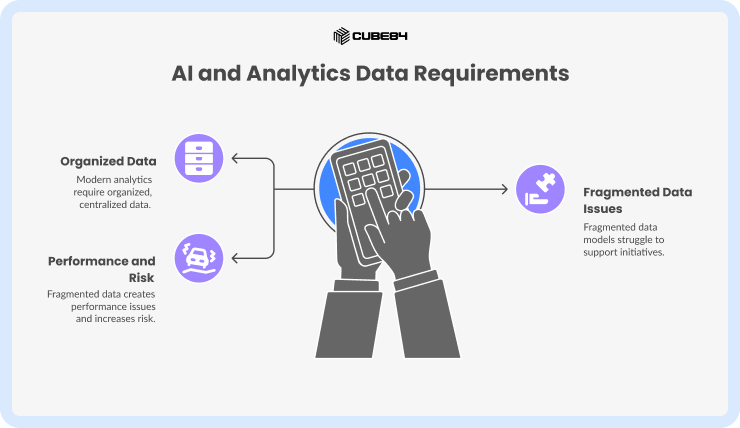
Modern analytics, machine learning, and predictive modeling depend on organized, centralized data.
Fragmented data models struggle to support these initiatives because data must be stitched together repeatedly before it can be analyzed. This creates performance issues and increases the risk of inconsistent results.
Here, the NPC model provides a more stable foundation by design. Centralized, standardized data structures make it easier to generate the high-volume, unified datasets required for advanced analytics and AI-driven insights. With this in place, organizations aren't just future-proofing in theory. This ensures, when the organization is ready to invest in these capabilities, the data model is not the limiting factor.
Increasing decision velocity at the leadership level
Perhaps the most visible benefit for executives is speed.
With a simplified and centralized data model, leadership gains real-time, consistent access to information, enabling faster and more informed decision-making.
From CUBE84’s experience, this shift changes how Salesforce is perceived at the executive level. It moves from being a system of record to a system of insight, one that actively supports strategic decision-making rather than slowing it down. |
In this context, the Accelerator and NPC data model don’t stop with just technical improvement. They also provide executives with clarity, assurance, and the ability to move the organization forward without being constrained by its data foundation.
IV. Strategic Comparison: Reporting Time Saved
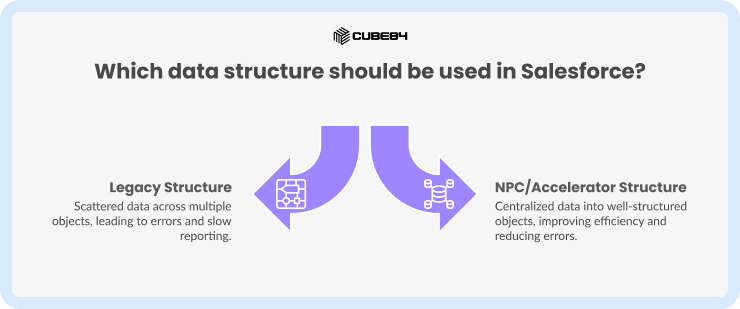
Visualizing complexity
The impact of data structure is easiest to see in the schema itself. As noted earlier, in legacy, heavily customized Salesforce orgs, a single constituent’s data is often scattered across multiple objects, forcing users to navigate several joins just to answer basic questions. Each join introduces potential for error, slows report generation, and makes dashboards fragile.
By contrast, the NPC and Accelerator model centralizes key constituent data into well-structured, consistent objects. The schema is easier to navigate, and reporting requires fewer connections. This simplification has a tangible and immediate impact, freeing up time for the teams who rely on Salesforce every day and allowing them to work more efficiently without wrestling with the system.
Case 1: The 360-degree constituent view
Teams often need a single view that brings together an individual’s full history, from contributions and event participation to volunteering and career involvement.
In a legacy model, this requires stitching together multiple objects using custom report types, often demanding IT or consultant intervention. With the NPC and Accelerator model, this data resides in a smaller, more unified set of objects. Fewer joins are required, reports run faster, and functional users can generate comprehensive views without waiting for administrator support.
The practical result is a 30 to 50 percent reduction in time spent creating typical constituent reports, depending on the complexity of the org. From C84’s experience, this reduction translates directly into less reliance on technical resources and greater agility for functional teams.
Case 2: Cross-object roll-up reporting
Another frequent challenge is reporting across historically separate activities, such as advancement donations and career services engagement. In legacy systems, these datasets often reside in different objects with no straightforward relationship, requiring complex custom roll-ups or external ETL processes to produce a unified view.
With the NPC model, cross-object relationships are standardized. Roll-up reports can be built natively, dashboards refresh more quickly, and insights that previously took hours or days to compile can now be generated in minutes.
For executives and functional leaders, this represents measurable ROI that holds up in budget discussions and performance reviews. By reducing the effort required to assemble data, organizations accelerate decision-making and ensure reporting supports strategic execution.
V. Strategic Path Forward: Migration and Adoption
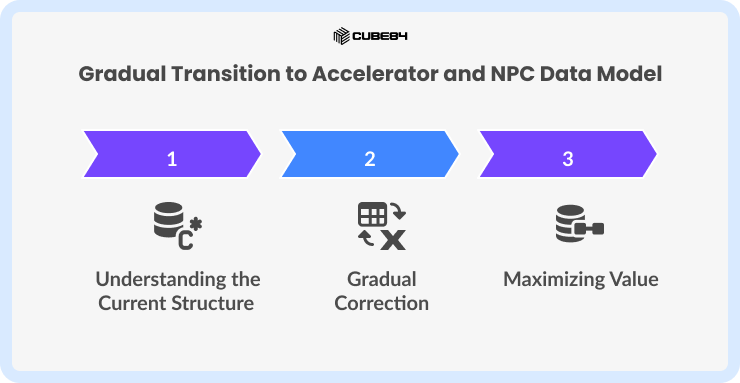
A shift to the Accelerator and NPC data model does not happen all at once, and it does not need to. Organizations that see the most value approach this transition as a gradual correction to how their Salesforce environment has evolved over time.
From C84’s experience, the most effective migrations follow a measured path. They begin by understanding the true cost of the current structure.
Phase 1: Data Audit and Justification
This phase focuses on understanding the current reality of the Salesforce org.
A data audit looks at how reporting is actually built today. It examines how many objects are involved in common reports, how many joins are required, how many custom report types are actively maintained, and where external tools or manual workarounds have been introduced.
This phase is critical because it reframes the problem in business terms. The hidden cost of complexity becomes visible during this process. Time spent maintaining fragile reports, delays in delivering insights, and dependence on ETL tools or consultants are all symptoms of a structure that no longer supports the way the organization works.
At this stage, organizations typically uncover that much of their ongoing Salesforce effort is spent preserving legacy decisions rather than enabling new capabilities.
Phase 2: Core Model Deployment and Proof of Value
Once the current state is understood, the next step is to demonstrate what improvement actually looks like.
Rather than a full migration, deploy the NPC/Accelerator template in a sandbox (with proper licensing) as a focused proof of concept. This environment is used to rebuild a small set of high-value reports, typically the three most requested executive or cross-functional dashboards.
This phase changes the conversation. Instead of discussing theoretical benefits, stakeholders can compare side-by-side outcomes. Reports that once required careful technical construction can now be built more easily.
Dashboards load more consistently, and functional users can interact with the data without relying on complex report types or technical intervention.
Migration Roadmap
Phase | Objective | What Happens | Why it Matters |
Phase 1: Data Audit & Justification | Exposes cost and complexity | Audit joins, report types, and external dependencies | Builds a quantified case for change |
Phase 2: Core Model Deployment (POC) | Prove impact safely | Deploy NPC in the sandbox and rebuild key reports | Demonstrates measurable reporting improvement |
Phase 3: Change Management and Adoption | Sustain impact | Enable users, retire legacy report types, and reinforce standardized usage | Ensures long-term adoption and prevents regression into complexity |
Change Management and Adoption
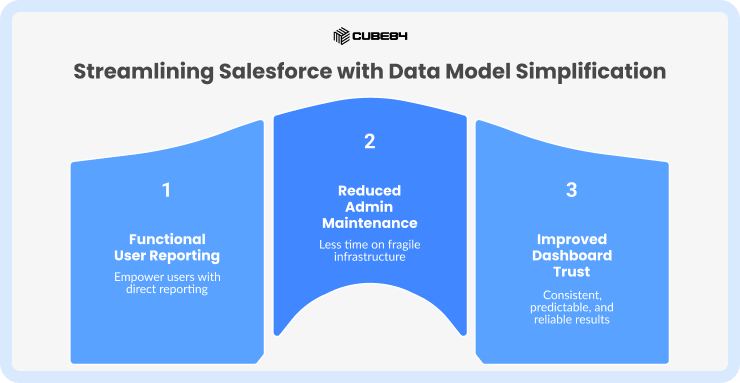
As the data model becomes simpler, the way teams use Salesforce begins to change.
Reporting shifts closer to functional users. Administrators spend less time maintaining fragile infrastructure. Trust in dashboards improves as results become more consistent and predictable. These changes reduce friction naturally, without forcing new processes or heavy retraining.
Supported by clear communication and targeted enablement, adoption progresses quickly. Teams recognize that reporting is easier, faster, and more reliable, and the system starts to feel supportive rather than restrictive.
From C84’s perspective, this is where the long-term value is realized. Organizations that treat this as an architectural correction rather than a system replacement experience far less resistance and significantly faster returns.
Conclusion: The Foundation for Future Analytics
Choosing Salesforce was the right decision, as it provides organizations with the tools to manage relationships and data at scale. Yet, many still struggle to see the full journey in one place due to how the data is structured and used. By adopting the NPC and Accelerator model, organizations reduce ongoing friction and prevent new technical debt from building up. Modernizing to a simplified, centralized model allows CRM data to work as intended, supporting analytics, AI, and advanced decision-making.
According to recent research, 84% of data and analytics leaders say their data strategy needs a significant overhaul before AI initiatives can succeed, highlighting the importance of a simplified, unified data foundation like NPC.
This architectural shift protects the Salesforce investment and ensures the platform continues to deliver value as the organization grows.