

Why Compare Snowflake and Salesforce Data Cloud?
Snowflake and Salesforce Data 360 (formerly Salesforce Data Cloud) both can handle large volumes of data and promise to connect data from multiple locations, yet they solve very different problems. Snowflake acts as a powerful cloud data platform, helping data teams store, query, and analyze information at scale. Data 360 (formerly Salesforce Data Cloud) serves as a customer data platform (CDP), designed to bring every interaction together into a live, unified view for personalized engagement.
They may seem similar at first glance, but their purpose is not. Snowflake supports analytics and business intelligence, while Salesforce Data 360 (formerly Salesforce Data Cloud) powers customer understanding and action.
This guide compares Snowflake vs Salesforce Data Cloud, (now known as Data 360) exploring how each platform approaches data, the value it delivers, and when combining both can create a smarter, more connected business strategy.
What Is Snowflake?

Snowflake is a cloud-based data platform built to store, manage, and analyze large volumes of structured and semi-structured data. It’s designed for data engineers, analysts, and scientists who need scalability and performance for analytics and reporting.
Key Features
1. Elastic scalability: Automatically adjusts resources to handle heavy workloads.
2. Separation of storage and compute: Lets teams pay only for what they use.
3. Supports multiple data formats: Works with CSV, JSON, and Parquet.
4. Cross-cloud compatibility: Runs across AWS, Azure, and Google Cloud.
5. Secure data sharing: Enables collaboration across departments or partners without moving data.
Ease of Use
Snowflake is powerful but technical. It’s best suited for organizations with dedicated data teams familiar with SQL, pipelines, and BI tools. For most organizations, Snowflake acts as the analytical backbone, powering reports, dashboards, and models that guide better decisions.
Example
A retail company uses Snowflake to analyze millions of transactions across stores and regions. By identifying seasonal buying trends, the team refines inventory planning and improves forecasting accuracy.
What Is Salesforce Data Cloud (Now Data 360)?

Salesforce Data 360 (formerly Data Cloud) is a customer data platform (CDP) designed to bring all customer information into one place, creating a live, unified profile of every individual. It helps marketing, sales, and service teams understand customer behaviour, personalize engagement, and act on insights instantly.
Key Features
1. Live data ingestion: Updates customer profiles as new data arrives.
2. Identity resolution: Merges duplicate records across multiple systems.
3. AI-driven insights: Uses Einstein and Agentforce to predict behaviors and recommend actions.
4. Native integration: Connects seamlessly with Salesforce Sales, Service, and Marketing Clouds.
Ease of Use
Salesforce Data 360 (formerly Data Cloud) is built for business users rather than data engineers. It’s intuitive for marketers, sales teams, and service leaders who want to activate data without relying heavily on technical support.
Example
A nonprofit uses Salesforce Data 360 (formerly Data Cloud) to unify donor data from events, email campaigns, and CRM records. This complete view helps them personalize outreach, identify recurring donors, and deliver impact updates to the right audience at the right time.
Snowflake vs Salesforce Data Cloud: Feature Comparison
Now that we’ve defined both platforms, it’s clear they address very different needs. Snowflake focuses on analytics and large-scale data management, while Salesforce Data 360 (formerly Data Cloud) is built for customer engagement and instant activation.
Capability | Snowflake | Data 360 |
Core Purpose | Enterprise data platform for analytics | Customer Data Platform for engagement |
Who Uses It | Data engineers, analysts, IT teams | Marketing, sales, and CX teams |
Data Types | Structured and semi-structured (CSV, JSON, Parquet) | Customer and CRM-related data |
Processing | Batch queries and analytics | Live personalization and activation |
Integrations | Tableau, Power BI, Looker, ML tools | Salesforce ecosystem and AppExchange |
AI/ML | Connects with external AI/ML frameworks | Built-in Einstein AI and Agentforce |
Scalability | Handles massive data volumes across multiple clouds | Optimized for live customer profiles |
Ease of Use | Built for technical users | Accessible to business users |
Industry Fit | Ideal for analytics-focused industries | Best for organizations running on Salesforce |
Takeaway: While Snowflake powers deep analysis and cross-cloud scalability, Salesforce Data 360 (formerly Data Cloud) turns those insights into personalized customer experiences within the Salesforce ecosystem.
Pricing Overview
Pricing is one of the biggest differentiators between Snowflake and Salesforce Data 360 (formerly Data Cloud). Both follow distinct models that align with their core purposes.
Snowflake:
Snowflake pricing follows a pay-as-you-go model. Storage and compute are billed separately, which gives teams flexibility to scale up or down based on usage. This approach is cost-effective for analytics-driven workloads but requires close monitoring to prevent unexpected costs.
Salesforce Data 360 (formerly Data Cloud):
Salesforce Data Cloud pricing follows a subscription model that uses data services credits. It is often bundled with existing Salesforce licenses, offering deeper value for organizations already on the platform. While the entry cost is higher, it scales efficiently for teams that rely on continuous customer engagement.
Example:
A mid-sized healthcare company might find Snowflake more affordable for large-scale data storage and reporting, while a retail brand already using Salesforce could see better ROI from Salesforce Data 360 (formerly Data Cloud) through connected personalization and engagement.
Choosing between the two goes beyond cost. Performance, usability, and long-term data goals should guide the final decision.
With cost considerations covered, the next step is understanding each platform’s strengths and limitations to see which aligns best with your data strategy.
Strengths and Weaknesses
Both platforms can transform how organizations use data, but they excel in very different environments. The key distinction lies in their day-to-day impact and the type of teams they empower.
Snowflake
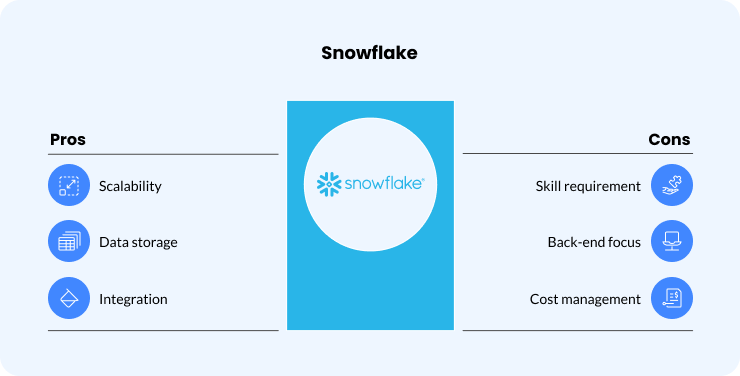
Snowflake delivers consistency and control for data-heavy operations. Its strength lies in managing scale without slowing performance and keeping analytics flexible across clouds.
Strengths
1. Scales across multiple cloud providers without complex reconfiguration.
2. Supports near-limitless data storage with strong governance.
3. Integrates easily with popular BI and machine learning tools.
Limitations
1. Requires specialized data skills to maintain and optimize.
2. Primarily supports back-end analytics, not front-line engagement.
3. Costs can rise with constant query workloads if not monitored closely.
Salesforce Data 360 (formerly Data Cloud)
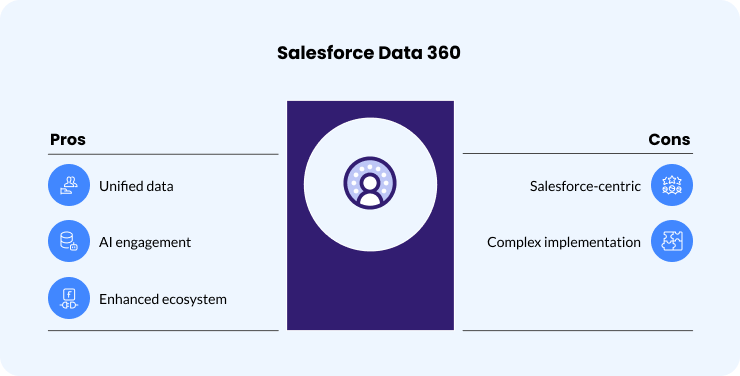
Salesforce Data 360 (formerly Data Cloud) is built for organizations that want to turn customer data into immediate action. Its strength lies in connecting data insights with real-time engagement across marketing, sales, and service.
Strengths
1. Unifies customer data from multiple systems into one live profile.
2. Automates engagement through AI-driven recommendations.
3. Enhances the Salesforce ecosystem by connecting every customer touchpoint.
Limitations
1. Designed mainly for Salesforce users; standalone value is limited.
2. Implementation and governance require careful planning.
3. Higher upfront cost compared to data storage-focused platforms.
Takeaway
Snowflake gives organizations depth in analytics. Salesforce Data 360 (formerly Data Cloud) brings data closer to customers. When used together, they create a full-circle approach: Snowflake refines data into insight, and Data 360 turns insight into engagement.
Which Businesses Should Choose Snowflake or Salesforce Data Cloud?
Choosing between Snowflake and Salesforce Data 360 (formerly Data Cloud) depends on what your business wants from its data. Some organizations prioritize deep analytics, while others focus on customer engagement. Both platforms are strong, but they serve very different needs.
Snowflake is best for:
1. Enterprises that prioritize large-scale data storage and analytics.
2. Companies needing flexibility across multiple cloud providers.
3. Teams with dedicated data engineers and analysts.
Example: A global bank uses Snowflake to process millions of transactions daily and identify patterns that point to potential fraud.
Salesforce Data 360 (formerly Data Cloud) is best for:
1. Businesses already using Salesforce Sales, Service, or Marketing Cloud.
2. Teams focused on delivering personalized customer experiences.
3. Organizations investing in AI-driven insights to improve engagement.
Example: A retail brand uses Salesforce Data 360 (formerly Data Cloud) to connect purchase history, browsing data, and loyalty activity to deliver personalized product recommendations and promotions.
Using Both Together
For many enterprises, the strongest approach is combining the two. Snowflake handles deep analytics, while Salesforce Data 360 (formerly Data Cloud) turns those insights into action through personalized engagement.
Example: A telecom provider analyzes usage data in Snowflake and uses Zero Copy Integration to connect it securely with Salesforce Data 360 (formerly Data Cloud). This setup allows the team to trigger upgrade offers for customers who exceed certain usage thresholds, without duplicating or moving data between platforms.
Common Mistakes to Avoid
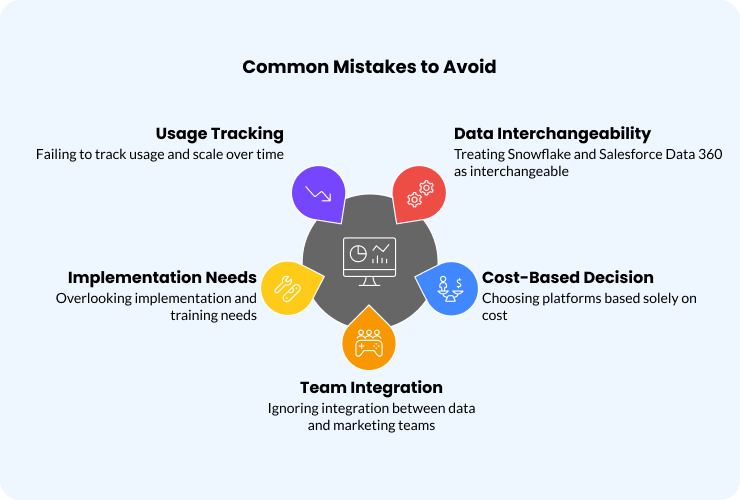
When evaluating Snowflake vs Salesforce Data Cloud, it’s easy to focus on features or pricing and overlook how each platform fits into your broader data strategy. Avoiding a few common mistakes can help your investment deliver lasting value.
1. Treating Snowflake and Salesforce Data 360 (formerly Data Cloud) as interchangeable
They both manage data but serve different goals. Snowflake powers analytics and reporting, while Salesforce Data Cloud drives customer engagement and activation.
2. Choosing based on cost alone
Snowflake’s pay-as-you-go model can appear flexible, and Salesforce Data 360 (formerly Data Cloud)’s licensing can seem high at first glance. The question to ask is which platform aligns with your long-term data goals and growth plans.
3. Ignoring integration between teams
Data teams may prefer Snowflake, while marketing and sales teams rely on Salesforce. Without coordination, insights stay siloed and personalization opportunities are lost.
4. Overlooking implementation and training needs
Both platforms require planning and skilled setup. Investing in user enablement ensures your team can apply the technology effectively from day one.
5. Failing to track usage and scale over time
As data volumes expand, costs and performance demands increase. Ongoing monitoring keeps both systems efficient and sustainable.
Conclusion: Snowflake vs Salesforce Data Cloud
As organizations scale, their data often tells two stories: one about understanding patterns and another about connecting with people. Snowflake and Salesforce Data 360 (formerly Data Cloud) approach these stories from different angles, yet both aim to turn data into something more useful.
Snowflake helps businesses uncover insights from large and complex datasets. It gives analysts and engineers the clarity they need to make confident decisions. Salesforce Data 360 (formerly Data Cloud) brings that understanding closer to the customer, helping teams personalize engagement and respond with relevance when it matters most.
Many organizations now use both platforms together. Snowflake provides the analytics depth, while Salesforce Data 360 (formerly Data Cloud) transforms those insights into timely, meaningful action. Together, they bridge the gap between information and impact.
Choosing between them is not just a technical decision. It is about aligning your strategy, your people, and the experiences you want to deliver. CUBE84 helps organizations find that alignment by designing data strategies that turn complexity into clarity and relationships into growth.