


Introduction: A New Type of Coworker Has Arrived
Salesforce AI agents are now being deployed across real Salesforce orgs, not as futuristic experiments but as practical digital coworkers. Gartner predicts that by 2026, more than 80 percent of enterprises will use AI agents in some form.
At Dreamforce 2025, Salesforce Agentforce is showcasing how these agents are stepping into the role of digital workers who act, respond to data, and collaborate across departments.
This marks a larger shift in AI innovation, known as Agentic AI. Traditional AI waits for you to ask a question. Agentic AI takes initiative, completes tasks, and works independently across workflows. Salesforce AI agents are among the most practical and trusted applications of this shift, since they are built directly into the platform where your customer data and workflows already live.
But this transition is not only about technology, but about the organization itself. The arrival of digital coworkers changes roles, responsibilities, and culture. This blog will help you:
- Understand what Salesforce AI agents are
- See how they fit into the concept of a digital workforce
- Learn the real requirements for adopting and scaling them responsibly
What Is a Digital Workforce and How Do Salesforce AI Agents Fit In?
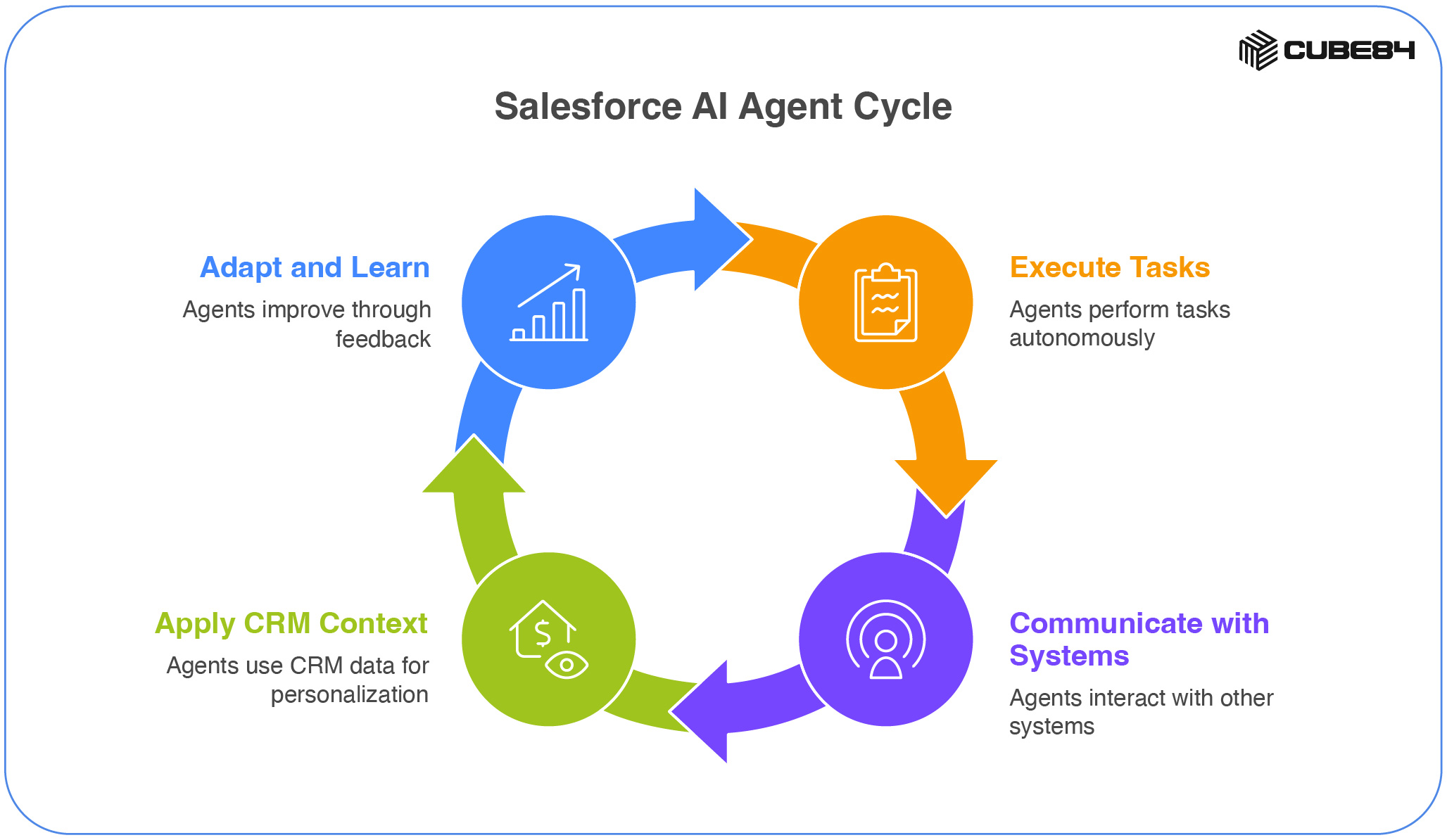
A digital workforce is a network of digital workers that carry out structured, repeatable tasks alongside your employees. These digital coworkers integrate with your systems, apply business rules, and complete work without constant human supervision.
Picture a customer service rep who spends hours tagging support tickets. A digital worker can categorize those tickets based on urgency, keywords, and history, freeing the human to focus on escalations. Or imagine a sales rep who wastes time updating opportunity notes. A Salesforce AI agent can summarize call transcripts and update records automatically, giving the rep more time for relationships.
Salesforce Agentforce is Salesforce’s official platform for deploying these digital workers. Built into Sales Cloud, Service Cloud, and Marketing Cloud, these agents can:
- Execute tasks instead of just suggesting them
- Communicate with other systems through MuleSoft, APEX, and APIs
- Apply CRM context from Data Cloud to personalize workflows
- Adapt through feedback, rules, and guardrails
This autonomy defines Agentic AI. Rather than waiting passively for prompts, Salesforce AI agents can act as collaborators, initiate work, and learn from outcomes.
The implication is clear: organizations must stop thinking of AI as “just automation” and start preparing to manage and collaborate with a digital workforce.
Why This Isn’t Just a Technology Change, It’s a Team Change
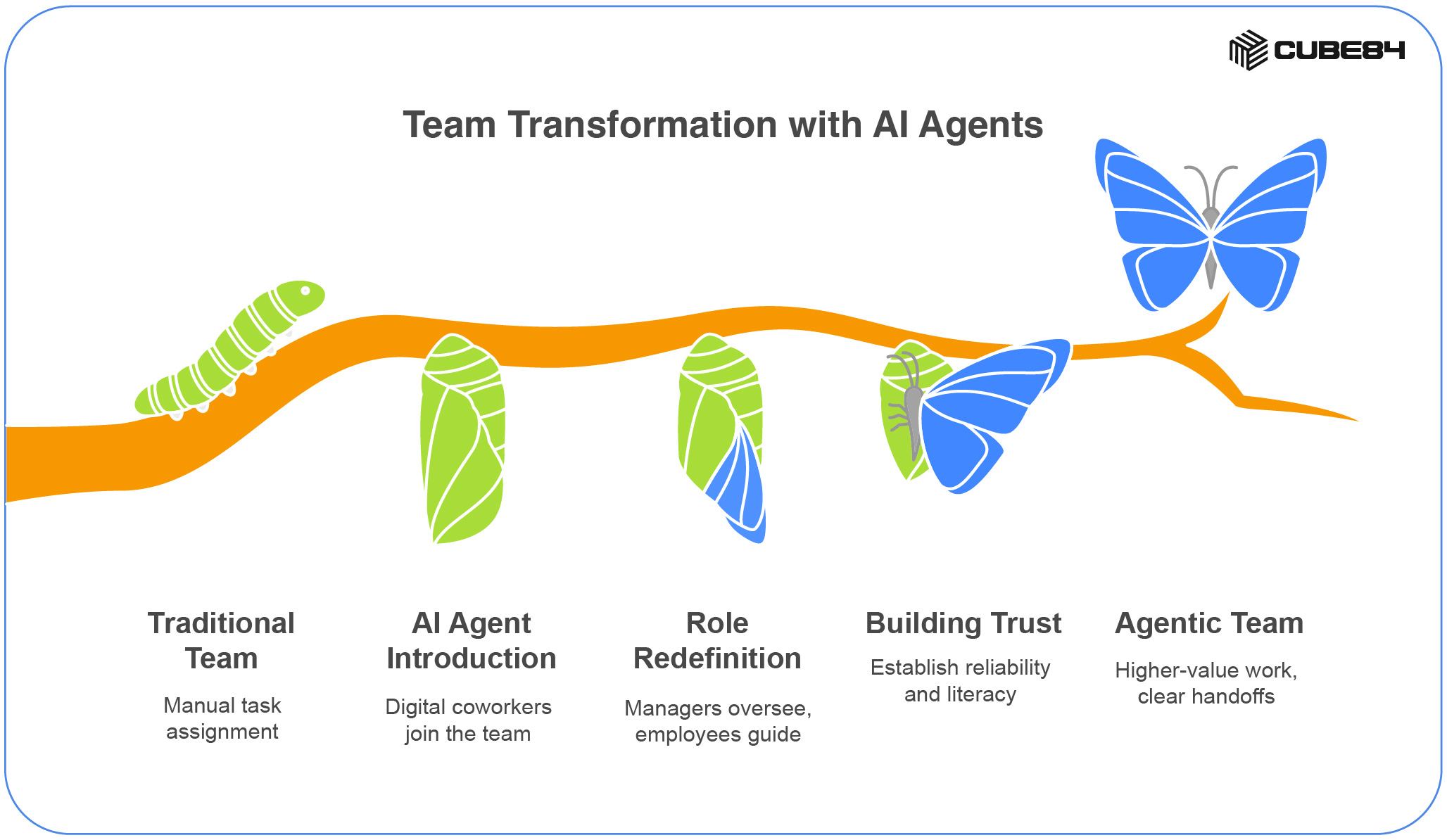
When Salesforce AI agents join your team, the impact goes beyond faster processes. It reshapes how people work. Employees are no longer simply “users” of a tool. They are colleagues of digital workers. Managers are no longer assigning every task. They are designing workflows where digital coworkers execute routine steps while humans provide oversight.
Take sales as an example. A manager who once manually assigned leads now supervises an agent that routes leads automatically based on engagement. The manager’s role shifts from clicking through assignments to refining business logic and coaching the team.
The work becomes higher-value, but it requires trust in the digital worker.
To succeed, organizations must intentionally build:
- Trust in automation so employees see agents as reliable partners
- Agent literacy, the ability to guide, prompt, and monitor AI coworkers
- Clear handoff workflows so humans and agents know when responsibility shifts
This is as much a cultural change as a technical one. With Agentic AI, you are not just equipping teams with smarter tools. You are introducing coworkers that act with purpose. That requires new ways of working, supported by leadership and reinforced through communication.
5 Things You Need Before Deploying Salesforce AI Agents
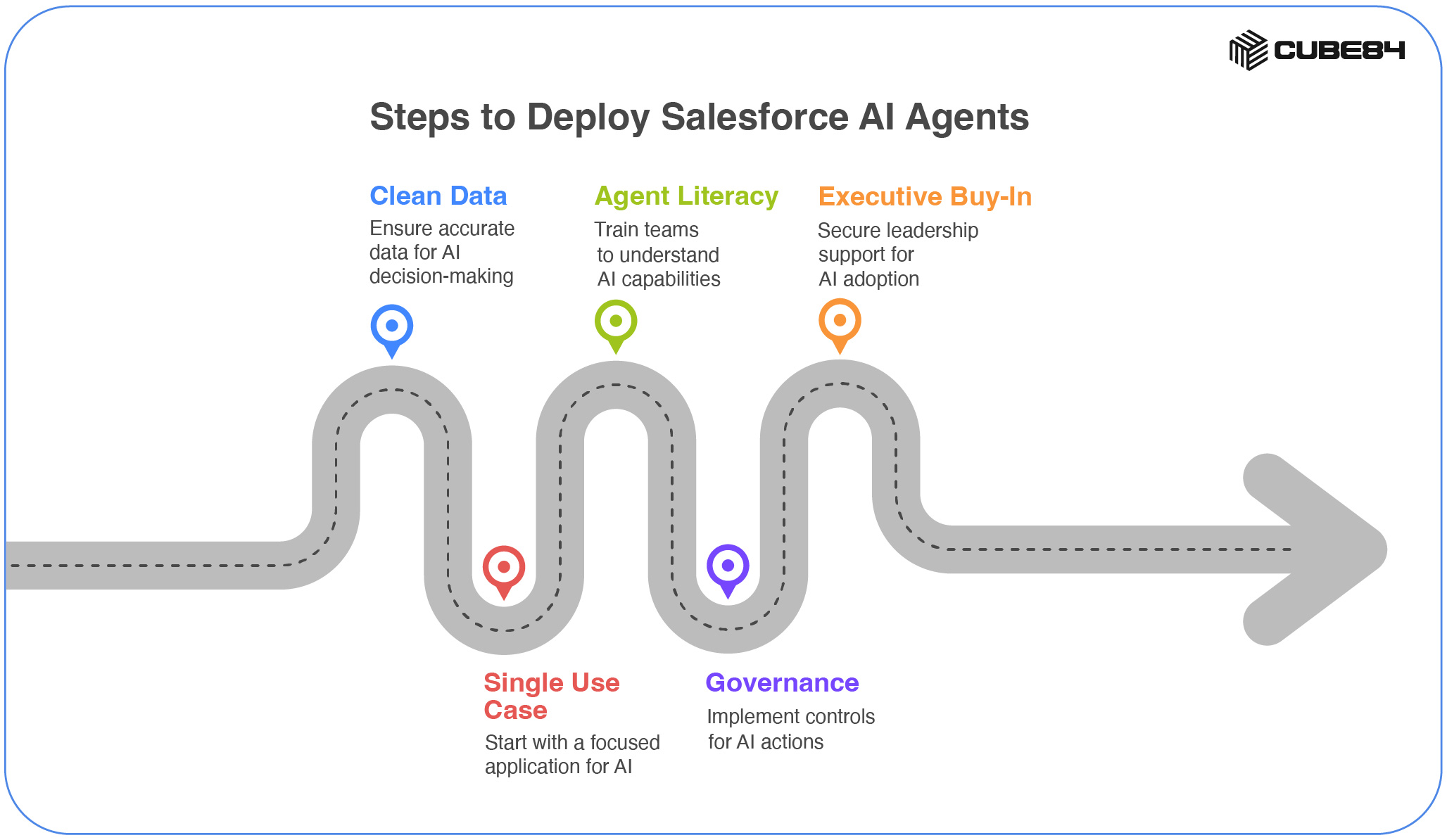
1. Clean, Connected Data
Salesforce AI agents depend on accurate data. Without clean inputs, digital workers make poor decisions. Conduct data quality audits, integrate connected systems, and remove duplication. A duplicate customer record can cause an agent to misdirect outreach or log activity incorrectly.
2. A Single, Measurable Use Case
Do not attempt to deploy agents everywhere at once. Start with a single use case such as auto-tagging support cases or sending post-demo follow-ups. For example, an SDR team can rely on a Salesforce AI agent to identify leads with high scores and draft emails, leaving reps to personalize and send.
3. Agent-Literate Team Members
Training matters. Teams must understand how agents make decisions and where their limits lie. Create playbooks that show how to prompt agents, review outputs, and provide feedback. This builds confidence and prevents misuse.
4. Guardrails, Monitoring, and Governance
Digital coworkers must be managed like real employees. Put in place approvals, escalation paths, and activity logs. A finance agent, for instance, should never finalize a discount beyond a set threshold without human review. These boundaries build trust and keep adoption safe.
5. Executive Buy-In and Champions
Adoption only succeeds with leadership support. Assign champions, explain clearly what agents will and will not do, and set expectations early. A VP introducing the first Salesforce AI agent to their team creates confidence and reduces anxiety.
What a Human + Digital Hybrid Team Looks Like
The future is all about machines working alongside humans, not merely replacing them. These are hybrid teams, where humans and digital workers each do what they do best. Humans bring empathy, strategy, and creativity. Salesforce AI agents bring execution, triaging, and scale.
[Read: Salesforce AI Agents: Sentience, Empathy, and the Future of Human-AI Collaboration]
Imagine a service interaction. A human support rep listens with empathy and calms the customer. Meanwhile, the agent drafts the reply, updates the CRM, and schedules the follow-up. The human handles the relationship. The agent handles the process. Together, they deliver both personal care and operational efficiency.
This hybrid model is the essence of working with a digital workforce. Success comes not from total automation but from smart collaboration.
What to Do If You’re Not Fully Ready
Not every business is ready to go live with Salesforce AI agents across the board. That does not mean you should wait.
Start with a Salesforce AI readiness checklist to spot your blockers. Choose one pilot use case. Run a two-week sandbox simulation. Monitor the results, retrain agents, and adjust processes before scaling.
The objective is to balance speed and responsible growth. Launch thoughtfully, learn quickly, and expand with confidence.
Conclusion: Your Digital Workforce Starts With One Smart Move
Salesforce AI agents are no longer a future concept. They are here today, improving sales, service, and marketing outcomes across industries. But adoption requires more than features. It requires:
- A mindset that embraces collaboration with digital coworkers
- Clean data and strong governance
- Teams trained to work confidently with AI
- Leadership that communicates clearly and sets expectations
Start with one use case. Build literacy. Trust the handoffs. Treat your agents as digital coworkers with defined roles and oversight. With that first smart move, you are not just adopting AI—you are building a digital workforce ready for the future.

