

The short version. Five of us worked an HMIS booth at the National Alliance to End Homelessness conference in July 2026 and talked with roughly 80 to 90 organizations over three days. Nine patterns recurred, across organizations of very different shapes: CoC members, HMIS leads, direct service providers, and locally funded government bodies that sit outside the CoC arrangement entirely. Eight of the nine describe the same distance from a different angle. The system of record is in one place and the daily work is somewhere else, and people have built something in the gap.
The most uncomfortable thing we learned is in the section on what we got wrong. Practitioners told us their participation agreements name them custodians of the data rather than owners. We assumed they had misread their own situation. Three of the four agreements we then read used that exact word. They knew. We did not.
How to read these numbers
Nobody wanders into an HMIS vendor's table by accident. Everyone who stopped already had an HMIS problem and had decided to spend ten minutes of a conference on it. This is a picture of that room, not a claim about the sector. Our notes from a state housing conference in March carry the same bias in smaller form.
The counts are distinct organizations, deduplicated across four sets of booth notes kept by Kiki Sundaramoorthy, Doug Heilbrun, Arvind Vasudevan, Sunil Jith S H, and Chrissy Thompson. We removed 12 duplicates we could identify and flagged 15 we could not resolve. Every figure below is CUBE84's own tally. There is no external source to check it against.
One methodological note belongs here rather than in a footnote. Our opening line in nearly every conversation was that data quality is the visitor's biggest problem. That is a leading question, and agreement with a claim we handed somebody is not evidence. It is why data quality is not one of the nine patterns below. The nine are what visitors raised first.
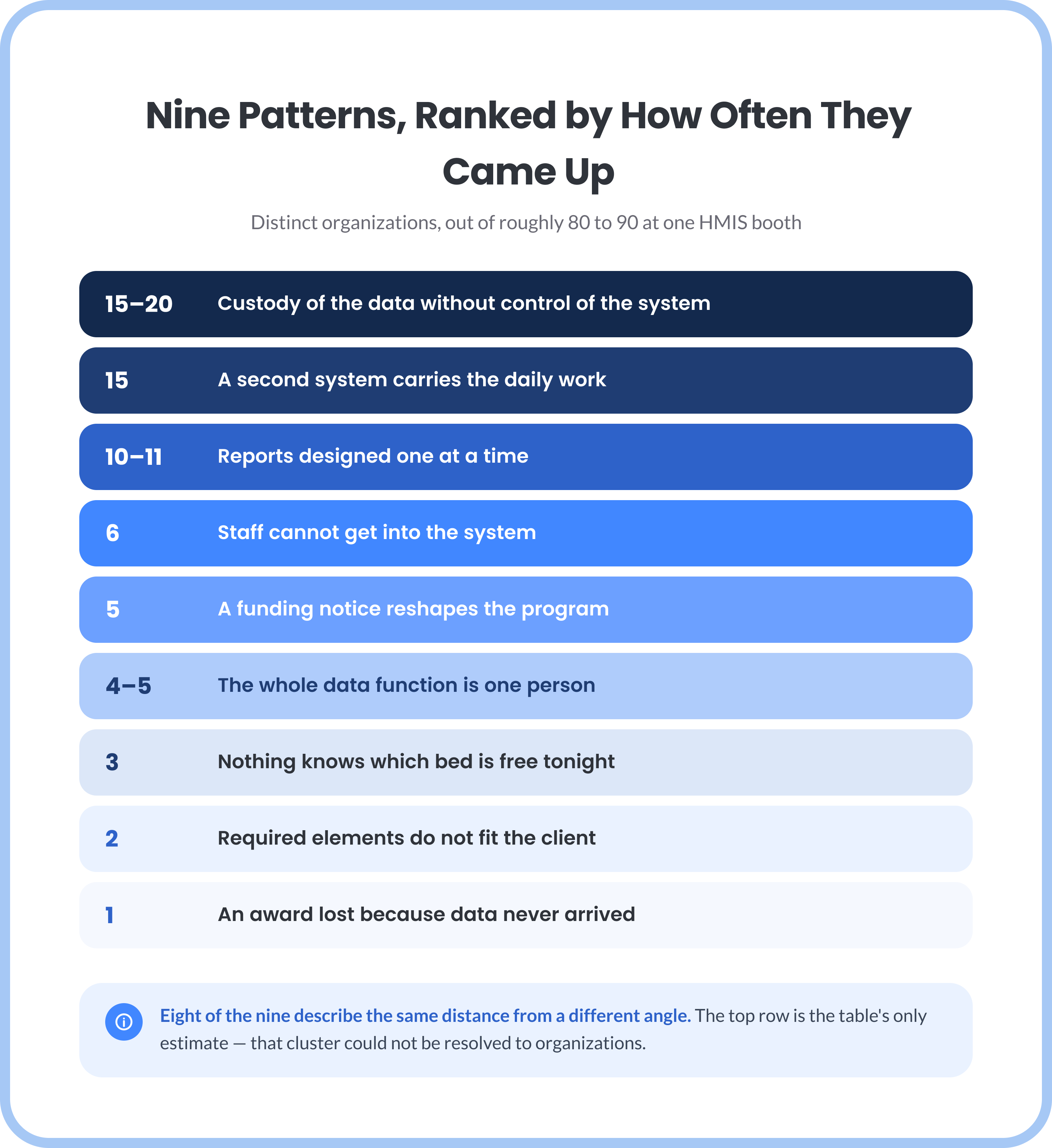
Counts are distinct organizations out of roughly 80 to 90. The first row is an estimate, and the only estimate in the table, because that cluster could not be resolved to organizations. Source: CUBE84's review of its own booth conversations, July 2026.
Custody without control, and the agreements say so
This was the largest cluster by raw count, which is why the table carries an estimate instead of a number. The same visitors appeared across several sets of notes and we could not resolve them all.
We are inputters. When it comes to exporting data we ask them for the report. We don't manage the data.
Another visitor said it shorter.
I don't get to choose. I'm just along for the ride.
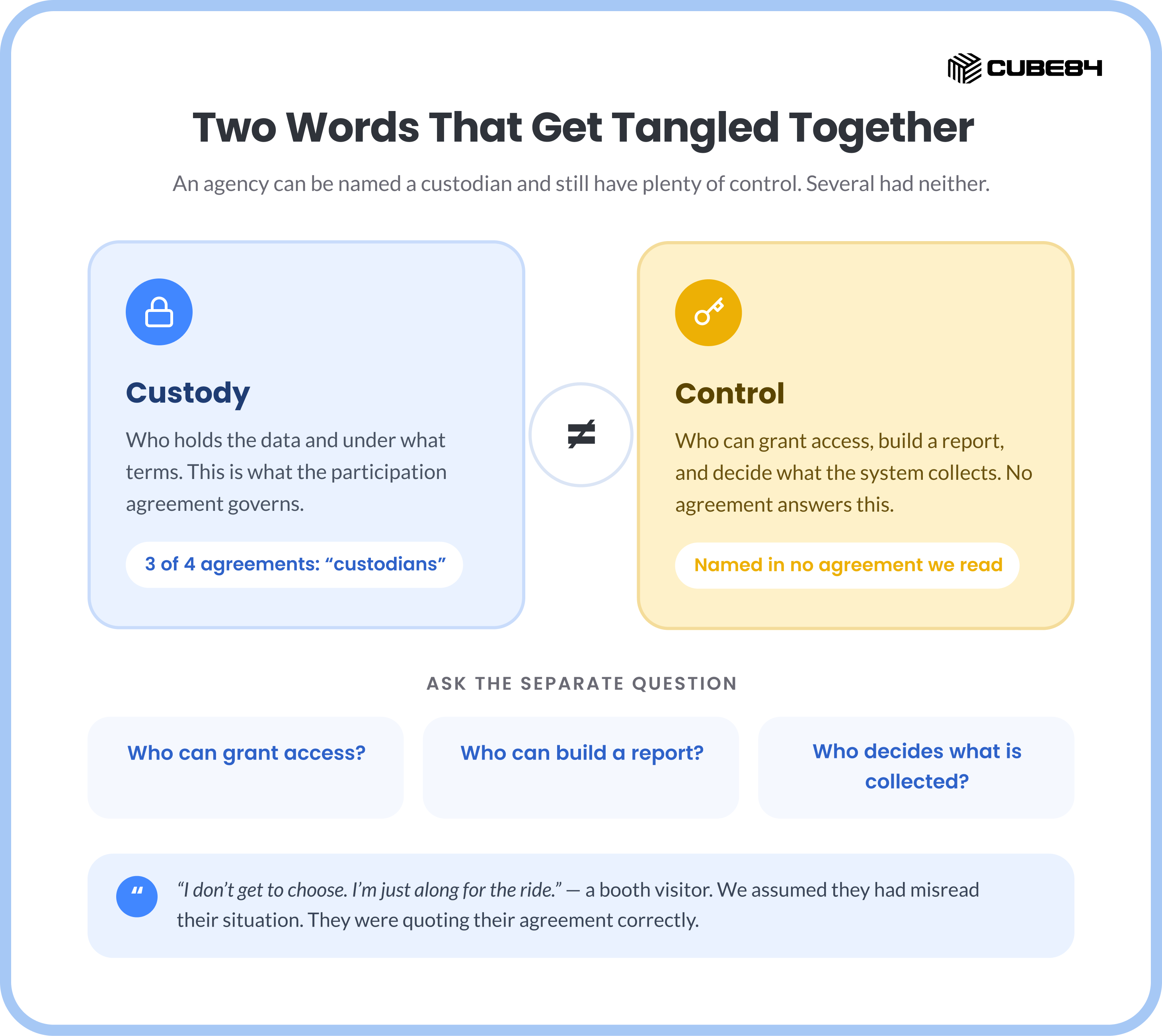
Two different things are tangled together here, and they are worth separating. The agreements govern custody: who holds the data and under what terms. What practitioners described is control: who can grant access, who can build a report, who decides what the system collects and how it is configured. The two are related, and they are not the same. An agency can be named a custodian and still have plenty of control. Several of the ones we spoke with had neither.
We assumed these visitors had misread their own situation. Then we read four participation agreements of the kind that governs this arrangement, and three describe participating agencies as custodians of the data rather than owners, in that word. They were quoting their agreements correctly.
You do not have to take our four. The agreement that matters to you is your own, and the word is in it.
This does not explain the other eight patterns, and we are not going to claim it does. Two of the organizations we spoke with were locally funded government bodies working beside the CoC with their own money and their own systems. "The CoC is working with federal funds. We work with local funds." One direct service provider had built its own coordinated entry product and could not deploy it past its own agency. Neither of those is a custody story, and both described the same distance between the system and the work. Custody without control is one route into that gap. It is not the only one.
Where the daily work actually sits
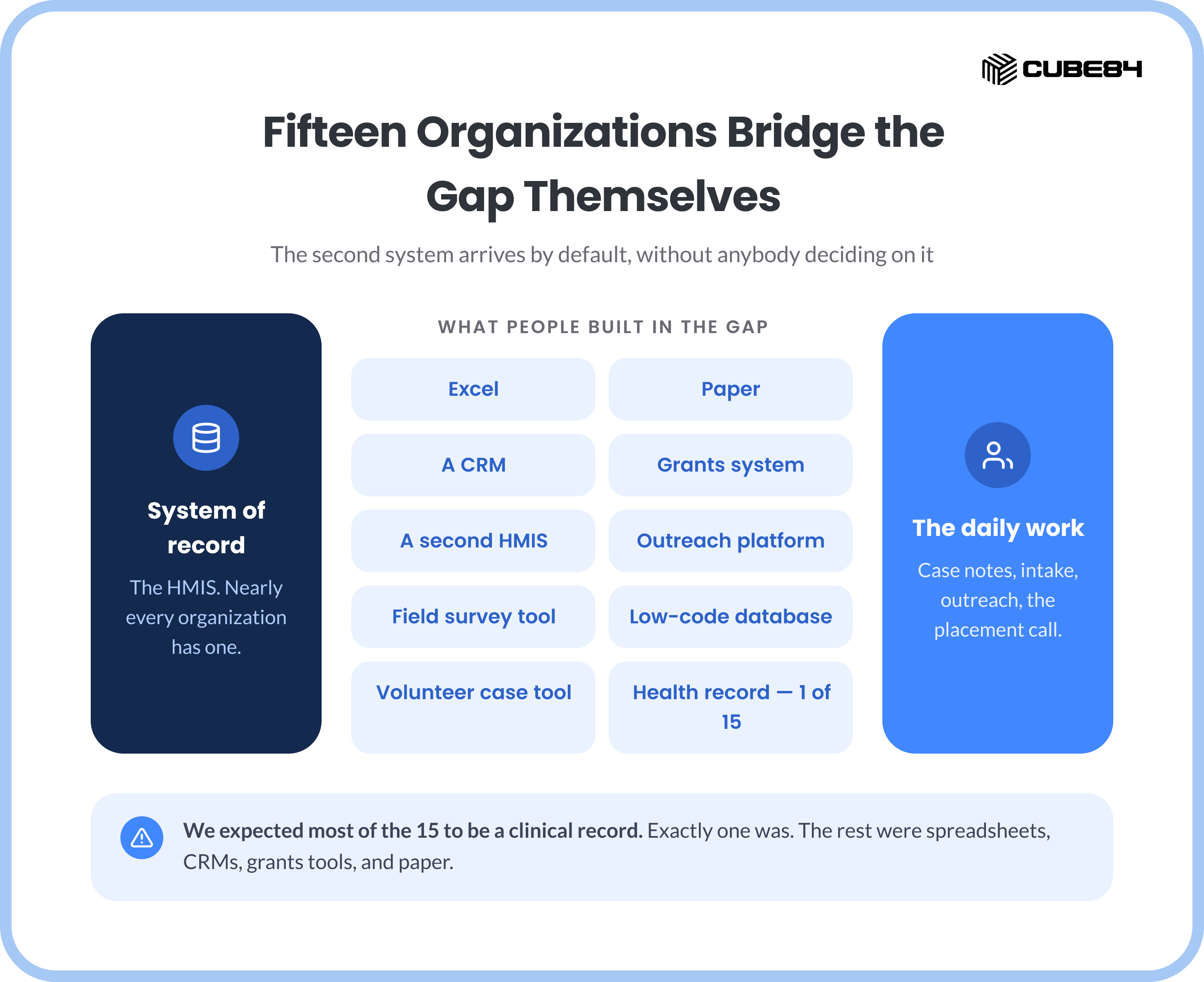
A second system carries it. Fifteen organizations.
I'm entering an HMIS, I'm entering an Airtable. It's a whole thing.
The second system arrives by default, without anybody deciding on it. The ones named: a CRM, a separate state HMIS instance, a grants system, a volunteer case management tool, an outreach platform, a field survey tool, a low-code database, paper, and Excel. Exactly one of the 15 was an electronic health record. We expected that number to be most of them.
Getting my staff up to that has been a challenge, to where they just say, you know what, I'll just put it in an Excel spreadsheet. And I'm just like, why am I paying all this money for it?
Somebody else needed nine words.
All we have is spreadsheets. That's all we have.
Every report is designed from scratch. Ten to eleven organizations.
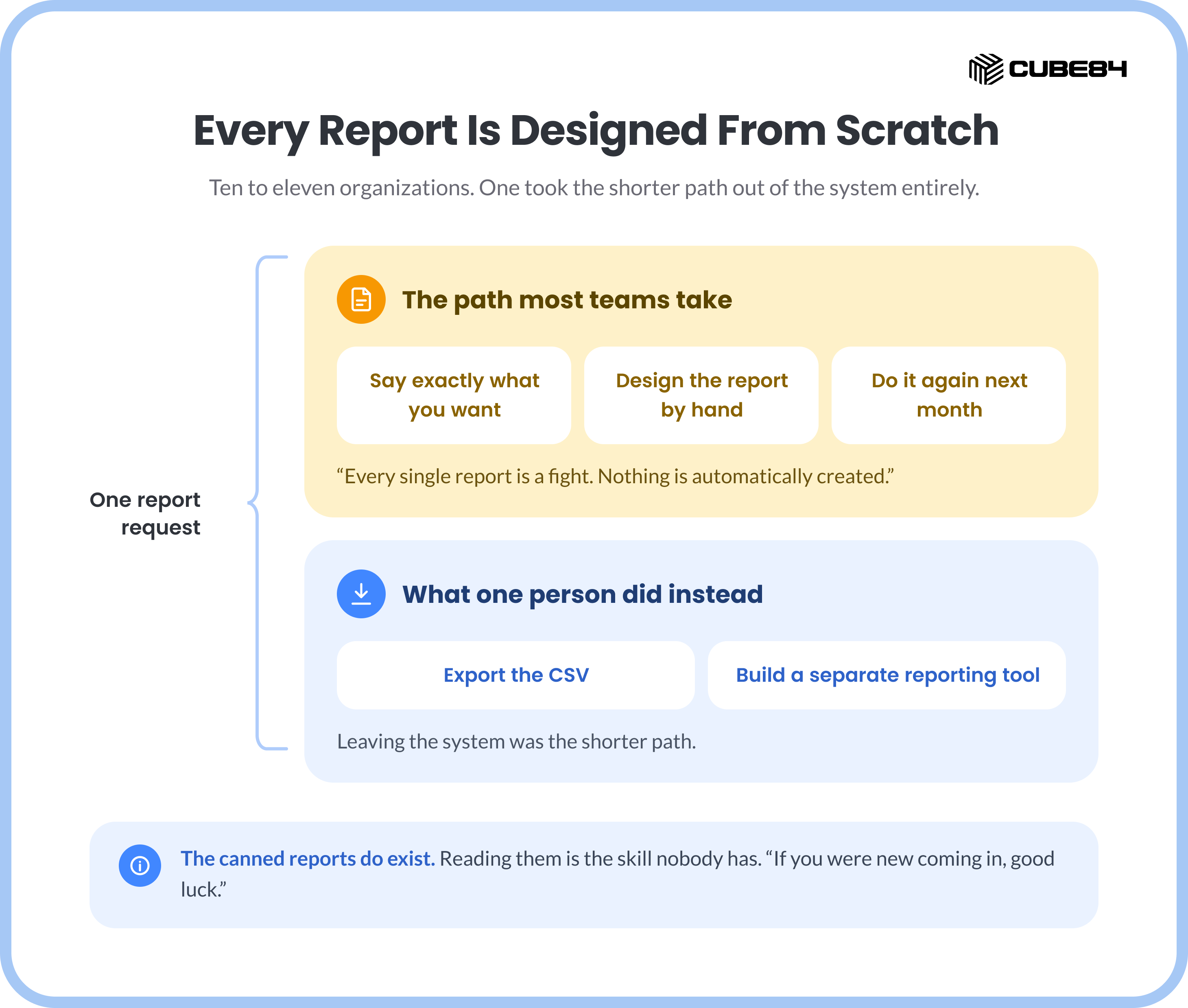
Every single report is a fight. Nothing is automatically created. You have to say, this is what I want, and then you go in there and you actually design it.
The canned reports do exist. Reading them is the skill nobody has.
You have to really know the system to understand what some of these basic canned reports are. I've been in it at least eight years now, so I know it. But if you were new coming in, good luck.
One person exported the CSV and built a separate reporting tool, because that was the shorter path.
Nothing in the system knows whether tonight's free bed is a bottom bunk. Three organizations.
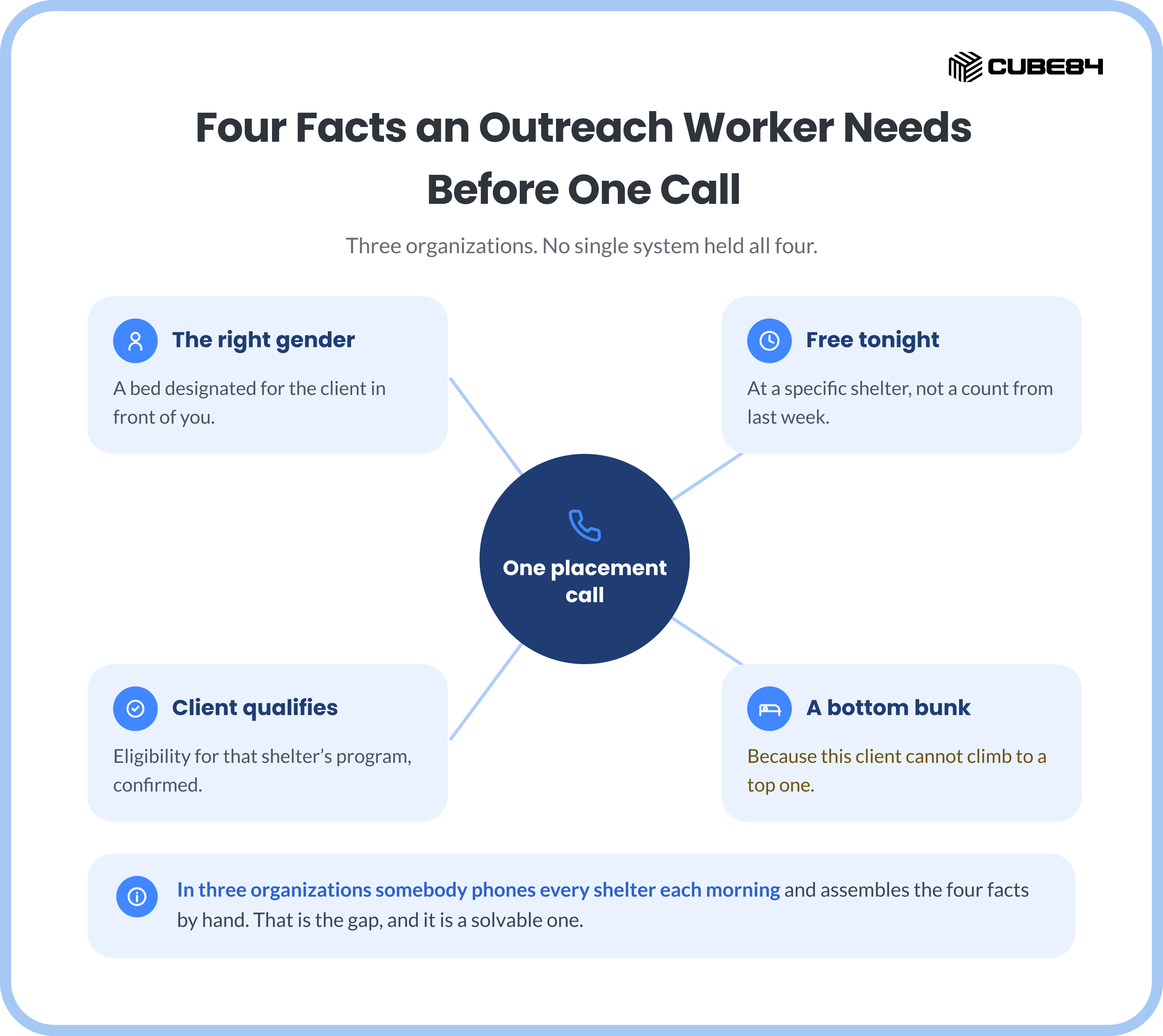
The sharpest version of this came from somebody listing what a street outreach worker has to establish before making one phone call. A bed of the right gender. At a specific shelter. Free tonight. In a shelter the client qualifies for, on the bottom bunk, because the client cannot climb to a top one.
No system held all four facts. In three organizations somebody phones every shelter each morning and assembles them.
Every morning we have to call every shelter to say, what is your bed inventory, because HMIS does not track in real time available bed inventory.
The by-name list has the same hole from the other side. A client entering rapid rehousing falls out of coordinated entry, which drops them off the by-name list, so "we have another list we have to have, and it's manually kept." We traced that gap through the federal requirements in what HUD's coordinated entry standards require and where the work falls through.
Staff cannot get in, and the blocker is never the price. Six organizations.
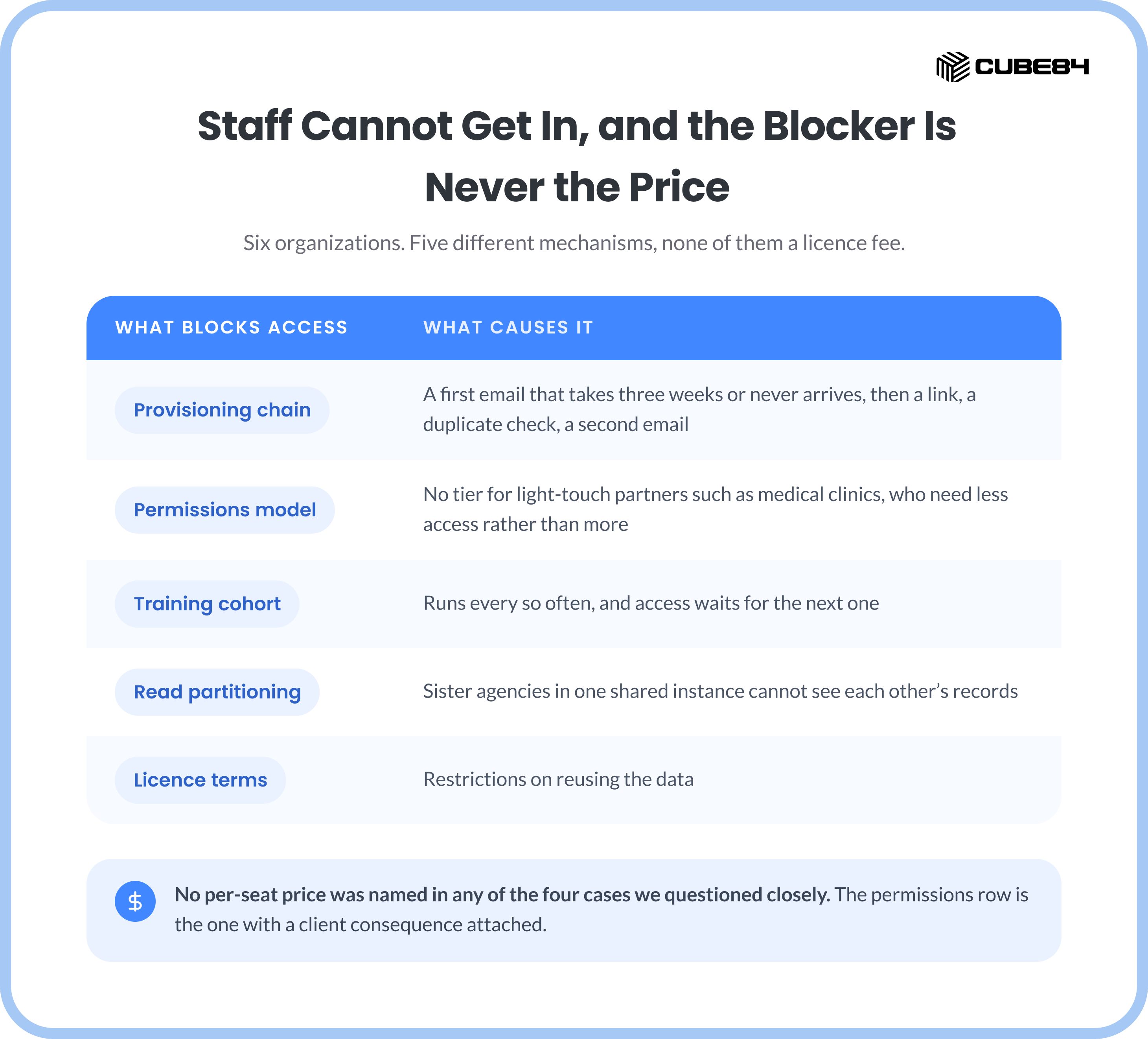
We questioned four of these organizations closely on cost. Not one named a per-seat price, and two named something that rules cost out. One HMIS administrator put the whole list down to layered federal, state, and city requirements. The best case on the provisioning chain was "getting access to the system in under a month."
The permissions gap is the one with a client consequence attached.
They don't necessarily need access to the full spectrum of clients that live in HMIS. But we don't have a way to plug them into the system.
The whole data function is one person. Four to five organizations.
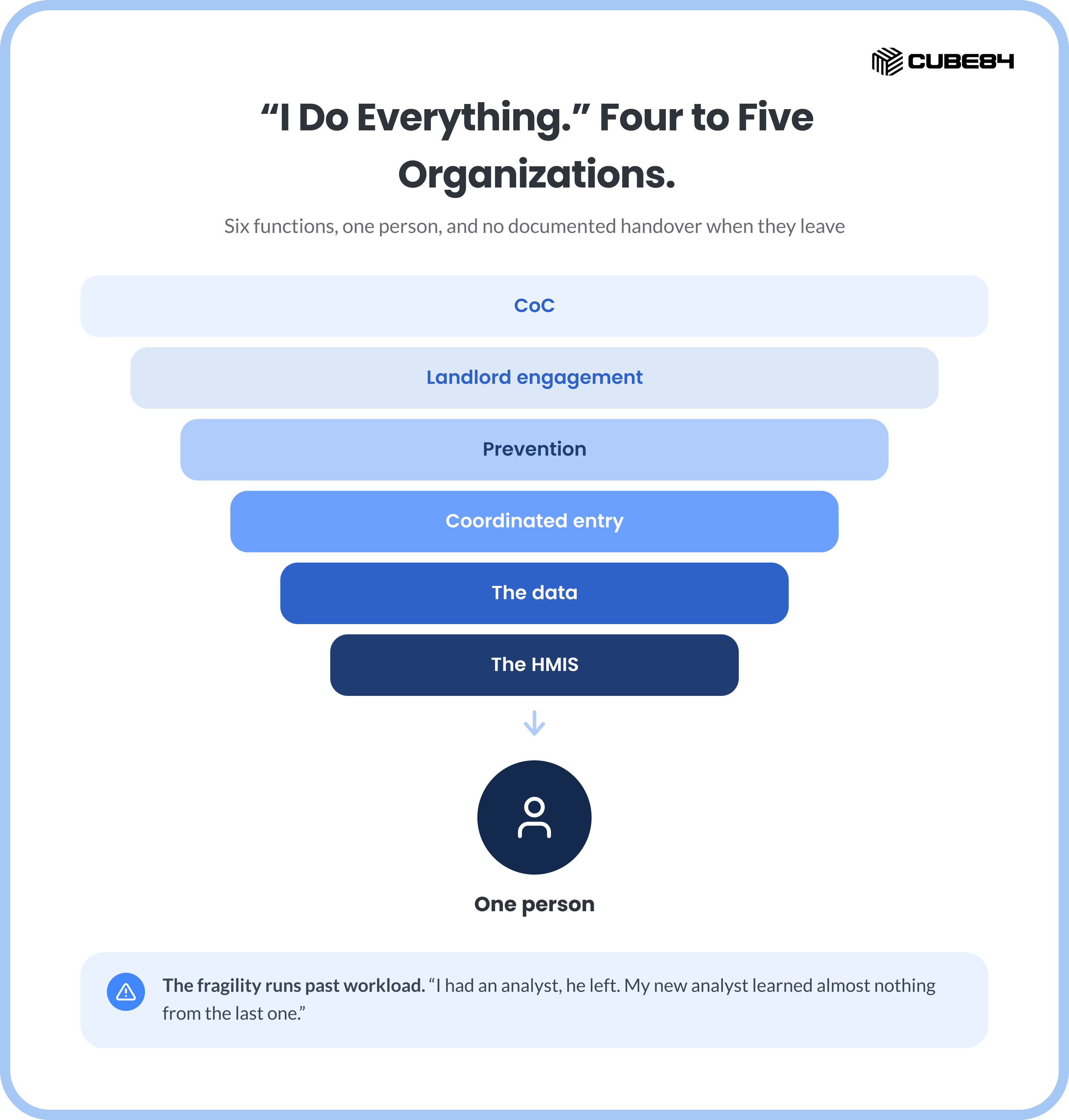
I do everything. I do the HMIS, the data, coordinated entry, prevention, landlord engagement, CoC. I do everything.
The fragility runs past workload into what walks out the door when somebody leaves. "I had an analyst, he left. My new analyst, she learned almost nothing from the last one. So now I have to hold her hand."
Where the distance reaches the client, not just the report
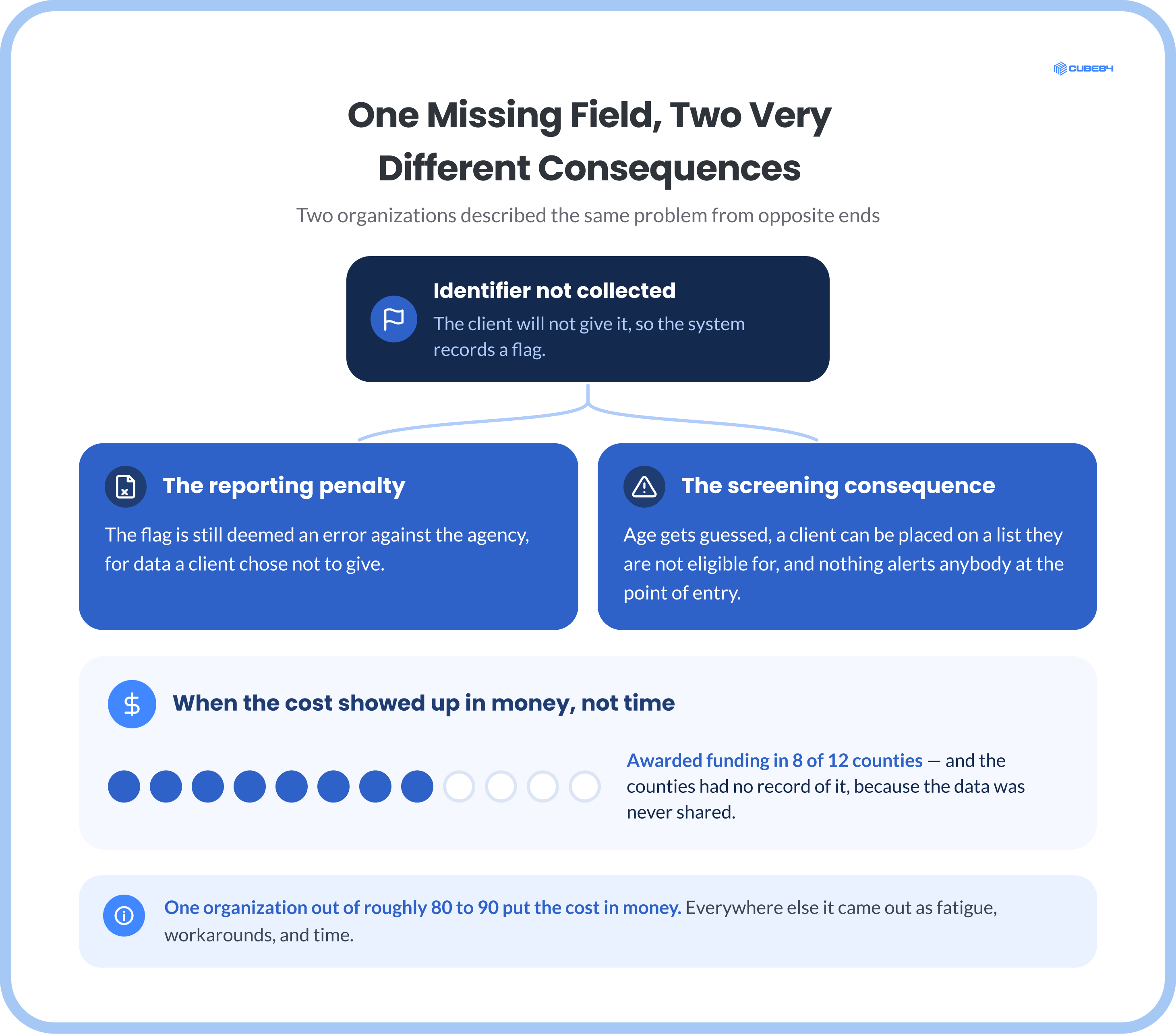
Two organizations described the required data elements not fitting the person in front of them, from opposite ends of the problem.
With our unhoused citizens, they're not going to give you their identifier. So it's just not going to be collected, it's going to be a flag. And they still deem it an error.
That is the reporting penalty. The screening consequence is the more serious one. "We're having to guess their age. Not everyone is cookie cutter." A client with a missing identifier can be placed onto a subsidized housing list they are not eligible for, and nothing alerts anybody at the point of entry.
One organization put the cost of a broken data path in money rather than in time.
We lost a lot of money because of that. The data was supposed to still be shared, and it wasn't. Out of twelve counties we were awarded funding for eight, and they had no record. So I don't know if we're going to even get that funding again.
One organization out of roughly 80 to 90. Everywhere else the cost came out as fatigue, workarounds, and time, which is harder to put in a budget line and easier to live with for another year.
One of the nine does not fit
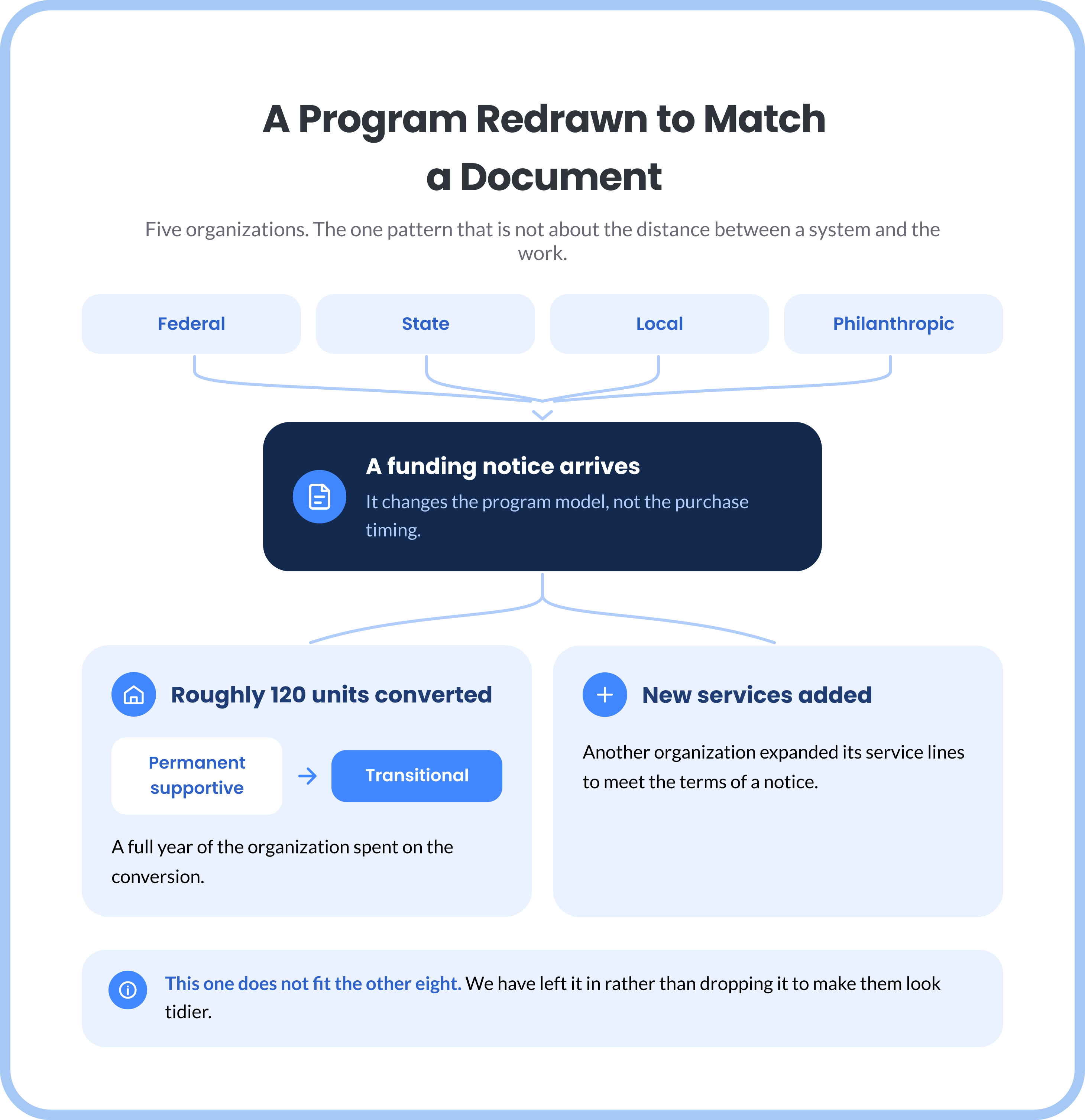
Five organizations described a funding notice changing the program model rather than the purchase timing. One is moving roughly 120 units of permanent supportive housing into transitional programs and spending the year on that conversion. Another is expanding into new services to meet a notice. That has nothing to do with the distance between a system and the work. It is a program redrawn to match a document, and the mix of federal, state, local, and philanthropic funders these programs draw on means the document can arrive from several directions at once.
We have left it in rather than dropping it to make the other eight look tidier.
Four things we walked in believing that the conversations disproved
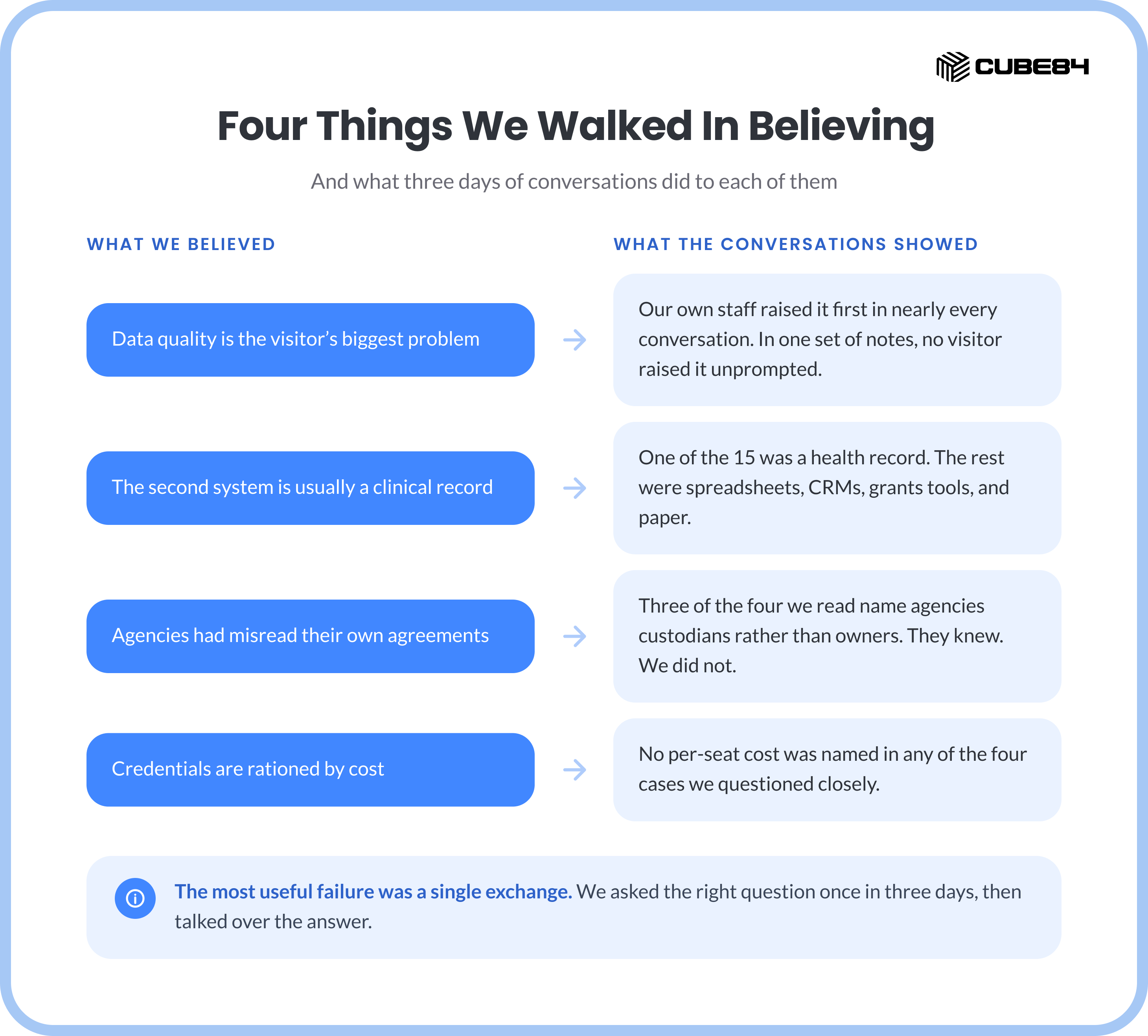
The most useful failure was a single exchange. One of us asked a social worker why she could not see her sister agencies' records, which is the exact question that would have explained the constraint, then pivoted to a demo invitation in the same breath. She never answered. We asked the right question once in three days and talked over the answer.
One conversation is missing from our notes entirely. We know because one of our own people said so.
What a CoC or agency lead can do with this on Monday
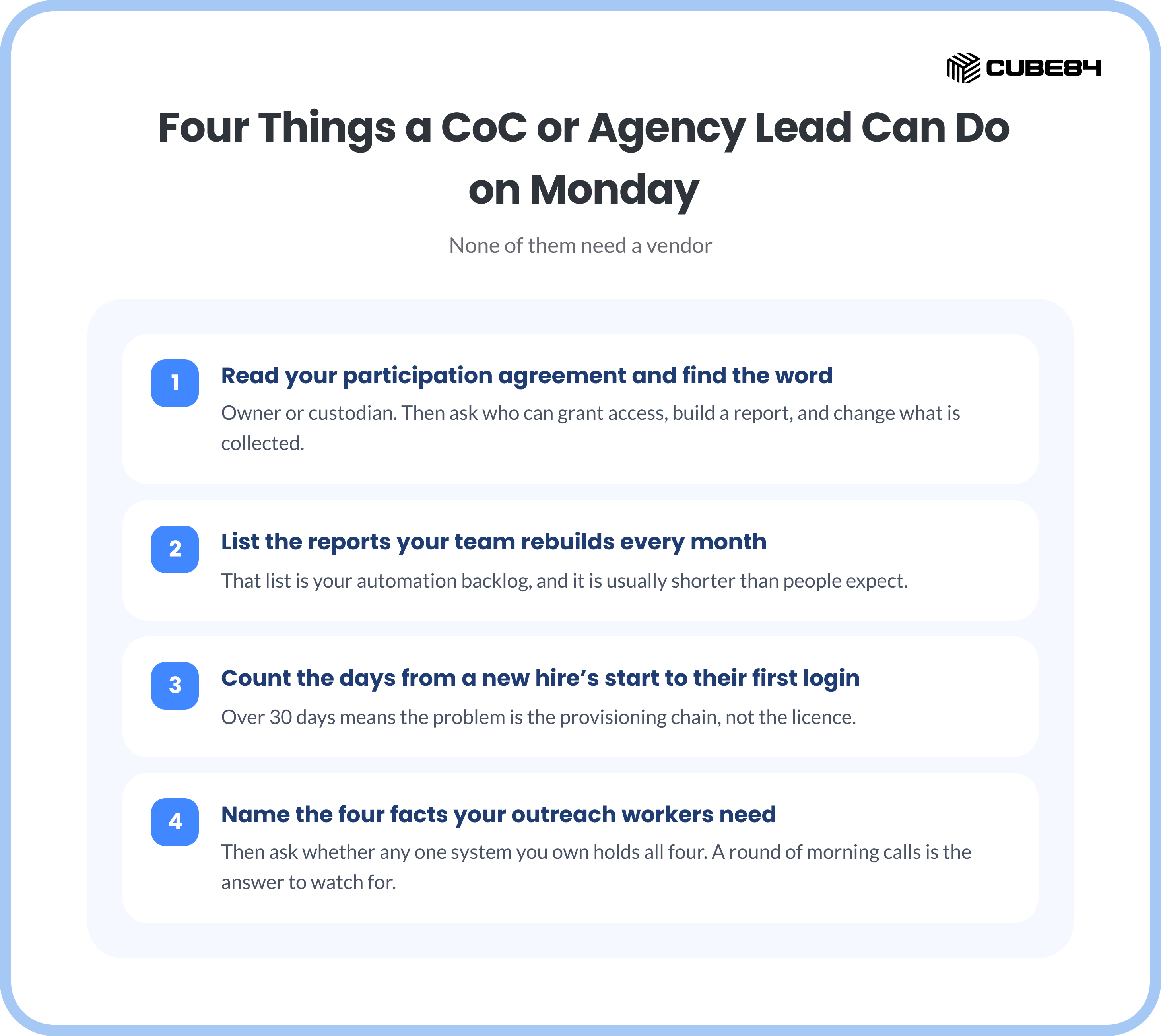
Four things, none of which need a vendor.
Read your participation agreement and find the word. Owner or custodian. Then ask the separate question the agreement does not answer: who can grant access, build a report, and change what the system collects.
List the reports your team rebuilds every month. That list is your automation backlog, and it is usually shorter than people expect.
Count the days from a new hire's start date to their first HMIS login. Over 30 days means the problem is the provisioning chain, not the license.
Name the four facts your outreach workers need before a placement call, then ask whether any one system you own holds all four. If the answer is a round of phone calls every morning, that is the gap, and it is a solvable one.
The question the booth left us with
Three days of these conversations did not leave us asking whether an organization has an HMIS. Nearly every one of them does. It left us with a narrower and harder question: can the person sitting with a client get the information they need, at the moment they need it?
In this room, mostly not. What filled the gap was a second system, a spreadsheet, a reporting tool somebody built themselves, or a round of phone calls before the day starts. None of those are failures of the people doing them. They are what capable people build when the system of record and the work have drifted apart, and every one of them is a description of what the system was supposed to do.