


alumni activated
their profiles
of the Hamilton alumni
community activated
for registrations to reach that
level after the welcome email
How do you turn a disconnected alumni base back into an engaged community?
Hamilton College has one of the most philanthropically active alumni communities in American higher education. Its alumni giving rate sits in the top 1% of all U.S. colleges and universities, and its per-student endowment is among the largest in the liberal arts category. Yet the digital front door to that community, the alumni portal, did not reflect the community the College wanted to support.
Navigation was difficult. Simple actions took too many steps. Alumni had no easy way to find or reconnect with each other, no easy way to edit or manage a profile, no granular privacy or communication controls, and no native mobile experience. Alumni felt disconnected from a community they valued, and advancement teams had minimal insight into alumni activity or donor interest.
Hamilton's team believed that alumni relationships grow when the experience feels effortless, and that modern engagement starts with a platform people actually want to return to. The objective was clear, create a modern, easy-to-use alumni portal, increase alumni engagement, and strengthen advancement and donor relationships.
The stakes were higher than a typical portal refresh. Hamilton's pilot group included advancement board members and trustees, many of them CXOs of some of the world's largest companies, a community with high expectations for what a modern digital experience should look and feel like, and the influence to shape whether the new platform would truly be embraced.
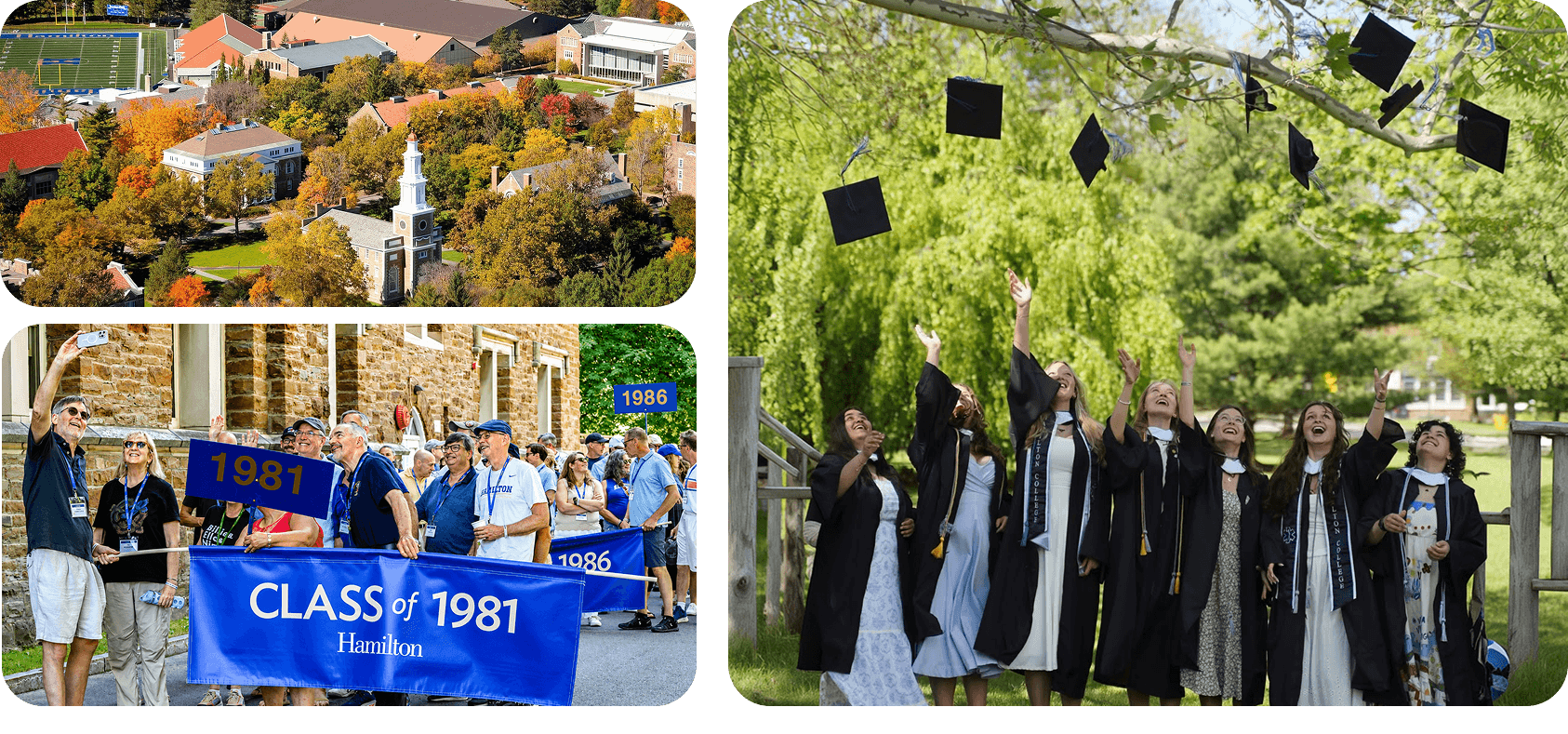
A phased Salesforce Experience Cloud rollout, from core portal to native mobile app on Salesforce Mobile Publisher.
CUBE84 implemented Salesforce Experience Cloud as the foundation for The Hamilton Quad (HQ), the College's next-generation alumni portal built for a community of more than 21,000 alumni. The solution draws directly from Hamilton's existing Salesforce ecosystem, including the Constituent record and the gift, campaign, and endowed fund data managed in Kindsight Ascend, alongside academic history and association records. The original roadmap called for a deliberate, three-phase rollout, built browser-first, so new features could be introduced methodically rather than all at once.
The team began with the core user experience, a refreshed profile system bringing service history, teams, associations, and giving history from Ascend into one place. A new directory introduced simple search, fast filtering, and clean layouts that let alumni search without friction, and a dedicated donation view gave users a clear summary of their contributions.
From the outset, CUBE84 treated the pilot group not as testers but as co-designers. Feedback was gathered continuously and consolidated into concrete decisions about what the best experience should look like for each feature. The directory, for instance, went through several rounds of optimization directly in response to what pilot users said was and wasn't working. Some changes were incorporated on the very last day before launch, based on input from the Hamilton team, because the team was committed to giving alumni the best possible experience from day one, not just a functional one.
That same feedback loop reshaped the entire product. Strong, unambiguous feedback came back from the alumni pilot group, many of them CXOs at some of the world's largest companies with little patience for a mobile web experience that felt like an afterthought. A true native mobile application was not a nice-to-have. It was a requirement.
In a short span, CUBE84 turned that feedback into a new product roadmap, a revised vision for the platform, a recommendation on which features to prioritize, and a proposed technology stack to make a native mobile experience possible within the existing engagement. When CUBE84 presented that vision to Hamilton's advancement board and trustees, many of them CXOs helping shape the future of the community they had already given so much to, the response was strong appreciation and buy-in for a bolder direction than anyone had originally scoped.
Winning that buy-in took its own effort. Delivering on it was the next challenge.
Salesforce Mobile Publisher was the deliberate choice to bring HQ to iOS and Android. It kept the entire alumni experience, browser and mobile, on a single Salesforce foundation, one data model, one identity layer, and one place to govern the Salesforce Constituent record. Hamilton's advancement team would never have to reconcile two versions of an alumnus, and every downstream investment in AI and personalization would build on that same foundation.
With the timeline unchanged, CUBE84 built the remaining web features and stood up the native mobile applications at the same time, not in sequence. That meant tight, continuous coordination across CUBE84, Hamilton, Salesforce, and the iOS and Android build tracks, all moving in parallel toward a single launch date. The team delivered every planned feature and the native mobile application on schedule, earning a high approval rating from the pilot group that had pushed for the pivot in the first place.
Across all three phases, Hamilton's team showed up as full partners in the build. John Nannas, Hamilton's Executive Director of Advancement Information Services and Business Intelligence, championed the project and its vision from the first conversation through every pivot. Alongside him, the College's advancement, technology, and communications teams brought the domain knowledge, decision-making authority, and hands-on commitment that made the mobile pivot and the compressed parallel build possible. What could have been a vendor engagement was, from day one, a joint effort between two teams that owned the outcome equally.

Executive Director of Advancement Information Services and Business Intelligence
Hamilton alumni responded in two days.
The response was almost immediate. Within two days of the welcome email hitting inboxes, more than 21,500 alumni had activated their profiles, close to 99% of the entire Hamilton community, responding to the clean layout, intuitive navigation, and the sheer simplicity of searching for and reconnecting with fellow alumni. The College also saw early positive indicators of user activity within the portal, encouraging Hamilton to explore how it can further enhance the experience going forward.
Much of that impact shows up in what alumni no longer have to ask someone else to do for them. Giving history, communication preferences, volunteer sign-ups, and affinity and team records now live inside HQ, all self-service, in place of the scattered emails, phone calls, and manual look-ups that used to stand in. Alumni can now form their own groups simply, and connect around the affinities that matter to them.
Milton, the AI-powered chatbot, extends that ethos. It answers alumni questions from a curated set of Ascend knowledge articles, and when it can't answer, or senses frustration, it automatically creates a case in Ascend and routes it to the right advancement team member. Every chat session is stored against the alumnus's Salesforce Constituent record, giving the team a running history of what each alumnus has asked about.
The advancement team no longer fields routine requests for information alumni can now access themselves. The College has a more current, alumni-maintained record of its own community than ever before, along with a clearer view of alumni activity and early signs of renewed donor interest. Proof that engagement grows when the experience is simple.
Deeper AI personalization, moving HQ from a place alumni visit to a place that knows them.
Milton is being extended from answering questions to proactively suggesting events, giving opportunities, and volunteer roles based on each alumnus's history. Forms will pre-fill from the Salesforce Constituent record and complete themselves in a tap. Content and outreach are being tuned to the individual, not the segment. Kindsight Ascend and Salesforce continue to serve as the unified source of truth that makes AI personalization credible in the first place.
Let's Talk About What We Learned At Hamilton.
Get in touch