
The Reality Most Nonprofits Discover Too Late
Imagine walking into a premium hardware store and the manager hands you the keys to a top-tier, industrial-grade toolkit at no cost. It feels like a big win. You take it home, open the neatly packed box, and then a simple but important reality sets in. The tools are excellent, but they do not build the house for you. You still need a clear plan, the right materials, and either the skills to do the work yourself or the budget to bring in someone who can.
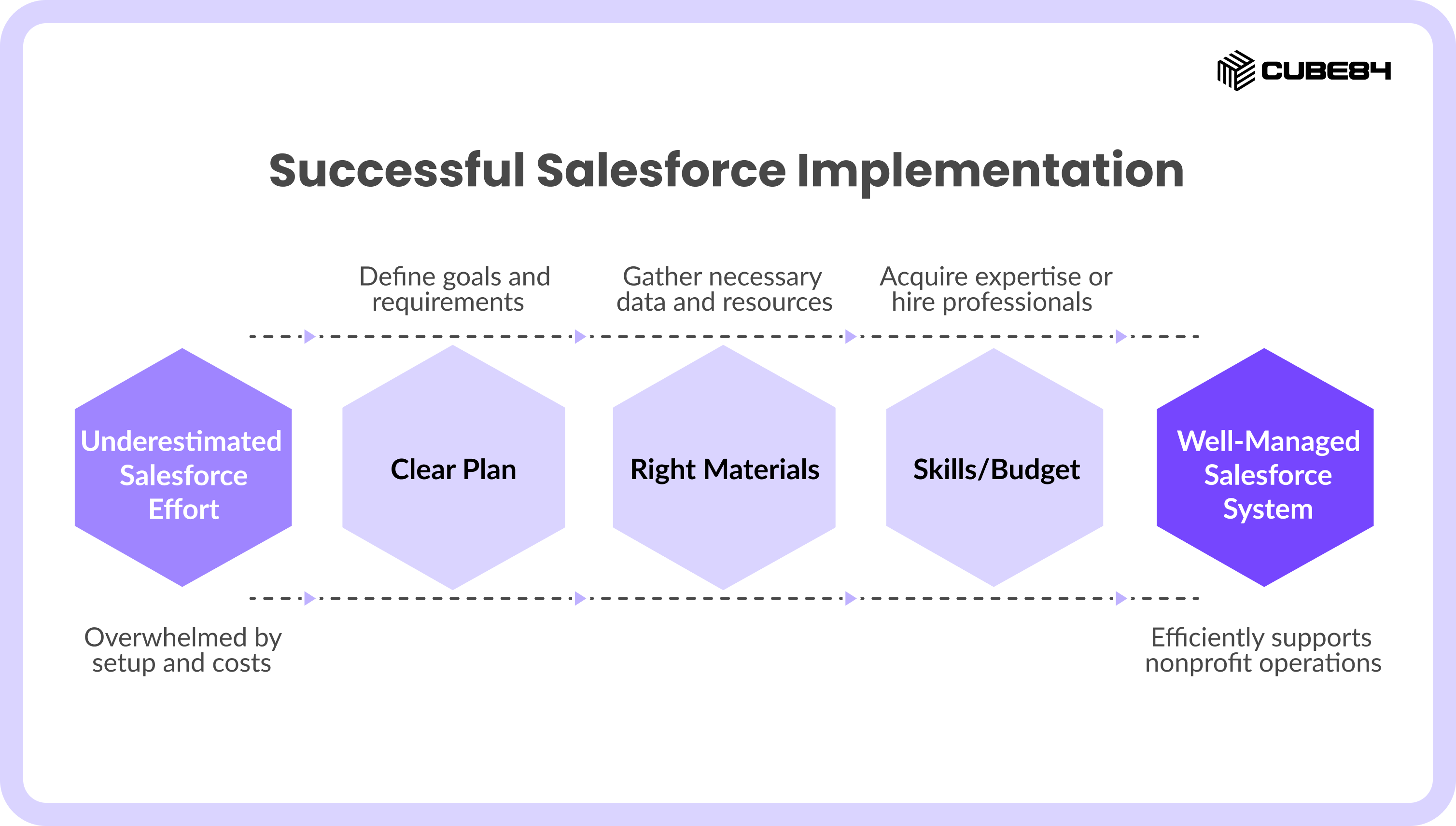
This is very similar to what many nonprofit leaders experience today. You hear about the Salesforce Power of Us program offering ten free licenses, and it genuinely sounds like the answer to tight budgets and scattered spreadsheets. Then, at some point, things shift. It could be during a do-it-yourself setup when the configuration starts to feel overwhelming. Or it might be when you receive your first implementation quote and realize there is more involved than expected.
From what we have seen across organizations, Salesforce is not something you simply install and start using right away. It is a system that needs to be thoughtfully designed, built, maintained, and managed over time. The real risk is not choosing the wrong platform. It is underestimating what it takes to make it work well and keep it that way.
What “Free” Actually Covers and What It Doesn’t
When you operate on a tight budget, the word free is incredibly appealing. We completely understand why so many organizations feel encouraged to explore this option. To plan effectively, you need a clear picture of what that grant actually puts in your hands.
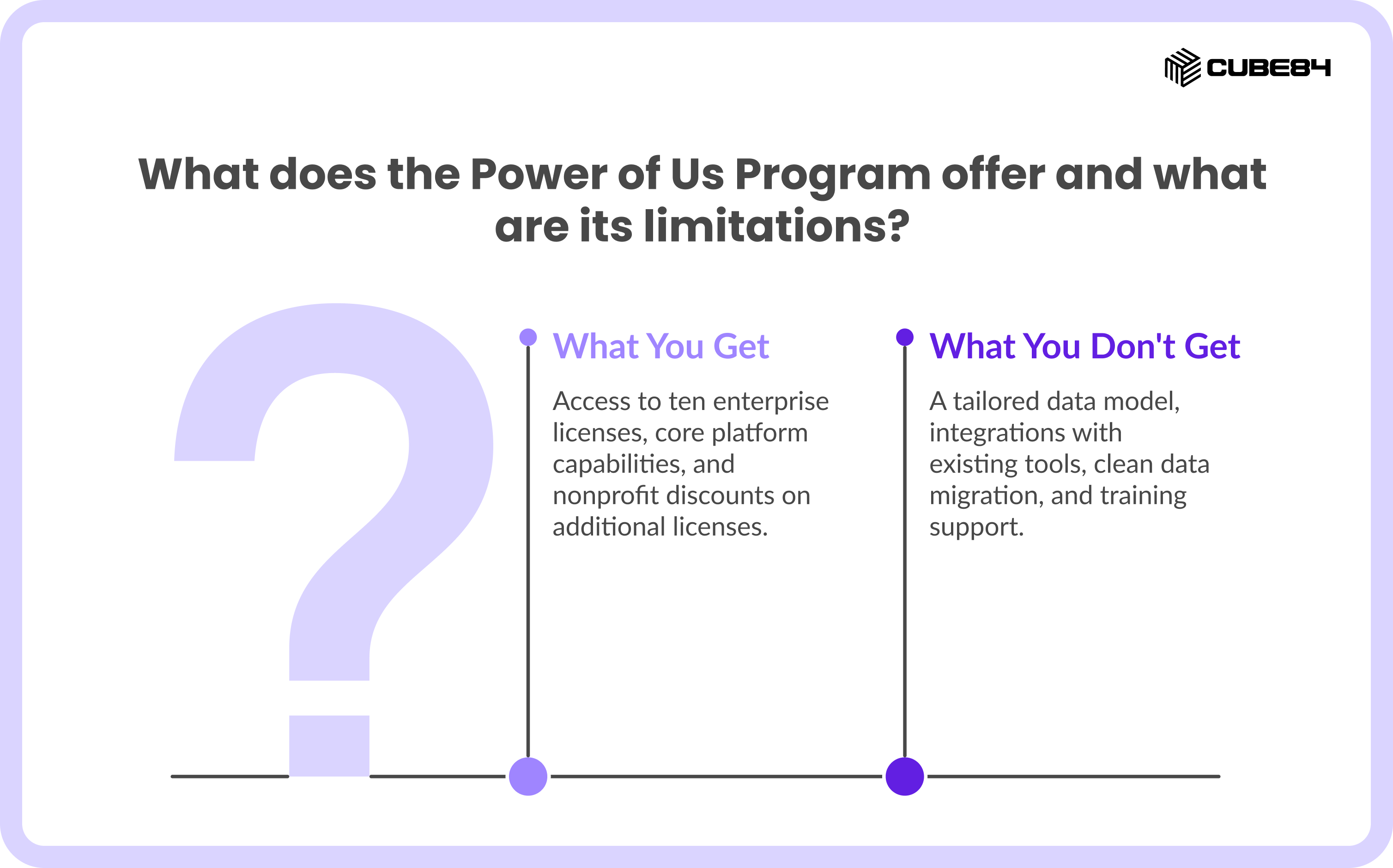
What you get:
Ten Enterprise licenses through the Power of Us Program. It is worth noting that since late 2025, new applicants are primarily directed toward the newer Agentforce Nonprofit licenses or standard Sales and Service Cloud products. Existing users on the older NPSP system remain fully supported.
Access to the core capabilities of the platform and deep nonprofit discounts on any additional licenses or products you might need as you grow.
What you do not get:
A data model tailored to your specific organization. A data model is essentially the way your database organizes and connects information, like linking a donation directly to a specific household or grant.
Connections or integrations with your existing tools like Mailchimp or QuickBooks.
Clean and usable data migrated from your old systems.
Training materials or adoption support for your staff.
Key takeaway: Licenses are the starting line of a marathon. New organizations are now steered toward a modern, highly capable path from day one, but you still have to run the race.
Building something that truly works for your team still takes planning, effort, and the right support over time.
The Platform Decision: NPSP vs. Agentforce Nonprofit
If you have been looking into Salesforce, you have likely felt like someone handed you the wiring diagram for a house when you only asked where the light switch is. Right now, the biggest conversation in the ecosystem revolves around choosing between NPSP and Agentforce Nonprofit. Let us break down what these terms actually mean in plain English.
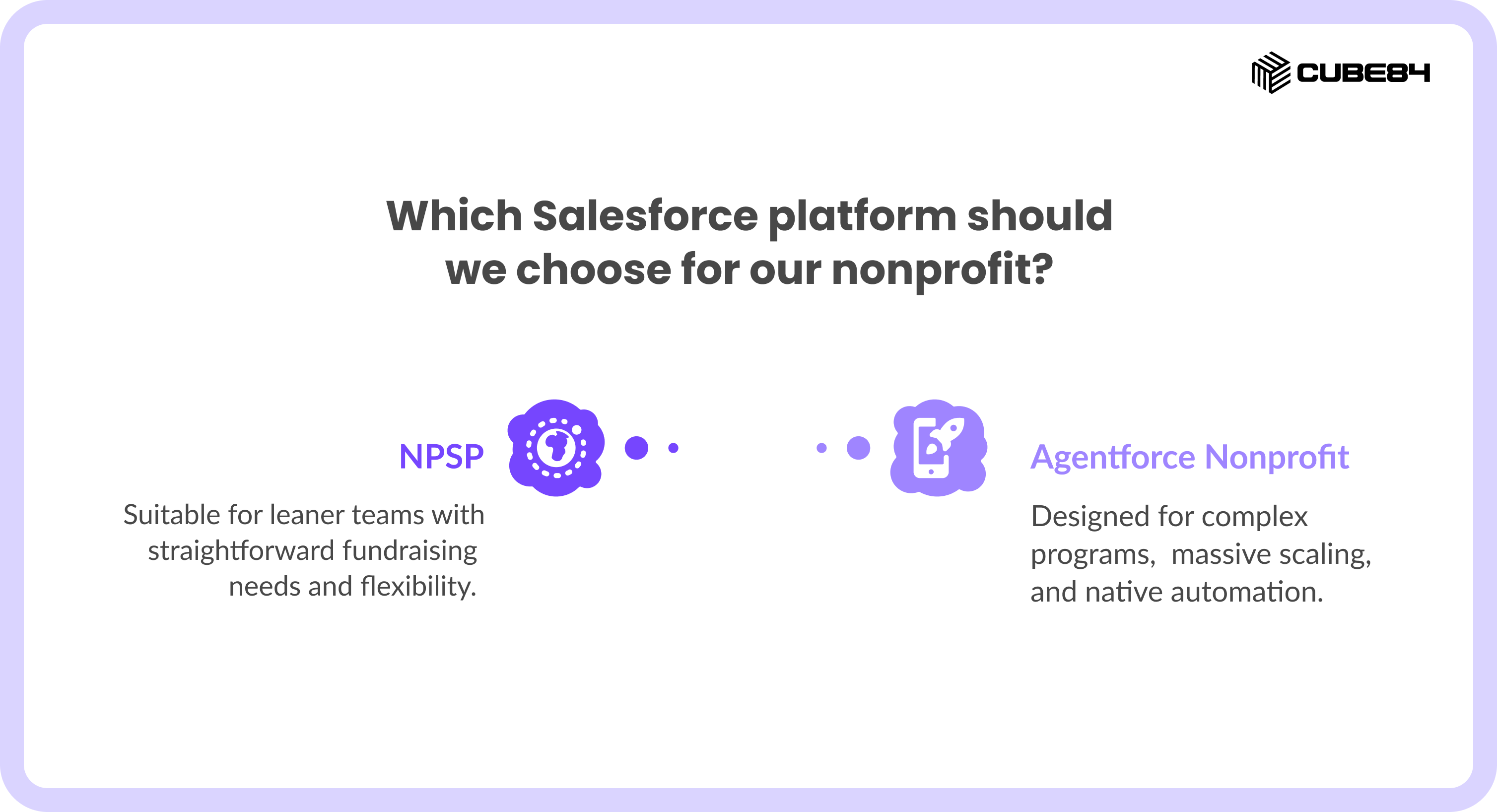
NPSP (Nonprofit Success Pack)
Think of NPSP as a customized layer added on top of the standard Salesforce platform. It was built specifically to help nonprofits track donors and households. It is still fully supported by Salesforce with no announced end date. It works wonderfully for leaner teams with straightforward fundraising needs. It is highly flexible, but the major new tech innovations from Salesforce are no longer being built here.
Agentforce Nonprofit
Formerly known as Nonprofit Cloud, this is the modern future of the platform. Instead of being an added layer, it is built directly into the core foundation of Salesforce. It is designed for complex programs, massive scaling, and native automation. It also serves as a much stronger foundation for AI tools that can help with donor support or volunteer coordination. Because it uses a very modern data structure, it requires you to have a crystal clear understanding of your internal processes before you start building.
The real decision filter: Choosing between the two depends heavily on your current reality. You need to look at your team's comfort with technology and your program's complexity. You also need to consider your interest in automation and whether you have the budget to support the system beyond the first year. If you are already using NPSP, migrating to Agentforce Nonprofit is absolutely doable, but it requires a meaningful effort to restructure your data and rebuild your reports.
Key takeaway: This choice is about what your organization can realistically support today and in the next three to five years. Both options are valid depending on your operational maturity.
The Money Question: What It Actually Costs to Make Salesforce Work
Let us talk about the budget. We know every dollar spent on overhead is a dollar you want to justify. When implementation costs surprise leadership teams, it is usually because they only budgeted for software and forgot about the labor required to make it functional.
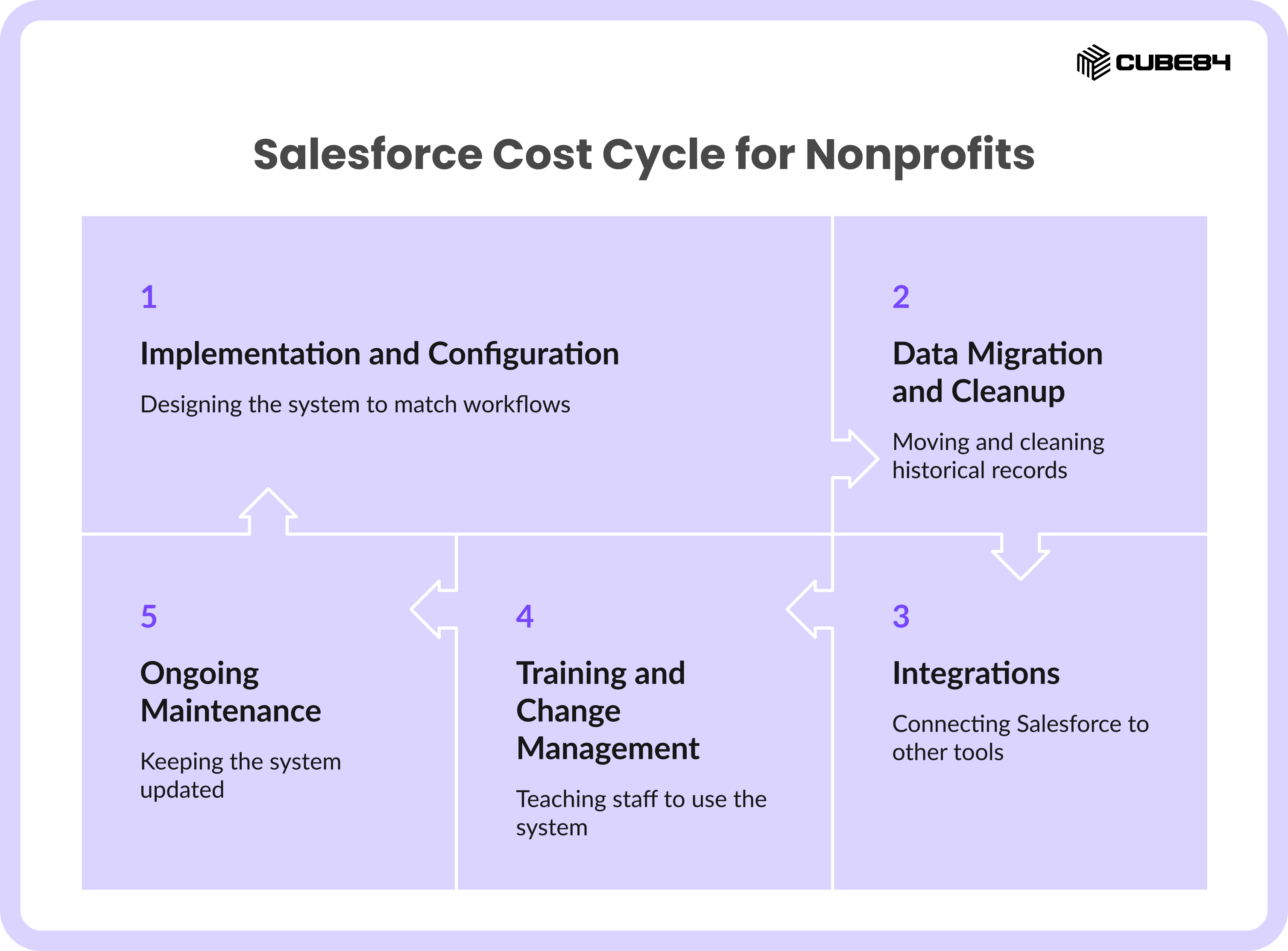
The cost layers you need to plan for:
Implementation and configuration: Paying experts to design the system to match your real world workflows.
Data migration and cleanup: Moving your historical records into the new system. This often takes the most time because old data is usually full of duplicates and errors.
Integrations: Making Salesforce talk to your website donation forms or email marketing software.
Training and change management: Teaching your staff how to use the system so they actually log in.
Ongoing maintenance: Keeping the system updated as your nonprofit evolves.
Real ranges to expect: A small and simple setup with basic configuration and limited integrations will be on the lower end of the spectrum. A mid-sized project involving custom workflows, complex reporting, and several external connections requires a moderate investment. A complex build involving multiple internal programs, heavy data migration from an old CRM, and advanced AI agents will require a significant enterprise level budget.
Why budgets fail: Budgets usually break down because the initial discovery phase was rushed. Organizations treat the implementation as a one time expense rather than an ongoing operational cost. They also frequently ignore the need to hire or designate an internal person to own the system.
Key takeaway: Most cost overruns are not surprises. They are simply planning gaps that can be avoided with thorough upfront discussions.
Why Many Salesforce Implementations Struggle
We often work with nonprofits that are trying to stabilize or improve their Salesforce setup. When a system feels broken or difficult to use, the first reaction is usually to assume the software is the problem. In reality, the root causes usually stem from how the technology intersects with your people and processes.
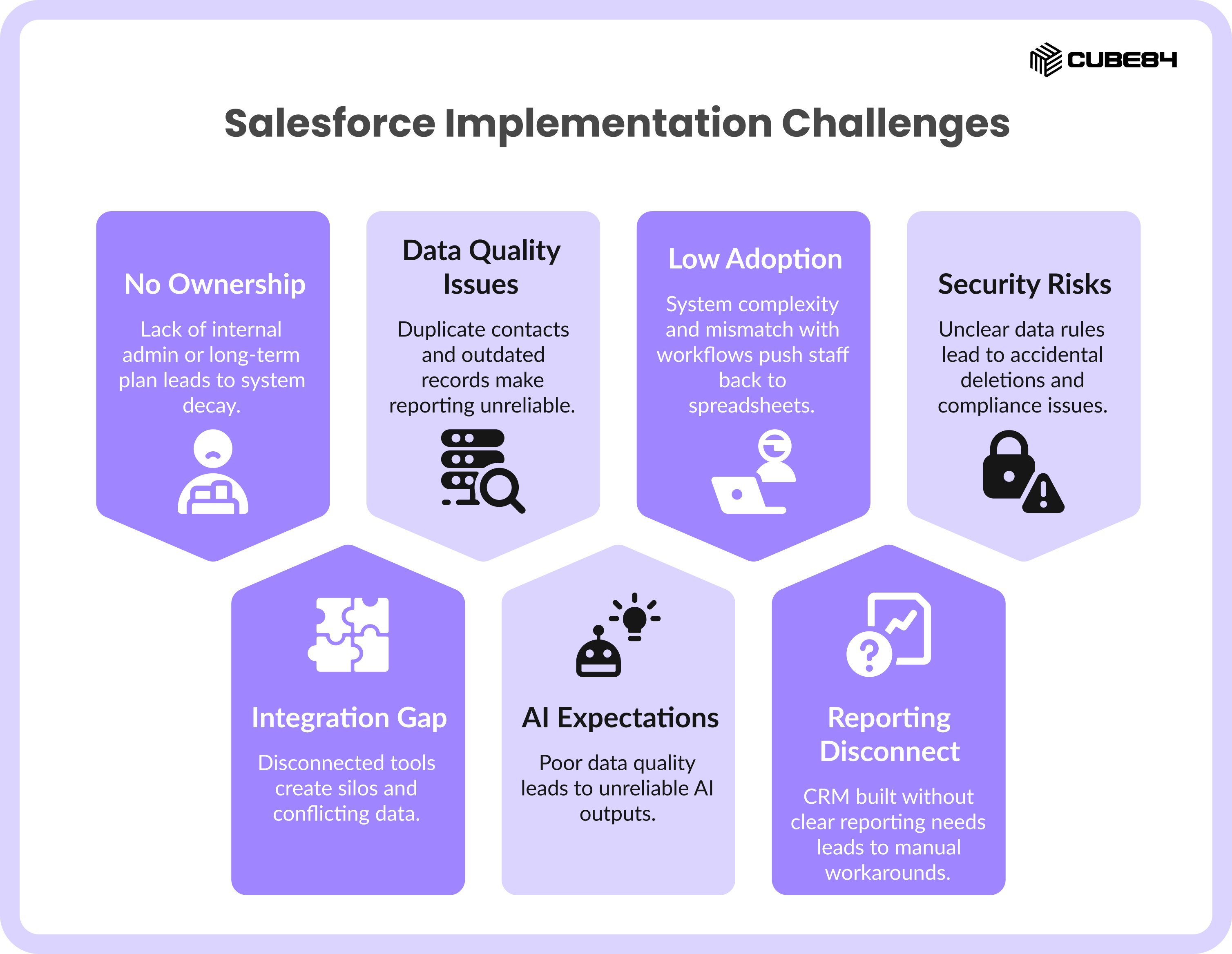
No ownership after go-live When there is no dedicated internal admin or a long term plan, the system slowly becomes stale. Fields get added randomly, and the database becomes cluttered and unusable.
The integration gap Your donation tools, email platforms, and accounting software remain disconnected. As a result, your development team and your finance team end up working in silos with conflicting numbers.
Data quality issues If your system is filled with duplicate contacts, outdated records, and no clear rules on how to enter information, your reporting will become entirely unreliable.
AI expectations vs. data reality There is incredible excitement right now about using Agentforce agents to automate tasks. AI relies entirely on the quality of the data it consumes. Poor underlying data leads to unreliable AI outputs and wasted potential.
Low adoption Nonprofit staff members are deeply committed to the mission, but they are often stretched incredibly thin. If the new system requires too many clicks and does not match their daily workflows, the friction will push them right back to their familiar spreadsheets.
Reporting disconnect If the CRM is built without a clear definition of what the board or your funders need to see, leadership will still have to rely on manual workarounds to get their quarterly numbers.
Security, access, and compliance risks Giving every user full permission to edit or delete data is a major risk. Unclear data rules can lead to accidental deletions or serious compliance issues with sensitive donor information.
Key takeaway: Most struggles are operational and organizational. They are rooted in limited internal capacity, high staff turnover, and the constant tension between mission priorities and structured administrative processes.
How Your CRM Choice Dictates Your Operating Model
The software you select directly impacts every level of your organization. When you map out your Salesforce strategy, you are essentially designing how your team will collaborate and execute the mission.
Consider how a well structured system touches your daily operations. In fundraising, it defines how you track donors, segment your campaigns, and understand lifetime giving value. For program delivery, it shifts your team from simply tracking daily activities to measuring the actual long term outcomes that major funders demand. It changes volunteer engagement by streamlining coordination, accurately tracking hours, and helping convert passionate volunteers into financial advocates. Finally, it transforms leadership and board reporting by connecting financial data with program impact, allowing you to tell a much stronger story to the community.
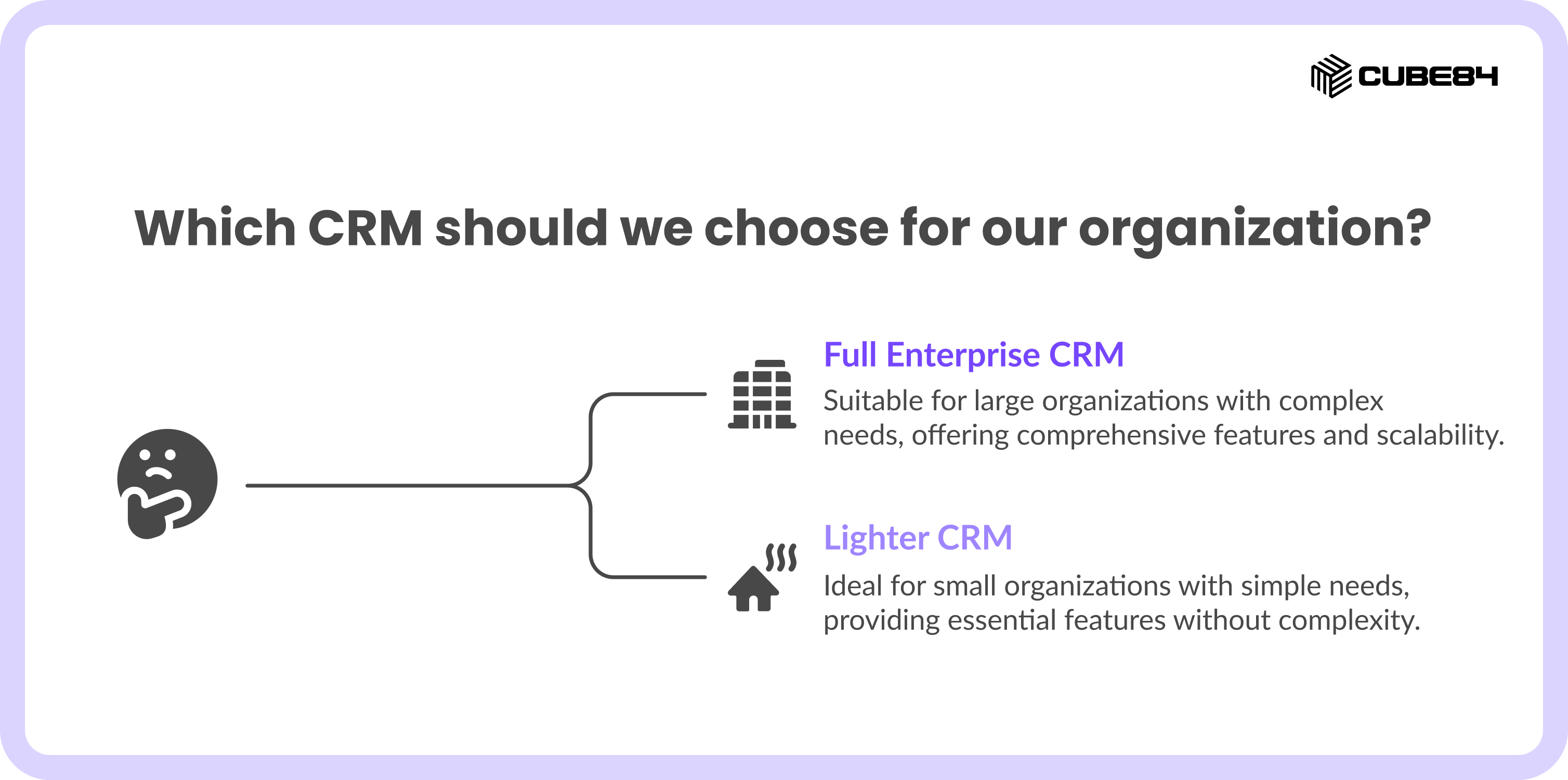
For very small organizations with extremely simple needs, lighter and less complex tools might suffice initially before committing to a full enterprise implementation.
Key takeaway: If your database does not reflect how your organization actually operates, including your culture and your constraints, your team will simply refuse to use it.
What Success Actually Looks Like
It is easy to get weighed down by the challenges, but it is equally important to focus on the finish line.
When it works: You have one trusted source of truth across all your departments. Your reporting cycles become significantly faster and highly reliable. You gain clear, instant visibility into your donor pipelines and program performance. Most importantly, it reduces manual data entry, freeing up your staff to focus heavily on the actual mission.
When it struggles: Your team ends up managing parallel systems, updating Salesforce occasionally while truly relying on hidden spreadsheets. You see incredibly low login rates, inconsistent data entry, constant rework, and a general sense of frustration across the office.
A Practical Way to Approach This
You can navigate this journey successfully without overcommitting your resources or burning out your staff. Here is a realistic path forward.
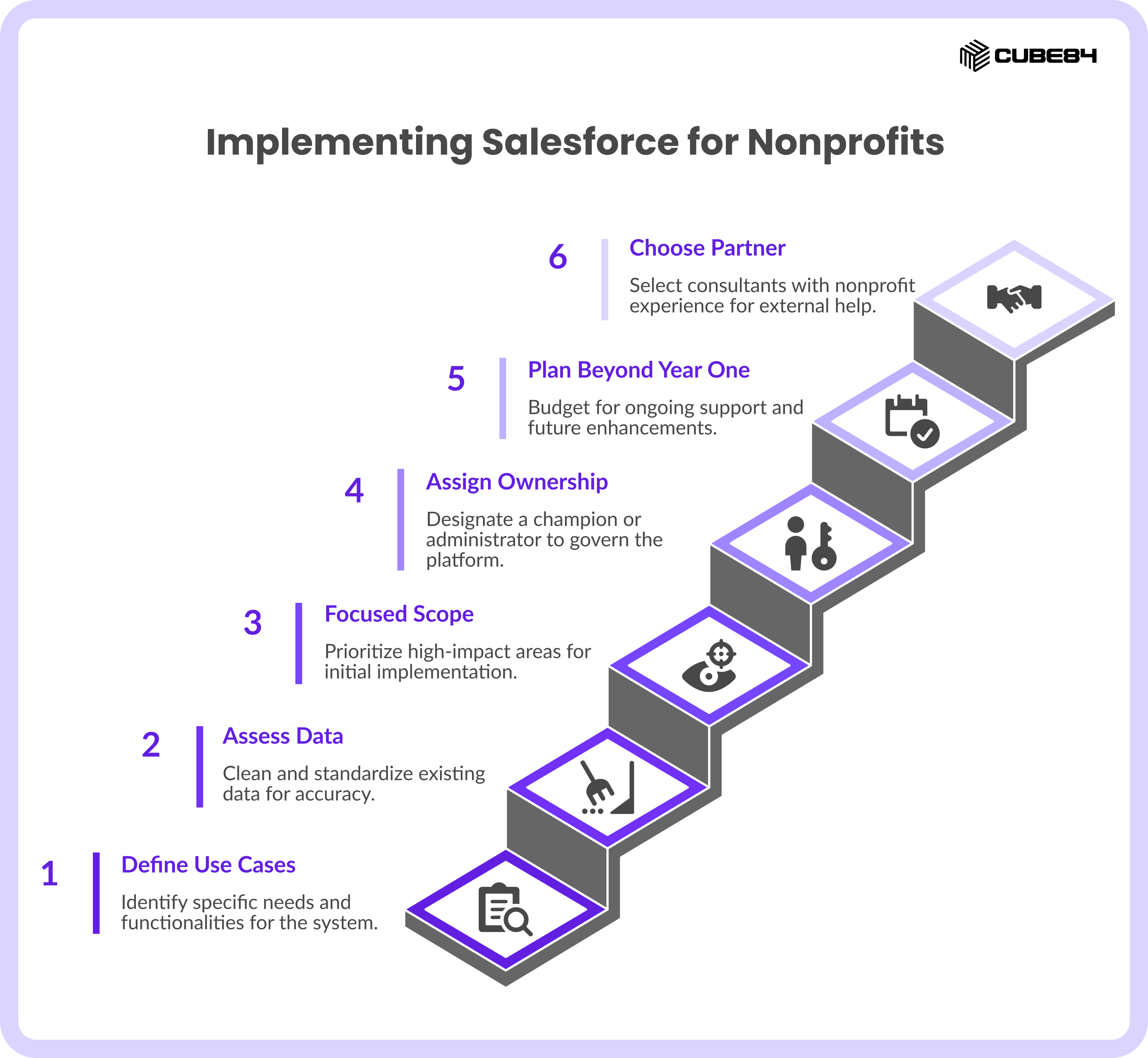
Step 1: Define your core use cases. Write down exactly what you need the system to do first. Focus on specific areas like donor management, program tracking, grant reporting, or volunteer coordination.
Step 2: Assess and clean your data early. Do not wait until the software is purchased to start deduplicating and standardizing your current spreadsheets.
Step 3: Start with a focused scope. Prioritize the high impact areas first. Do not try to solve every departmental problem in phase one.
Step 4: Assign clear ownership. Designate an internal champion or hire a dedicated system administrator who will govern the platform.
Step 5: Plan beyond year one. Salesforce releases major updates three times a year. Plan your budget to include ongoing support and future enhancements.
Step 6: Choose the right partner. If you need external help, look for consultants who have specific nonprofit experience and a strong focus on sustainable design.
Final Perspective: Make the Decision With Full Visibility
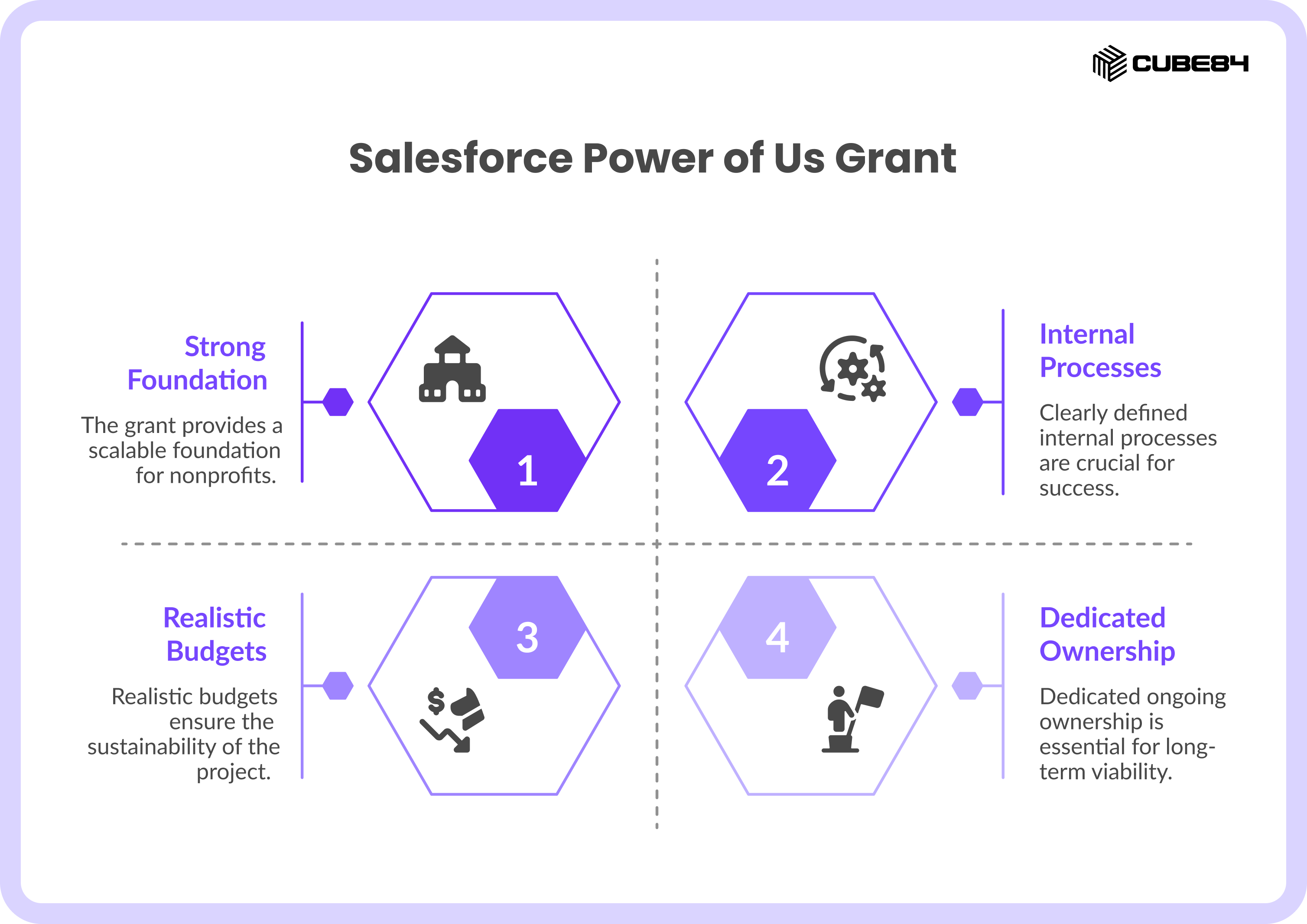
The Salesforce Power of Us grant is an incredible resource that has transformed thousands of organizations. It can absolutely serve as a strong, scalable foundation for your nonprofit's future. However, that foundation only holds strong when it is paired with clearly defined internal processes, realistic budgets, and dedicated ongoing ownership.
The ultimate goal is never simply to get a new piece of software live. The goal is to build a reliable system your team trusts, an engine that grows alongside your organization, and a tool that actively amplifies your impact in the world.
If you are currently evaluating your setup or trying to figure out the right starting point, we are always happy to talk it through. Sometimes a short conversation can help bring clarity on what makes sense for your stage and capacity. You can reach out anytime. We would be glad to help you think it through.