
Executive Summary
Did you search for tools or solutions to ease, help, or reduce administrative burden with research funding workflows?
You're in the right place!
For many North American universities, managing thousands of scholarship applications and multi-million-dollar research grants has become a quiet crisis. What started as support work has turned into an administrative burden that now eats into the very research time and student support these institutions exist to fund.
This piece walks through a different way to approach this. Instead of treating AI as a copilot that sits beside your staff, you start treating it as an autonomous operations layer. With Salesforce Agentforce for Nonprofit, powered by agents such as the Prospect Research Agent and grantmaking-focused workflows, you can offload the pre-work of grant and scholarship management. That leaves your people free to focus on judgment, strategy, and relationships.
For nonprofit leaders in research-heavy universities, Vice Presidents of Research, Directors of Financial Aid or Scholarships, and Advancement Leaders, this is where the real value sits. You get enterprise-grade research and grant automation without the cost and complexity of a highly specialized research platform.
Introduction: The $1.2B Challenge
The volume crisis in grant and scholarship administration
You have likely seen the headlines. Federal and private research funding into North American universities runs into the tens of billions of dollars each year, and the administrative drag alone costs major institutions an estimated $1.2 billion annually in lost research time. Yet the systems around it still feel surprisingly manual.
Research administrators and finance teams continue to lose hours every week to repetitive compliance checks, eligibility reviews, and status tracking that should have been automated by now.
A 2023 study published in the Journal of Research Administration pointed to frequent regulatory changes, disconnected systems, and heavy reporting requirements as the main sources of administrative burden.
Many staff no longer describe this as extra work. It feels like the job itself has shifted away from supporting research and toward preventing compliance issues.
If you are leading research or financial aid, this is not abstract. You are dealing with it directly.
Hundreds or sometimes thousands of scholarship applications each cycle.
Dozens of active grants, each with its own reporting timelines and rules.
Small teams trying to manage both pre-award and post-award work.
Recent conversations in higher education have started calling this out more directly. Burnout in administrative and professional services roles is now being seen at an institutional level, where it is a structural risk, not a people issue.
If you are here, you have already moved past asking whether this is sustainable. The real question is what can change without adding more headcount or introducing yet another system.
From AI “copilots” to agentic grantmaking
By 2026, the conversation around AI in higher education has already moved on from dashboards and writing assistants.
The focus now is on systems that can actually take action.
Salesforce’s Agentforce for Nonprofit is built around this idea. It allows guided and autonomous agents to execute workflows within your existing Salesforce Nonprofit Cloud and Student Information System setup.
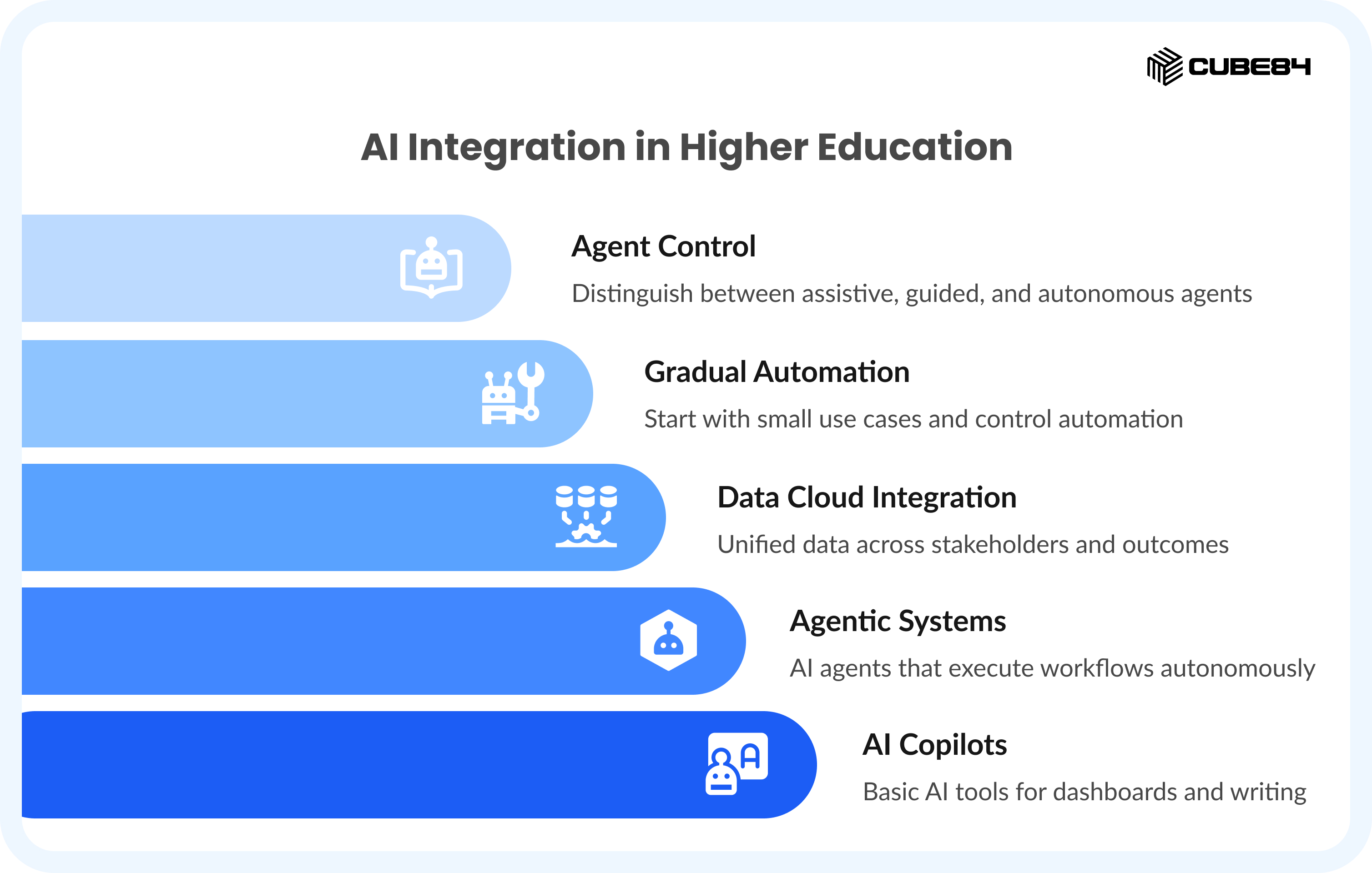
It is designed to help grantmakers, fundraisers, and operations teams reduce repetitive work and spend more time on what actually matters. Because it sits on top of Data Cloud, these agents can work with unified data across stakeholders, funding, and outcomes.
So what does this look like in practice?
You are no longer deciding whether to use AI, because that shift has already happened. The real question is where it can take pressure off your teams first.
You can start small, with use cases like eligibility screening, donor research, or milestone tracking, instead of trying to change everything at once.
And you can control how far automation goes. Salesforce distinguishes between assistive, guided, and autonomous agents, so you can move at a pace that fits your governance and comfort level.
Later in this guide, we will walk through how this shows up across the grant lifecycle, and how teams can start putting this into practice within their existing setup.
The Agentic Grant Lifecycle
Phase 1: The Prospect Research Agent
For advancement teams, prospect research is one of the clearest starting points. Salesforce’s Prospect Research Agent is built to track and analyze wealth indicators, philanthropic activity, and giving patterns, so teams can focus more on relationships and less on searching for data.
In a university setting, this helps with identifying donors whose interests align with specific research areas, whether that is health, sustainability, or emerging fields. It can also surface signals like past giving behavior or affiliations that might indicate a strong fit for research funding.
Because this sits within Salesforce, it is not a separate tool. It works with your existing data and respects your institution’s privacy and communication policies. Over time, it becomes a steady support layer that keeps your pipeline active without adding pressure on your team.
Phase 2: The Application Screener
For financial aid and scholarship teams, the most time-consuming work is often the most repetitive.
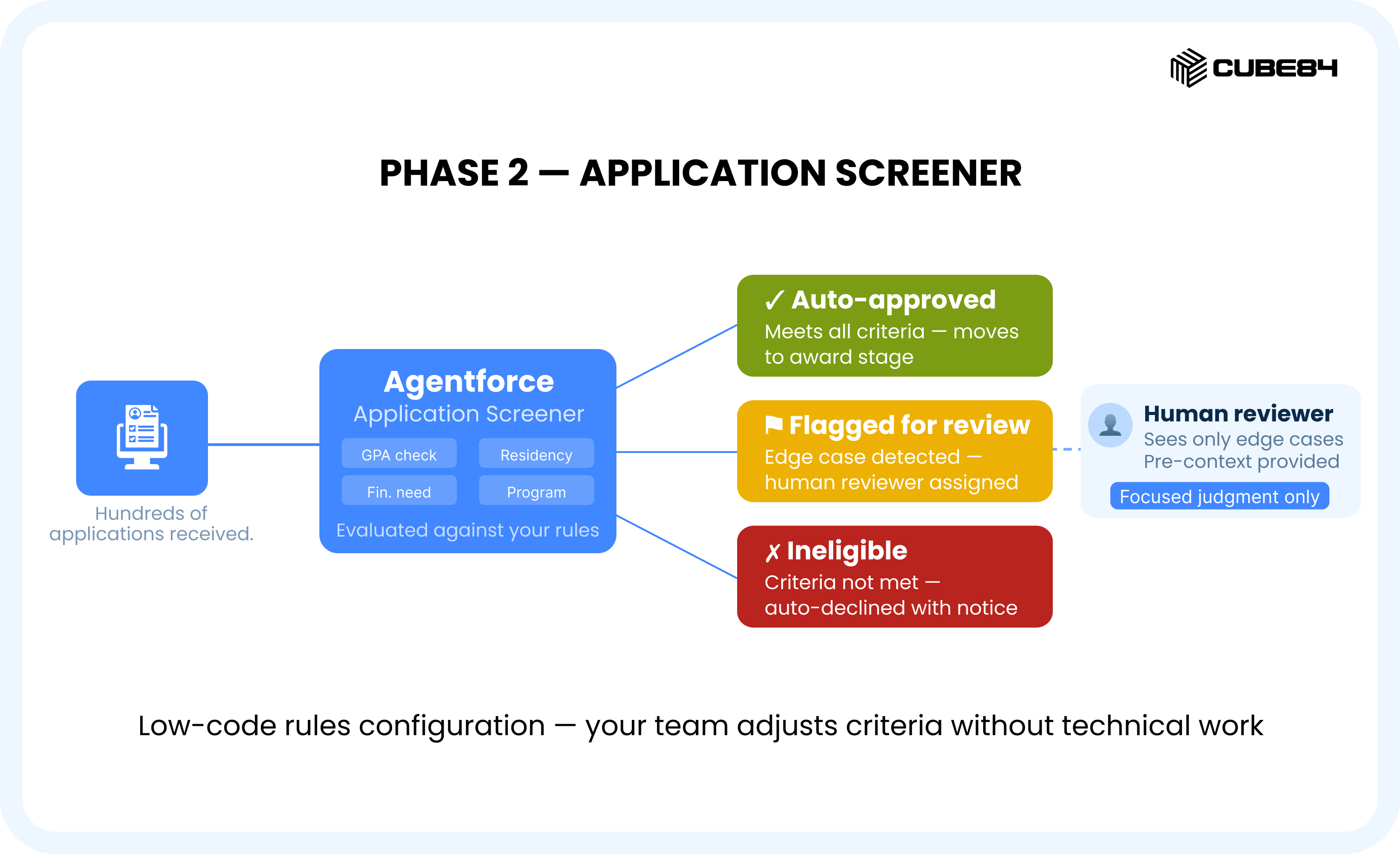
Reviewing GPA, residency, program eligibility, and financial need across hundreds of applications takes time, even though the logic itself is straightforward.
With Agentforce connected to your Student Information System or Data Cloud, this can be handled upfront. Applications are evaluated against your rules before they reach a human reviewer.
This can include verifying eligibility criteria, applying institutional priorities, and flagging edge cases that need closer attention.
The key here is control. Agentforce is designed with low-code configuration, so your team can adjust rules without heavy technical work. You can begin with simple ranking and flagging, then gradually expand automation as confidence grows.
Phase 3: The Indicator Monitor
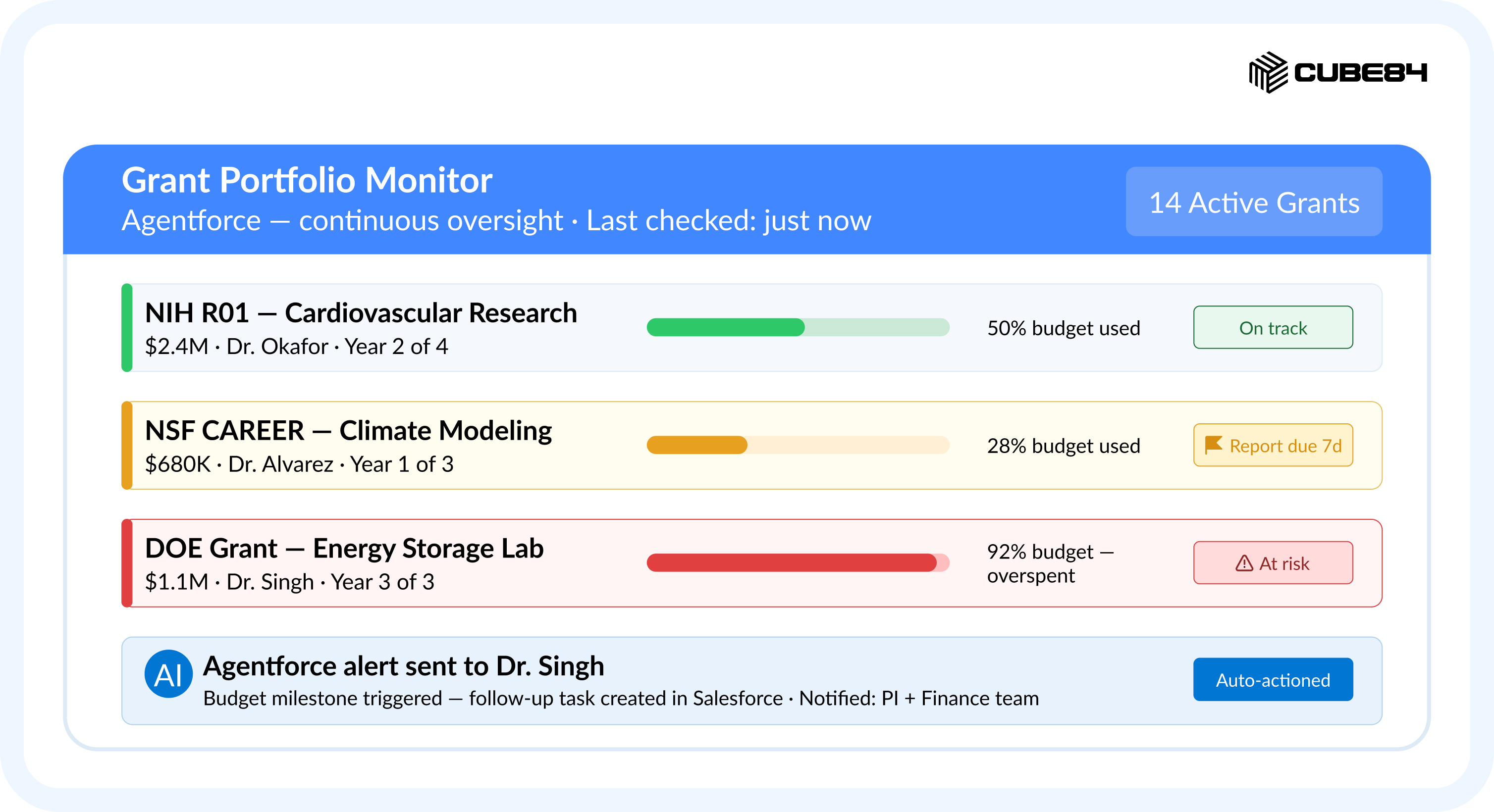
Post-award work is where things often become reactive.
Researchers are managing milestones, reporting requirements, and budgets, while also trying to focus on their actual work. Deadlines get tracked manually, and issues usually surface late.
With Agentforce, this can shift into a more continuous process.
Agents can monitor grant records and performance data through Data Cloud, checking whether reports are submitted on time, whether spending is on track, and whether any risks are starting to show up.
When something needs attention, the system flags it and notifies the right person. It can also trigger follow-up tasks or reminders within Salesforce.
This keeps oversight in place without relying on constant manual tracking.
Phase 4: The Board Version
At the leadership level, the challenge is often about clarity.
Detailed grant proposals are necessary, but they are not always practical in decision-making settings where time is limited.
Agentforce can help by creating concise summaries that highlight the key points, funding structure, and risks. It can also connect proposals back to institutional priorities, making it easier for leadership to see why a specific grant matters.
Because these summaries are based on your own data, they stay grounded in your context rather than sounding generic.
The Architecture of the “Value Play”
Nonprofit Cloud as the engine
For research-heavy universities, a key decision is how Salesforce is structured underneath all of this.
Nonprofit Cloud is built around grants, funding, outcomes, and relationships. That structure often aligns more naturally with research and scholarship workflows than a general setup.
It allows you to manage grants, track outcomes, and maintain relationships with donors and institutions in one place.
When Agentforce sits on top of this, the platform starts doing more than storing data. It can route work, flag issues, and surface insights without waiting for manual input.
Zero-copy grounding with Data Cloud
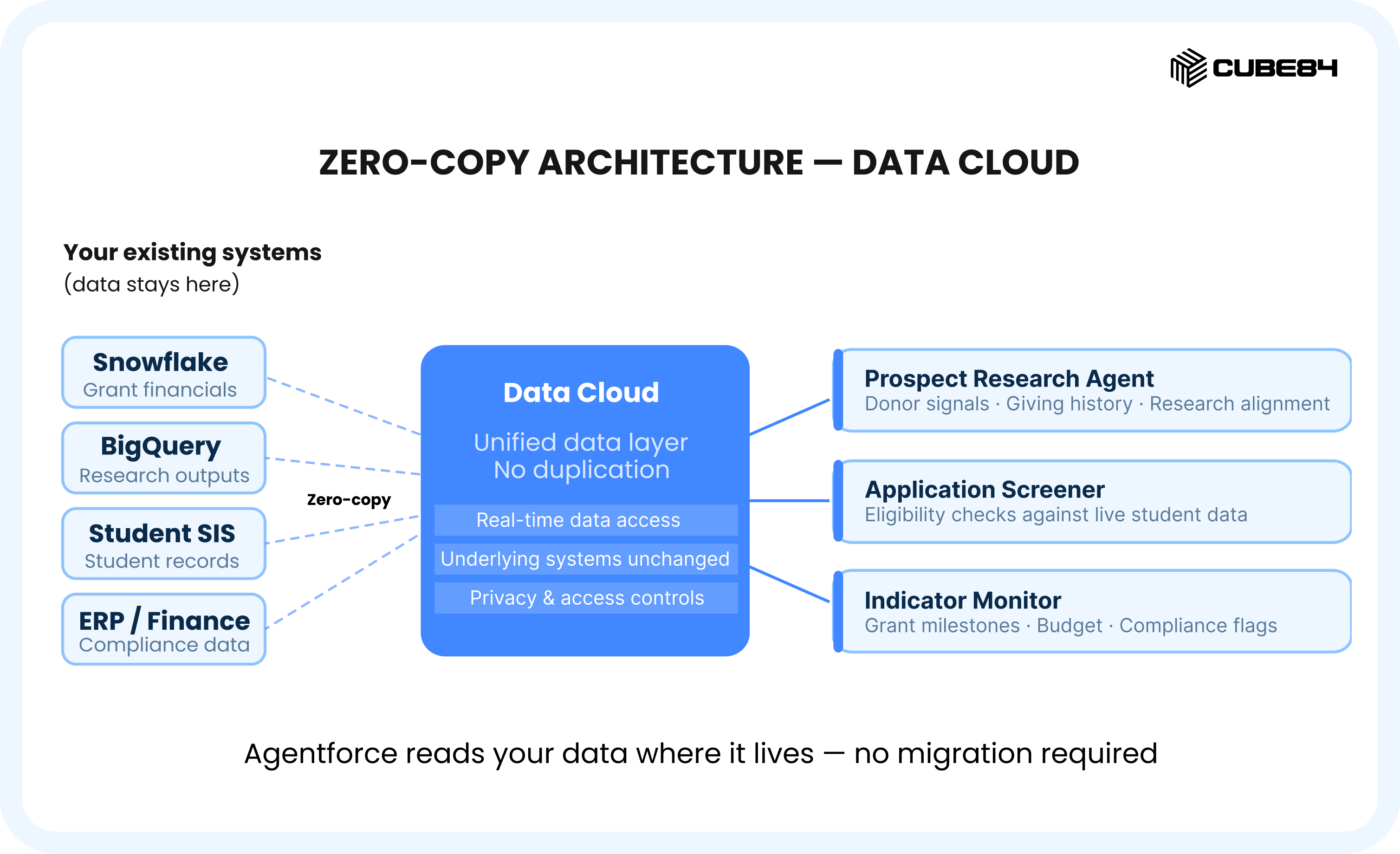
One of the first concerns that usually comes up is data movement.
Most universities we’ve seen, already have data stored in systems like Snowflake or BigQuery. Moving everything into Salesforce is not always easy.
Agentforce works with this reality. Through Data Cloud, it can access and use data where it already lives, without needing to duplicate it.
This means agents can work with grant data, financial records, and student information in real time, while your underlying systems remain unchanged.
For most institutions, this reduces both risk and effort while still enabling automation.
Security, Trust, and “Human-in-the-Loop”
The ethics of AI in scholarships
For scholarship teams, efficiency cannot come at the cost of fairness. When agents are involved in screening or ranking applications, the rules need to be clear and controlled.
Agentforce allows you to define exactly what criteria are used and how decisions are supported. It also keeps a record of how those decisions are made.
Human review can stay in place for cases that need closer attention, so the system supports the process without taking over accountability.
The Einstein Trust Layer
Data privacy is a core concern, especially in university environments.
Salesforce’s Einstein Trust Layer is designed to keep your data within your environment and prevent it from being used to train external models. Access is controlled, and activity can be audited.
This gives teams a clearer path to using AI without stepping into unknown territory.
Conclusion
“Vision without execution is hallucination.”
— Thomas Edison
Most institutions already have a clear vision of what better research and funding workflows should look like. The challenge has always been execution, especially with teams that are already stretched.
Agentforce helps take some of that execution off your plate. The repetitive parts that slow everything down.
And once that pressure eases, your team can focus on the work that actually moves research forward.
If you want to explore where Agentforce could take pressure off your teams, we can walk through your current setup together and map out what this could look like.