
For North American mid-market leaders, the prestige of hiring a Global Systems Integrator (GSI) like Accenture or Deloitte often feels like the "safe" bet for project approval. However, in 2026, a critical trend has emerged: mid-market firms are increasingly feeling like "small fish" in massive corporate ponds, leading to a shift in how CRM investments are managed.
According to Forrester’s 2026 Predictions, 2026 is the "year of reckoning" where wary buyers are moving away from the "hype" of massive scale and toward tangible proof of value. As budgets tighten, technology leaders are being forced to step past tech experimentation and deliver measurable, secure business outcomes.
The question for your organization is no longer just "Who is the biggest?" but "Who is the right fit for our speed?"
The "Right Fit" Matrix: A Decision Framework
This grid helps you identify where your project falls. Success in 2026 isn't defined by the size of the partner's workforce, but by Architectural Intimacy.
Selection Criteria | Global SI (GSI) | The "Boutique Standard" |
Primary Audience | Fortune 100 / Global Enterprises | Mid-Market & Growth-Stage Firms |
Resource Model | Junior-heavy delivery; Senior-led sales | Senior-led delivery; Direct Architect access |
Onboarding Speed | 4–8 Weeks (Heavy Governance) | Rapid Start (Kick-off in < 7 days) |
Tech Philosophy | High-code / Custom-heavy | "Click-over-Code" (Scalable & Native) |
Agility | Rigid Change Order cycles | Agile / Pivot-friendly |
Partner Status | Global Strategic Tier | Crest Partner (Top 1% Success) - Like CUBE84 |
1. The GSI Reality: The "Bureaucracy Tax"
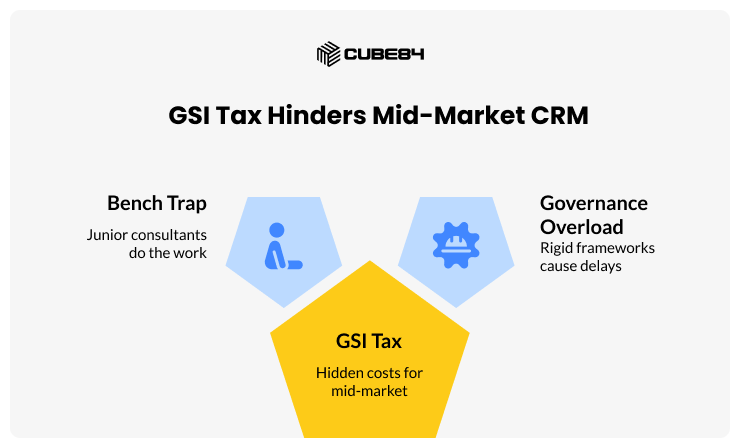
Global SIs are masters of the "Enterprise Blueprint." If you are rolling out a unified CRM across 15 countries with 24/7 global support, a GSI is essential. However, for a North American firm with 200–2,000 users, the GSI model often introduces a hidden "Bureaucracy Tax."
The Risks for Mid-Market Buyers:
The Bench Trap: Large firms often use mid-market projects as training grounds for junior consultants. While you pay senior rates, the actual "work" is frequently delegated to resources with minimal real-world experience.
Governance Overload: Rigid frameworks designed for $10M+ projects can stall a mid-market implementation for weeks. When agility is your primary competitive advantage, a partner that requires three weeks of "Steering Committee" approval for a field change is a liability.
2. The Boutique Advantage: Precision Over Presence
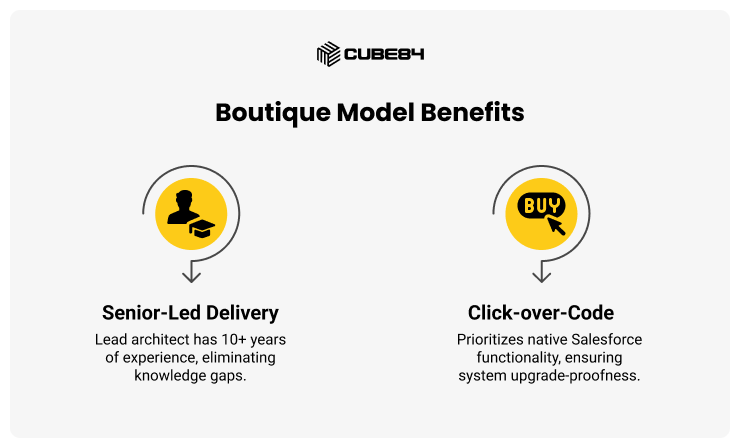
High-tier boutique firms operate on a "Reverse Pyramid" model. By maintaining a lean, expert-heavy team, these partners provide what many call "Architectural Intimacy" - where the person designing your solution is the same person building it.
Senior-Led Delivery
In the boutique model, your lead architect isn't just a voice on a quarterly review call; they are typically a 10+ year veteran of the ecosystem. This eliminates the "Knowledge Hand-off Gap" where requirements get lost between the sales team and the offshore delivery center.
"Click-over-Code" Philosophy
One of the greatest risks in 2026 is technical debt. While GSIs often favor heavy custom code (increasing billable hours for maintenance), boutique standards prioritize native Salesforce functionality. This ensures your system is "upgrade-proof" for Salesforce's tri-annual releases.
3. The 2026 AI Factor: Agentforce Readiness
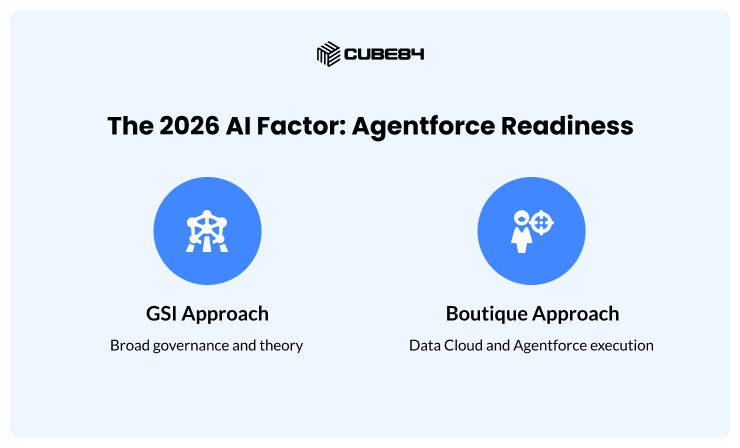
In 2026, Salesforce has shifted from "CRM as a Database" to "CRM as an Agentic System." Gartner predicts that 40% of enterprise applications will be integrated with task-specific AI agents by the end of 2026.
The GSI Approach: Often involves massive "AI Discovery" phases that focus on broad governance and theory.
The Boutique Approach: Focused on Data Cloud and Agentforce execution. Boutiques focus on "AI Readiness Audits," ensuring your data foundation is clean enough for autonomous agents to actually drive ROI within weeks, not quarters.
Conclusion: Choosing the "A-Team"
If your goal is a logo that impresses your board, hire a Global SI. If your goal is a Salesforce org that drives revenue and simplifies workflows, the boutique model is your "A-Team."
Firms like CUBE84 embody this modern standard - combining the technical muscle of a muscle of a Salesforce Partner with the agility that mid-market leaders demand. When you choose a partner that values your success as their primary metric, you aren't just a "small fish"; you are the priority.