

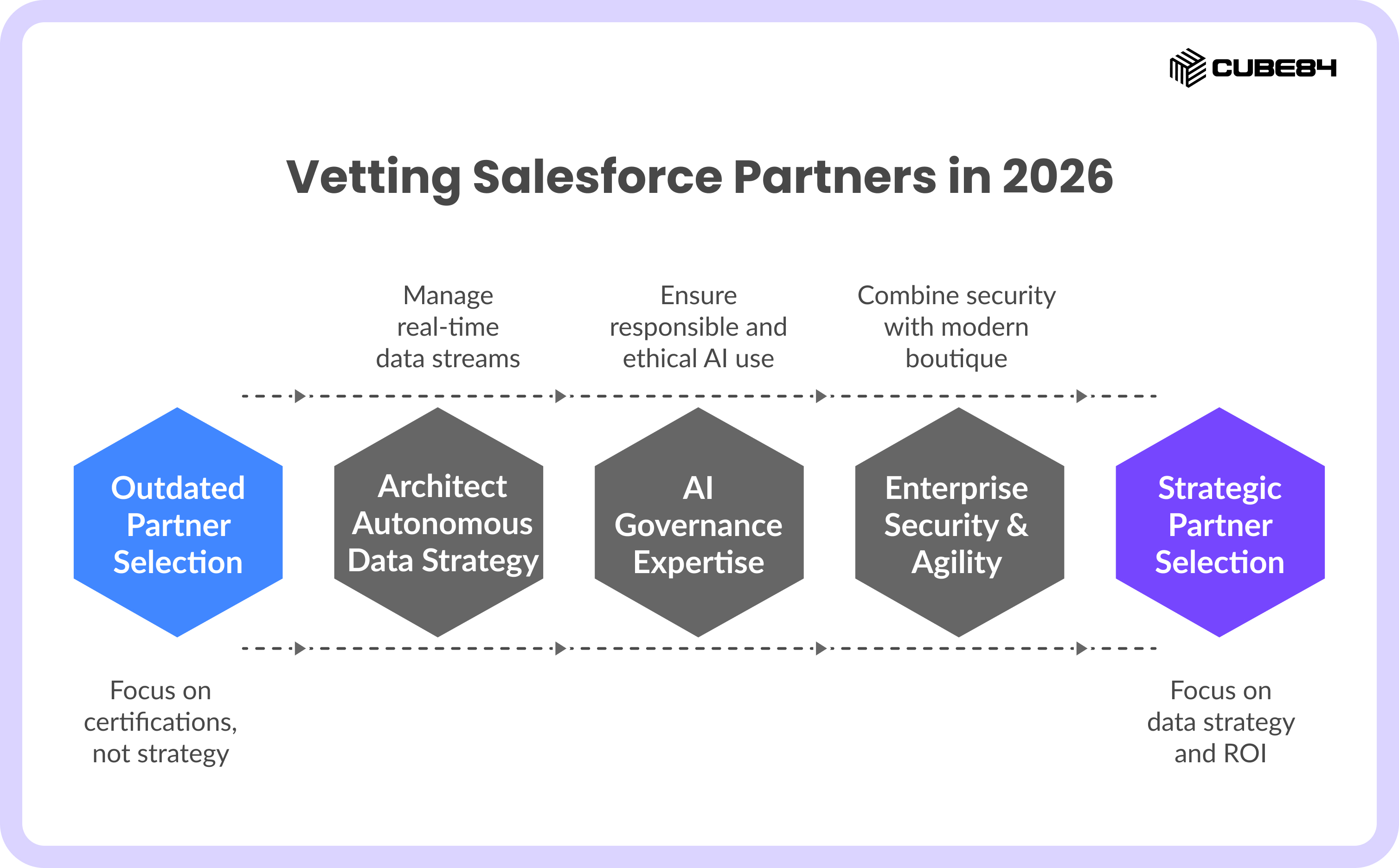
In 2026, the criteria for selecting a Salesforce Certified Partner have shifted from "Who has the most certifications?" to "Who can actually architect an autonomous data strategy?" With the rise of Agentforce and Data Cloud, a partner’s ability to manage real-time data streams and AI governance is now the primary driver of ROI.
For mid-market firms, the goal is to find a partner that offers the security of an enterprise-grade consultant with the agility of a modern boutique.
The 2026 Partner Vetting Scorecard
Use this clinical checklist to evaluate potential partners. In 2026, a "pass" in these categories is no longer optional - it is a baseline for system survival.
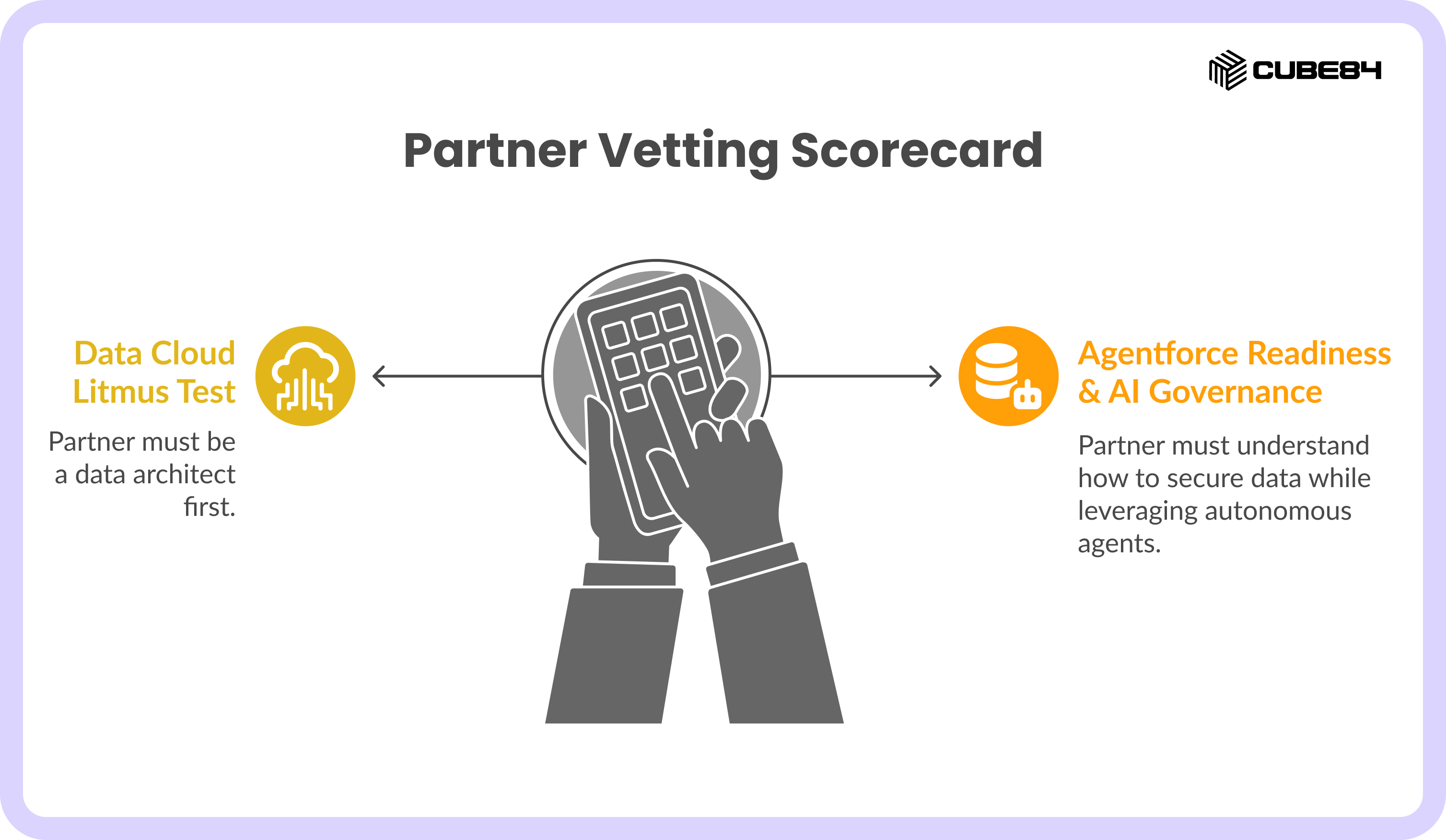
1. The "Data Cloud" Litmus Test
In 2026, Gartner’s Magic Quadrant for CDPs confirms that the market has bifurcated into platformization and agentification. This means your partner must be a data architect first.
The Question: "Can you demonstrate a successful Identity Resolution strategy for a client with multiple unstructured data sources?"
The Benchmark: A qualified partner must show Data Cloud Navigator status, proving they can unify disparate data streams into a single, actionable "Customer 360" profile.
2. Agentforce Readiness & AI Governance
AI is no longer a "bolt-on" feature; it is the engine. A partner must understand how to secure your data while leveraging autonomous agents.
The Question: "How do you configure the Einstein Trust Layer to prevent proprietary data from entering public LLMs?"
The Benchmark: Look for partners who have built custom Agentforce actions. They should move beyond "out-of-the-box" setup and into custom agentic workflows that solve specific business bottlenecks.
3. The "Modern-Native" Sweet Spot
The age of the firm is less critical than its "Technical Currency." In the 2026 landscape, a firm with 10 years of experience is often the ideal fit.
The Logic: A 10-year firm is old enough to have "muscle memory" for complex integrations but young enough to have never built for legacy on-premise systems. They think in API-first, cloud-native terms by default.
The Red Flag: Firms that still prioritize "Heavy Custom Code" (Apex) over Salesforce Flow and Data Cloud Zero Copy are building you into a corner of technical debt.
4. Understanding Partner Tiers in 2026
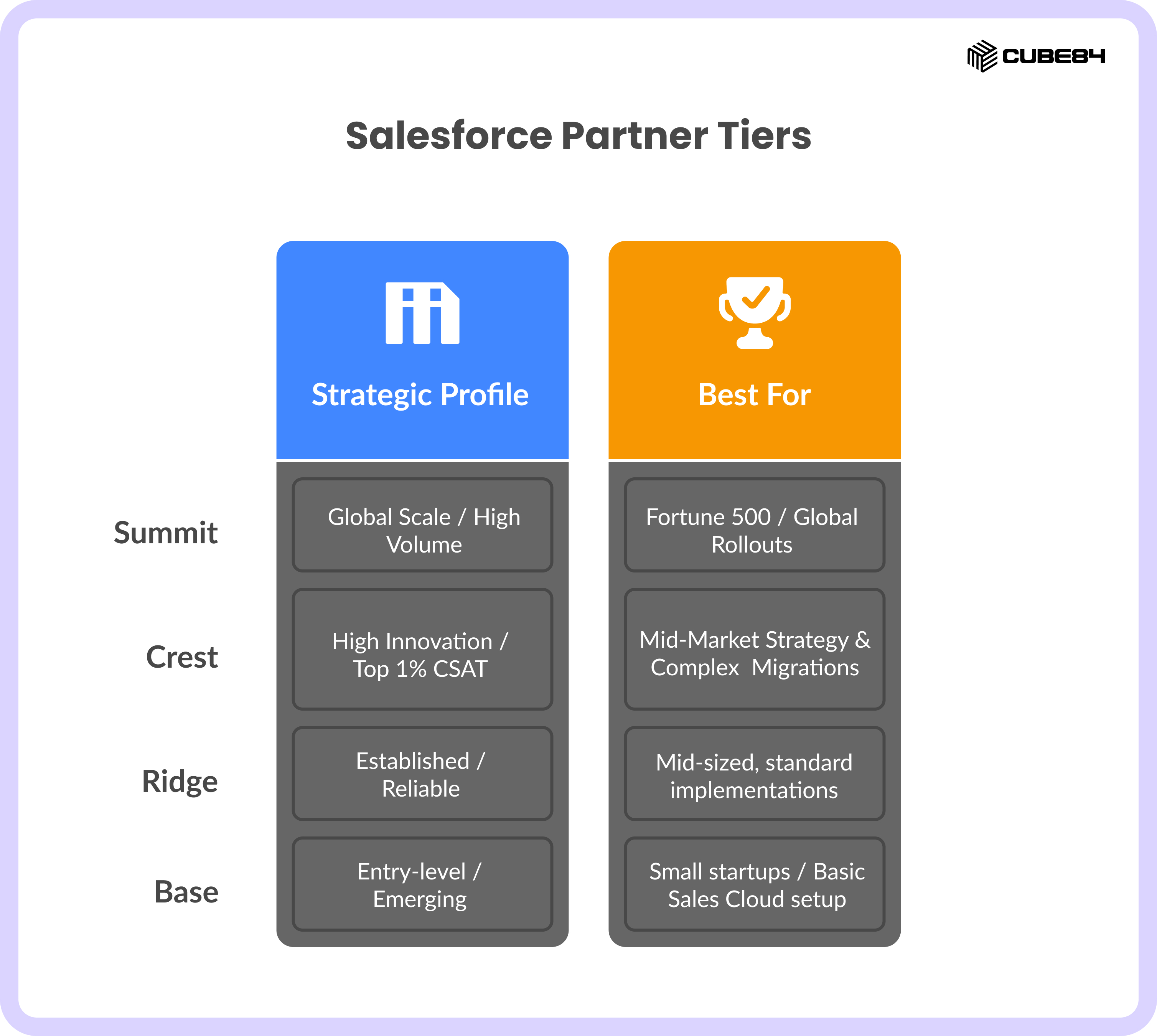
Salesforce evaluates its partners through the Trailblazer Score, which measures customer success (CSAT), innovation, and growth.
Tier | Strategic Profile | Best For |
Summit | Global Scale / High Volume | Fortune 500 / Global Rollouts |
Crest | High Innovation / Top 1% CSAT | Mid-Market Strategy & Complex Migrations |
Ridge | Established / Reliable | Mid-sized, standard implementations |
Base | Entry-level / Emerging | Small startups / Basic Sales Cloud setup |
5. Five "Hard" Questions for Your Next RFP
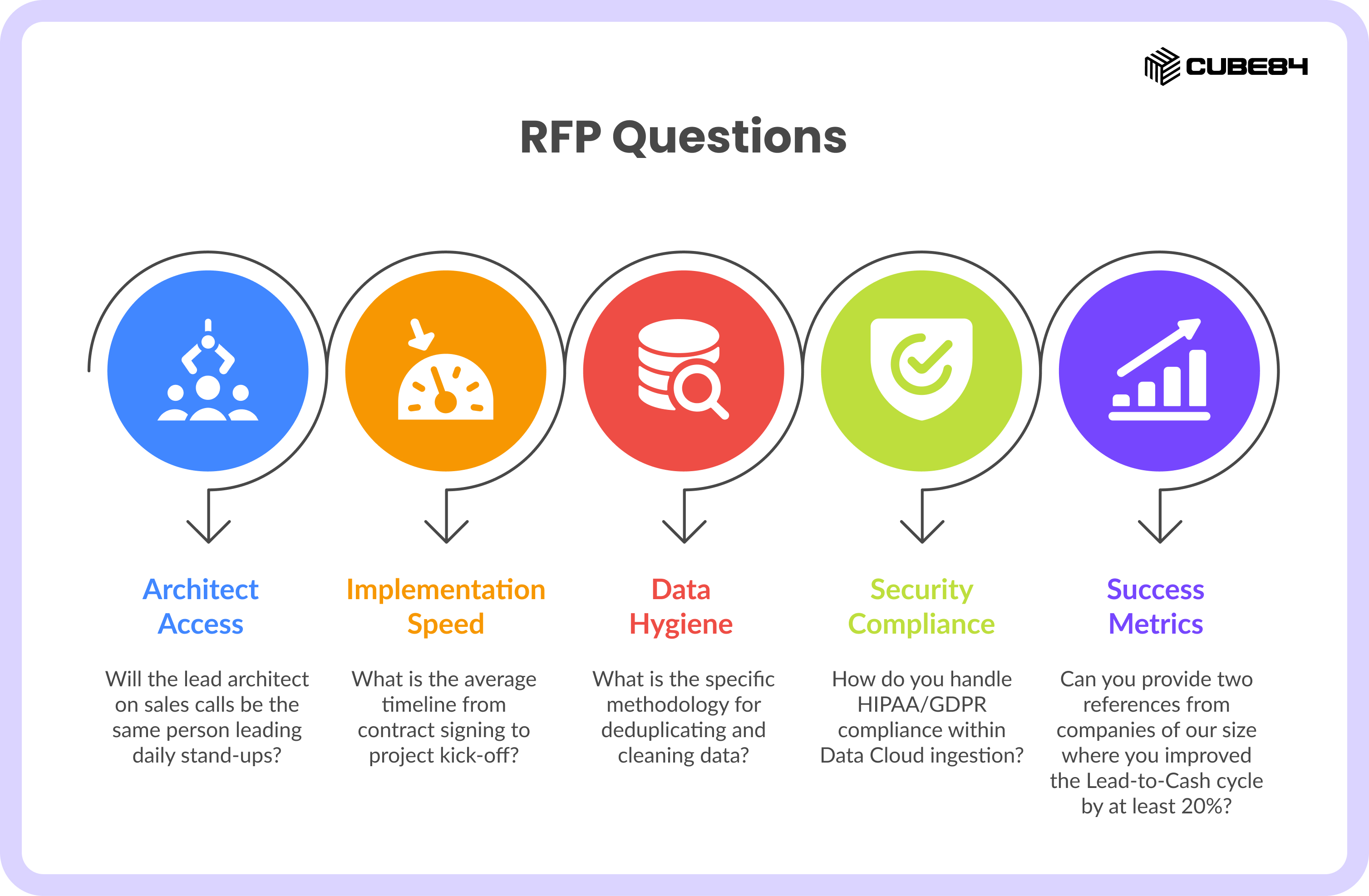
To cut through the sales pitch, include these specific technical inquiries in your next Request for Proposal:
1. Direct Architect Access: "Will the lead architect on our sales calls be the same person leading our daily stand-ups, or is delivery handled by a separate offshore junior team?"
2. Implementation Speed: "What is your average timeline from 'Contract Signed' to 'Project Kick-off'?" (Modern boutiques like CUBE84 aim for < 7 days; legacy firms often take 4–6 weeks).
3. Data Hygiene: "What is your specific methodology for deduplicating and cleaning data before it enters our production org?"
4. Security Compliance: "How do you handle HIPAA/GDPR compliance within the context of Data Cloud ingestion?"
5. Success Metrics: "Can you provide two references from companies of our size where you improved the Lead-to-Cash cycle by at least 20%?"
Conclusion: Value over Volume
In the age of Agentic AI, the "biggest" partner is rarely the most efficient. You need a partner that treats your implementation as a flagship project, not a billable-hour quota.
By selecting a Crest-level partner with a "Modern-Native" mindset, you ensure your Salesforce instance is built for the requirements of 2026 - agile, data-driven, and AI-ready. This is where firms like CUBE84 excel, offering the deep technical pedigree of a 10-year veteran with the specialized focus that mid-market leaders require.