

Introduction
Search for 'Salesforce consulting partner,' and you will find hundreds of companies with similar logos, similar language, and a similar promise: that they will transform your Salesforce investment into a competitive advantage.
What most of them will not tell you upfront is what, precisely, they actually do — and what distinguishes a reseller from an implementation partner, a strategy consultant from a managed services team, and a general Salesforce partner from a Crest-tier firm.
This guide exists to cut through that. Written from years of working inside real Salesforce engagements — with real revenue operations teams, real IT leaders, and real executive sponsors trying to make smart decisions — it answers the question plainly: what does a Salesforce consulting partner actually do, and how do you know which type of engagement you need?
If you have already made some of the common mistakes that come from choosing the wrong type of Salesforce partner, our guide to navigating the Salesforce consulting maze covers those traps in detail. And if you are trying to shortlist specific firms, our guide to the top 10 Salesforce consulting companies in the US in 2026 gives you a vetted starting point. This guide is about understanding the landscape before you make either of those decisions.
Reseller vs Consulting Partner : The Distinction That Changes Everything
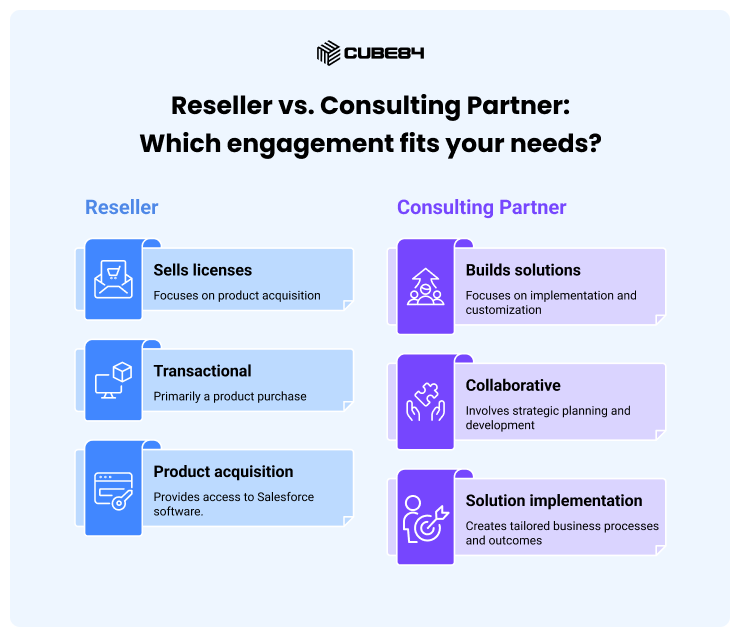
The word 'partner' in the Salesforce ecosystem covers two fundamentally different relationships. Understanding which type you are dealing with is the first decision — because it determines what kind of help you will actually receive.
What a Salesforce Reseller Does
A reseller's primary function is transactional. They sell Salesforce licenses — often at a negotiated rate — and may provide basic onboarding or training. They are the right point of contact if you need to procure additional licences, understand your contract, or access Salesforce's own support channels through a local partner.
What a reseller is typically not positioned to do: design your data model, configure complex automation, build custom integrations, or advise on how your Salesforce investment should evolve over time. Their value is commercial, not architectural.
What a Salesforce Consulting Partner Does
A consulting partner's primary function is operational and architectural. Their job is to take Salesforce — a highly configurable, enormously capable platform — and make it work for the specific way your business operates. That means understanding your revenue processes, your data, your team structures, and your technical environment, and then translating that understanding into a Salesforce configuration or build that delivers measurable business value.
The distinction is not subtle. A reseller hands you the tool. A consulting partner builds what you do with it.
Table 1 — Reseller vs. Consulting Partner: What Each Actually Provides
Dimension | Salesforce Reseller | Salesforce Consulting Partner |
Primary function | License procurement and renewal | Configuration, build, strategy, ongoing governance |
What they sell | Salesforce subscriptions | Services: implementation, strategy, development, managed support |
Technical depth | Minimal to none | Deep platform expertise — certifications, architecture, code |
Business process involvement | None | Central — they design Salesforce around your processes |
Right for | Contract management, license top-ups, basic training | Any implementation, integration, customisation, or ongoing development |
Wrong for | Anything that requires building or configuring the platform | If you only need to procure additional licences |
What Is a Base Partner — and Why Does It Matter?
Base is the entry point of Salesforce's consulting partner programme. A partner at this tier has registered with Salesforce, holds a foundational set of certifications across their team, and has begun building a delivery track record. The requirements to achieve Base are less demanding than those of the higher tiers — it reflects that a partner is operating within the Salesforce ecosystem, not that they have demonstrated capability at scale.
Base designation tells you that the partner is a recognised participant in the programme. Salesforce has acknowledged their existence and verified a minimum certification threshold. For newer or smaller practices, Base is often where they start while building toward Ridge and beyond.
What Base Partnership Actually Means in Practice
For buyers, Base requires the most careful evaluation of any tier. It tells you that the partner has a relationship with Salesforce and holds some certifications — it does not tell you how many engagements they have delivered, how complex those projects were, or how their customers rated the experience. The customer satisfaction and delivery volume requirements that give the higher tiers their signal strength are not yet present at this level.
That does not mean Base partners should be disqualified outright. A newer practice at Base may carry experienced practitioners who have moved from larger firms, or may specialise narrowly in a product area where their depth exceeds that of a larger Crest partner. But the absence of tier-based validation means the due diligence burden falls more heavily on you as the buyer. Certifications, reference calls, and delivery methodology will need to do the work that the tier itself cannot.
What Is a Ridge Partner — and Why Does It Matter?
Salesforce's consulting partner programme is structured around demonstrated capability, not just tenure or revenue. Ridge sits in the middle of the tier stack — above Base, below Crest — and is earned through a combination of team certifications across Salesforce products, customer satisfaction scores gathered through Salesforce's own survey process, and evidence of successful delivery across engagements.
Ridge designation indicates that a partner has built a credentialed team with meaningful Salesforce expertise, has delivered implementations that their clients have reported positively on, and has met the threshold requirements that Salesforce applies to advance a partner beyond the entry level.
What Ridge Partnership Actually Means in Practice
For buyers, Ridge is a useful filter, not a verdict. It tells you that the partner is not simply self-declared — Salesforce has verified their certifications and collected satisfaction data from their customers. A Ridge partner has cleared a meaningful bar.
What it does not tell you is whether that bar is sufficient for the complexity of your specific engagement. Ridge partners vary considerably in team size, product depth, and industry focus. Some are strong regional specialists with deep expertise in a narrow product set. Others are generalists building toward Crest. The tier tells you they are credible — it does not tell you they are the right fit for your project.
What Is a Crest Partner — and Why Does It Matter?
Salesforce ranks its consulting partners in a tiered programme. The tiers — Base, Ridge, Crest — are assigned based on a combination of certifications held by the partner's team, customer success scores (measured through Salesforce's own satisfaction surveys), and demonstrated delivery experience across Salesforce products.
Crest is the second highest tier. It signals that a partner has a significant number of certified practitioners across multiple Salesforce products, a demonstrated track record of successful, complex implementations, and consistently high customer satisfaction scores validated by Salesforce itself.
What Crest Partnership Actually Means in Practice
For buyers, the Crest designation is not a guarantee — it is a meaningful signal. It tells you that this partner has survived the scrutiny of Salesforce's own partner management process, that their team certifications have been verified, and that their customers have reported positive outcomes at the volume and consistency required to earn and maintain the tier.
It does not tell you that every delivery resource at that firm is senior, that the architect who presents in the sales process is the one who will build your org, or that their methodology is right for your specific use case. Those questions still require the vetting process described later in this guide.
What Is a Summit Partner — and Why Does It Matter?
Summit is the highest tier in Salesforce's consulting partner programme. Earning it requires a partner to have a large number of certified practitioners across multiple Salesforce products, an extensive and verified track record of complex, enterprise-scale implementations, and customer satisfaction scores that are consistently high across a significant volume of engagements. Salesforce reserves Summit for partners who have demonstrated capability at scale — not just occasionally, but repeatedly.
The tier is not awarded on the basis of relationship or revenue alone. It reflects measurable outcomes: certifications that have been counted and verified, satisfaction surveys that have been submitted and scored, and delivery history that Salesforce's partner management team has assessed against its criteria.
What Summit Partnership Actually Means in Practice
Summit is the strongest independent signal the Salesforce ecosystem offers for partner quality. For buyers evaluating partners for large, multi-cloud, or strategically significant programmes, Summit narrows the field to firms that have demonstrated they can operate at that level.
The same caveats apply that apply to every tier. Summit tells you the firm is capable — it does not tell you that the team assigned to your engagement reflects the firm's best, that the methodology they propose suits your organization's maturity, or that their focus areas align with your specific Salesforce products. A Summit partner with deep Sales Cloud experience may not be the right choice for a complex Field Service implementation. Tier is the starting point for evaluation, not the conclusion of it.
Table 2 — Salesforce Partner Tiers: What Each Signals to a Buyer
Tier | What It Signals | Buyer's Caution |
Base | Entry tier — minimum certifications, limited delivery history, no CSAT requirement. | Tier confirms ecosystem registration only — delivery capability requires direct verification. |
Ridge | Mid-tier — growing certifications and delivery history. | Verify that certifications sit with delivery team, not just sales |
Crest | Second highest tier — significant certifications, high CSAT, volume delivery. | Tier confirms track record, not individual delivery quality per engagement. |
Summit | Top tier — extensive certifications, enterprise-scale delivery, consistently high CSAT across high volume. | Tier confirms capability at scale, not that the assigned team or methodology matches your specific programme. |
The question partnership tier level answers — and the one it does not It answers: does this firm have the scale, certification depth, and customer satisfaction history to have earned the highest tier in Salesforce's partner programme? It does not answer: will the specific team assigned to your project deliver with the same quality? The latter question is answered by your vetting process and discovery conversations — not by the badge on their website. |
For a practical, question-by-question framework to evaluate any partner you are considering in 2026, see our Salesforce partner vetting checklist — it covers Data Cloud readiness, Agentforce capability, delivery team transparency, and reference checks in detail.
The Reality of How Salesforce Partners Are Actually Structured
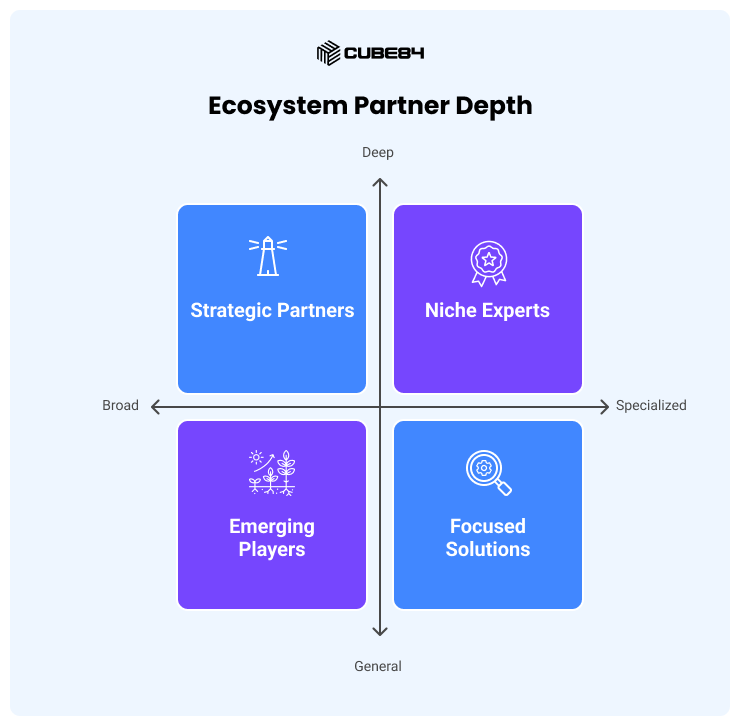
When buyers search for a Salesforce partner, they typically encounter a set of terms that the ecosystem uses interchangeably — but that describe genuinely different orientations, capabilities, and appropriate use cases. Understanding this landscape prevents a common and expensive mistake: hiring the right kind of partner for the wrong kind of problem.
Here is the reality of how these partner types actually work — not as Salesforce defines them in programme documentation, but as they operate in practice on real projects.
The Consulting Partner: Strategy Is Where It Begins
The title 'consulting partner' is the broadest designation in the Salesforce ecosystem. But in practice, the consulting work — the real consulting work — starts before any configuration begins. It is the phase where the most important and often the most expensive decisions are made. And they are made theoretically, on whiteboards and in discovery sessions, before a single field is created in a sandbox.
A consulting engagement for a complex Salesforce project looks like this: a series of structured sessions where a partner works with your operations leadership, your IT team, and your process owners to map how your business actually works — not how it is supposed to work on paper. What data does the sales team actually rely on? Where does the handoff between marketing and sales break down? How does the service team escalate, and what does that look like in the current system?
From those sessions, the partner builds a picture of the gap between your current state and the Salesforce capability that could close it. That picture — the architecture proposal, the phased roadmap, the data model sketch — is still theoretical at this stage. It has not been validated in a sandbox. It has not been tested against your actual data. It exists on slides and in documents.
This is not a weakness of the consulting phase. It is its purpose. The decisions made here determine the quality of everything built later. A consulting partner who rushes through this to get to implementation is saving weeks now and costing months later.
The nonprofit example Take a nonprofit Salesforce partner working with an organisation migrating to Nonprofit Cloud (NPC). For many straightforward NPC implementations — standard objects, Fundraising module, core constituent management — the consulting layer is still present, but it is embedded. It lives inside the discovery calls at the start of implementation. The partner understands NPC well enough to ask the right questions quickly, map the answers to the right objects, and move to build without a separate strategy phase. The consulting work is not absent. It is compressed into the implementation because the partner's product depth makes it possible to do both simultaneously. |
The Implementation Partner: Building What Strategy Designed
An implementation partner takes the architectural decisions made in the consulting phase and executes them on the platform. This is the build phase — configuration, development, data migration, integration, testing, and go-live. The implementation partner is responsible for translating a business requirement into a functioning Salesforce environment.
In practice, most partners that call themselves consulting partners are also implementation partners. The distinction matters most when you are trying to understand what a specific engagement involves. A pure strategy engagement ends with a roadmap and a recommendation. An implementation engagement ends with a live Salesforce environment.
What changes between a simple and a complex implementation is not the sequence of phases but the depth of each one. A straightforward Sales Cloud deployment for a 30-person team has a short discovery phase, minimal custom development, and a focused data migration. An enterprise Service Cloud deployment with complex routing logic, custom portals, and multiple system integrations has a long discovery phase, significant custom development, and a multi-wave migration. The framework is the same. The effort — and the expertise required — is not.
The Development Partner: When the Build Goes Beyond Configuration
Development partners specialise in the layer of Salesforce work that requires code — Apex classes, Lightning Web Components, custom REST APIs, complex integration middleware, and DevOps pipelines for organisations with sophisticated deployment requirements.
Not every Salesforce project needs a development partner. A significant portion of what businesses need from Salesforce can be achieved through declarative tools — flows, validation rules, approval processes, dynamic forms, and standard integrations. A good consulting partner will tell you when you have crossed the line from configuration into development, and whether the custom build is genuinely necessary or whether an AppExchange product solves the problem at a fraction of the cost.
Development partners become the primary resource when a project requires custom business logic that Salesforce's declarative toolset cannot express, a bespoke user interface that standard Salesforce pages cannot deliver, or a system integration with an ERP, data warehouse, or external platform that requires custom API architecture.
RELATED: HOW TO FIND THE RIGHT SALESFORCE DEVELOPMENT PARTNER
The Integration Partner: Connecting Salesforce to the Rest of Your Tech Stack
Integration partners focus on the connections between Salesforce and the other systems in your organization's technology environment — your ERP, your marketing automation platform, your data warehouse, your financial systems, your customer support tools. This is a distinct technical discipline. Building a reliable, maintainable integration between Salesforce and an external system requires deep knowledge of both systems' data models, API architectures, and failure modes.
The most common integration mistakes we see are not in the initial build — it is in the architecture of the connection itself. Point-to-point integrations that work in low-volume testing environments collapse under production load. Synchronous integrations that should be asynchronous become performance bottlenecks. Integrations with no retry logic or error alerting fail silently and corrupt data for weeks before anyone notices.
A capable integration partner designs integrations that are built to fail gracefully — with retry logic, error alerting, monitoring dashboards, and documentation that your internal team or a future partner can understand and maintain.
The Product + Industry Specialist: End-to-End Depth on a Specific Problem
This is where the Salesforce partner ecosystem becomes genuinely powerful — and where the most specialist value lives. A product and industry specialist is a partner whose entire practice is built around a specific Salesforce product in a specific industry context. They are not generalists who happen to have done some nonprofit work. They are partners whose team certifications, project history, and internal methodology are all oriented around one product-industry combination.
What this depth unlocks is end-to-end capability across consulting, implementation, development, and integration — all within the context of a problem they have solved dozens of times before. A nonprofit Salesforce partner who has implemented Nonprofit Cloud twenty times knows the questions to ask in discovery that a generalist would not think to ask until week six of the build. They know which NPC objects map to which donor management concepts, where the edge cases in the Fundraising module surface, how to structure household relationships for organisations with complex constituent profiles, and which AppExchange products work well with NPC and which introduce more complexity than they resolve.
The practical implication: if your project is a standard implementation of a well-supported Salesforce product in an industry the partner knows deeply, you can move faster, with less risk, and with a discovery phase that is embedded in the build rather than preceding it — because the partner's product knowledge carries the consulting work implicitly.
Table 3 — Partner Types in the Salesforce Ecosystem: What Each Does and When to Engage
Partner Type | Primary Focus | When to Engage | What They Cannot Replace |
Consulting Partner | Strategy, architecture, process design | Before any build — when the problem is not yet clearly defined | Technical execution depth |
Implementation Partner | Configuration, build, go-live | When requirements are defined and the build can begin | Upfront architectural thinking |
Development Partner | Custom code, LWC, Apex, DevOps | When declarative tools cannot deliver the required logic or UI | Business process understanding |
Integration Partner | Connecting Salesforce to external systems | When reliability, scale, or complexity of system connections requires specialist design | Deep Salesforce platform knowledge |
Product + Industry Specialist | End-to-end delivery within a specific product-industry combination | When your project maps closely to a product the partner has delivered repeatedly in your industry | Breadth across unfamiliar products or industries |
The reality that most buyers do not account for In practice, the best mid-market and enterprise partners span multiple of these types simultaneously. A strong Crest-tier boutique is consulting when they challenge your requirements in discovery, implementing when they build your org, developing when the business logic requires code, integrating when your ERP needs to connect, and functioning as a product specialist when their vertical expertise means they have seen your exact problem before. The question is not 'which type of partner do I need?' — it is 'does this partner have genuine depth across the types my project requires, and can they show me evidence of that?' |
The Three Core Engagement Types — and What Each One Actually Involves
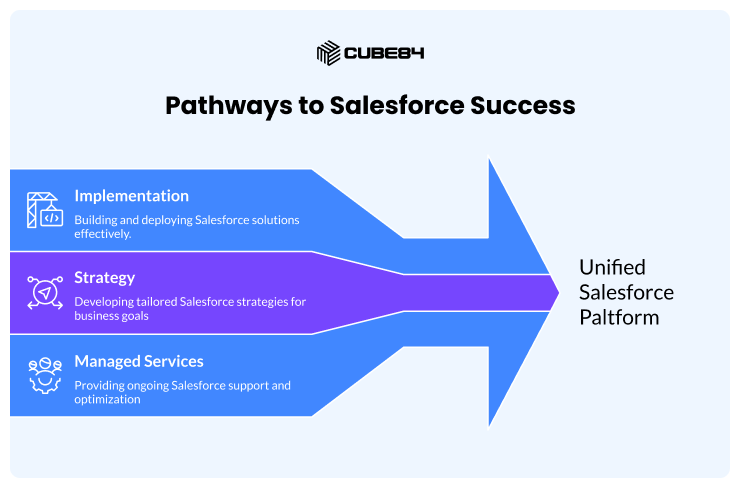
The term 'Salesforce consulting partner' covers three distinct types of work. Most mid-market and enterprise organisations need all three at different points in their Salesforce lifecycle — but they need to know which they are buying before they sign a contract.
Implementation
Implementation is the work of taking Salesforce — which arrives as a configured but largely generic platform — and building it into a system that reflects how your business actually operates. It is the foundational engagement: the point at which your data model, business logic, automation, user experience, and integrations are designed and built.
A Salesforce implementation is not a software installation. It is a business transformation project executed on a software platform. The quality of the outcome depends as much on the partner's ability to understand your business processes as it does on their technical execution.
What Salesforce implementation includes in practice:
Discovery and requirements gathering — structured sessions to map your revenue processes, data model requirements, and user workflows to Salesforce's object model and feature set
Architecture design — decisions about which Salesforce products to use, how objects relate to each other, which automation approach is appropriate, and how the org will scale
Configuration — setting up standard objects, page layouts, record types, validation rules, flows, approval processes, and reports without writing code
Custom development — Apex classes, Lightning Web Components, custom APIs, and integrations that go beyond what declarative tools can achieve
Data migration — moving historical records from your source system into Salesforce with the right structure, relationships, and data quality
Testing and user acceptance — validating that the build reflects business requirements before go-live
Training and go-live support — equipping your team to operate the system from day one
EXAMPLE | Mid-market manufacturing firm — Sales Cloud implementation A manufacturer with 120 sales reps across three regions had been managing their pipeline in a combination of spreadsheets and an underconfigured legacy CRM. The implementation engagement involved mapping their existing quoting and approval process to Salesforce's Opportunity and Approval Process objects, building custom territory assignment logic using Apex, integrating Salesforce with their ERP for real-time pricing data, and migrating four years of deal history. Total engagement: 14 weeks. The business outcome: forecast accuracy improved and manual data entry eliminated across the sales team. |
Strategy and Governance
Strategy engagements address a different problem than implementation. Where implementation is about building, strategy is about ensuring that what you build — and how you maintain it — is aligned with where your business is going, not just where it is today.
Most organizations discover the need for strategy work either before a major implementation (when they need to make sound architectural decisions upfront) or after one (when the system has been live for 12–24 months and has accumulated technical debt, misaligned processes, or an org structure that no longer fits the business).
Strategy and governance work includes:
Salesforce org health assessments — auditing your current configuration, custom code, data model, and automation for technical debt, security gaps, and architecture misalignment
Roadmap planning — mapping your Salesforce investment to business goals over a 12–24 month horizon
Governance framework design — defining who can change what in the org, how change requests are managed, how deployments are controlled, and how data quality is maintained
Product selection guidance — advising on which Salesforce products or AppExchange solutions to adopt, and in what sequence
Organizational design — helping you structure your internal Salesforce team, define roles, and manage the relationship between IT and business stakeholders
EXAMPLE | Professional services firm — post-implementation strategy engagement A management consulting firm had completed a Sales Cloud and Service Cloud implementation 18 months prior. Usage had grown, but the org had accumulated over 300 active flows, inconsistent field naming across objects, and no documented governance process. New features were being built on top of a fragile foundation. The strategy engagement produced an org health assessment, a prioritized remediation plan, a change control process, and a 12-month Salesforce roadmap aligned to the firm's growth targets. |
Managed Services
Managed services is the ongoing engagement model — the relationship that begins after an implementation is complete and ensures that Salesforce continues to evolve with your business rather than drifting behind it.
A managed services relationship is typically structured as a monthly retainer with a defined hours allocation and a clear scope of supported activities. The right partner in a managed services model functions as an extension of your internal team — available for new feature development, bug resolution, user support, and proactive monitoring without the overhead of hiring full-time headcount.
What managed services typically covers:
Ongoing development — building new features, automations, and integrations as business requirements evolve
System administration — user management, security reviews, permission set maintenance, and licence governance
Bug resolution and break-fix — rapid response to issues that affect business operations
Salesforce release management — evaluating and enabling relevant features from Salesforce's three annual releases
Proactive health monitoring — identifying data quality degradation, governor limit risks, and emerging technical debt before they become crises
User training and enablement — keeping new team members current and ensuring adoption of new features
The choice between a dedicated development resource and an on-demand or managed services model depends on your workload volume, system complexity, and operational dependencies. Our guide to dedicated vs. on-demand Salesforce developers covers that decision in detail.
EXAMPLE | Nonprofit organization — managed services engagement A nonprofit running Salesforce Nonprofit Success Pack (NPSP) completed an initial implementation and needed ongoing support without the budget or need for a full-time hire. The managed services engagement covered monthly backlog development (new donation workflows, report builds, integration maintenance), quarterly release reviews, and an annual data quality audit. The retainer provided predictable cost, institutional knowledge continuity, and senior-level access without a full-time headcount commitment. |
Table 4 — The Three Engagement Types: A Decision Framework
Engagement Type | When You Need It | Typical Duration | Primary Output |
Implementation | New Salesforce deployment, major re-architecture, product expansion | 8–20 weeks (project) | A live, configured Salesforce environment |
Strategy & Governance | Pre-implementation planning, post-implementation health check, org re-alignment | 4–8 weeks (project) | Roadmap, health assessment, governance framework |
Managed Services | Ongoing development, admin support, continuous evolution | Monthly retainer (ongoing) | Continuous platform evolution and support |
What a Consulting Engagement Actually Looks Like — Phase by Phase
Most buyers have a vague idea of what a consulting engagement involves. What they rarely see is the full sequence — the decisions that happen before a line of code is written, the governance structures that determine whether a project stays on track, and the handoff activities that determine whether go-live is a beginning or an ending.
Here is what a well-run implementation engagement looks like, phase by phase. Strategy and managed services engagements follow adapted versions of the same structure.
Table 5 — The Consulting Engagement Lifecycle: What Happens in Each Phase
Phase | What Happens | Who Is Involved | Key Output |
Discovery | Partner interviews stakeholders, maps business processes, identifies requirements and gaps | Partner team + IT lead + process owners from Sales, Ops, Finance | Requirements document, data model proposal, scope of work |
Architecture Design | Partner designs object model, automation approach, integration architecture, DevOps pipeline | Solution architect + IT lead | Architecture decision record, technical specification |
Build (Sprints) | Development executed in 2-week sprints. Each sprint ends with a demo reviewed by business stakeholders | Developer team + internal POC | Working Salesforce configuration / code, sprint review notes |
User Acceptance Testing | Business users validate the build against real-world scenarios. Issues documented and resolved | Business users + IT + partner QA | Signed-off UAT checklist, resolved issue log |
Data Migration | Source data audited, mapped, deduplicated, and loaded to Salesforce. Sandbox-tested before production | Partner data team + IT + data owners | Migration execution log, validation report |
Go-Live | Cutover executed per plan. Business users validated. Automation re-enabled. System declared live | Full project team | Go-live execution log, user notification |
Hypercare | Partner provides intensive post-launch support for 2–4 weeks. Issues triaged and resolved rapidly | Partner support team + internal POC | Issue resolution log, handoff to managed services or internal team |
The phase is most often underestimated Discovery is underestimated more consistently than any other phase in a Salesforce engagement. Teams want to get to build as quickly as possible. Partners who allow this — who skip or compress discovery to win a shorter timeline — are setting both parties up for rework. The best consulting partners spend as much time understanding your business as they do building on your platform. Discovery is not overhead. It is work. |
What Differentiates a Good Consulting Partner from an Average One
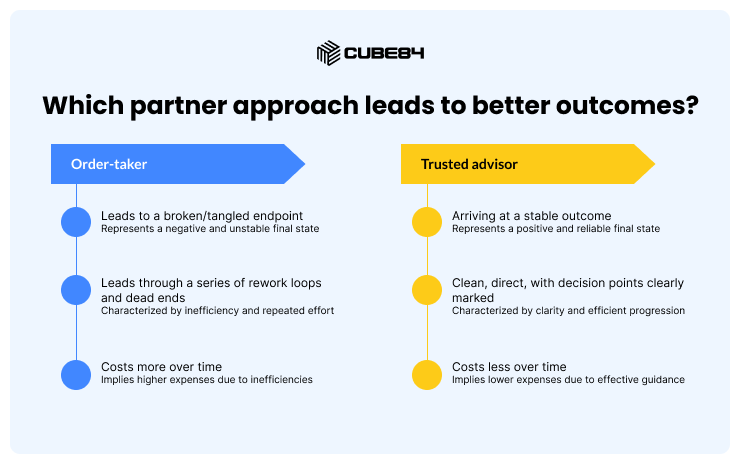
Every Salesforce consulting partner will tell you they are strategic, experienced, and client-focused. The ones who actually are, behave differently in practice. Here is what separates them.
They challenge your requirements — not just fulfill them
A good consulting partner does not simply build what you ask for. They ask why. If your requirements document specifies a solution before it specifies the problem, a strong partner will push back — not to slow the project down, but because they have seen what happens when a technically correct build solves the wrong problem.
This is especially visible in discovery. Average partners treat discovery as a requirements-gathering formality. Strong partners treat it as the most important investment in the engagement — the place where the real business logic surfaces and where the most expensive mistakes are prevented.
They tell you when not to build
One of the most valuable things a consulting partner can do is tell you that the problem you want to solve with custom development is already solved by an AppExchange product — or that the problem itself is not worth solving at the cost you are considering.
Partners who are compensated purely on delivery hours have a structural incentive to build. Partners who are genuinely focused on your outcomes will tell you when an $800-per-year AppExchange licence serves you better than $40,000 of custom code.
Their delivery team matches their sales team
The bait-and-switch — where a senior architect closes the sale and a junior developer executes the build — is one of the most consistent complaints about Salesforce consulting engagements. A trustworthy partner will introduce you to the actual delivery team before contracts are signed, and will give you direct access to the developer or architect who will be working on your account throughout the engagement.
They invest in knowledge transfer, not dependency
A consulting partner who builds systems that only they can maintain is not a partner — they are a vendor. Strong partners document their architectural decisions, write code that your internal team or a future partner can understand, and actively transfer knowledge to your team throughout the engagement. The goal of a good engagement is to make you more capable, not more reliant.
Table 6 — Salesforce Consulting Partner Quality Signals: Green Flags vs Red Flags
Dimension | Green Flag | Red Flag |
Discovery approach | Asks questions about the business process before proposing solutions | Jumps to a solution within 48 hours of receiving your brief |
Scope management | Challenges scope that seems over-engineered; proposes AppExchange alternatives where appropriate | Agrees to build everything without questioning the approach |
Delivery team | Introduces a named developer/architect who will own delivery before the contract is signed | Senior architect in sales meetings; different (junior) team in delivery |
Documentation | Architecture decision records, field mapping documents, and deployment notes | 'We document as we go' with no defined documentation standard |
Knowledge transfer | Actively trains your team, hands over code comments and process notes | Builds in dependency — the system can only be maintained by them |
Post-go-live | Defined hypercare window, SLA, and managed services option | 'We hand off at go-live' with no defined support path |
What CUBE84 Does — and How We Work
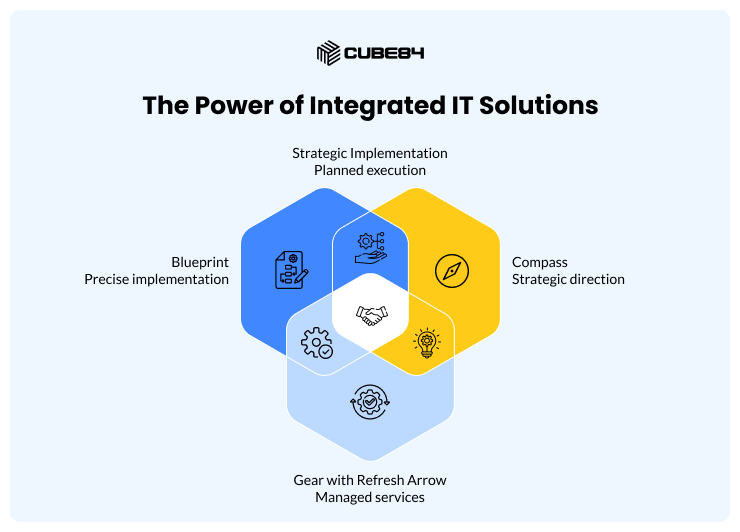
CUBE84 (cube84.com) is a Salesforce Crest consulting partner. We work with mid-market and enterprise organizations across industries, including nonprofit, financial services, manufacturing, professional services, and high-tech — building, optimizing, and supporting the Salesforce environments that power their revenue operations.
We operate across all three engagement types described in this guide: implementation, strategy and governance, and managed services. What does that look like in practice?
Implementation
We build Salesforce environments from the ground up — or re-architect existing ones that have accumulated technical debt. Our implementations span Sales Cloud, Service Cloud, Experience Cloud, Revenue Cloud (CPQ), Nonprofit Cloud (NPC and NPSP), and Marketing Cloud. Discovery is never compressed. Architecture decisions are documented. Delivery teams are named before contracts are signed.
Strategy and Governance
We conduct Salesforce org health assessments, build roadmaps, design governance frameworks, and help organizations make the right architectural decisions before they build. If you have a Salesforce environment that has been live for more than 12 months and you are not sure whether it is serving your business well, a strategy engagement is usually the right starting point.
Managed Services
We offer monthly retainer-based managed services for organizations that need ongoing development, administration, and support without a full-time hire. Our managed services engagements are structured around a named team with institutional knowledge of your org — not a rotating help desk.
How We Work
Every engagement begins with discovery — no shortcuts
Delivery teams are named and introduced before contracts are signed
We tell you when not to build — including when AppExchange serves you better than custom code
We document architectural decisions, not just deliverables
We design for your future team's ability to maintain the system — not for our own continued engagement
A note on our consulting approach We have learned over the years of Salesforce engagements that the most expensive mistakes are made before the first line of code is written. They happen in discovery sessions where no one asks the right process question. They happen in architecture reviews where the right decision was deferred in favour of speed. The value of a consulting partner is not the hours they bill — it is the problems they prevent. |
How to Choose the Right Salesforce Consulting Partner for Your Situation
The right partner for a 20-user Sales Cloud implementation is not the same as the right partner for a multi-cloud enterprise re-architecture. Before you open a formal selection process, your team needs to agree on three things: what type of engagement you need, what tier of partner is appropriate for your scope, and what vetting process you will use to distinguish between firms that look similar on paper.
The Situation-to-Engagement-Type Matrix
Table 7 — Which Engagement Type Do You Need?
Your Situation | Implementation | Strategy | Managed Services |
New Salesforce deployment — greenfield | Primary need | Optional (pre-build) | Post go-live |
Existing org — significant technical debt | Possible (re-architecture) | Start here | After remediation |
Expanding to a new Salesforce product | Primary need | Advisable upfront | After launch |
Ongoing feature development + admin support | Not required | Periodic review | Primary need |
Pre-implementation decision-making (build vs. buy, architecture) | Not yet | Primary need | Not yet |
Post-implementation: system not being used well | Not required | Start here | After alignment |
For a detailed framework on evaluating and selecting a development partner — including the vetting checklist, discovery question bank, and engagement model comparisons — see our guide: How to Find the Right Salesforce Development Partner.
Conclusion: The Right Partner Changes What Is Possible
Salesforce is a platform of extraordinary capability. What it is not, is self-configuring. The distance between a Salesforce licence and a Salesforce environment that actually drives your business forward is filled by the quality of the consulting partner you choose.
Understanding what a consulting partner actually does — the distinction between a reseller and a true partner, the difference between implementation and strategy and managed services, and what the Crest designation signals — is the foundation of a good selection decision.
But the final question is simpler than the taxonomy. Find a partner who asks harder questions than you do, who tells you when not to build, who names their delivery team before the contract is signed, and who measures their success by yours.
That is what a Salesforce consulting partner actually does, when they are doing it right.
Related Reading
→ How to Find the Right Salesforce Development Partner
→ How to Vet a Salesforce Partner: The 2026 Checklist
→ Top 10 Salesforce Consulting Companies in the US in 2026
→ Dedicated vs. On-Demand Salesforce Developer: Which Model Is Right For You?
→ Navigating the Salesforce Consulting Maze: Avoiding Costly Mistakes
→ Salesforce Marketing Cloud Consulting vs. DIY Marketing Strategies
Quick-Reference Glossary
Term | Definition |
Consulting Partner | An external firm that designs, builds, and supports Salesforce environments. Distinct from a reseller, who primarily sells licences. |
Crest Partner | Salesforce's second highest consulting partner tier. Indicates significant certifications, delivery volume, and customer satisfaction scores — verified by Salesforce. |
Discovery | The phase of an engagement where the partner understands your business processes, data, and requirements before designing or building anything. |
Governance | The framework defining who can change what in a Salesforce org, how change requests are managed, and how deployments are controlled. |
Hypercare | The intensive post-go-live support period — typically 2–4 weeks — during which the partner provides rapid issue response before handoff. |
Implementation | A project engagement that builds or re-architects a Salesforce environment. Covers configuration, custom development, data migration, and go-live. |
Managed Services | An ongoing monthly retainer engagement covering development, administration, support, and continuous platform evolution. |
Reseller | A Salesforce partner whose primary function is licence procurement and commercial transactions, not technical implementation. |
Strategy Engagement | A project focused on architectural planning, org health assessment, governance design, or roadmap development — not production builds. |