


Salesforce staff augmentation services are often misunderstood. You’re not outsourcing a full project to a consulting partner. Instead, you’re bringing in external team members who work alongside your internal team and operate under your direction.
On paper, it sounds simple, but in reality, it rarely is. Many teams only realize they’ve chosen the wrong vendor a few months in, when deadlines slip, communication breaks down, or the work delivered doesn’t quite match expectations. By then, the cost isn’t just financial. It’s lost time, frustrated teams, and delayed progress.
In this blog, we’ll walk through patterns we’ve seen across real Salesforce projects. Specifically, what separates vendors who genuinely improve your team’s output from those who simply fill seats, and how to spot the difference before you commit.
Seat-Fillers vs Force-Multipliers: What Actually Separates Good Vendors from Bad Ones
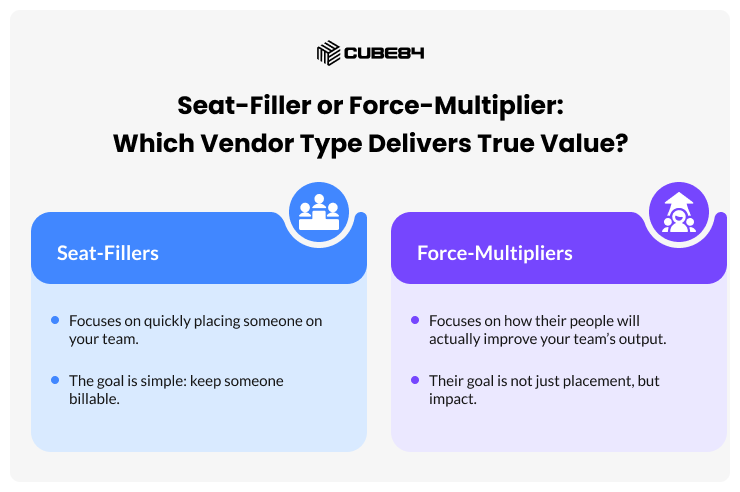
Not all Salesforce staff augmentation vendors operate the same way. Some act as seat-fillers while others act as force multipliers.
A seat-filler vendor focuses on quickly placing someone on your team. The conversation revolves around CVs, hourly rates, and availability. Once the resource is assigned, there’s minimal follow-through. The goal is simple: keep someone billable.
A force-multiplier vendor takes a different approach. They focus on how their people will actually improve your team’s output. They think about how the augmented staff will fit into your workflows, tools, and communication patterns. Their goal is not just placement, but impact.
This distinction matters even more in Salesforce.
The platform spans multiple clouds and specializations, from Sales Cloud and Service Cloud to CPQ, Marketing Cloud, and beyond. A strong vendor aligns talent to your exact setup. A weaker one simply says “we know Salesforce” and assigns whoever is available.
Before You Sign: What Good vs Bad Vendors Reveal in the First Few Conversations
The difference between a good and a bad vendor often shows up before any contract is signed.
A good Salesforce company takes the time to understand your context. They ask about your team structure, backlog, environments, and delivery model. They want to know how you work, whether you follow Scrum, Kanban, or something more flexible. They dig into the specific Salesforce products you use, your integrations, and any constraints.
They also help you think through the kind of roles you actually need. For example, whether your use case requires a CPQ-focused developer, an admin, or a mix of skills.
A weaker vendor moves quickly to CVs and rate cards. They use vague labels like “Salesforce expert” without clarifying what that actually means. Questions about performance management or replacements are often avoided.
The difference becomes obvious in real scenarios. A team working with Education Cloud and complex system integrations needs a very specific skill set. A strong vendor will recognize that immediately. A weaker one will not.
Onboarding Is Where It Breaks (or Works): Why Integration Matters More Than Access
Even with a good vendor, the engagement can fail if onboarding is handled poorly. Strong vendors treat onboarding as a structured process. The first one to two weeks are planned out. This includes setting up access, walking through environments, understanding key workflows, and aligning on how work will be delivered.
Their team members actively join your standups, sprint reviews, and communication channels. Expectations are documented clearly, from coding standards to how work is reviewed and completed. There is usually a gradual transition from observing to owning work.
Weaker vendors tend to treat onboarding as a one-time setup. Once access is granted, there is little follow-up. Their team works in isolation, with minimal integration into your processes. It's places like this where misalignment often begins.
Skills, Seniority, and Bench Depth: What Actually Matters in Salesforce Staff Augmentation
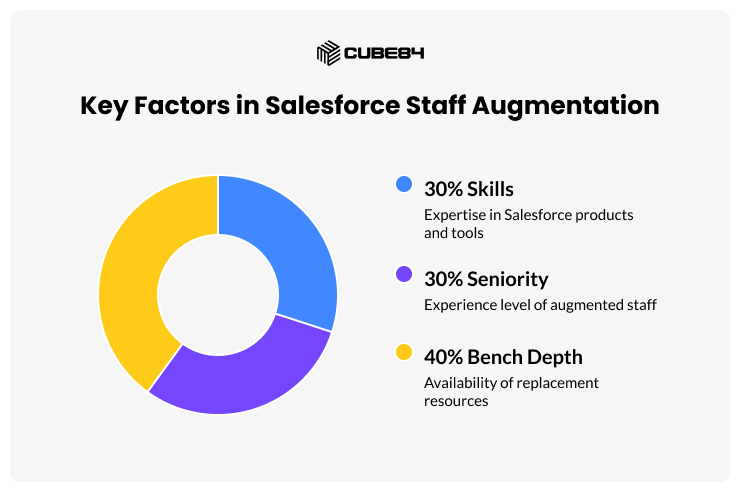
Salesforce staff augmentation is not just about adding more people. It’s about adding the right people.
Strong vendors can clearly explain the roles they are providing and why those roles fit your needs. They talk in specific terms about Salesforce products, tools, and implementation approaches. They also have the depth to replace a resource if needed, without starting from scratch.
Weaker vendors blur these distinctions. Roles are loosely defined. Junior resources may be positioned as senior. Replacement options are limited, which can leave you stuck if the engagement isn’t working.
A simple way to test this is to ask about past projects. If a vendor cannot clearly explain how they handled a similar Salesforce setup, that’s usually a sign to look deeper.
Communication and Ownership: Who’s Actually Steering the Work?
Staff augmentation works best when ownership is clearly defined.
In a healthy setup, your internal team leads define priorities and accept work. The vendor supports execution, brings technical expertise, and helps maintain quality. There is a shared understanding of how work flows and who is responsible for what.
Good vendors actively participate in this structure. They join conversations, flag risks early, and communicate openly when something needs to change.
Weaker vendors tend to stay at the ticket level. Work gets done, but without context or direction. Over time, this creates what can be thought of as a steering gap. Work is happening, but no one is actively guiding outcomes, priorities, or technical direction.
Staff augmentation alone cannot fix that gap. Strong vendors will call it out early. Weaker ones will not.
The Day-30 Reality Check: Are You Getting Value or Just Filling Seats?
One of the simplest ways to evaluate a vendor is to step back after the first 30 days and assess what has actually changed.
Ask yourself:
Can you clearly describe the business value your augmented team delivered?
Do they understand your system well enough to suggest improvements?
Has communication settled into a predictable rhythm?
Would the engagement remain stable if your internal lead stepped away?
Strong vendors tend to show early signs of ownership and impact. Weaker ones often remain reactive and dependent on constant direction.
Interestingly, a good vendor will not resist this kind of evaluation. They will expect it.
How to Set Up a Staff Augmentation Engagement That Actually Works
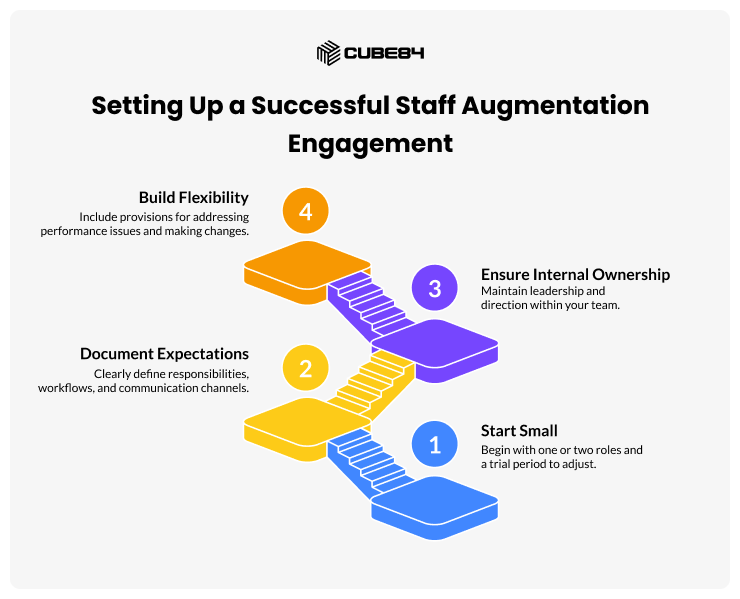
Even the best vendor needs the right setup to succeed.
Start small. Begin with one or two roles and a defined trial period. This allows both sides to adjust before scaling further.
Document expectations clearly. Define responsibilities, workflows, and what “done” looks like. Establish communication channels and review processes early.
Make sure you have internal ownership. Staff augmentation supports your team, but it does not replace leadership or direction.
And importantly, build flexibility into your agreement. There should always be a clear path to address performance issues or make changes if needed.
A Simple Checklist to Evaluate Any Salesforce Staff Augmentation Vendor
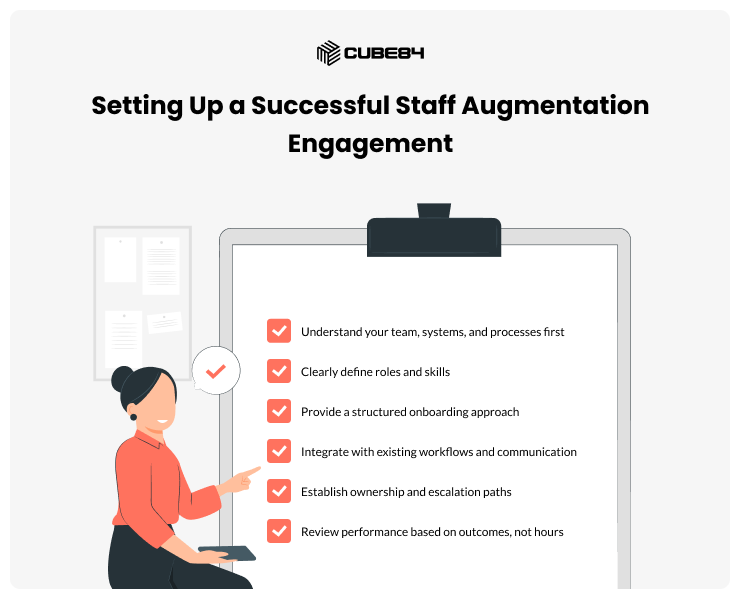
To make this easier, you can use a structured evaluation approach.
A strong vendor will:
Take time to understand your team, systems, and processes before discussing rates
Clearly explain the roles and skills they are providing
Offer a structured onboarding approach
Integrate into your workflows and communication channels
Define ownership and escalation paths
Be open to reviewing performance based on outcomes, not just hours
To help with this, we’ve put together a Salesforce Staff Augmentation Vendor Evaluation Workbook. It gives you a practical way to score vendors across discovery, onboarding, communication, and real outcomes after 30 days.
It also includes:
A structured vendor scoring checklist
A Day-30 reality check framework
A side-by-side vendor comparison sheet
A readiness checklist before you even begin
You can use it to evaluate any vendor you’re considering, including CUBE84, and make a more confident decision.
Conclusion
Choosing the right Salesforce staff augmentation services vendor isn’t just about finding someone who can start quickly or fits your budget. It’s about finding a partner whose people can actually plug into your team, understand your system, and contribute in ways that move things forward.
The difference between a strong engagement and a frustrating one usually shows up early. It’s visible in how vendors approach discovery, how their team integrates during onboarding, and whether they take ownership beyond just completing assigned tasks. Taking the time to evaluate these aspects upfront can save a lot of time and effort later.
If you came across this blog while trying to figure out how to choose the right vendor, you’re probably already asking the right questions. And if you’d like to talk through your specific setup or get a second perspective on what might work best, feel free to reach out to us.