

Across North American campuses, CIOs are expected to improve student experience, accelerate admissions decisions, and enable credible data and AI initiatives within flat or shrinking budgets.
In most institutions, recruitment, admissions, advising, advancement, and service teams operate in Salesforce, while academic and student data reside in Ellucian Student powered by Banner or Colleague. This creates a fragmentation that our Salesforce consulting team for Higher Education often solves by aligning system roles with institutional goals. When enrollment status changes, financial holds are placed, or academic milestones are reached, that information must surface quickly in Salesforce so staff can act without delay.
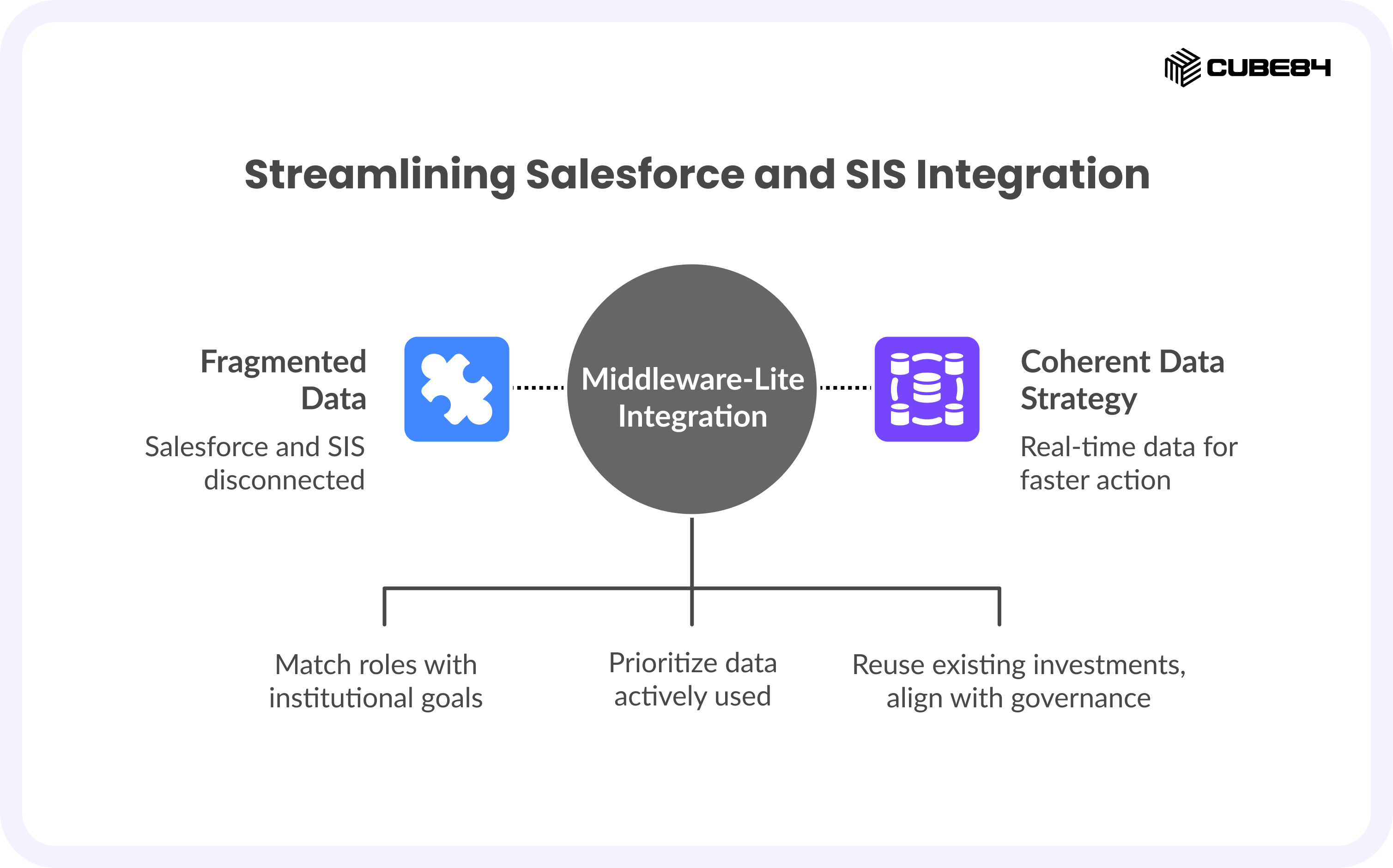
Institutions often respond by implementing large ESB or ETL platforms to link SIS and Salesforce, only to find that most of the desired impact depends on a small set of high-value data flows. Those platforms introduce ongoing licensing and support costs that are difficult to justify when only a handful of flows drive measurable outcomes.
This calls for a near real-time bidirectional connection focused only on the data actively used in recruitment, advising, advancement, and operations, without hardwiring SIS schema into downstream systems or expanding the middleware footprint.
The sections below outline three pragmatic, middleware-lite integration patterns that reuse existing investments, align with governance and security expectations, support a coherent data and AI strategy, and can deliver measurable results within 60 to 90 days.
Ellucian vs Salesforce: Let Each System Do Its Job
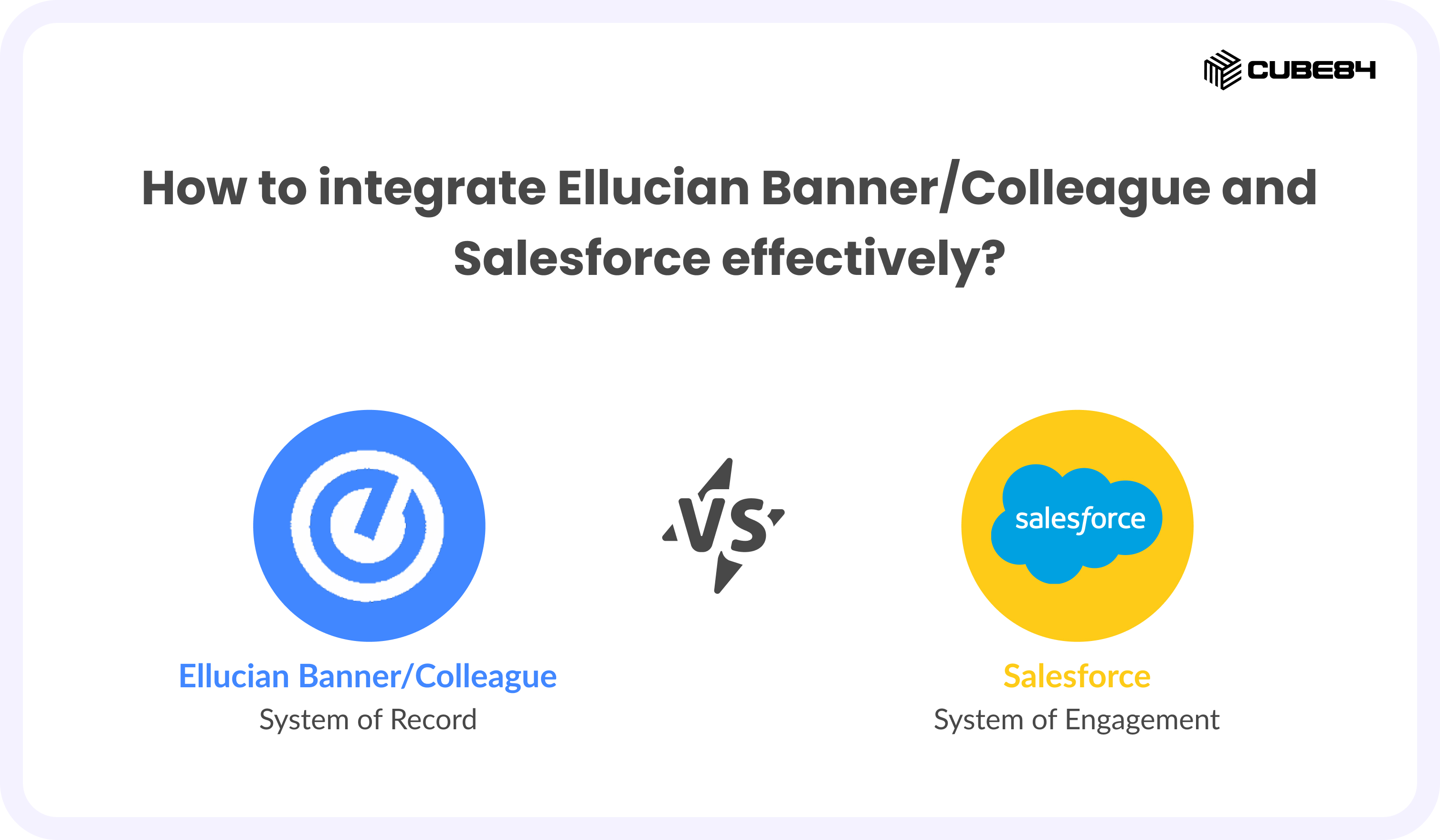
Ellucian Banner or Colleague, and often the central data warehouse, are systems of record. They hold authoritative data such as grades, enrollment status, financial aid, billing, academic standing, and FERPA-sensitive attributes. They are built for accuracy, compliance, and transactional integrity.
Salesforce is the system of engagement. It manages recruitment outreach, admissions workflows, advising notes, service cases, student success tasks, and advancement interactions. It is built for action, visibility, and coordinated workflows across teams.
When these roles blur, cost, risk, and reconciliation work increase.
Follow a Data Minimalist Approach
Do not replicate the entire SIS in Salesforce.
Instead:
Sync only the data used to drive decisions and workflows
Expose the rest through governed views or external objects, such as warehouse-backed OData endpoints via Salesforce Connect
Keep sensitive or low-use attributes in the system of record unless there is a clear operational need
This reduces storage and API cost, limits exposure of sensitive student data, simplifies security design, and supports a cleaner analytics and AI architecture.
Make Source-of-Truth Rules Explicit
Document:
Which system owns enrollment status, program, and academic standing after matriculation
Whether Salesforce or SIS masters attributes during prospect and applicant stages
How advising notes and service interactions flow, if at all, back to SIS
How conflicts are resolved
Ownership can shift by lifecycle stage:
Prospect: Salesforce owns engagement
Applicant: SIS owns application status; Salesforce drives communications
Enrolled: SIS owns academic and financial status; Salesforce drives workflows
Explicit ownership rules reduce reconciliation work, prevent shadow updates, and strengthen governance credibility.
Three Middleware-Lite Patterns for Connecting SIS and Salesforce
Approach | Best Used When | What You Already Own | Time to Visible Impact | Key Trade-Offs |
Ethos as Your Integration Hub (API-First) | You run Ellucian Banner or Colleague with Ethos or Data Connect and want a vendor-aligned backbone | Ethos, Data Connect, monitoring, internal integration and data teams | 1 to 2 high-value flows live within 1 to 2 semesters as legacy jobs are migrated | Deeper alignment with Ellucian architecture; requires in-house Ethos design and operations skills |
Higher-Ed Integration Platforms (Lightweight Connectors) | You need quick wins and have limited integration capacity | Salesforce, Ellucian Banner or Colleague, and a vendor with higher-ed specific connectors | 1 to 3 recruitment or student success flows live within one admission cycle | Subscription cost, vendor dependency, formal security and FERPA review required |
SIS or Warehouse as an External Data Source (Direct Connect) | You have a mature warehouse and strong DBA or data engineering teams | Curated reporting database or warehouse, secure OData or SQL exposure, Salesforce Connect | Weeks for read-mostly views; longer for controlled write-back services | Salesforce Connect limits, external performance dependency, careful security and data platform alignment required |
The right choice depends on existing investments, internal capability, and how you want SIS integration to support modernization over the next three to five years.
Ethos as Your Integration Hub
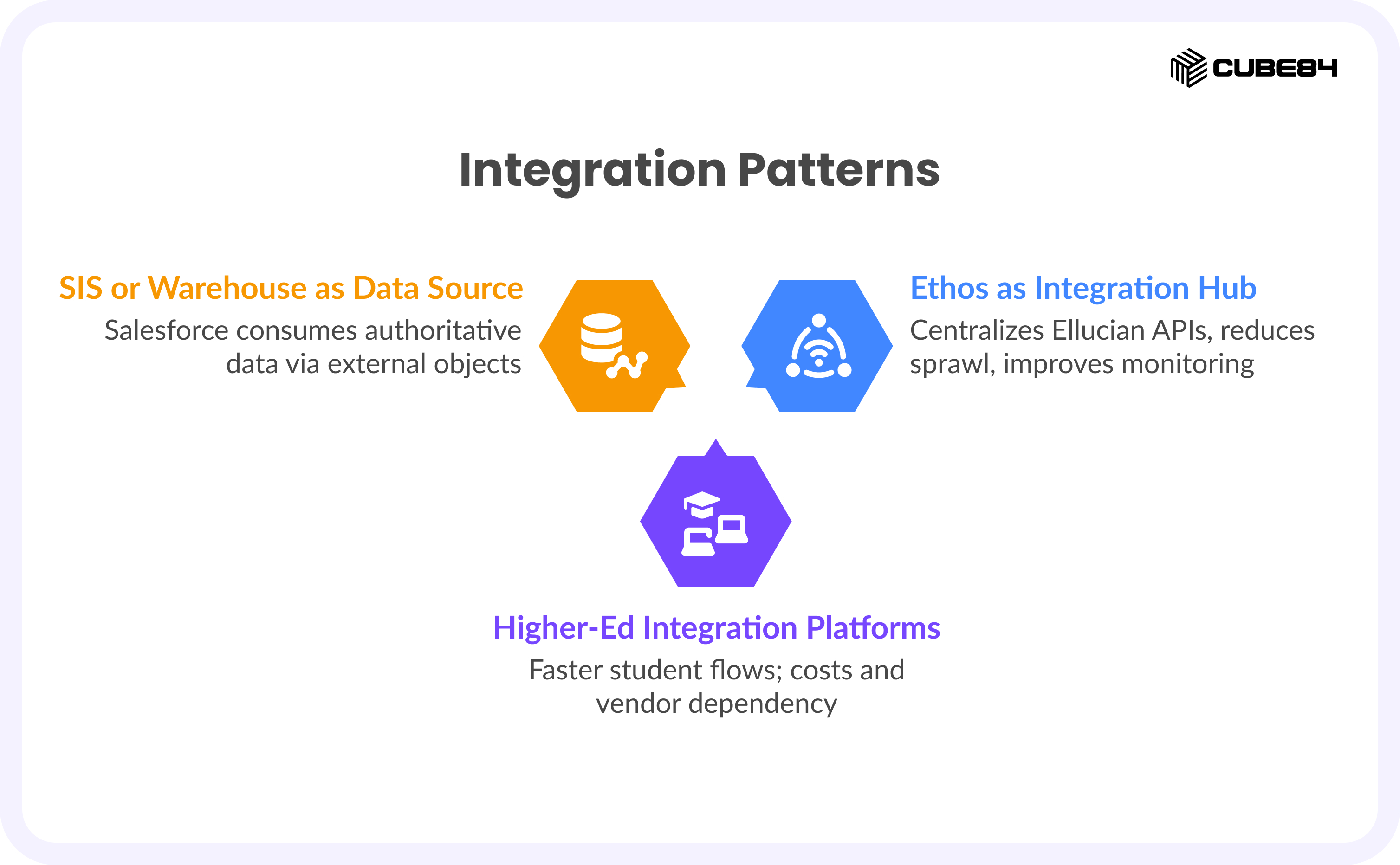
This pattern centralizes integration around Ellucian’s API and event model rather than custom scripts.
Instead of maintaining multiple point-to-point jobs, Ellucian Banner or Colleague publishes standardized entities through Ethos, and Salesforce consumes from the hub. Integration sprawl decreases, monitoring improves, and SIS upgrades introduce less disruption. This path favors institutions seeking tighter vendor alignment and reduced long-term integration cost.
Higher-Ed Integration Platforms
This pattern prioritizes speed.
Prebuilt Ellucian Banner or Colleague to Salesforce connectors accelerate delivery of common recruitment and student success flows. Enrollment and advising teams gain faster visibility, often within a single admission cycle. The tradeoff is subscription cost and vendor dependency, which must be governed carefully.
Connectors such as Lingk are purpose-built for higher education and offer preconfigured SIS-to-Salesforce data pipelines. Broader enterprise iPaaS platforms such as MuleSoft, Boomi, Workato, Informatica IICS, or Azure Logic Apps are also commonly used when institutions want reusable orchestration across multiple systems.
SIS or Warehouse as an External Data Source
This pattern treats Salesforce as a consumer of authoritative data rather than a parallel store.
Curated views are exposed securely and surfaced in Salesforce as external objects instead of copied records. Storage and duplication remain controlled, and operational users see the same governed data as institutional research. This approach works best where the warehouse is already the backbone of analytics and AI strategy.
Common Integration Mistakes to Avoid
Implementing an enterprise ESB or iPaaS solely to connect SIS and Salesforce without a funded, multi-system roadmap.
Allowing departments to implement their own automation tools outside central IT, security, and data governance.
Relying on undocumented SQL or ETL jobs with no monitoring, ownership, or succession plan.
Syncing every SIS field into Salesforce without a defined operational use case.
Security, Compliance, and Risk
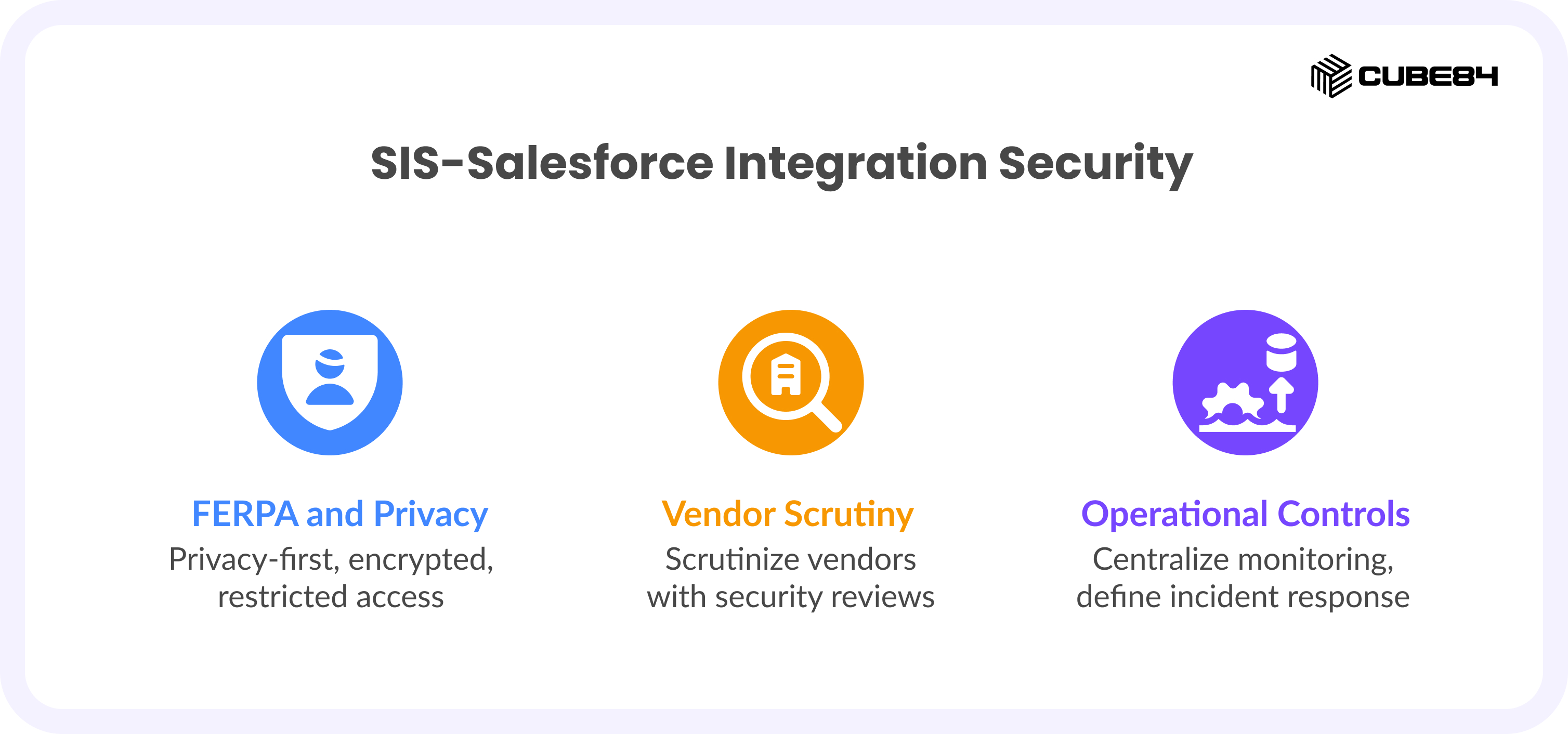
SIS–Salesforce integration moves regulated student data. Security and compliance must be built into the architecture, not layered on later.
Design for FERPA and privacy by default
Encrypt data in transit and at rest. Treat integration vendors and cloud platforms as fully subject to FERPA obligations. Restrict access to financial aid, conduct, disability, and health-related data through strict field-level and role-based controls.
Apply the same vendor scrutiny you apply to core systems
Run connector and iPaaS providers through formal security and procurement review. For Canadian institutions, ensure architecture and contracts align with provincial privacy and data residency requirements such as FIPPA.
Operational controls
Avoid one-off scripts running under personal accounts. Centralize logging, monitoring, and access control. Define clear incident response paths when integrations affect admissions, registration, or advising workflows.
A 60-Day Plan to Execute Your First Integration
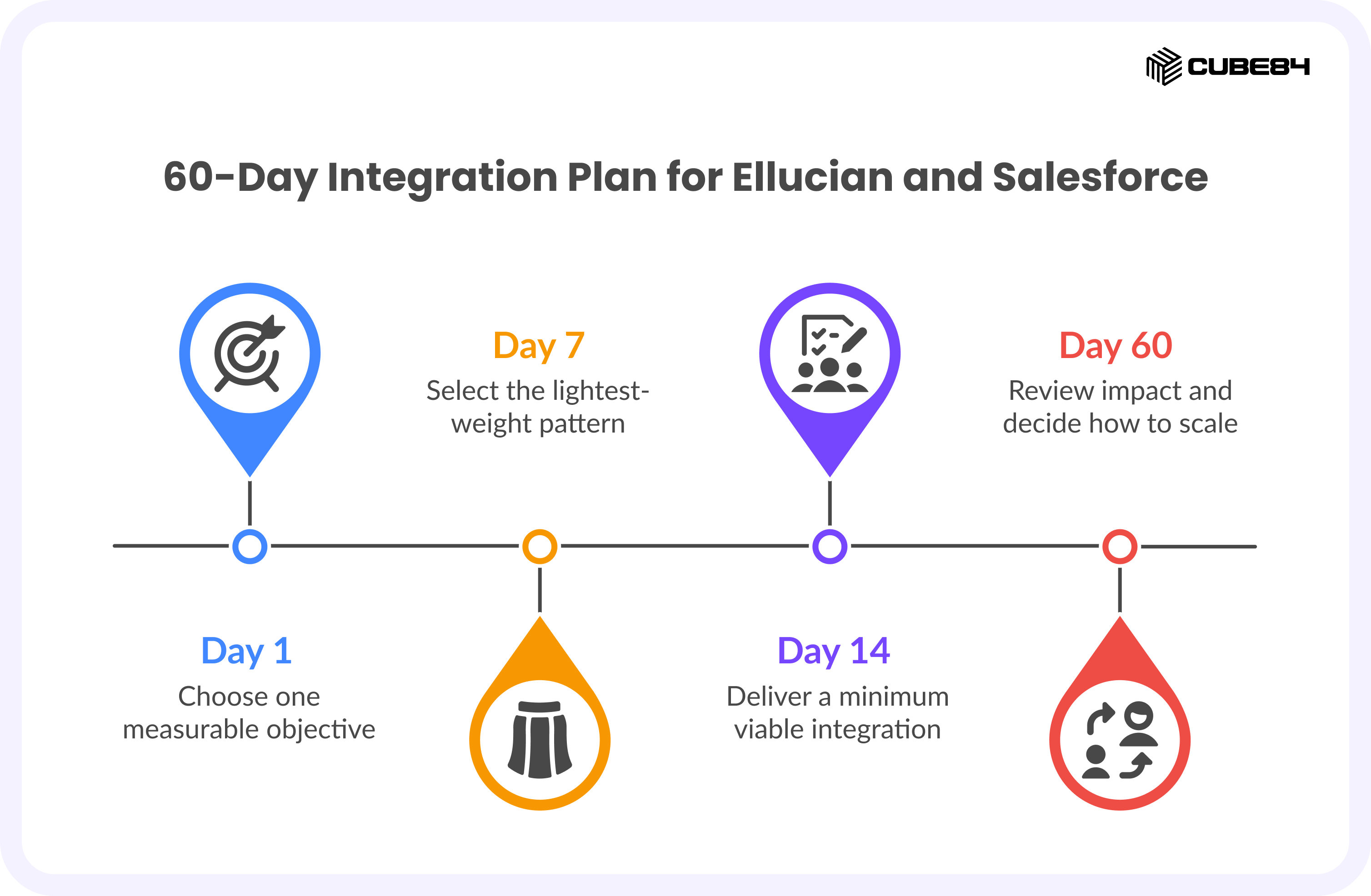
1. Choose one measurable objective
Select a single institutional outcome:
Reduce admissions decision lag by three to five days
Give advisors a unified view of first-year at-risk students
Eliminate manual reconciliation between SIS and Salesforce
If the objective is unclear, scope will expand and stall progress.-
2. Select the lightest-weight pattern that fits your reality
Match the pattern to your existing assets and capacity.
If Ethos or Data Connect is already in place and the integration team has bandwidth, migrate one or two high-value flows into that hub.
If integration capacity is constrained but a budget exists, use a higher-ed connector for a defined recruitment or student success scope.
If the warehouse and data engineering team are strong, prioritize the direct-connect pattern to surface governed data in Salesforce quickly.
Avoid designing for every future scenario. Design for the chosen outcome.
3. Deliver a minimum viable integration
Form a small cross-functional team across integration, data, functional leadership, and Salesforce.
Implement only the flows required for the selected metric. Include monitoring, logging, runbooks, and clear operational ownership from day one.
4. Review impact and decide how to scale
Within one term, report back to IT strategy and data governance bodies with measurable results:
Cycle time improvement
Error rates
Data quality indicators
User adoption and feedback
Use these results to decide whether to extend the same pattern or apply a different one.
The real risk is not the connection between Ellucian Banner or Colleague and Salesforce. It is the cost and fragmentation created when integration is over-engineered or left incomplete.
A middleware-lite strategy that reuses existing investments, aligns with governance, and supports your data and AI agenda can deliver visible gains within a single term. Integration is not a one-time project. It is an architectural discipline practiced deliberately, with cost, modernization, and risk always in view.
Next Steps and Resources
These resources expand on architectural, governance, and AI decisions that shape long-term Salesforce cost and performance in higher education.
1. The Biggest Mistakes Universities Make When Using Salesforce
A look at structural and governance missteps that increase cost, create shadow processes, and limit long-term scalability.
2. 5 Ways Salesforce Einstein Analytics Is Transforming Higher Education Reporting
A view of how Salesforce analytics supports better reporting, cross-department visibility, and data-informed decision-making.
3. The Ultimate Guide to Salesforce for Higher Education
An overview of how Salesforce supports recruitment, advising, advancement, and service, and the architectural choices that influence integration strategy.
4. Unlock Agentforce with Salesforce Data: A Guide for Higher Education
A guide on how governed, integrated data enables AI agents and automation across student and advancement workflows.