
January 2027 is an odd-numbered year, which makes the unsheltered count a requirement rather than an option. Planning starts in the fall.
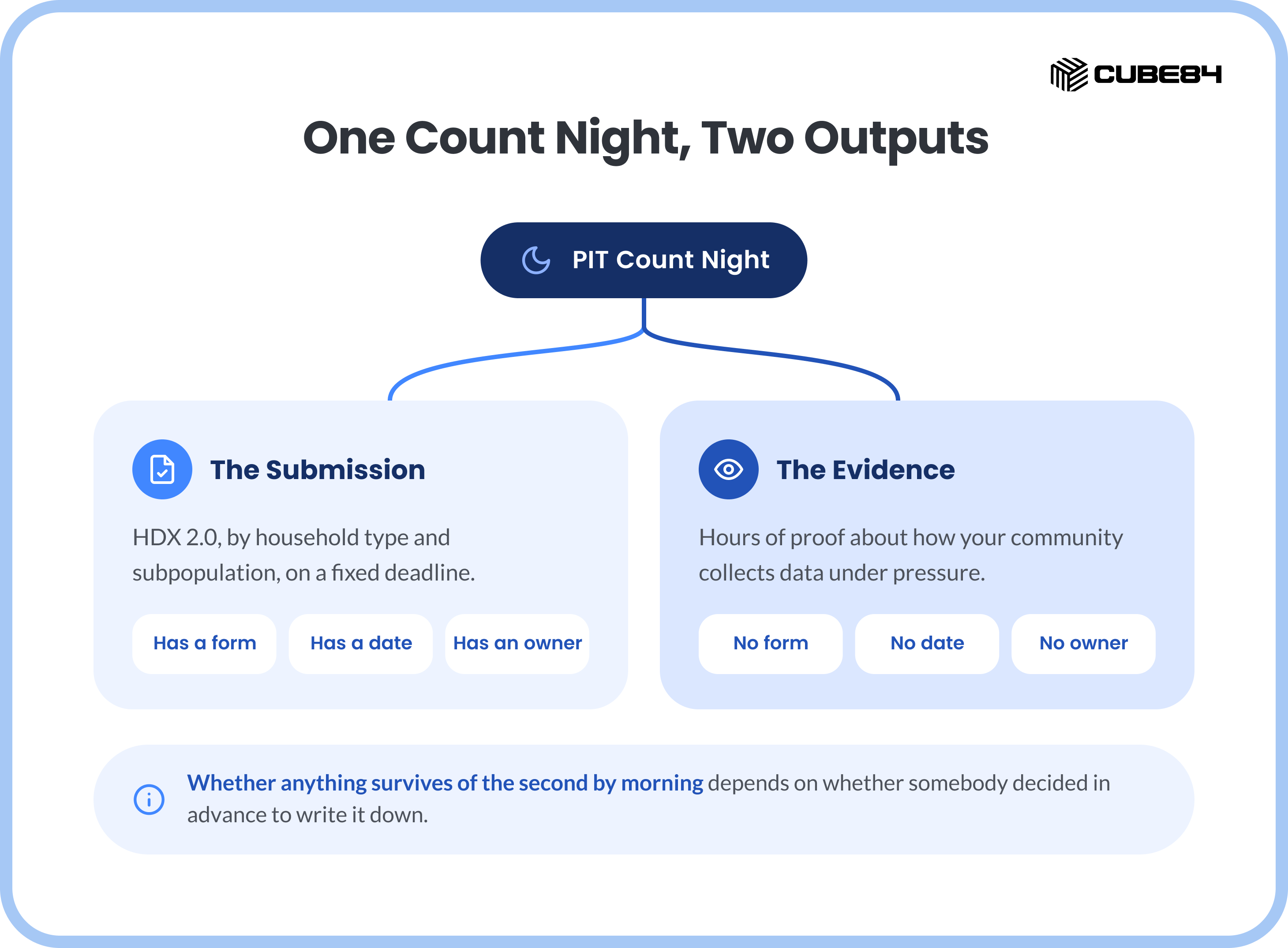
So this is the season to decide what you want out of the night, because the count produces two outputs. The first is the submission. The second is several hours of evidence about how your community collects data under pressure, generated by dozens of people at once, in the open, where anyone can watch how it goes.
The first output has a form, a deadline, and an owner. The second has none of those. Whether anything survives of it by morning depends on whether somebody decided in advance to write it down.
The Count Is Understandably Treated First as a Compliance Exercise
HUD requires a sheltered count every year and an unsheltered count every other year, in odd-numbered years. It sets the methodology. It receives a submission through HDX 2.0, broken out by household type and subpopulation, and that submission has to hold up to scrutiny.
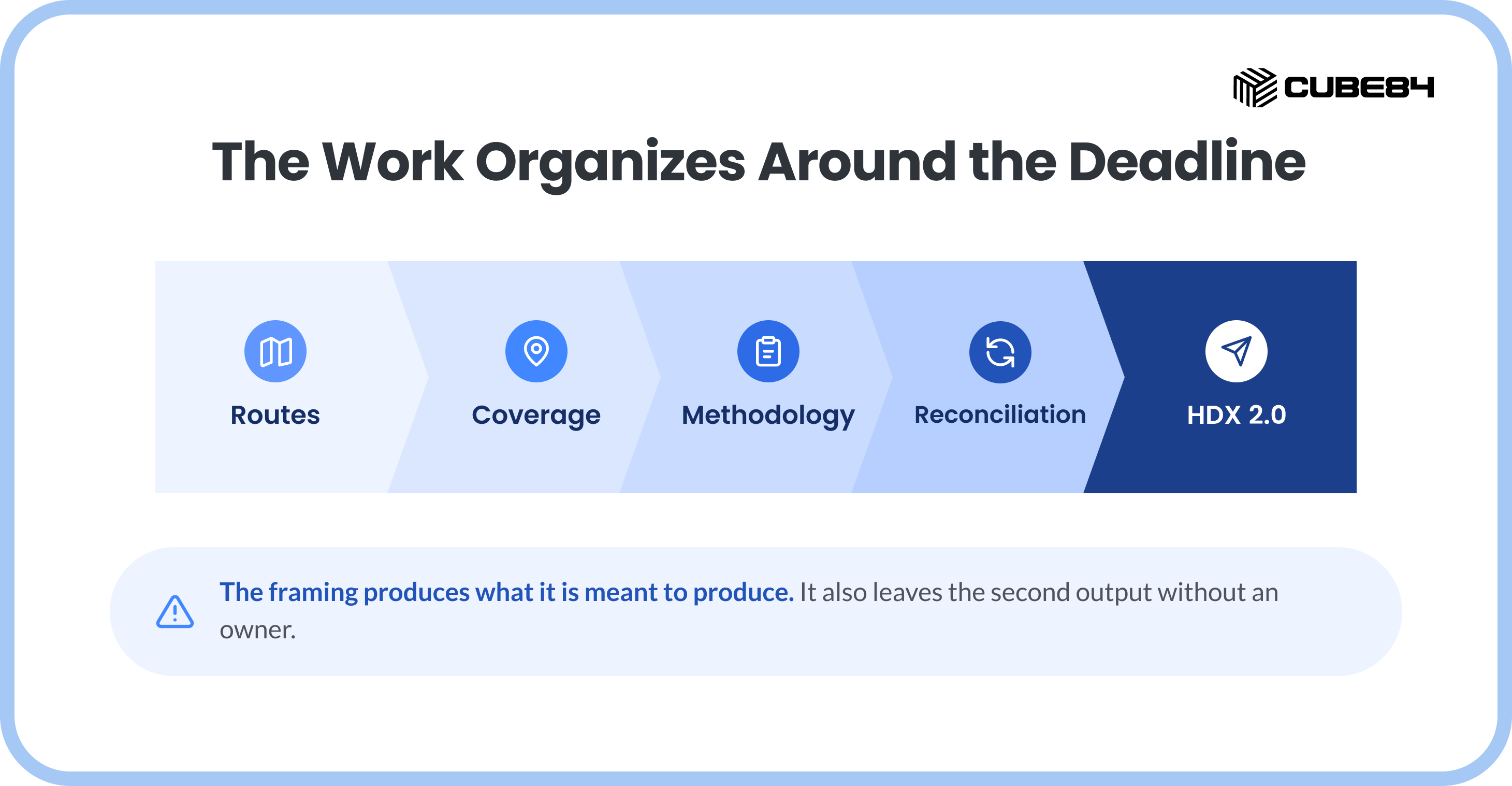
That is a real obligation with a real deadline, and putting it first is correct. The work organizes around it: routes, coverage, methodology, reconciliation, submission. Under that framing, the natural debrief question is whether the count came in high or low, and how that will read to the funder and the board.
The framing produces what it is meant to produce, which is a defensible submission. It also leaves the second output without an owner. Nothing in the design of the night captures it, so capturing it has to be a decision somebody makes on purpose.
What Count Night Tests
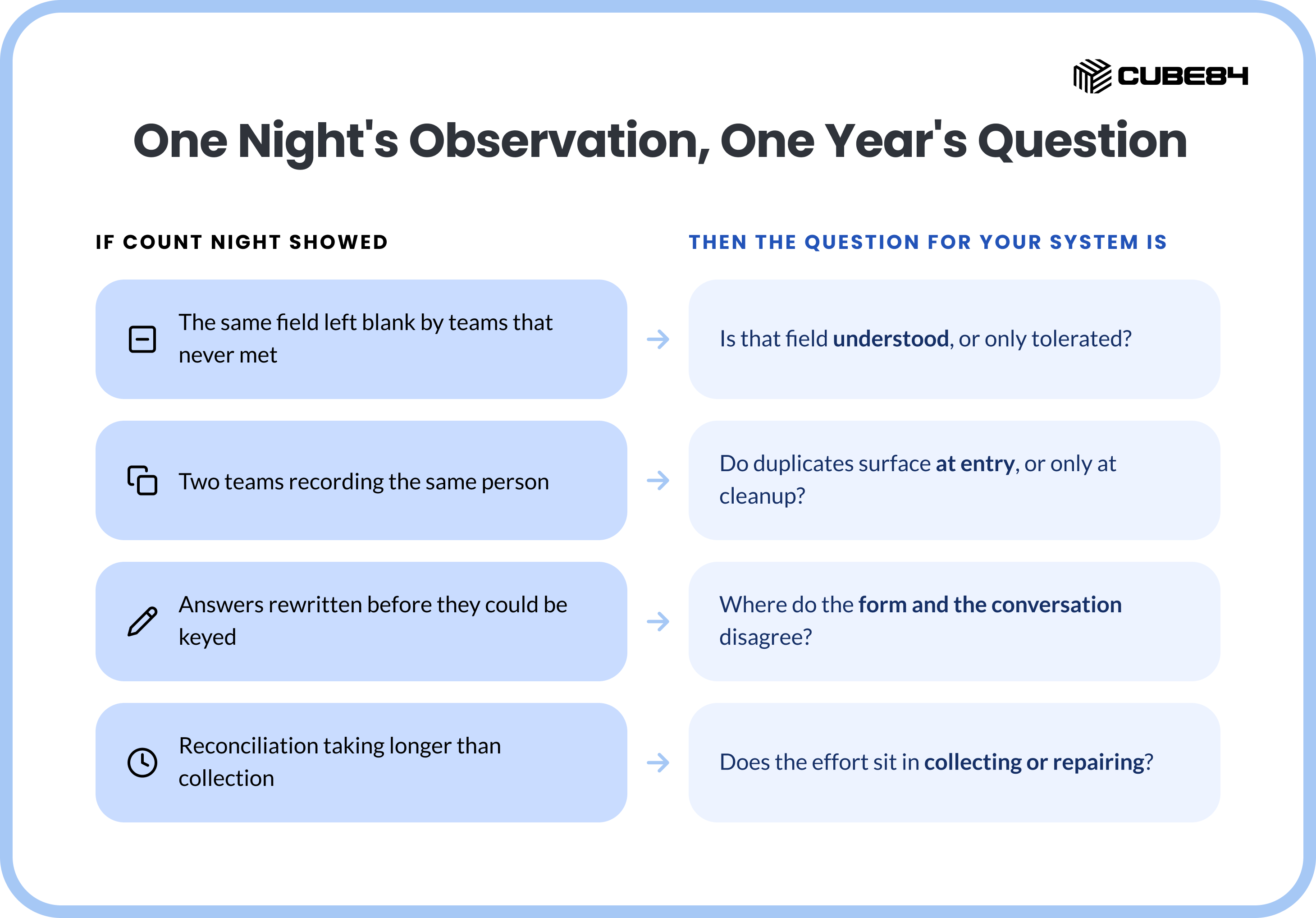
Set the obligation aside for a moment and look at the count as an operation. Dozens of people, most of them untrained in your data standards, put a fixed set of questions to a person in a difficult setting, under time pressure, and hand the answers to somebody who has to make them consistent enough to submit.
Be precise about what that tests, because the loose version of this argument overreaches. A count survey is short, observational, and administered once by a volunteer. HMIS intake is longer, consented, bound by data standards, and handled by trained staff inside a system that validates as it goes. The night is not a test of your case managers.
It is a test of what sits underneath them. Whether a question can be asked and answered the same way by people who have never met. Whether two records of the same person can be told apart. How much repair the data needs once it is collected. Those are properties of the instrument, and they hold for the other 364 days too.
Each row turns one observation from the night into a question about the rest of the year, answerable without changing anything about the count. When reconciliation runs longer than collection did, the cost has moved from gathering data to repairing it, the pattern this sector knows best from the scramble that arrives at APR and CAPER time.
A Field a Volunteer Gets Wrong at Eleven at Night Is a Field Somebody Reads Cold in March
This is the connection worth holding onto.
A field that a volunteer reads cold, under pressure, and gets wrong is likely a field a new case manager reads cold in March and also gets wrong. Not because the two jobs are the same. Because it is the same field, with the same wording, asked of the same population.
What changes is who is watching. In March, one person misreads one field and nobody sees it until a report is due. On count night, dozens of people meet that field within the same few hours, separately, with no chance to compare notes. A weakness in the wording stops looking like an individual mistake and starts looking like a pattern, because that is what it was the whole time.
Count night hands you that pattern at no cost, in a sample you could not commission and could not afford. It feels like it does not count because it happened outside the system, and anything that happens outside the system leaves no record. That is the architecture problem CUBE84 set out in a webinar on housing systems built to report rather than to run, reaching one night further than the daily workflow.
Keep the Method. Keep the Clipboard. Change the Week After.
None of this is an argument for changing the count, and that is worth stating plainly, because advice in this sector often arrives as a suggestion to buy something.
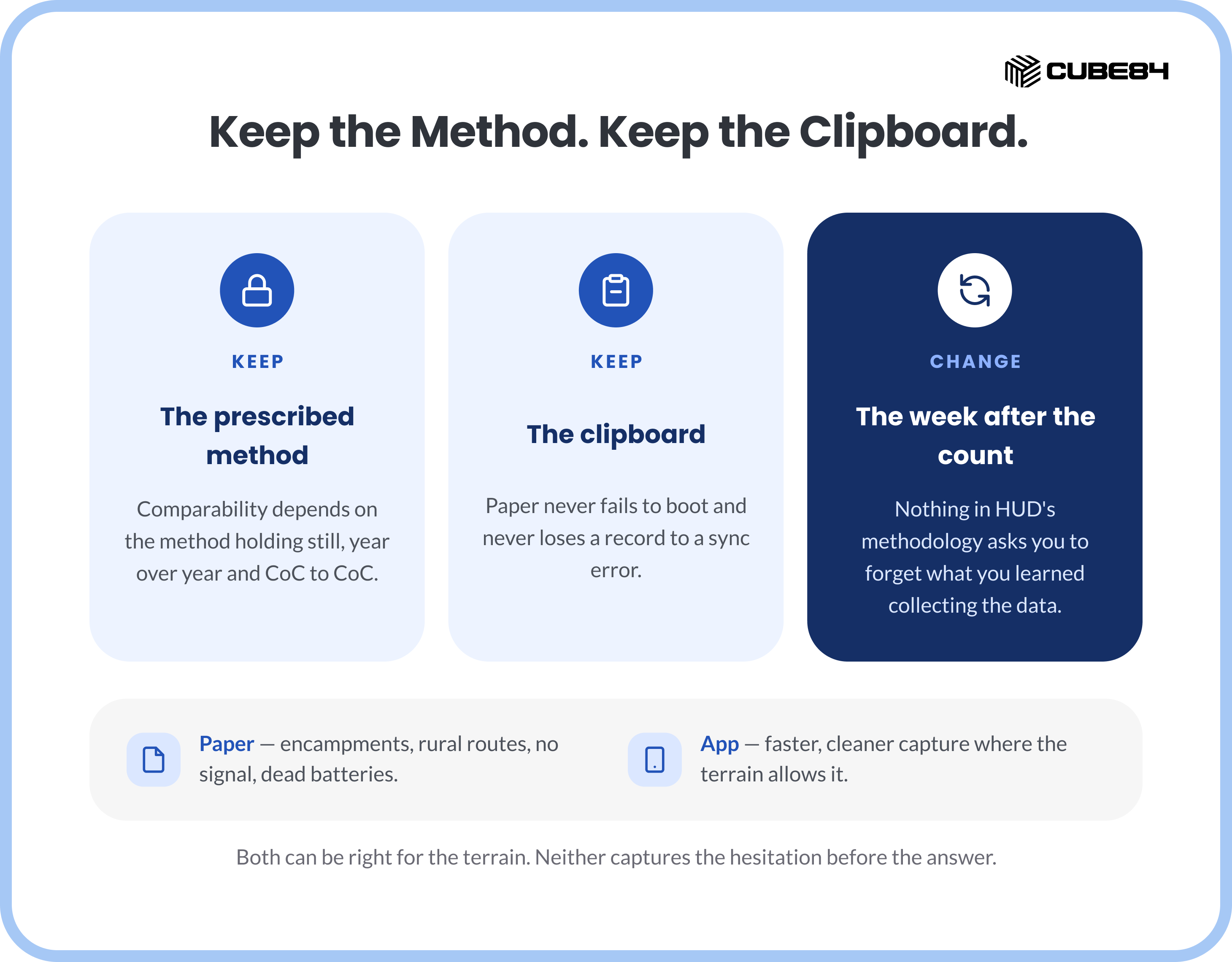
Comparability is why the method is prescriptive. The count's value as a national instrument depends on the method holding still. A CoC that redesigns its count into a better internal diagnostic damages its own year-over-year series and its comparability with every other community. Methodology drift is a real failure mode, and a coordinator who resists it is protecting something worth protecting.
Paper deserves the same defense. Encampments, rural routes, parking structures, underpasses. No signal, cold hands, dead batteries, volunteers handed a device they have never opened. A clipboard never fails to boot and never loses a record to a sync error. Where a count runs on paper, that is usually an engineering decision rather than an oversight. Other CoCs have gone the other way. Both choices can be right for the terrain.
The mode changes nothing about the argument. An app captures the answers faster and cleaner than a clipboard does. Neither captures the hesitation before the answer: which question a volunteer had to rephrase twice, which field a team stopped asking after the third refusal, where the form and the conversation pulled apart.
So keep the paper. Keep the prescribed method, without a single change to it. Change what happens in the week afterward. Nothing in HUD's methodology asks a CoC to forget what it learned while collecting the data.
Knowing Which Fields Are Broken Was Never the Hard Part
An HMIS lead reading this has an objection ready, and it is the right one. Nobody needs count night to discover that a field is unreliable. The data quality reports say so every month.
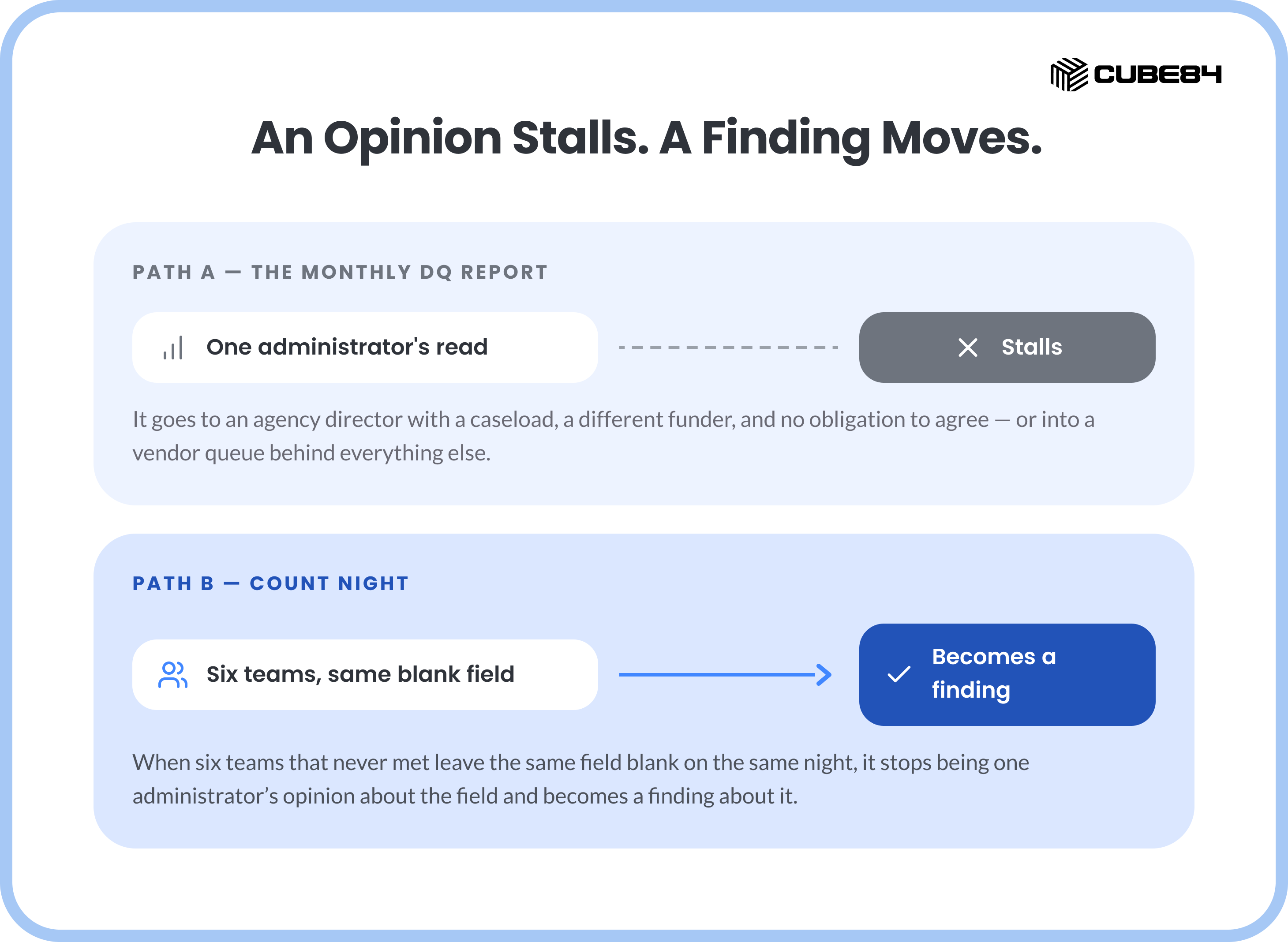
The gap is not knowledge. It is standing. A DQ report is one administrator's read, going to an agency director who has a caseload, a different funder, and no obligation to agree. Requests can stall there, or stall in a vendor queue behind everything else.
Count night produces something a DQ report cannot. When six teams that never met leave the same field blank on the same night, that stops being one administrator's opinion about the field and becomes a finding about it. The case for the hour is not discovery. It is evidence.
Capacity is the constraint that kills most good intentions in this sector. The people who could run a debrief are the same small group who worked through the night and still have the submission ahead of them. Which is why the version below runs to one hour and seven steps, and why the first step happens before count night.
The Debrief That Has to Happen Within a Week of the Count
Memory of a night like that decays fast, and the forms get filed. The whole intervention is a short, structured conversation held before either happens.
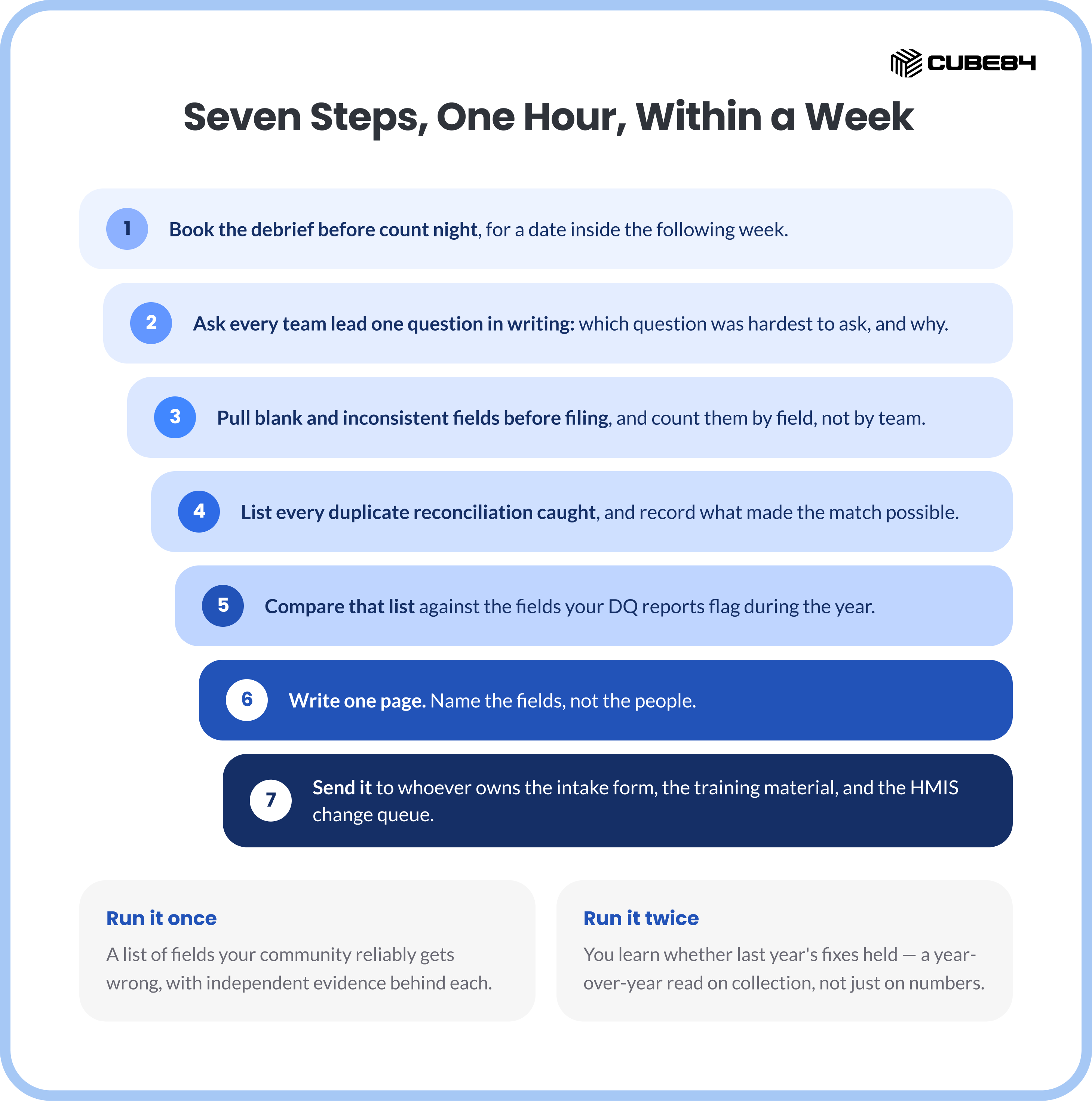
Run it once and you have a list of fields your community reliably gets wrong, with independent evidence behind each one. Run it twice and you know whether last year's fixes held, which gives you a year-over-year read on your data collection to set beside the year-over-year read on your numbers.
None of that touches the count. It requires deciding that the night produced two outputs, and giving the second one an owner and two hours, the way you already do for the first.
The Question to Ask After the Next Count
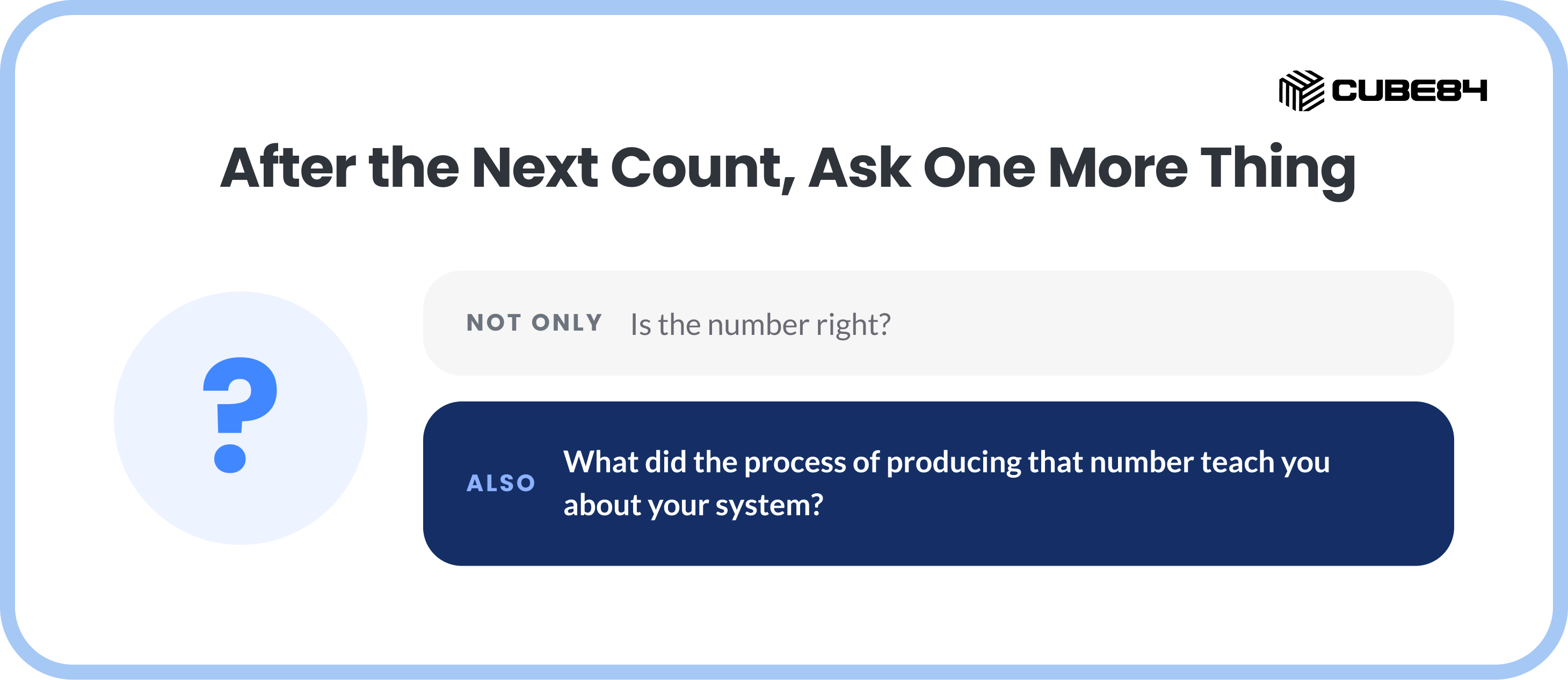
This started with one conversation. A CoC lead described a count carried on paper, without mapping, and held up by frontline staff. We are not presenting that as a sector-wide finding. We are presenting it as a question worth testing against your own PIT Count experience.
Here is the question. After your next PIT Count, don't just ask whether the number is right. Ask what the process of producing that number taught you about your system.