


The HMIS Data Standards Case Managers Misread, in Plain Language
A director of data management at an organization that runs its region's HMIS asked us for something narrow and unusually clear. The ask was for HUD's data elements explained in plain language, inside the application, at the point where a case manager actually fills them in, because the same elements kept coming back wrong.
The request is worth taking literally, because it locates the problem somewhere most data quality work never looks. A case manager reading an element on a form has a few seconds and a client sitting in front of them. What gets typed is whatever the wording brought to mind. If the wording invites the wrong answer, everyone gives the wrong answer, and the annual report is the first place anybody finds out.
When Every Case Manager Gets the Same Element Wrong, Blame the Wording
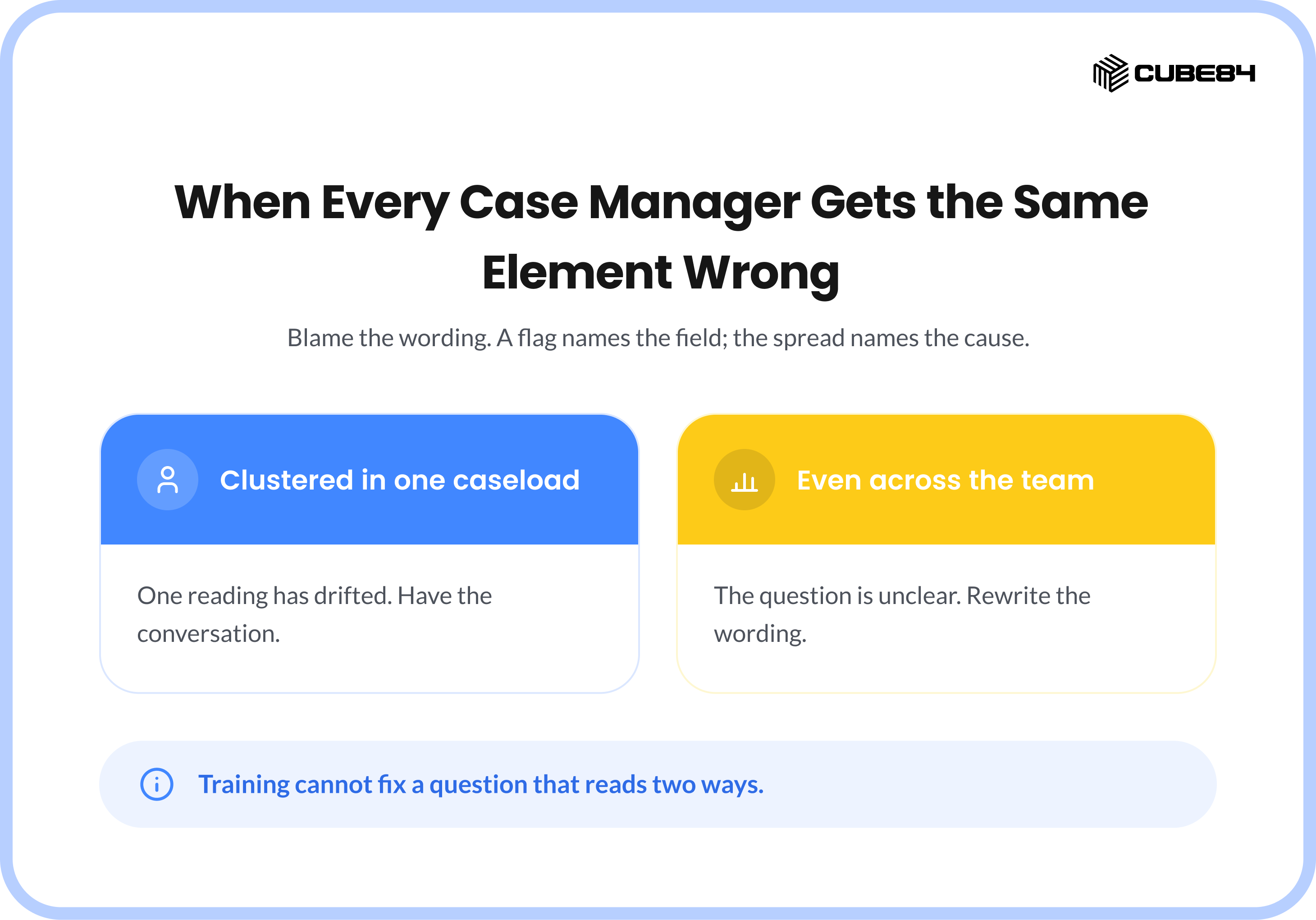
Data quality reports name fields. They do not name sentences. A flag tells you that Prior Living Situation is incomplete or inconsistent across a caseload, and it cannot tell you that six case managers all read that question as asking for the client's last permanent address. Those are different failures with different fixes, and only one of them is reached by sending people back to training.
The distribution is the tell. Where errors on an element cluster inside one person's caseload, the person is worth a conversation. Where the same element comes back wrong at roughly the same rate across everyone, including your most careful staff, the element is asking a question the form has failed to make clear. Check the spread before you book the training room.
Six Elements Where the Intuitive Answer Is the Wrong One
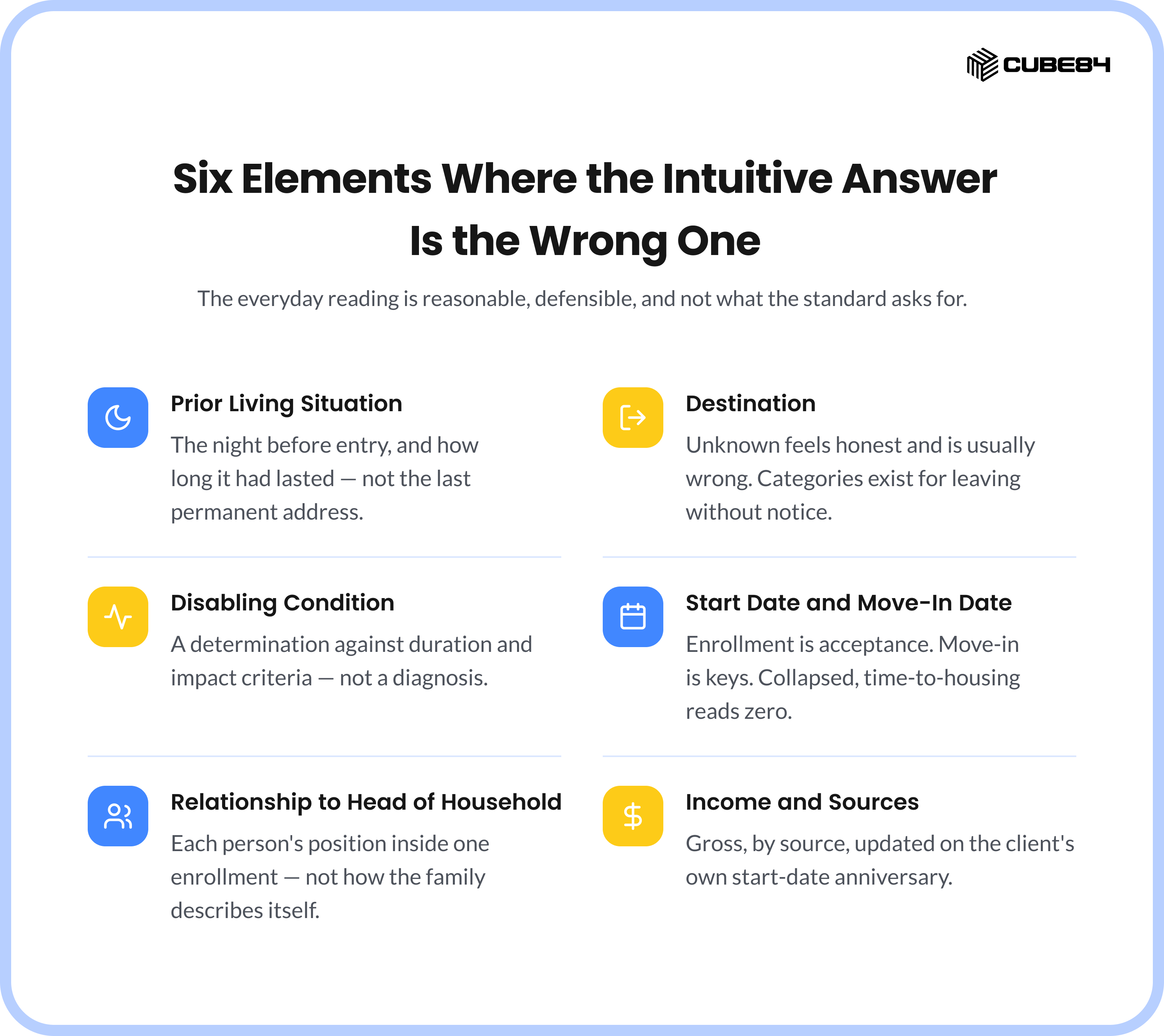
The six below come up repeatedly in conversations with data management leads, and they share a shape. In each one, the everyday reading of the question is reasonable, defensible, and different from what the standard is asking for. That combination is what makes them durable errors rather than careless ones.
Prior Living Situation. Read quickly, the question sounds biographical, so a case manager reaches for the last address that felt like a home. The standard is asking about the night before entry, and about how long that situation had already lasted. The gap between those two readings is the gap between a client who qualifies as chronically homeless and one who does not.
Destination. When somebody stops showing up, recording the exit as unknown feels like the honest answer, and it is the answer most likely to be wrong. Exit destination carries specific categories for clients who leave without notice, and choosing the accurate one preserves the difference between a client who disappeared and a client who moved into a permanent home. Your permanent housing rate is assembled out of this field.
Disabling Condition. The question reads as medical and gets answered as medical. What sits behind it is a determination made against criteria about how long a condition is expected to last and how far it limits independent living. A case manager who ticks yes because a diagnosis exists, or no because the verification paperwork has not arrived, is answering a different question than the one on the screen.
Project Start Date and Housing Move-In Date. In permanent housing projects these are two different days, and they are frequently entered as one. Enrollment happens when the client is accepted into the project. Move-in happens when the client has keys. Collapse them and your time-to-housing measure reports zero days for everybody, which reads on a dashboard as outstanding performance.
Relationship to Head of Household. Everyday language and HMIS language diverge here. Staff describe a family the way a family describes itself, while the field wants each person's position inside a single enrollment. An adult child, a partner with no legal status, a grandparent providing care—each has a defined place, and getting it wrong splits one household into several across your household type counts.
Income and Sources. Gross, by source, and repeated on a schedule. Two errors recur. The first is entering the amount that lands in the client's account rather than the amount before deductions. The second is treating the annual update as a calendar-year task, when the annual assessment is anchored to the anniversary of that client's own project start date, so it falls on a different day for every person on the caseload.
Chronic Homelessness Is Calculated, So an Entry Error Stays Silent Until the Report
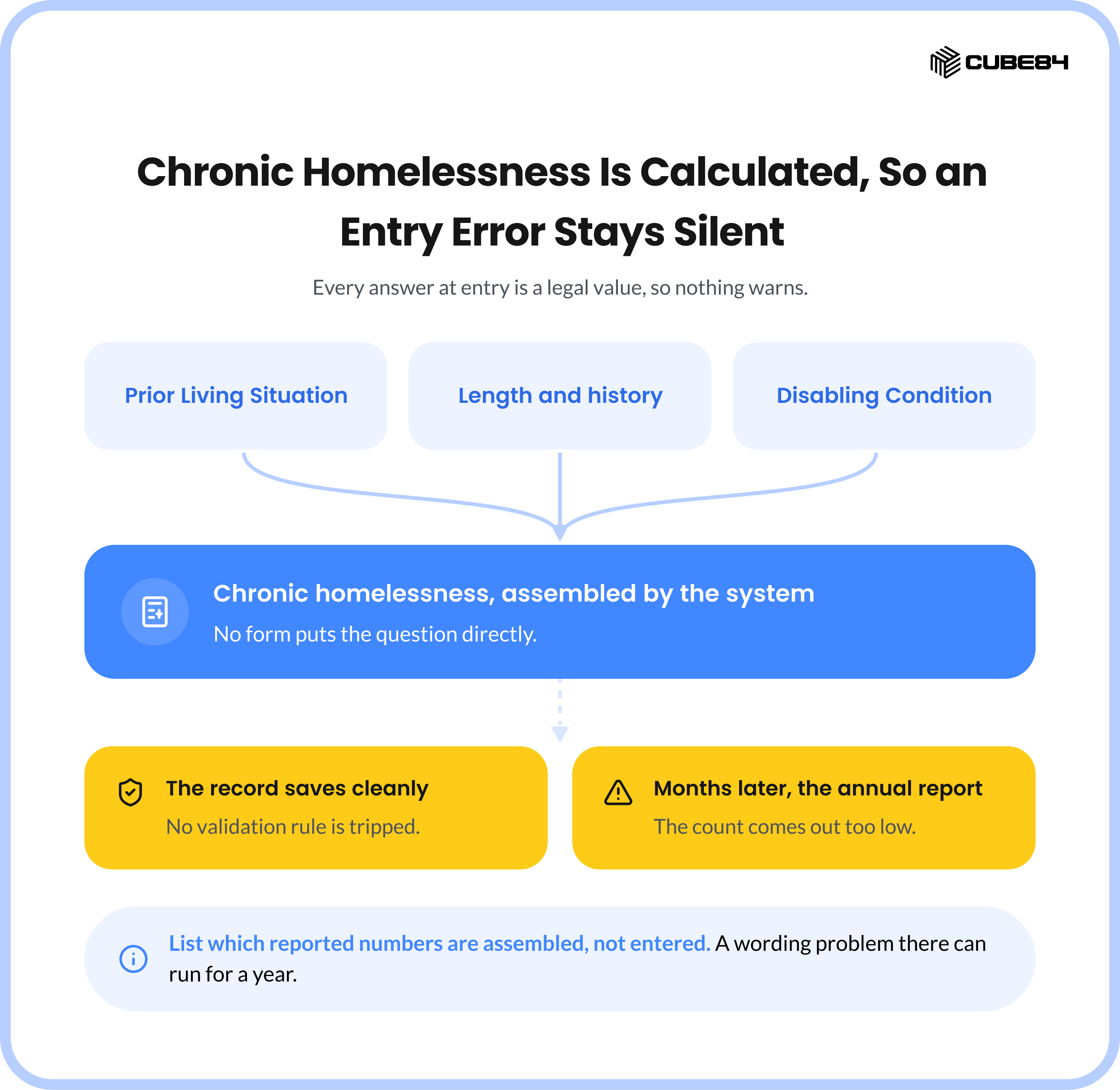
Some of what HUD asks for is never typed by anybody. Chronic homelessness is the clearest case: no case manager selects it, and no form puts the question directly. The system assembles it from Prior Living Situation, the length and history of that situation, and Disabling Condition. That structure has a consequence worth sitting with. An error in the inputs to a derived field produces no error message, because nothing invalid was entered. Each individual answer is a legal value. The record saves, the enrollment looks complete, and the client's status quietly resolves to the wrong side of a threshold that governs both their priority for housing and your community's reported numbers.
The distance between the mistake and the discovery is usually months. It closes at the annual report, when a count comes out lower than the community knows to be true and somebody starts working backward through enrollments to find out why. By then the intake conversation that produced the answer is long over, and the client may have exited.
How a derived element hides an entry error. Every answer at the entry stage is a valid value, so nothing errors and nothing warns. The preview renders this as a diagram. Structure per HUD's HMIS Data Standards; see the note on sources below.
The same shape applies anywhere a measure is computed rather than captured. It is worth spending an afternoon listing which of your reported numbers are entered and which are assembled, because the assembled ones are where a wording problem can run for a year without tripping a single validation rule. Our walkthrough of the APR and CAPER reporting challenges housing nonprofits run into covers what that costs a team once reporting season starts.
Write the Plain-Language Version Where the Answer Gets Typed
The fix the director asked for is small and specific. Put the plain-language version next to the field, rather than in a document staff read once during onboarding. A definition that lives in a manual is consulted by the people who already know the answer. A definition sitting under the label gets read by the person about to get it wrong.
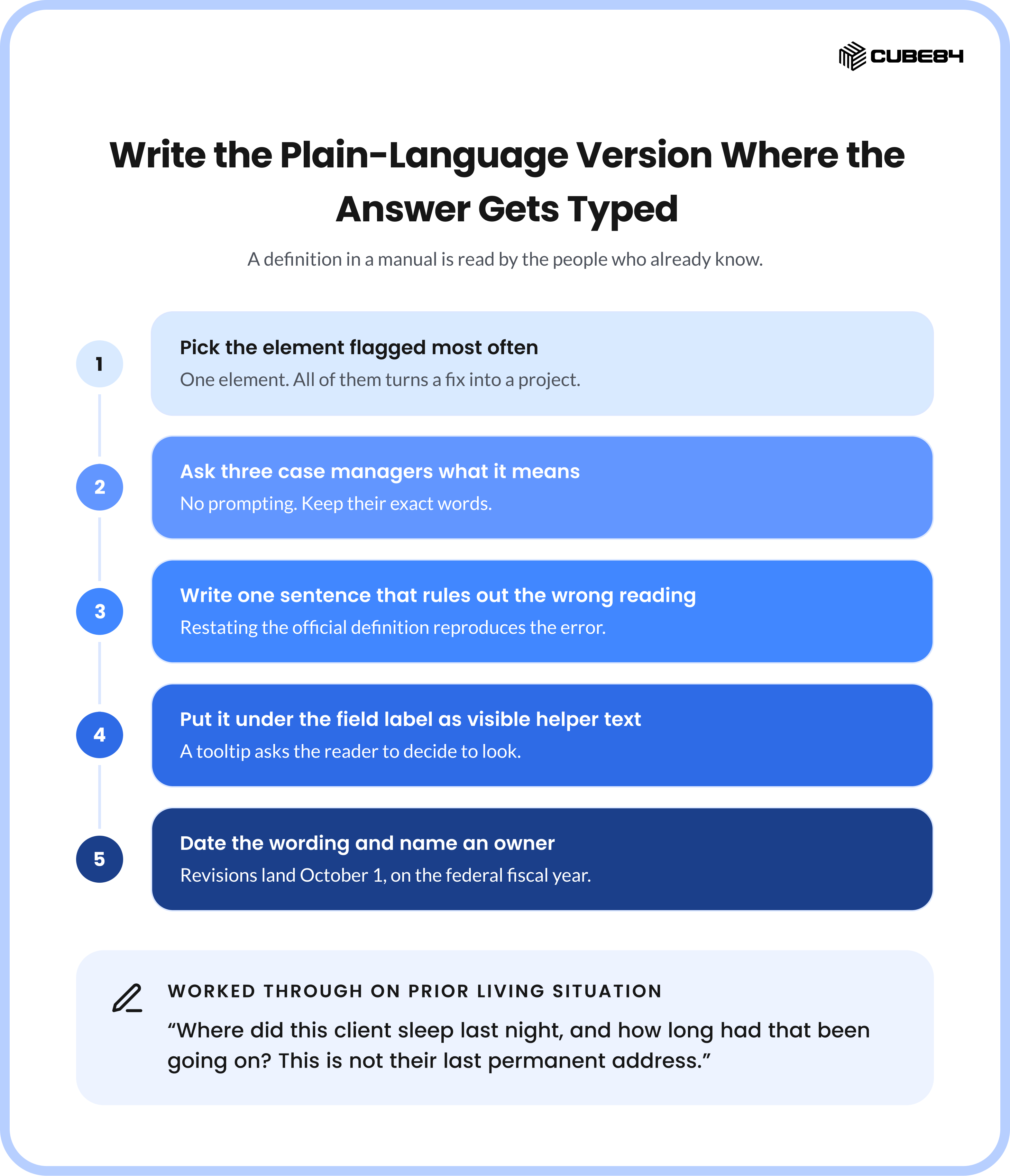
Pick the element your data quality report flags most often. One element. Rewriting all of them at once turns a fix into a project, and projects wait for budget.
Ask three case managers what the question means, without prompting them. Write the answers down word for word. The wrong readings you collect are the raw material for step three.
Write one sentence that rules out the most common wrong reading. Wording that restates the official definition will reproduce the same error, because the official definition is what got misread in the first place.
Put the sentence under the field label as visible helper text. A tooltip asks the reader to decide whether to look, and a case manager mid-intake will not stop to decide.
Date the wording and name an owner. HUD publishes the data standards against a federal fiscal year, so a revision lands on October 1 and every sentence you wrote needs re-reading against the new version.
Step three is where most attempts fail, so it earns a table of its own. The difference between helper text that works and helper text that decorates the form is whether it names the wrong answer out loud. Staff do not need the element restated. They need to know which of the two readings in their head is the one the system wants.
Worked through on Prior Living Situation, that produces something closer to “Where did this client sleep last night, and how long had that been going on? This is not their last permanent address.” It is longer than the official label and shorter than the manual, it uses the words a case manager would use out loud, and it closes off the reading that causes the error. Wording of that kind takes twenty minutes to write and removes a category of mistake permanently.
Start With the One Element That Fails Most Often
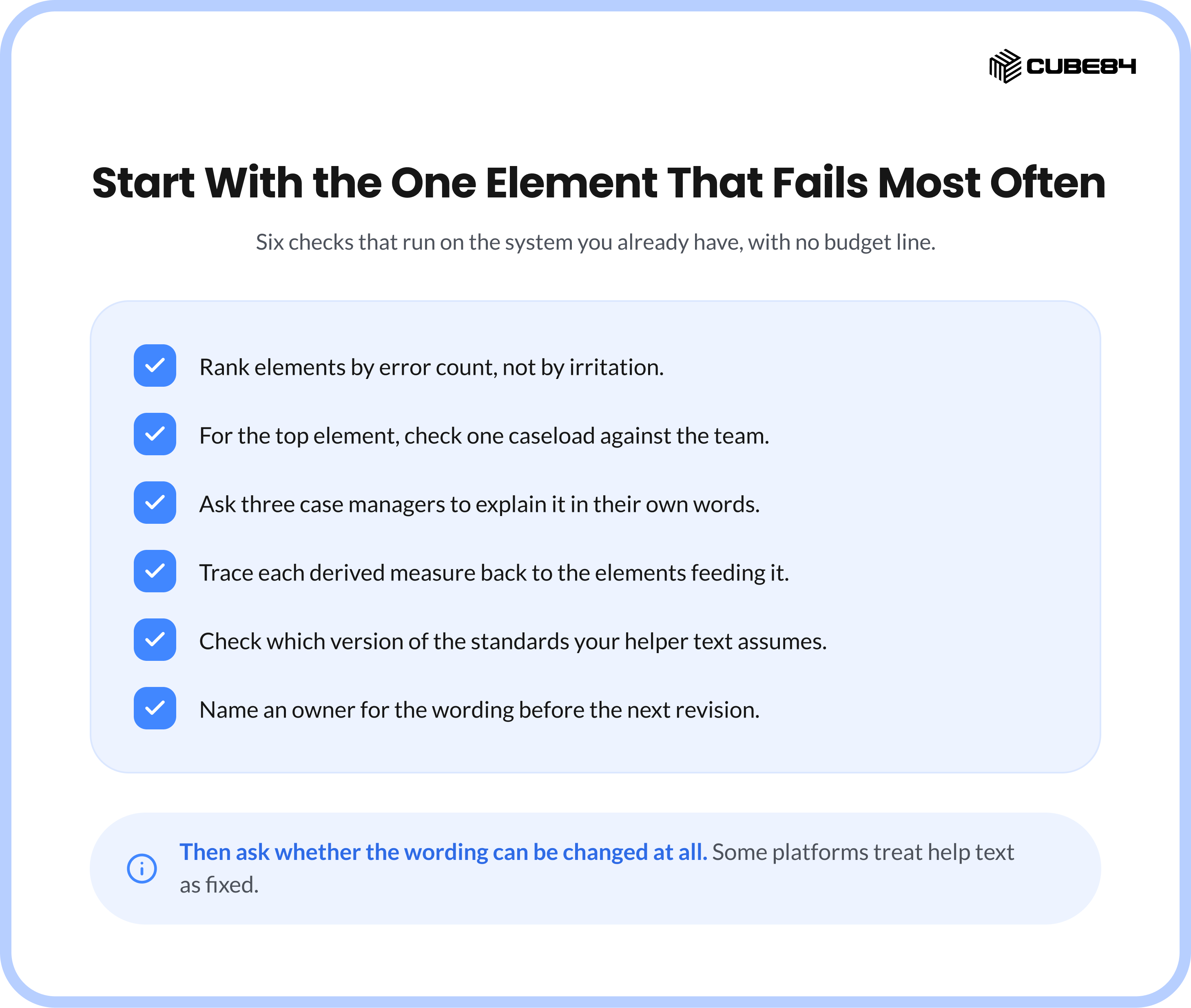
Six things to check before the next intake conversation. All of them run on the system you already have, and none of them need a budget line.
Pull the last data quality report and rank elements by error count, rather than by how irritating each one feels to fix.
For the element at the top, check whether errors sit inside one caseload or spread evenly across the team.
Ask three case managers to explain that element in their own words, and keep the exact phrasing they use.
List which of your reported measures are derived rather than entered, and trace each one back to the elements that feed it.
Check which version of the data standards your current helper text was written against.
Confirm that somebody owns the wording by name, before the next fiscal year revision lands.
All of that is a wording exercise, and it will move data quality further than another training cycle will. Where the system starts to matter is whether the wording can be changed at all. Some platforms treat field labels and help text as fixed, which leaves a program managing a defect it can see clearly and cannot reach. Housing360 keeps element help editable by the people accountable for the data, and Care360 carries the same wording into coordinated entry, so a client assessed in one place and enrolled in another meets the same question phrased the same way.
That editability question is one of the more useful things to put to a vendor, and it rarely appears on a comparison grid. Our read of the 2026 HMIS vendor landscape sets out what else is worth testing before signing. The deeper reason these problems surface at reporting time instead of at entry time is the subject of our webinar on why most housing systems were built to report rather than to run.
Sources, and What Was Left Out
HUD's HMIS Data Standards Manual and HMIS Data Dictionary are the authority on every element named above. Read the current version rather than any vendor's summary of it, including this one. This article deliberately does not reproduce element numbers or response option lists, because both are revised on a fiscal year cycle and a copy of them ages into a liability the moment a new version publishes. Element names and the misreadings around them are far more stable than the numbering.
The request that prompted this piece came from a director of data management at an organization that runs its region's HMIS, described by role and organization type. No statistics have been cited, because none could be verified against a source at the time of writing.