


May might feel like just another month to most people. But if you work in higher education, you know it’s anything but ordinary.
While others might be on vacation, things get a whole lot busier with enrollments and deposits coming in.
And isn’t that exactly what you worked toward? The early forecasts suggest targets will be met, but can you really take a breath just yet?
What follows is what changes the entire narrative.
By the time August rolls around, the incoming class that once looked completely full no longer holds up. Suddenly, anywhere from 10% to 40% of those committed students simply do not show up. Across higher education, this pattern is widely documented, with 10% to 40% of deposited students not enrolling. The numbers tend to be even higher for first-generation students, low-income students, and those planning to attend community colleges.
This is what is commonly referred to as summer melt.
Why Summer Melt Is Getting Harder to Predict
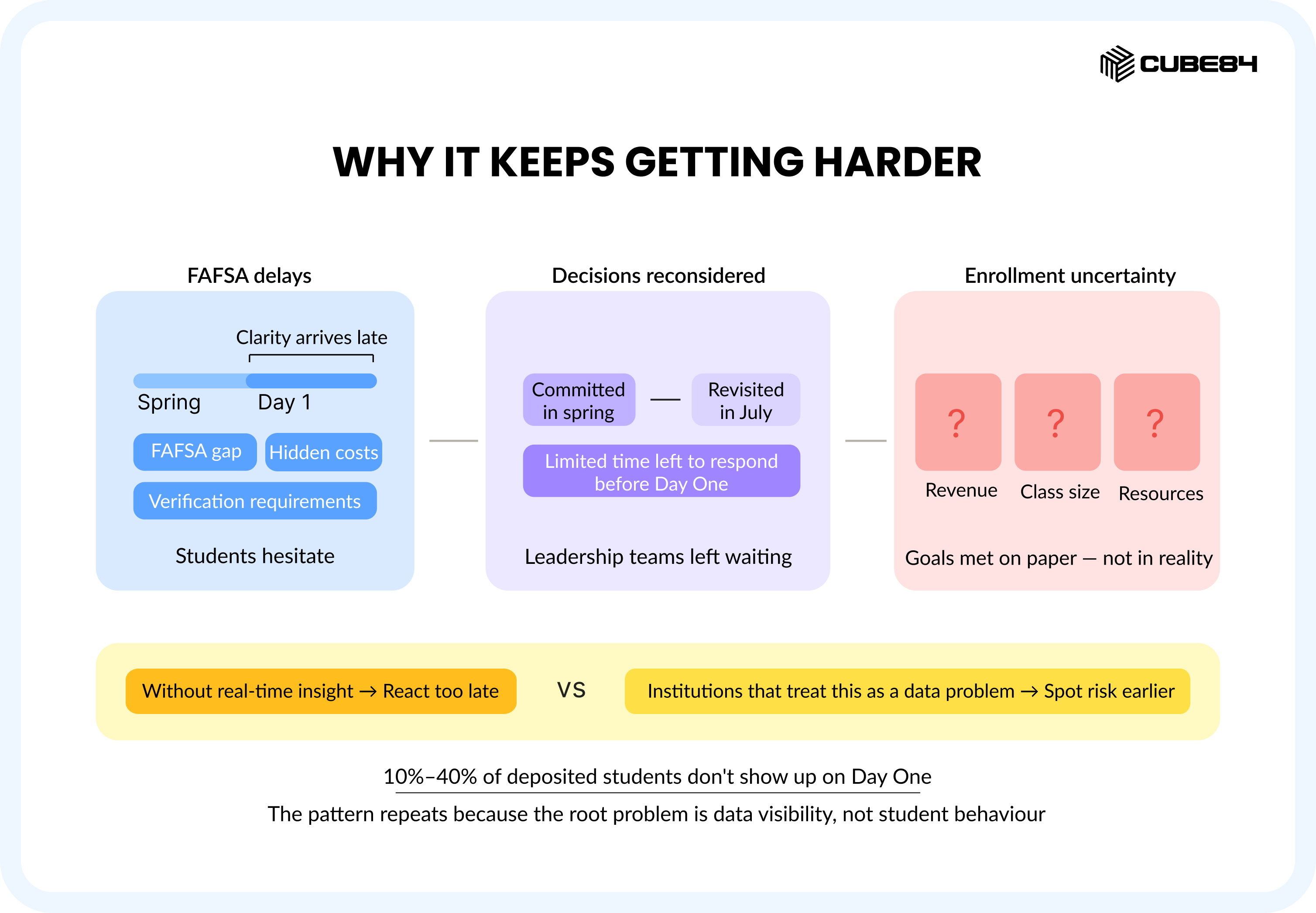
In recent years, this has become harder to anticipate and even harder to manage. Changes to the FAFSA process have pushed financial clarity further into the summer, leaving many students unsure about affordability until much later than before. As a result, decisions that once felt settled in the spring are now being reconsidered in June or July, often when institutions have limited time to respond.
This creates a difficult situation for leadership teams. Enrollment goals may be technically met based on deposits, yet there is still uncertainty around actual revenue, class size, and resource planning. Teams are left waiting for final confirmations, knowing that a percentage of those students may still drop off.
It is easy to view summer melt as a series of individual student decisions, shaped by personal circumstances, financial challenges, or changing preferences. While all of those factors are real, they do not fully explain why this pattern continues year after year.
We often talk about summer melt as if students simply changed their minds at the last minute. The truth is quite different. The core issue revolves around data visibility and timing. Without real-time insight into how students are engaging and where they are getting stuck, enrollment teams end up reacting far too late to prevent drop-offs that could have been avoided. Institutions that treat melt as a data challenge are already spotting risk much earlier. They intervene more effectively and stabilize their final enrollment numbers.
What Higher Ed Leaders Are Actually Facing
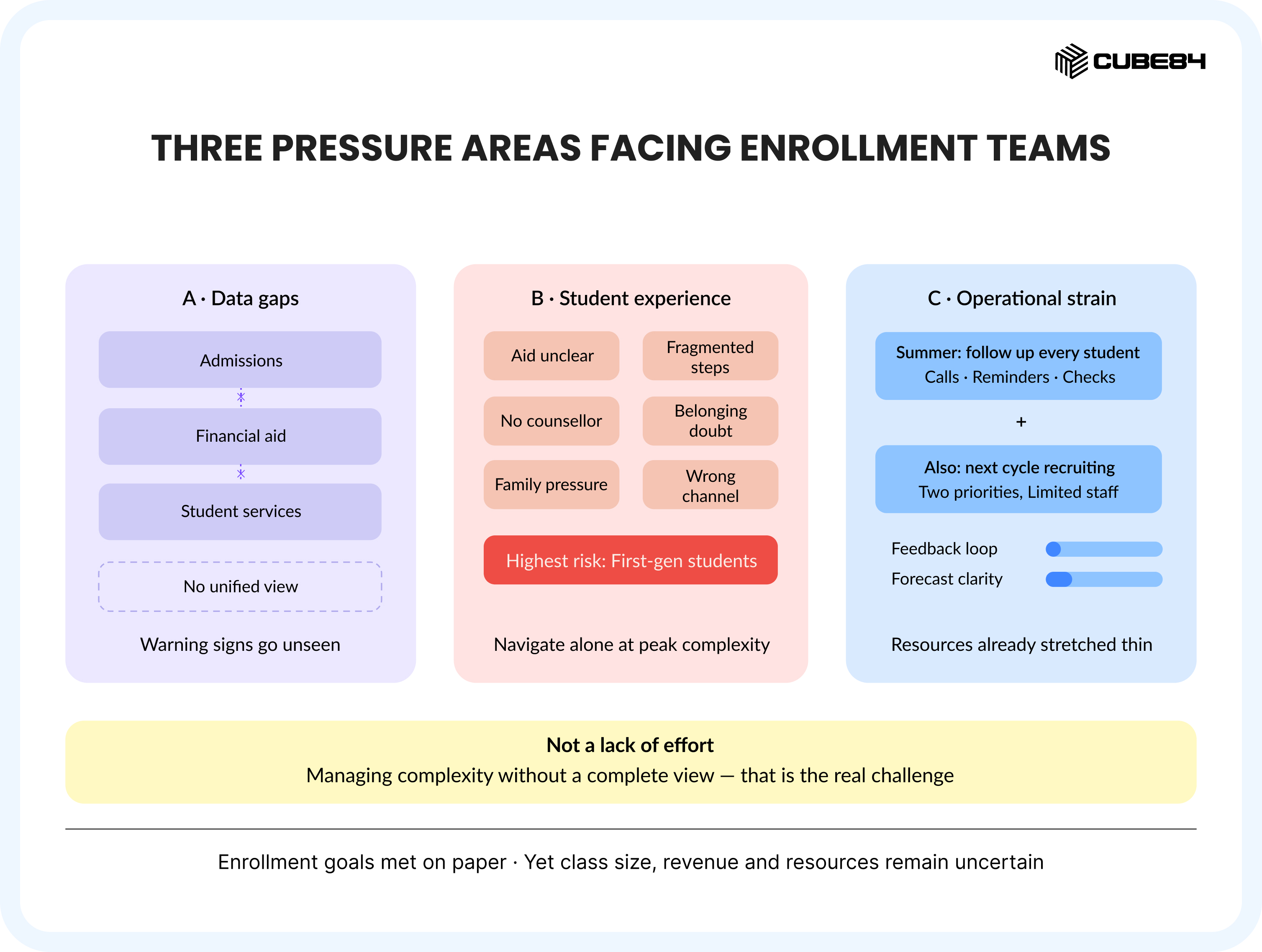
Let's talk about the real pressure your teams face every day. From what we’ve seen the challenge is usually not a lack of effort or commitment. The reality is that they are managing a complex process with many moving parts, often without having a complete view of what is happening across the student journey. When you break this down, the pressure tends to show up in three main areas.
A. Data and Visibility Gaps
In many institutions, student information is spread across multiple systems that do not always communicate with each other. Admissions teams track applications and deposits, financial aid offices manage FAFSA completion and award packages, and student services oversee housing, orientation, and onboarding steps. Each of these areas holds important information, but it is not always brought together in a way that provides a clear and unified picture.
Because of this, early warning signs can easily be missed. A student who has not completed their FAFSA might not be flagged in time for outreach. Another student who has stopped logging into the portal may not be noticed until much later.
They look like isolated issues, don’t they? They’re not. Without a connected view, they remain hidden until the impact becomes visible in enrollment numbers.
Communication also becomes less effective in this environment. When teams do not have detailed segmentation, outreach tends to be broad and uniform. Students at very different stages of readiness receive the same messages, which can lead to confusion or disengagement. Over time, this reduces the likelihood that important information actually reaches the students who need it most.
B. Student Experience Breakdown
From the student’s perspective, the period between deposit and enrollment can be overwhelming. While the decision to attend may feel final in the spring, the steps required to get to Day One are often complex and spread across multiple offices.
Financial uncertainty plays a major role here. Many students are still waiting for clarity on their aid packages, especially in cycles where FAFSA timelines have been delayed. Without a clear understanding of the total cost, it becomes difficult to move forward with confidence. In some cases, students begin to reconsider their options simply because they do not have enough information.
At the same time, the process itself can feel fragmented. Students are asked to complete orientation registration, secure housing, submit health forms, and finalize course selections, often with different instructions and deadlines for each step. Without consistent guidance, it is easy for something to be missed.
Another important factor is the loss of support after high school. Many students, especially first-generation students, rely on counselors during the application process. Once school ends, that support is no longer available, leaving students to navigate a complex system on their own.
There is also an emotional dimension that is often overlooked. Students may begin to question whether they belong, whether they are ready, or whether they have made the right choice. Families become more involved at this stage, particularly when financial details become clear, and their influence can shape the final decision.
Finally, communication preferences vary widely. Some students respond to email, while others are more engaged through text or messaging platforms. Relying on a single channel means that some students simply do not receive or act on important information.
C. Operational Pressure on Teams
While students are navigating their own challenges, institutional teams are managing a different kind of pressure. Summer often becomes a period of intense follow-up, with staff making calls, sending reminders, and trying to ensure that students complete the necessary steps.
At the same time, planning for the next recruitment cycle is already underway. This creates a situation where teams are balancing immediate needs with future priorities, often with limited resources.
One of the ongoing challenges is the lack of clear feedback on what is actually working. It is not always possible to determine which communication or intervention helped a student stay on track. Without that insight, it becomes difficult to refine strategies or justify investment in certain approaches.
All of this contributes to uncertainty in planning. Enrollment numbers directly impact budgeting, staffing, and program decisions, so even small variations can have significant consequences. When melt is not well understood or managed, it adds another layer of complexity to an already demanding process.
Root Causes: Why This Keeps Happening
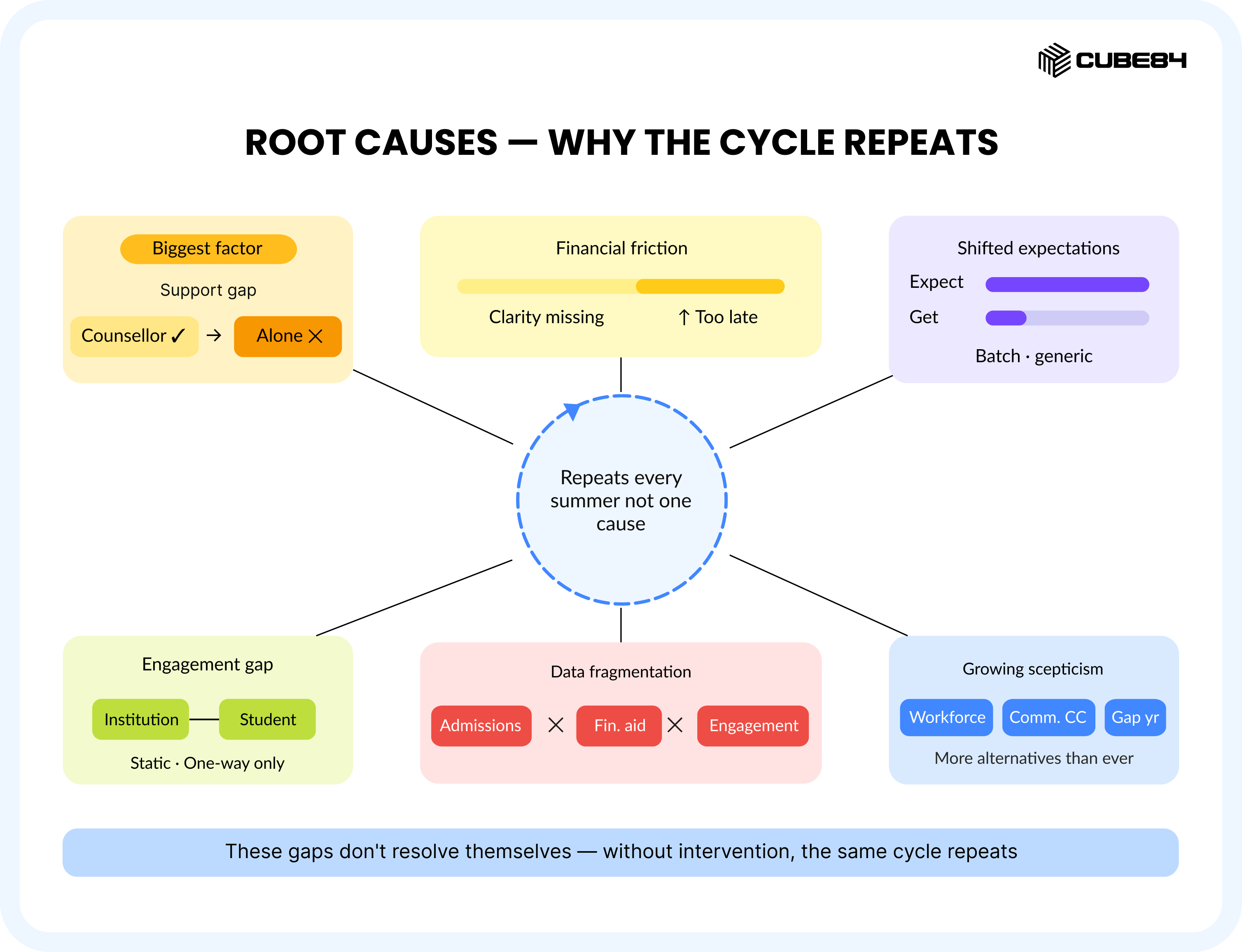
Why does this cycle repeat every year? When these challenges are viewed together, it becomes clear that summer melt is not driven by a single issue, but by a combination of gaps that build over time.
The biggest factor is the post-high school support gap. Students lose access to their high school counselors at the exact moment college logistics become the most overwhelming. Financial and systemic friction also plays a major role. FAFSA delays and verification requirements cause major headaches. When clarity about financial aid arrives too late, or when hidden costs appear, students hesitate.
We also see a major breakdown in engagement. A lot of institutional communication is static and one-way. There is very little real-time or behavior-based follow-up. This connects directly to data fragmentation. When systems are disconnected, it is impossible to get a unified view of the student. Without that view, teams cannot flag early signs of risk.
Meanwhile, student expectations have shifted. They are used to real-time, highly personalized communication in every other area of their lives. Yet, many institutions still operate on batch campaigns, sending the same message to thousands of people at once. We also have to consider the broader context. There is a growing public skepticism about the value of a college degree. Students are weighing more alternatives than ever before, from entering the workforce immediately to attending a community college or taking a gap year.
The Reality Check: Where This Leads
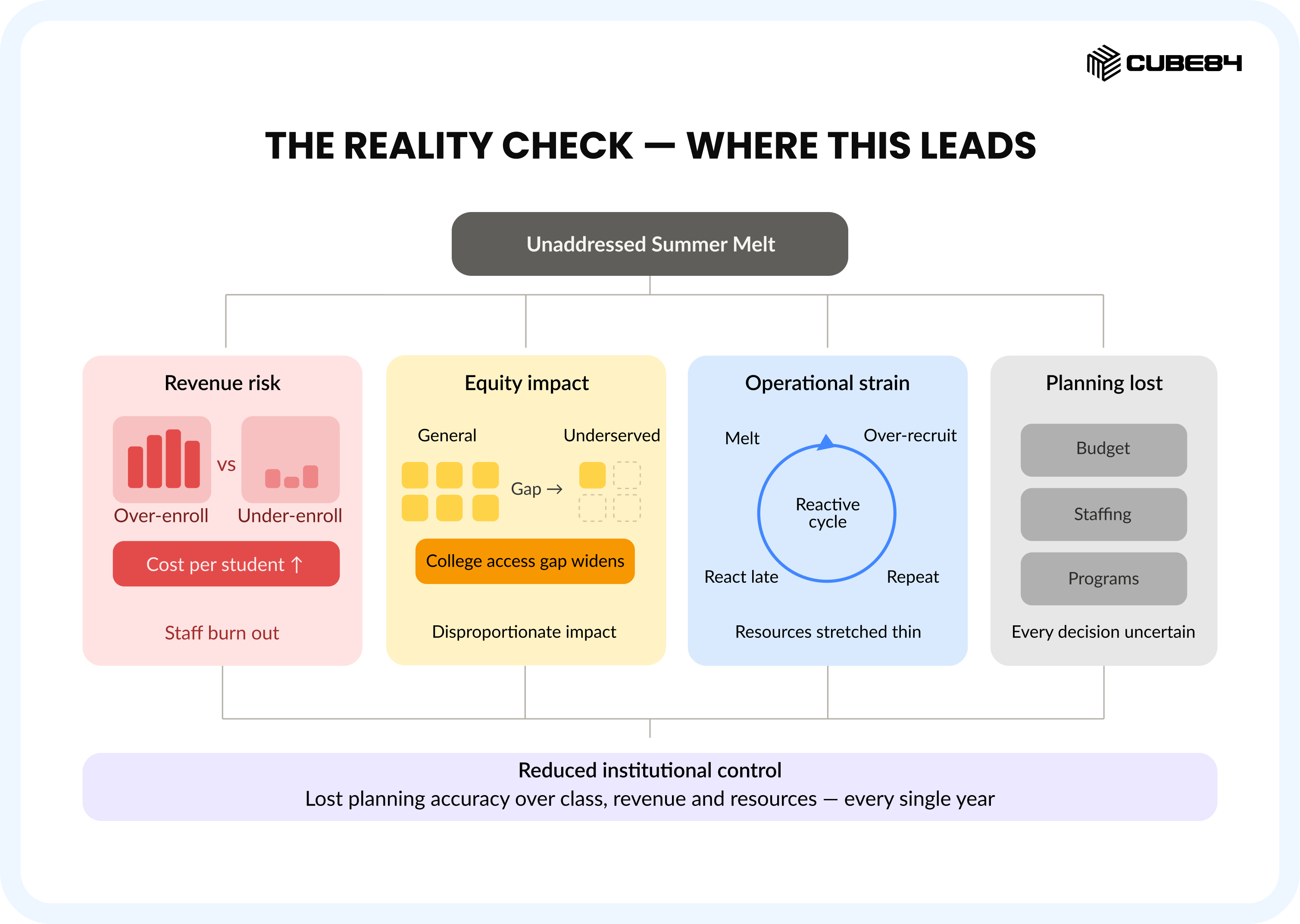
If we do not address these gaps, the consequences go far beyond a few empty seats. It leads to severe revenue unpredictability. You end up over-enrolling to compensate or under-enrolling and missing budget targets. This increases the cost of acquiring every single enrolled student and forces a heavy reliance on over-recruitment strategies that burn out your staff.
There is also a massive equity impact. Underserved students are disproportionately affected by confusing summer logistics, which widens the gap for college access. Operationally, your teams are stuck in constant reactive cycles, straining resources that are already stretched thin.
Ultimately, summer melt means lost planning accuracy and reduced institutional control over your incoming class.
Data-Driven Solutions: How to Identify and Stop Melt Early
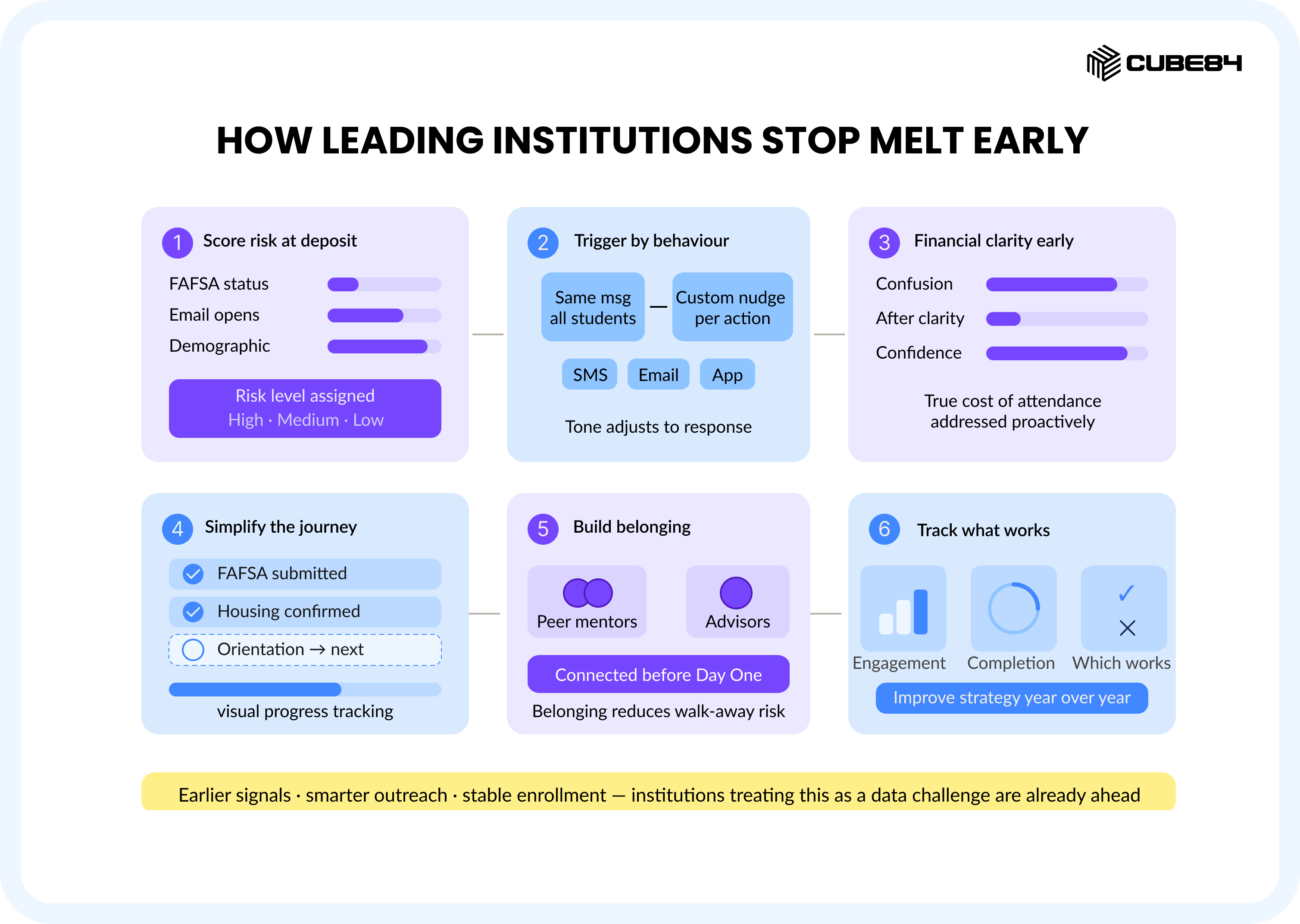
Leading institutions are tackling this by changing their approach. Here is what they are doing differently to fix the problem.
Identify risk early: One of the first steps is to begin tracking risk as soon as a student deposits. They build melt-risk scoring models. A scoring model is a system that assigns a risk level to a student based on specific data points. These signals include their FAFSA status, how often they engage with emails, and demographic indicators. The key is to start tracking these signals the moment the student deposits.
Shift to behavior-based communication:. Instead of sending the same message to all students at the same time, based on a calendar date, trigger your outreach based on what the student actually does. If they miss a step, send a customized reminder. Use multiple channels like SMS, messaging apps, and email. Adjust your tone and messaging based on how the student responds.
Address financial clarity proactively: Talk about the true cost of attendance early on. When students understand their costs and available support, they are better positioned to move forward with assurance. Provide support and clear next steps before confusion has a chance to escalate.
Simplify the student journey: The enrollment process is daunting. Break complex processes into small, manageable steps. Provide simple checklists and visual progress tracking to reduce friction at every single stage.
Build belonging before arrival: Students need to feel connected before they step on campus. Facilitate connections with peer mentors, encourage early engagement with academic advisors, and expose them to the campus community virtually.
Track and measure what works: Monitor how students engage with your outreach and track their completion rates for key tasks. Identify which specific interventions actually reduce melt so you can improve your strategy year over year.
The Actionable Framework: The 30-60-90 Day Melt Prevention Plan
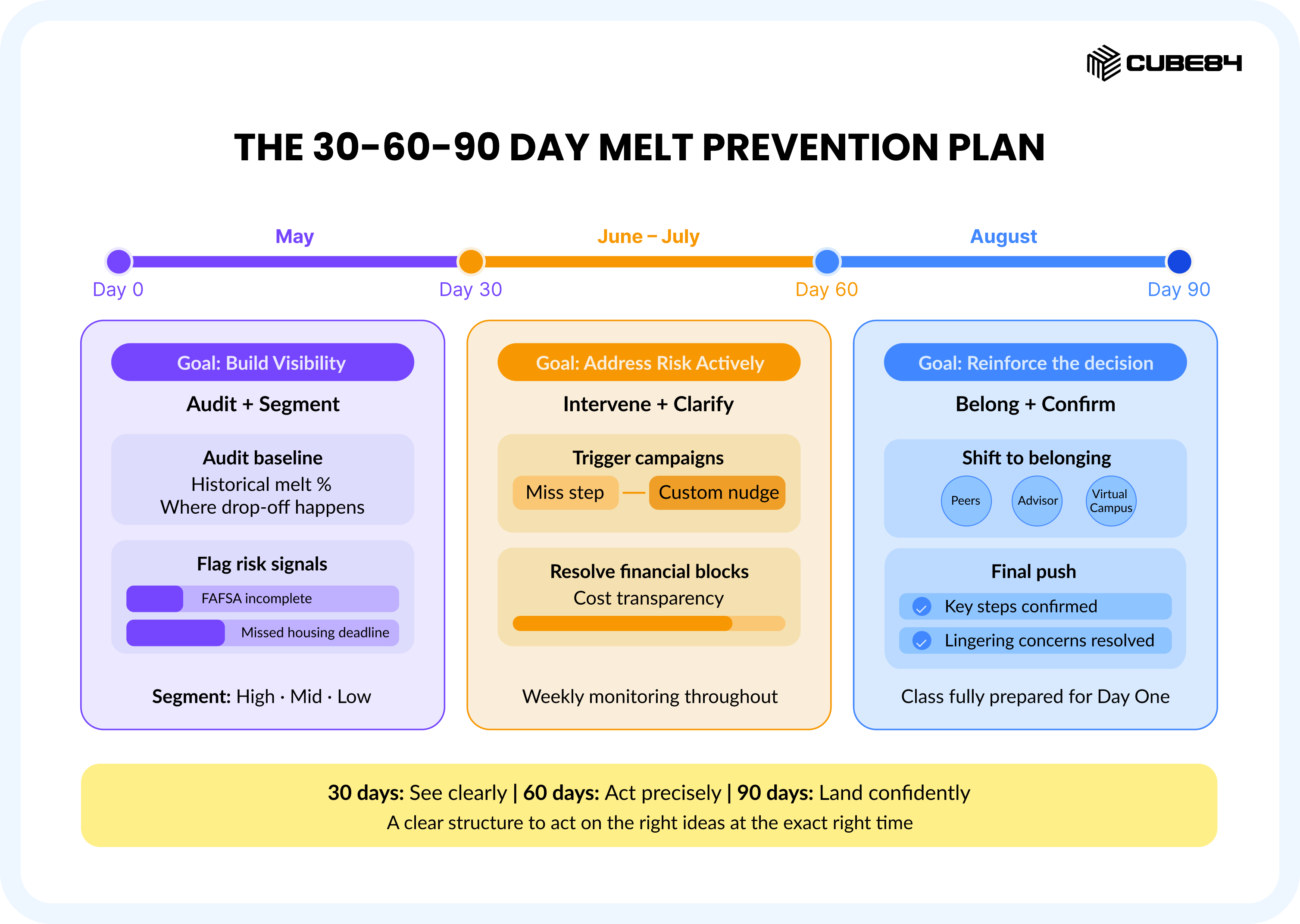
At this point, the question most teams ask is simple: where do we start? The challenge with summer melt is rarely a lack of ideas. The real hurdle is finding a clear structure to act on those ideas at the exact right time. A highly effective way to approach this is to break your summer into three distinct phases, each with a specific goal and timeline. Now, let’s bring these ideas together into a clear execution plan.
30 Days (May): Build Visibility and Segment Risk
The first 30 days after your deposit deadline are critical because this is when early warning signals begin to appear.
This is the time to step back and understand your current position. You should start by reviewing available data and establishing a baseline. Look at what percentage of your students typically melt, which groups are most affected, and where they have historically dropped off. From there, your focus needs to shift toward identifying risk.
Audit the Baseline: Look closely at your historical data to see exactly where you stand before the summer chaos begins.
Build Risk Models: Start flagging students who have an incomplete FAFSA, missed a housing deadline, or stopped opening your emails. These signals might seem small in isolation, but together they form a clear picture of who needs support.
Segmentation becomes important at this stage. Not every student requires the exact same level of attention. Grouping your deposited students based on their risk level allows your team to be much more focused in how they engage.
60 Days (June and July): Targeted Intervention
By the time summer is in full swing, your goal shifts from identifying risk to actively addressing it.
This is where behavior-based communication becomes essential in practice. Instead of sending broad reminders to your entire list, your outreach should respond to specific student actions.
Trigger Meaningful Campaigns: If a student misses a key step, the communication they receive should guide them through that exact process.
Resolve Financial Roadblocks: Financial clarity must be a priority during this phase. Many students are still working through aid questions, and delays can quickly lead to hesitation.
Provide clear, timely information and transparent cost breakdowns. Making financial support easily accessible prevents uncertainty from turning into disengagement. Your focus during these months is consistency. Regular monitoring and targeted support keep students moving forward.
90 Days (August): The Final Mile and Building Belonging
As the start of the term approaches, the nature of your conversation needs to change.
At this stage, most of the heavy logistical steps are either complete or very close to it. What matters now is reinforcing the student's decision and helping them feel genuinely ready to show up on campus.
Shift the Message: Transition your communication away from administrative checklists and focus entirely on belonging. Introduce students to peer mentors, connect them with their academic advisors, and offer virtual orientation previews.
Execute the Final Push: Run a final round of engagement to confirm readiness.
Even small interactions can eliminate last-minute hesitation. Checking that key steps are complete and addressing any lingering concerns ensures your incoming class is fully prepared and excited for Day One.
Streamlining the Process: Practical Steps to Take Now
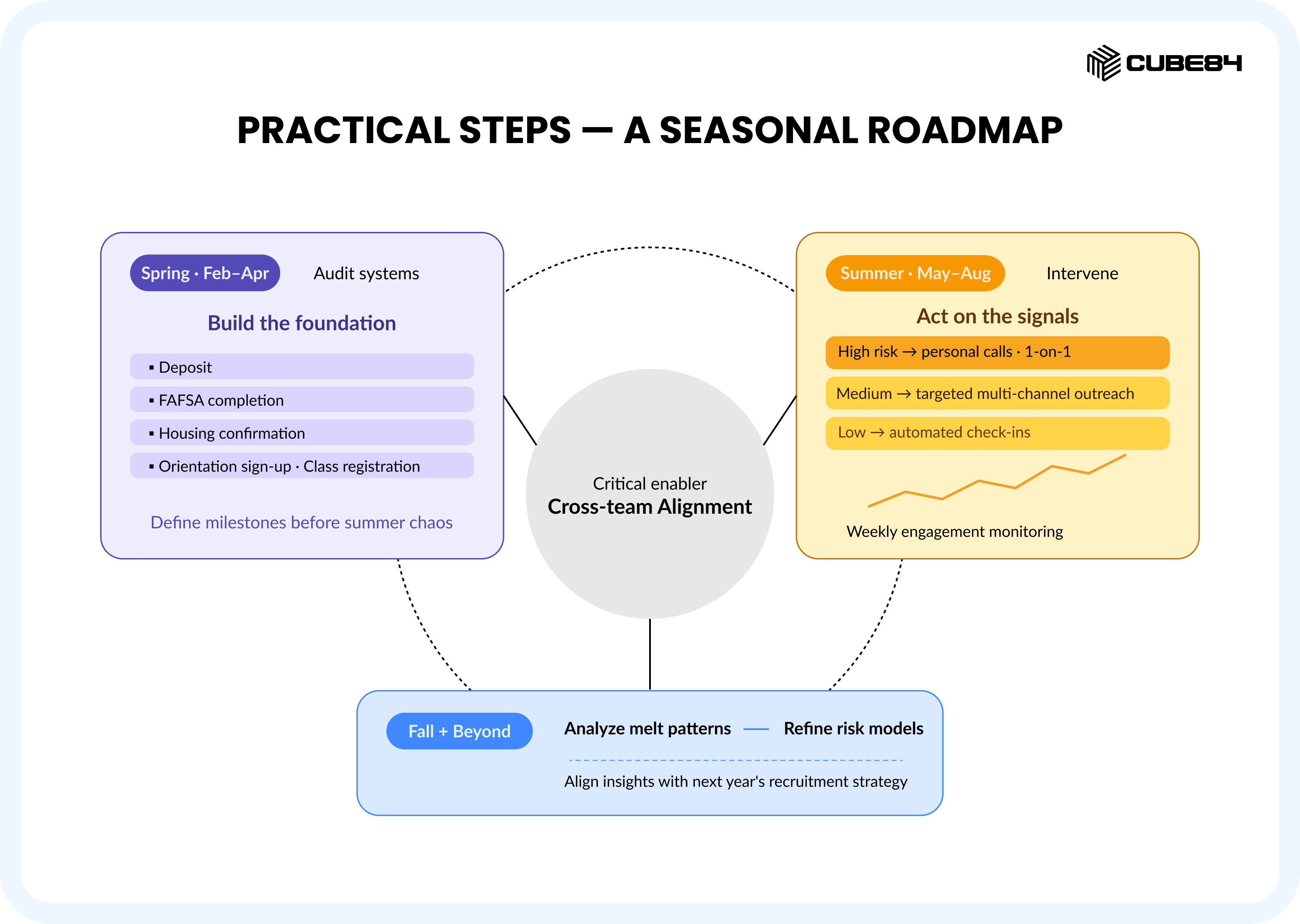
You can start putting a framework in place today. Here is a clear roadmap to get your teams aligned.
What to focus on in Spring (February to April)
In the Spring, from February to April, use this time to audit your existing systems and data sources. Define the key milestones that a student must complete. These milestones usually include the deposit, FAFSA completion, housing confirmation, orientation sign-up, and class registration.
What to execute during Summer (May to August)
During the Summer, from May to August, segment your deposited students based on their risk level. Launch targeted, multi-channel outreach campaigns. Monitor their engagement on a weekly basis. For the students showing the highest risk, step in with personal phone calls or one-on-one interventions.
What to refine in Fall and beyond
In the Fall and Beyond, once the dust settles, analyze the melt patterns from the summer. Refine your risk models based on what you learned. Align these new insights with your overall recruitment strategy for the next year.
The critical enabler for all of this is cross-team alignment. Admissions, financial aid, and student success teams must work together and share information seamlessly.
Technology as the Enabler
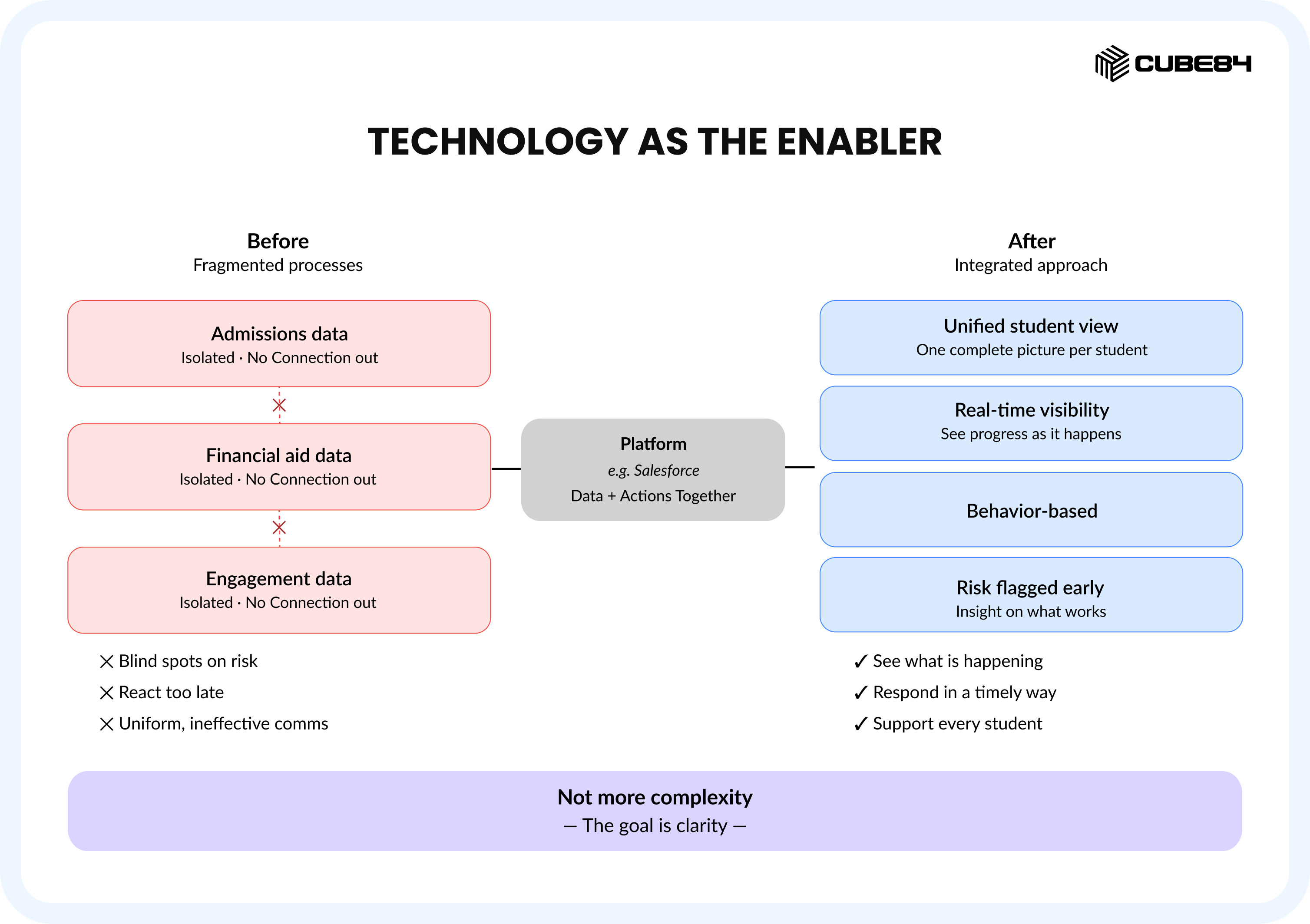
To support this kind of coordinated approach, institutions need systems that bring data and actions together in a meaningful way.
This includes having a unified view of each student, real-time visibility into their progress, and the ability to automate communication based on behavior. It also involves tools that can identify risk early and provide insights into what is working.
Platforms like Salesforce are often used to create this level of connection, helping institutions move from fragmented processes to a more integrated approach.
The goal is not to introduce complexity, but to create clarity. When teams can see what is happening and respond in a timely way, they are better equipped to support students throughout the journey.
Conclusion
We truly believe that summer melt is highly predictable. Because it is predictable, it is also preventable. Students rarely disappear without signals. In many cases, those signals appear weeks or months before the final decision is made. When institutions rely only on end-of-cycle outcomes, they miss the opportunity to act earlier.
The goal is to shift your entire operation from reactive guessing to proactive, data-informed action. Institutions do not lose students in August. They lose them in the signals they never saw in May.
Want to continue this conversation or know how we can help you prevent Summer Melt? Let’s talk!