

Introduction
While working through data migration, we’re reminded of what Peter Drucker, the father of modern management, said: “If you want something new, you have to stop doing something old.” Modernization is exactly that. You stop operating on outdated systems, while still protecting the history those systems hold.
When a nonprofit moves to Salesforce Nonprofit Cloud, it is stepping away from spreadsheets, legacy CRMs, and manual reconciliations. What cannot be left behind is the record of how the organization has been funded and supported over time. Decades of gifts, pledges, donor relationships, and fund commitments must be preserved, even as the underlying systems change.
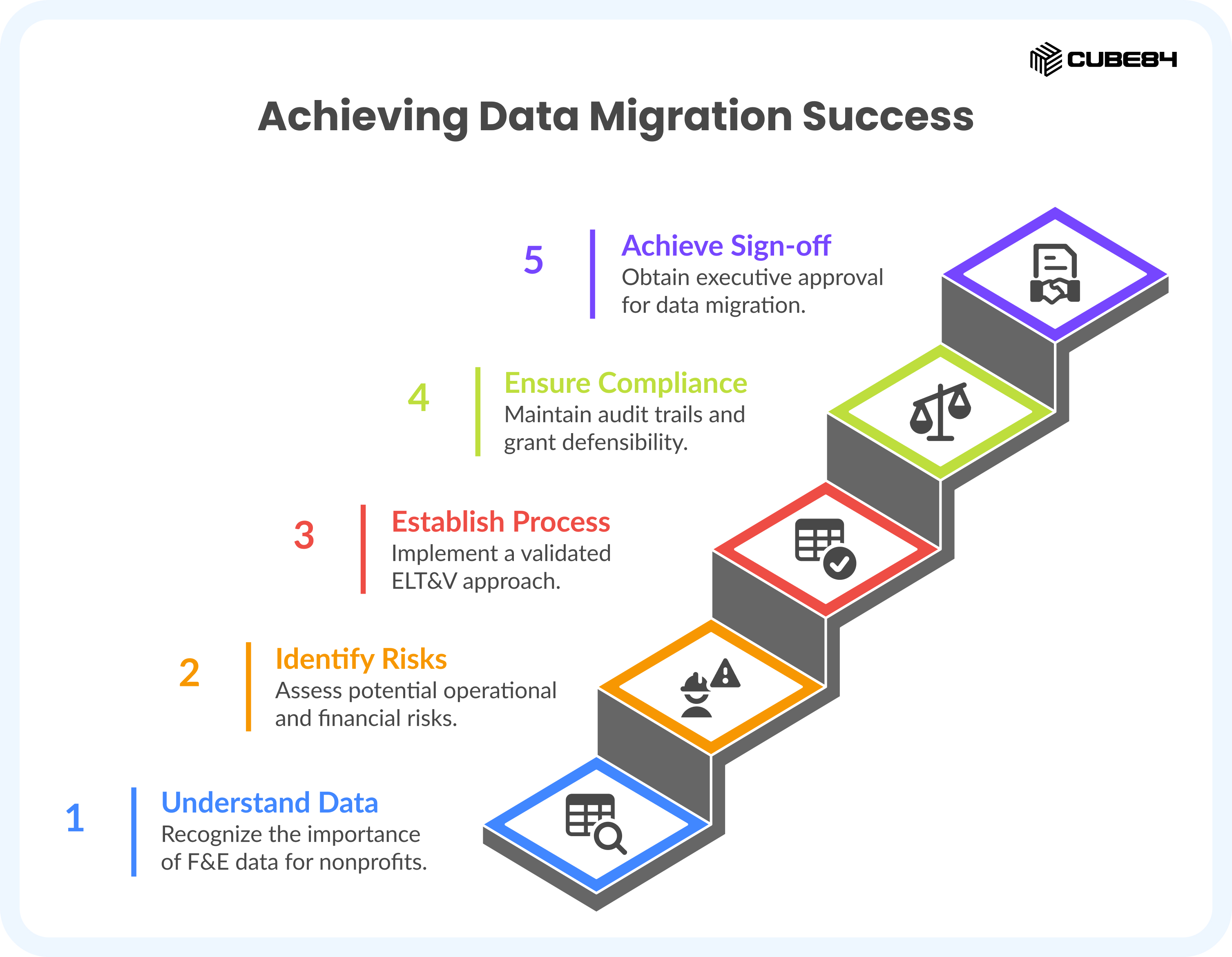
This is what Financial and Engagement data (F&E data) represents. Financial data includes gifts, pledges, payments, receivables, and restricted fund allocations that support audits and grant compliance. Engagement data captures the relationships around that money, donors, board members, affiliations, and historical giving context. Migrating this data introduces operational and financial risk, not a technical one. A single mapping error can compromise audit trails, misstate donor credit, or weaken grant defensibility.
For mid-size and large organizations, scale amplifies that risk. Many manage decades of donor history under North American accounting and regulatory standards. As a result, the CFO’s mandate is clear: zero data loss and full audit parity. Legacy totals, balances, and historical reports must reconcile exactly with legacy records.
Meeting that mandate requires a validated business process. An ELT&V approach (Extract, Load, Test, & Validate) introduces control, reduces downtime risk, and ensures executive sign-off before production.
This playbook is built on that discipline.
Phase 1: The Governance and Audit Pre-Flight Check
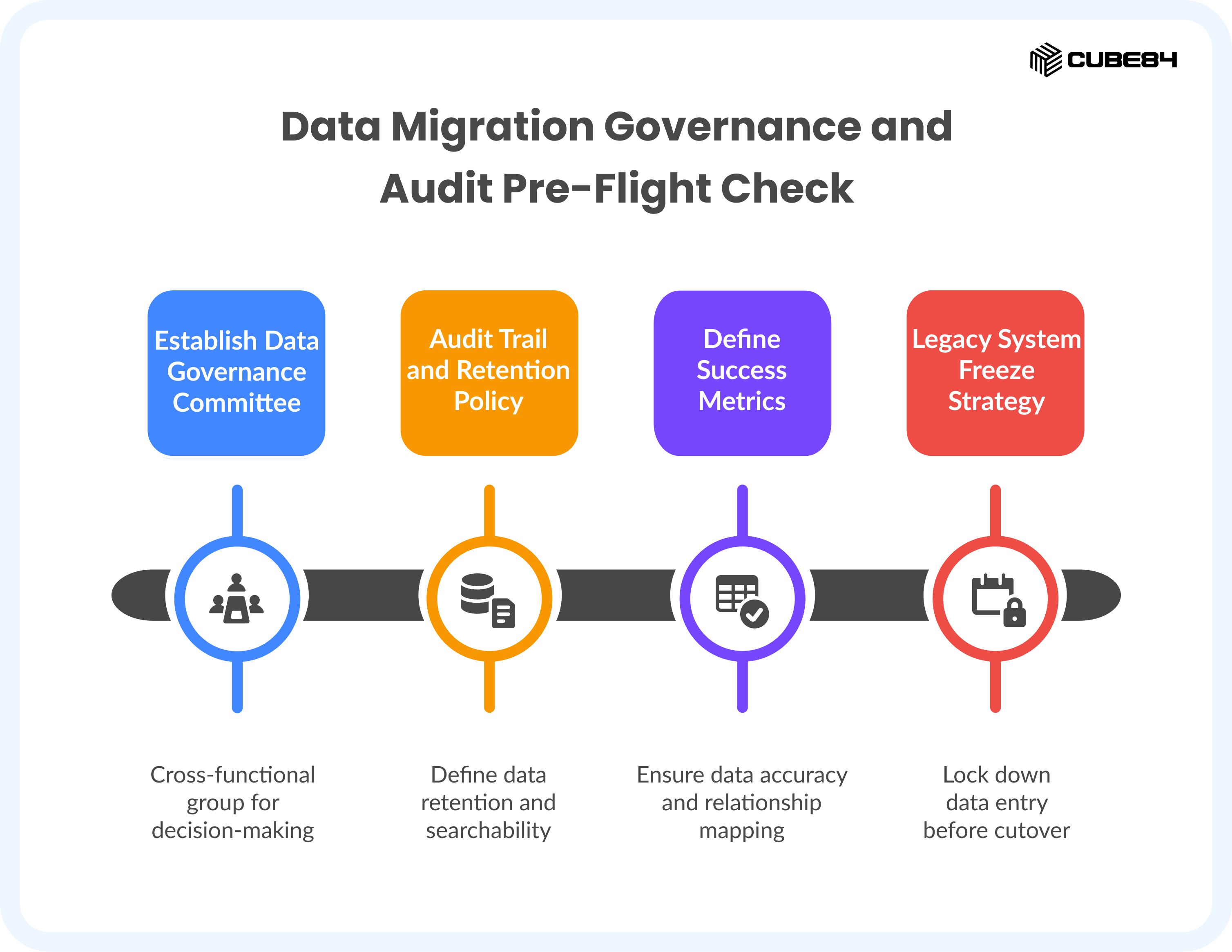
Think of this first phase like checking an airplane before takeoff. You would not let pilots start the engines without confirming fuel levels, weather conditions, and emergency procedures. Data migration works the same way. Before anyone touches your F&E data, you establish a Data Governance Committee. This is a cross-functional group that includes a CFO representative, the VP of Development, and the CIO or IT Director. This is not optional. This committee becomes the final sign-off authority at every phase gate. No committee means no progression.
Start with the audit trail and retention policy. North American nonprofits are generally expected to retain financial records for at least seven years under IRS and audit best practices. Ask the hard question upfront: do historical transactions from 1995 stay searchable in Salesforce, or do they move to a compliant archival system? Clearly document what qualifies as a historical record. This decision prevents panic later when auditors ask for proof of a 2012 restricted fund.
Next, define what success actually means. Success goes far beyond asking whether the data is loaded. Financial Parity requires that totals such as Total Lifetime Giving and Open Pledges balance exactly between the legacy system and Salesforce. Engagement Parity confirms that critical relationships, including board members and key donors, are mapped to the correct Salesforce relationship structures, not flattened into generic records. Without these definitions, validation becomes guesswork.
Finally, establish the Legacy System Freeze Strategy. Lock down data entry hours or days before the final cutover. Any activity during the freeze is captured separately and reconciled before the system is launched.
This phase creates the foundation for everything that follows. Phase 2 should not begin without formal committee sign-off.
Phase 2: Data Cleansing and Data Dictionary Finalization
If Phase 1 was about deciding who is responsible, Phase 2 is about deciding what actually deserves to move forward. This is where most migrations fail, mostly because old problems are carried into a new system and not because of the tools.
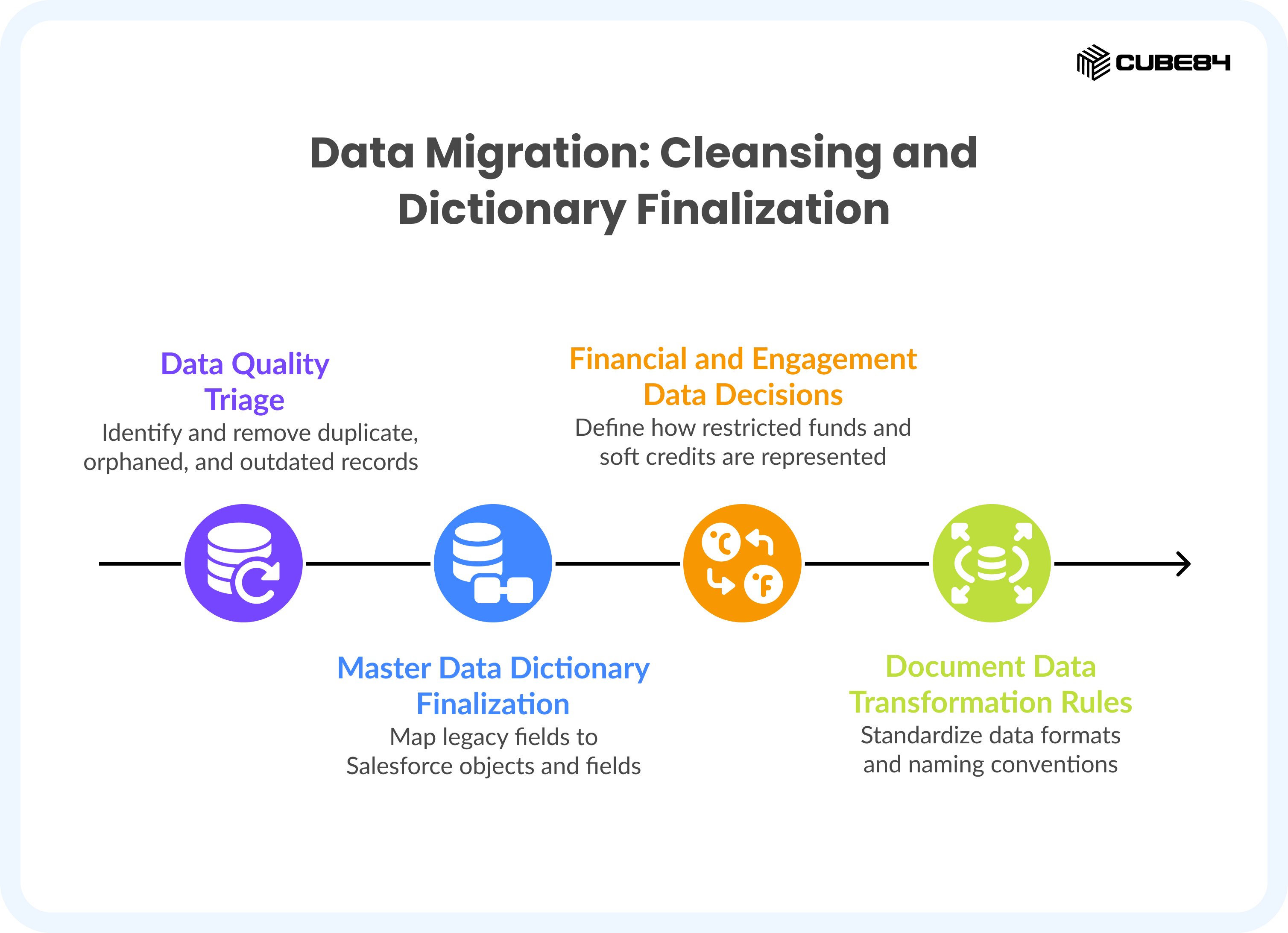
Start with Data Quality Triage. Legacy systems almost always contain duplicate records, orphaned records, and outdated contact information. Multiple versions of the same donor, gifts tied to inactive records, addresses that have not been updated in years. If this data crosses into Salesforce unchanged, it does not become better, it becomes harder to fix. The mandate here is simple. No poor-quality data crosses the threshold. Cleansing happens before migration, not after.
Next comes the Master Data Dictionary, often called the cross-walk. In this required document, every legacy field must be mapped to a specific Salesforce object and field. For example, a Raiser's Edge Appeal Code must map accurately to a Salesforce Campaign or Campaign Member structure. Without this dictionary, teams make assumptions, and assumptions are what break financial and engagement reporting later.
This phase also surfaces the most important F&E decisions. Financial data includes restricted funds, grants, pledges, and payments. Engagement data includes soft credits, householding, affiliations, and influence relationships. You must explicitly define how restricted funds align to Salesforce accounting structures and how complex soft credits are represented in the data model. These decisions shape reporting accuracy long after migration is complete.
Finally, document all data transformation rules. Category codes become picklist values. Date formats are standardized. Naming conventions are aligned. Nothing is left implicit.
Phase 2 is about discipline. When data is cleaned, mapped, and defined here, Phase 3 becomes execution instead of damage control.
Phase 3: The Technical Execution and Staging Environment (ELT)
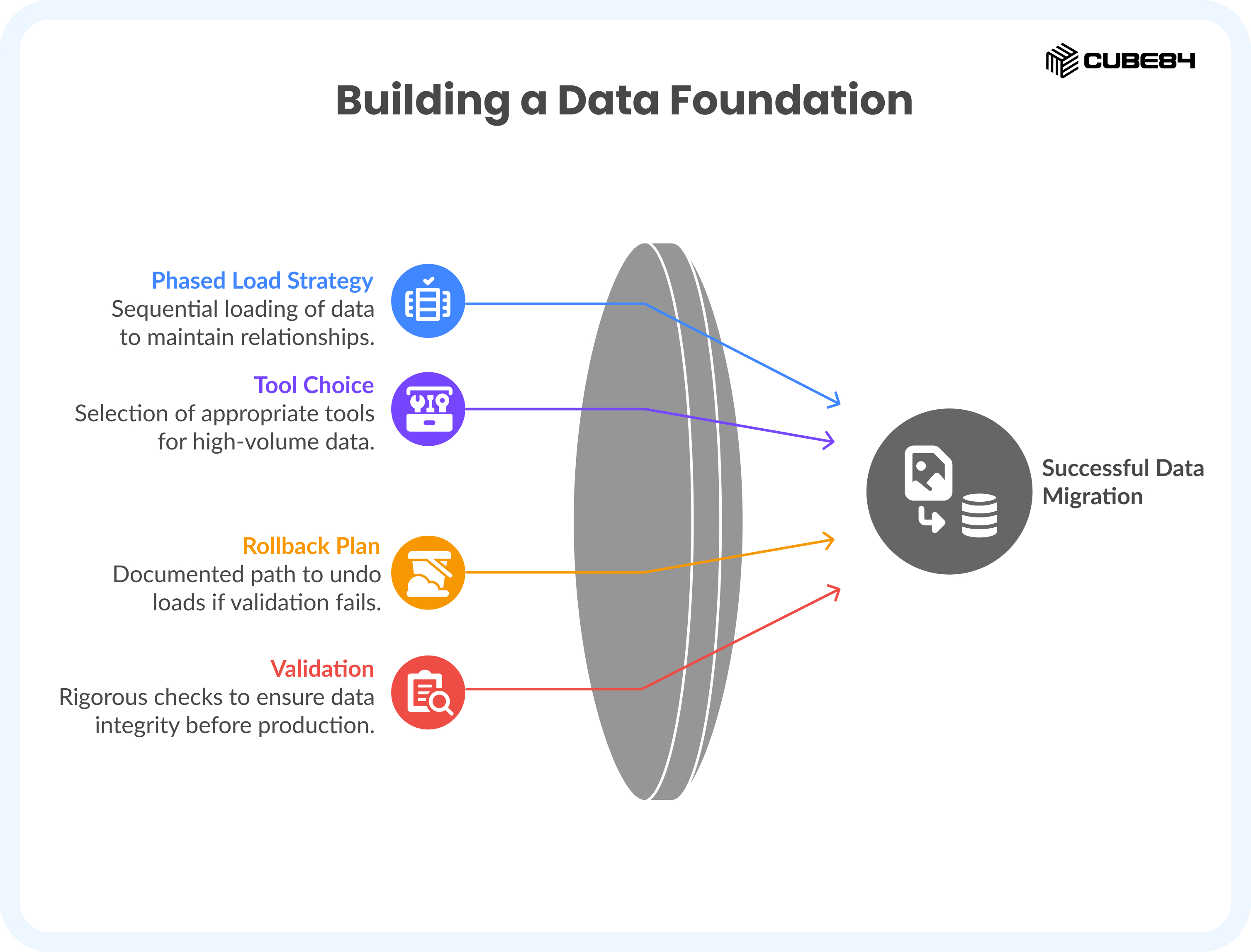
Phase 3 is where planning turns into action, but still not in production. This work happens in a controlled staging environment, typically a Salesforce sandbox, where mistakes are expected, caught, and corrected without impact.
The execution follows a phased load strategy because F&E data has dependencies. Contacts and Accounts are loaded first to establish the foundation. Engagement data comes next, household links, affiliations, board roles, and influence relationships that rely on those core records. Financial data comes last. Gifts, pledges, payments, and allocations are only loaded once Salesforce knows exactly who they belong to. Skipping this order breaks relationships and creates reconciliation issues later.
Tool choice matters at this stage. High volume F&E data cannot rely on basic import tools alone. Teams typically use Salesforce Data Loader or enterprise ETL tools that support transformations, error logging, and retry logic. The goal is control and traceability, not speed.
Equally important is the rollback plan. Before any load begins, there must be a documented path to undo it. If validation checks fail, the team needs the ability to stop, revert, and reload without debate. This safety net protects both timelines and trust.
Phase 3 is still execution under supervision. Data is extracted, loaded, and staged, but nothing moves forward without validation. That checkpoint comes next.
Phase 3 is still execution under supervision. In personal matters you often hear people ask you to not look for validation, but we assure you, here validation is key. Data is extracted, loaded, and staged, but nothing moves forward without validation. That checkpoint comes next.
Phase 4: Validation and Audit Parity Testing (The CFO Checkpoint)
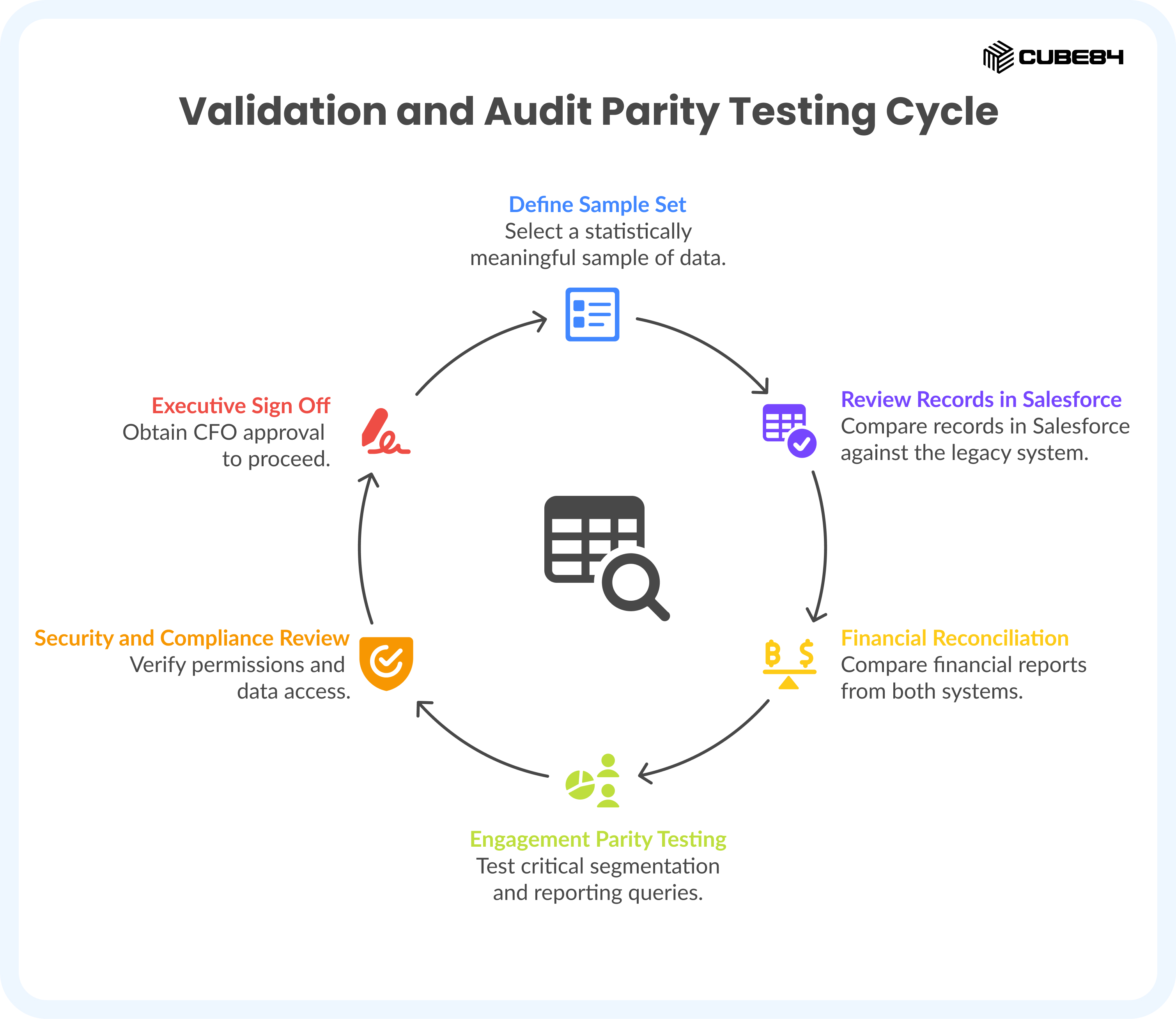
Phase 4 is where assumptions are replaced with proof. This is the validation step in ELT&V, and it belongs to the business, not IT alone. Until this phase is complete, the migration is not considered ready to move forward.
Start with a defined sample set. Most organizations validate a statistically meaningful portion of data, commonly five percent of records or the top one hundred donors by lifetime giving. Each record is reviewed in Salesforce and compared against the legacy system. Total Lifetime Giving, pledge balances, soft credits, and key relationships must align exactly.
Next comes financial reconciliation, led by the CFO or finance team, since audit parity cannot be validated by IT alone. Reports are run in both systems and compared directly. At minimum, this includes Total Lifetime Giving, Open Pledges or Receivables, and Year to Date Revenue by Fund. Totals must match with zero variance.Any discrepancy is resolved before moving forward.
Engagement parity is tested in parallel. Development teams run their most critical segmentation and reporting queries to confirm that board members, key donors, and household relationships appear as expected. If the data cannot be used the same way, it is not ready.
The phase closes with a security and compliance review. Permissions are verified so financial data is visible only to authorized roles, while engagement teams retain access to relationship context.
Phase 4 concludes with executive sign off. Without CFO approval, the migration does not proceed.
Phase 5: Go-Live and Post-Migration Governance (Cutover)
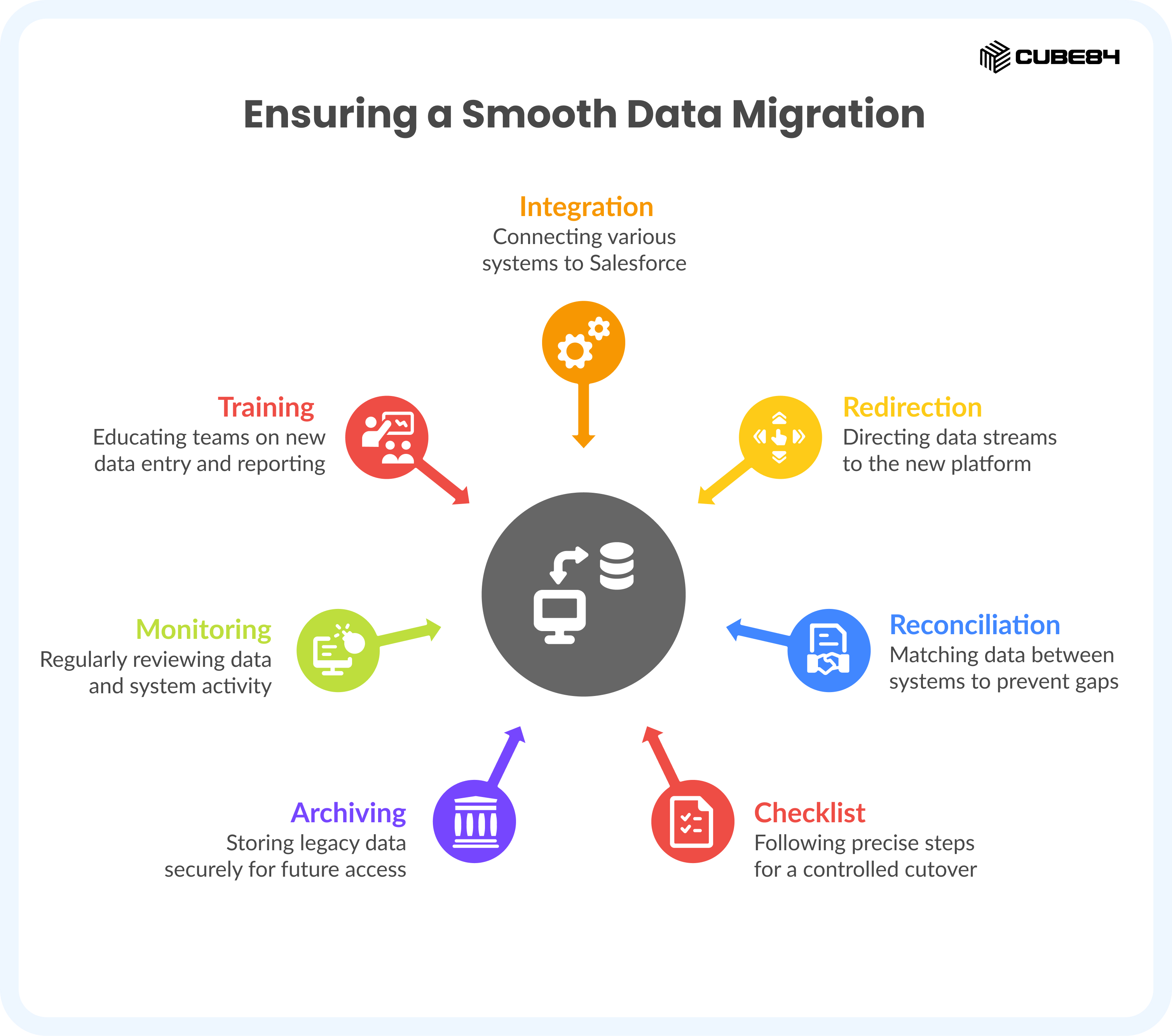
Phase 5 is about control during transition. This is where systems change hands, data streams are redirected, and the new platform becomes the source of truth. A rushed cutover creates data gaps that surface weeks later. A controlled cutover prevents them.
Start with integration, redirection and reconciliation. Inventory every system that sends or receives Financial and Engagement data. This includes website donation forms, payment processors, peer-to-peer tools, accounting syncs, and event platforms. Each integration must follow a preapproved sequence for switching from the legacy system to Salesforce. Transactions received during the switch window are captured in a buffer file or staging table and reconciled after the cutover. This prevents lost gifts and partial records.
Follow the cutover checklist precisely:
1. Freeze legacy data entry
2. Final data sync from buffer file
3. Communicate planned system outage to stakeholders
4. Redirect all remaining data streams
5. Declare go-live only after final validation
Legacy data is then archived. Historical systems are moved to secure, read-only storage that meets retention and audit requirements. This preserves access for audits and reference without maintaining costly legacy licenses.
Post-migration monitoring begins immediately. For the first thirty days, a dedicated team reviews financial reports, integration volumes, and engagement activity on a regular cadence. Any discrepancies are addressed immediately. Training reinforces new data entry and reporting behaviors so teams align to the new source of truth.
This phase completes the migration, but governance continues. The discipline established here protects Financial and Engagement data long after the system is launched.
Conclusion: Mitigating Risk Through Process
As you can see from the phases above, data migration is not just a technical task; it is a business challenge solved by process and governance. By following this playbook and obtaining the necessary audit and executive sign-offs, nonprofit leaders can safely move their Financial and Engagement data, maintain full audit parity, and ensure operations continue without disruption.
When pre-planning is thorough, execution is phased, and ELT&V validation is complete, the organization gains confidence that decades of donor history, restricted funds, and complex relationships are preserved. The system is ready to deliver reliable reporting and actionable insights from day one.
Taking these steps allows leadership to focus on mission-driven work instead of firefighting data issues, knowing that the foundation they built is secure and trusted.
Looking to migrate your Financial and Engagement data safely?