


The Forecast That Didn’t Hold
Fall 2025 may have given many institutions a confusing signal. According to Forbes, National enrollment grew by about 1.0%. Yet, beneath that surface-level growth, private nonprofit four-year institutions saw their undergraduate enrollment drop by 1.6 percent, and for-profit institutions fell by 2.0 percent.
For years, the higher education sector has talked about the enrollment cliff, which is the projected steep drop in college-aged students driven by declining birth rates from nearly two decades ago. That cliff is no longer a theoretical concept discussed in boardrooms. It is actively shaping the 2025 and 2026 recruiting cycles.
For decades, institutional forecasting models were built on a foundation of stable demographics and predictable yield behavior. Yield behavior simply refers to the percentage of admitted students who actually decide to enroll. When the world was predictable, you could look at last year's numbers, make a few minor adjustments, and accurately guess your upcoming class size. That environment has shifted in ways traditional models were not designed to handle.
Traditional enrollment forecasting is breaking down under layers of deep volatility. Institutions that continue to rely on these outdated models face serious risks, including revenue instability, delayed hiring or financial decisions, and a severe misalignment of academic programs.
In this blog, we will break down what is actually changing, why forecasting is falling short, and what institutions can do to move toward a more reliable and adaptive approach.
The 2026 Reality: A System That No Longer Behaves Predictably
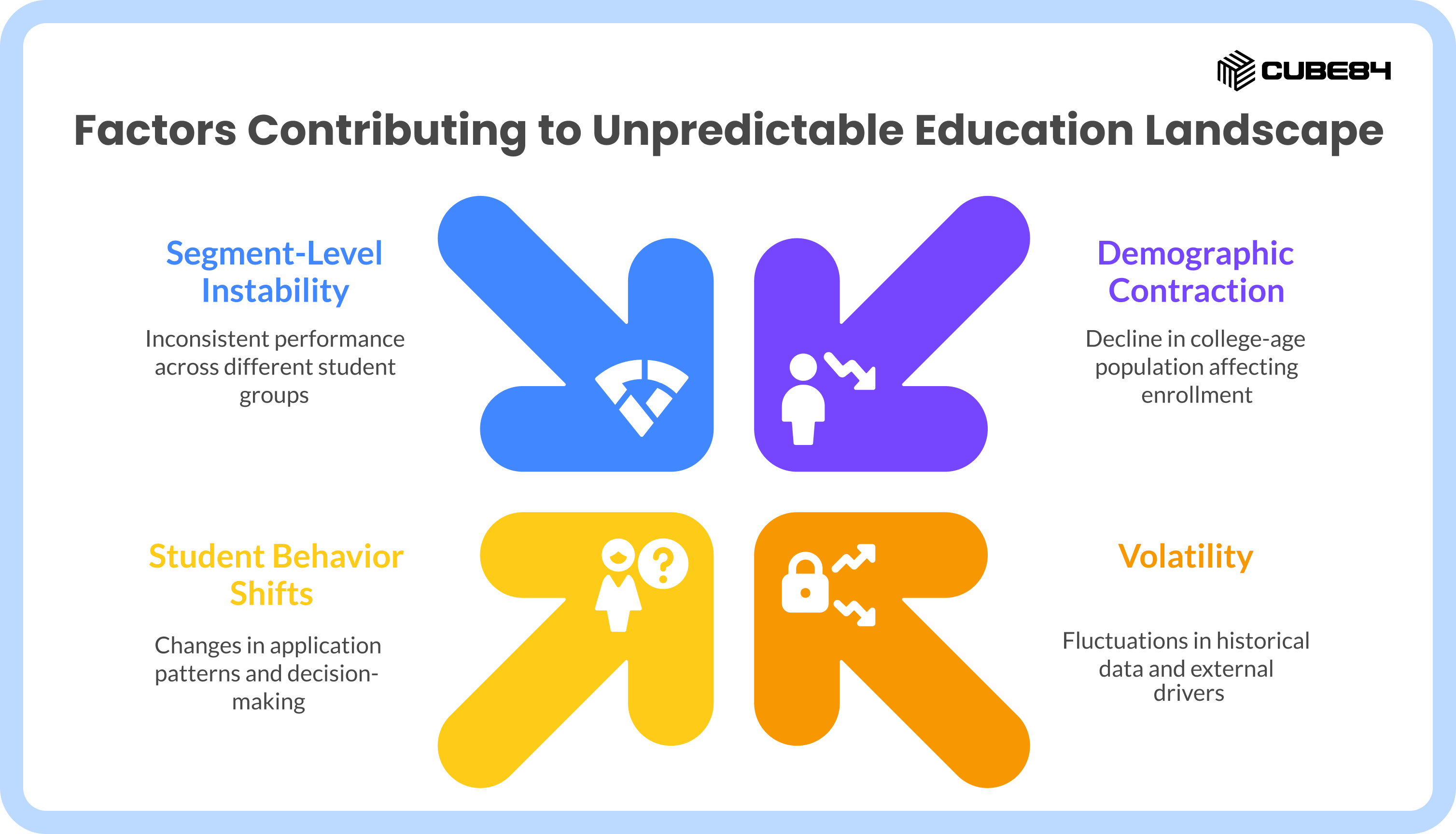
A. Demographic Contraction Is Now Active
The decline in the traditional college-age population has officially begun. High school graduates in the US peaked in 2025 and are now entering a steady decline projected to continue over the next decade.
What makes this more complex is that the decline is not evenly distributed. Some regions are seeing sharper drops than others, which means national trends do not reflect what individual institutions are experiencing.
For enrollment teams, this creates a clear challenge. A national outlook may suggest stability, while the local pipeline tells a very different story.
B. Volatility Has Broken Historical Patterns
For a long time, historical data served as a reliable starting point. Yield rates, application behaviors, and conversion timelines fluctuate far more than they used to. External drivers like government policy changes, deep concerns over affordability, and shifting student priorities now dominate the decision process. A strategy that worked well last year may not produce the same results this year.
This makes historical data less useful as a baseline. It still has value, but it cannot be the foundation on its own.
C. Student Behavior Has Fundamentally Shifted
Student behavior has fundamentally shifted as well. Prospective students are applying to more institutions than ever before, making their final decision timelines highly unpredictable. They are also heavily influenced by Return on Investment (ROI) and concrete career outcomes. If a student cannot clearly see how a specific degree will lead to a specific career, they are likely to look elsewhere. Forecasting models cannot assume stable conversion behavior when the students themselves are constantly changing how they evaluate their options.
D. Segment-Level Instability
Not all student segments are moving in the same direction.
We are also seeing massive instability at the segment level. International enrollment remains highly sensitive to global policies and external economic conditions. Graduate programs are seeing mixed performance depending on field and market demand.
When you rely on aggregate, high-level forecasting, it hides these critical shifts happening within specific student segments.
Core Problems Institutions Are Facing
We know how frustrating it is to try and plan for the academic year when the ground is constantly shifting. Most institutions are currently battling a few core operational problems.
We see a few common challenges:
1. Fragmented and Delayed Data
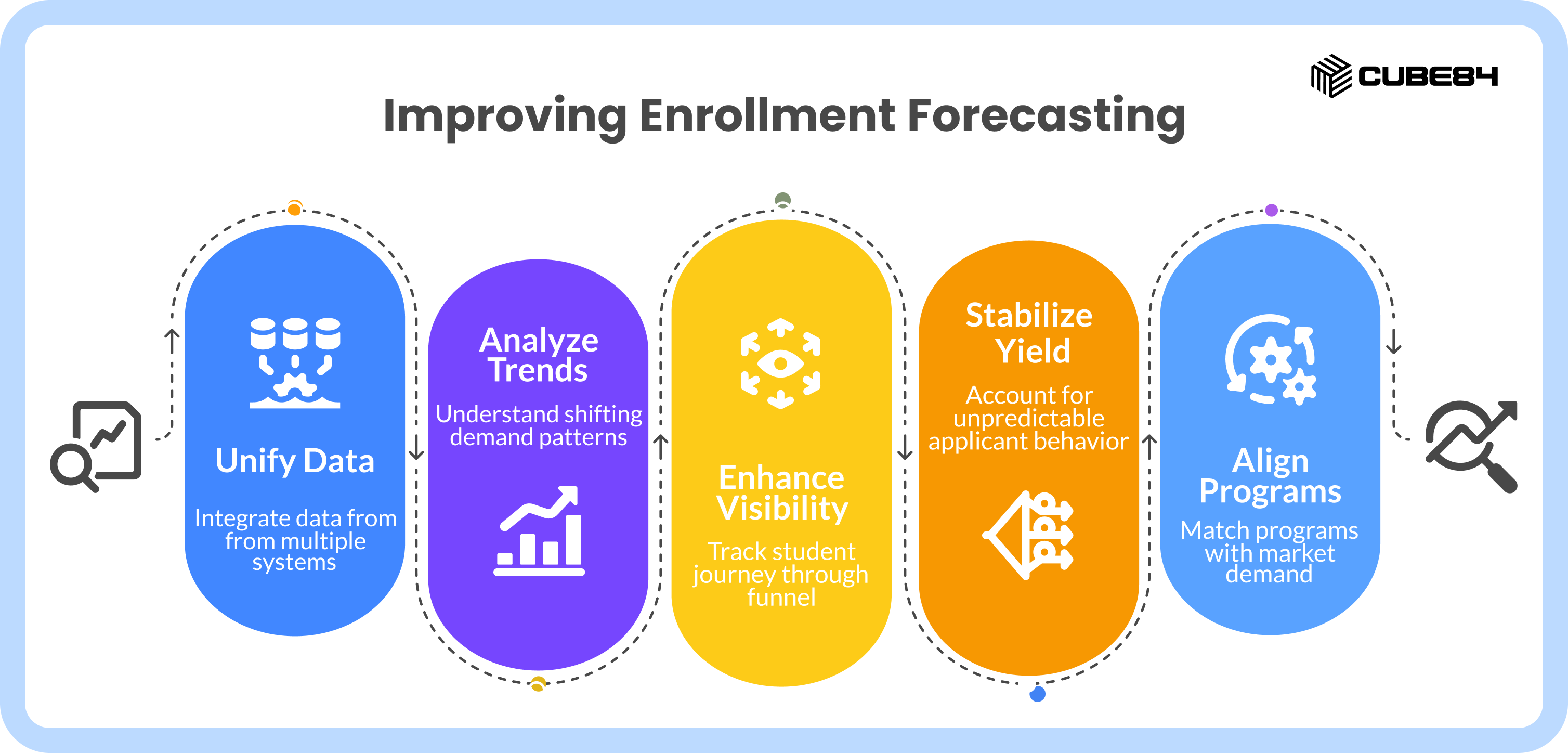
Most institutions are working with data spread across multiple systems. Admissions, marketing, academics, and finance each hold part of the picture.
Without a unified and real-time view, teams are forced to rely on delayed reports or manual consolidation.
The result is simple. Forecasts are built on information that is already a step behind current funnel activity.
2. Over-Reliance on Historical Trends
It is natural to look at past performance when planning ahead. Many forecasting models still depend heavily on prior-year data.
The issue is that demand is no longer moving in a steady, predictable way. It is shifting across programs, geographies, and student segments.
Using last year as the baseline can lead to conclusions that do not fully reflect current demand patterns.
3. Limited Funnel Visibility
In many cases, visibility into the full enrollment journey is still limited.
And the funnel is the step-by-step journey a student takes from their very first inquiry to their final enrollment.
Teams may have strong data at the application stage but less clarity earlier in the funnel or between stages. This makes it difficult to understand where students are dropping off or slowing down.
Without that visibility, forecasts miss what is actually happening inside the pipeline.
4. Unpredictable Yield Behavior
Yield has always been a critical part of forecasting, but it is now far less stable.
Students are applying to more institutions and making decisions later. Outcomes are influenced by changing applicant pools and competitive dynamics.
Even carefully built projections are becoming harder to rely on consistently.
5. Misalignment Between Programs and Market Demand
Many institutions still forecast at a high level, focusing on total enrollment numbers.
At the same time, student demand is shifting at the program level. Some areas see strong interest, while others decline.
Without program-level insight, it becomes difficult to align resources and strategy with actual demand.
6. Operational and Financial Pressure
Small changes in enrollment now have a bigger impact than before.
A slight drop in incoming students can affect revenue, staffing, and program sustainability. This creates pressure across teams and often leads to reactive decisions.
Root Cause: Forecasting Is Solving the Wrong Problem
If you look closely at how enrollment forecasting is typically approached, the traditional question leadership asks is usually, "How many students will enroll?"
That question made sense when patterns were relatively stable and outcomes could be estimated with a fair degree of confidence. Over time, models were built to refine that prediction using historical data, yield rates, and past performance.
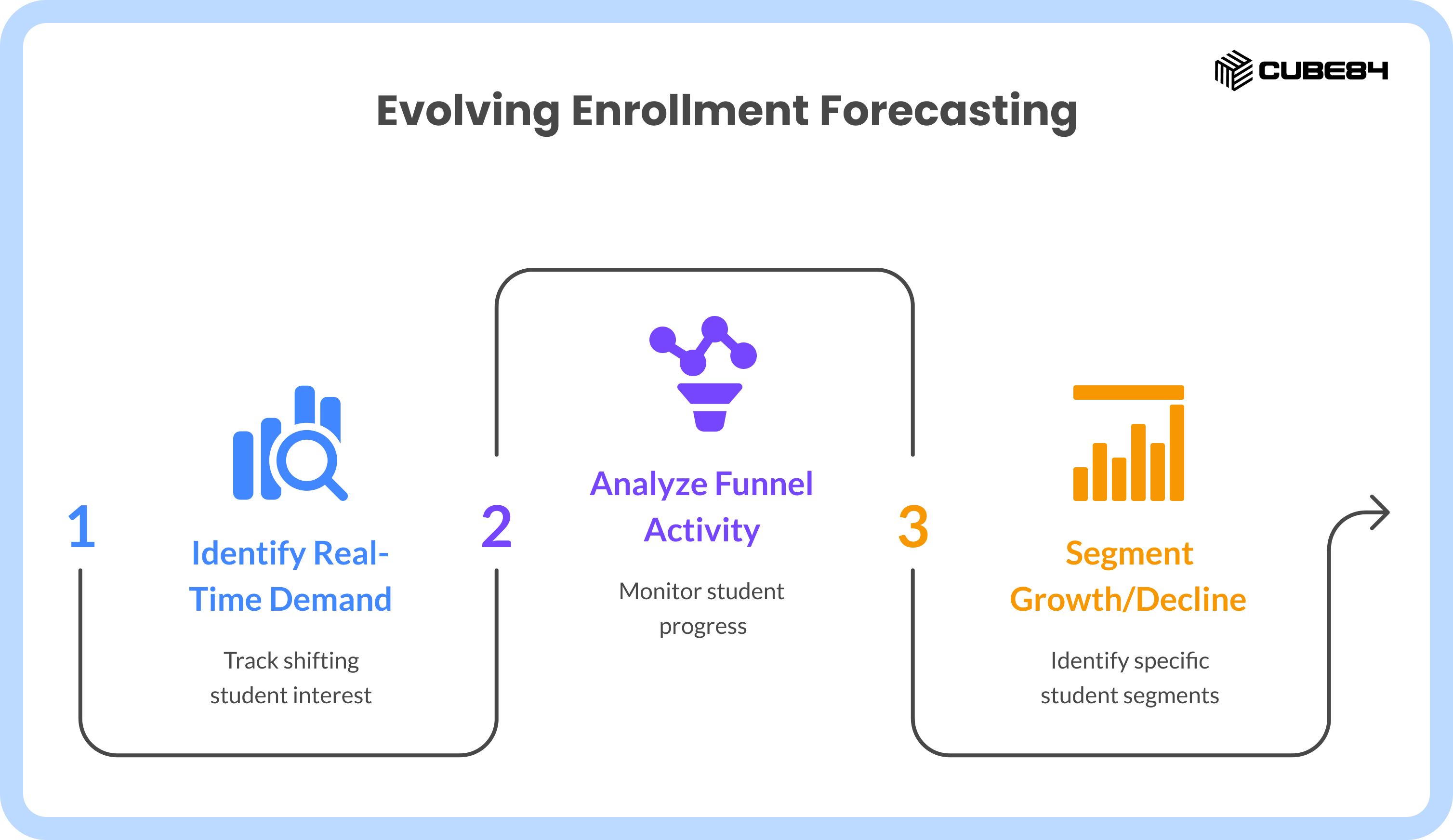
The challenge today is that this approach assumes the underlying system behaves in a consistent way. So, the actual questions we need to be asking are entirely different. We need to know where demand is shifting in real time. We need to know exactly what is happening inside the enrollment funnel. We need to identify which specific segments are growing or declining.
Legacy models assume stability, but the current higher education environment requires continuous, daily adaptation.
Where This Leads If Unaddressed
In the near term, national trends may look manageable. The decline appears gradual at a high level.
If institutions do not adapt, the long-term risks are substantial. We are looking at sustained enrollment declines, increased financial strain, forced program cuts, campus restructuring, and a much higher likelihood of consolidation across the entire higher education sector.
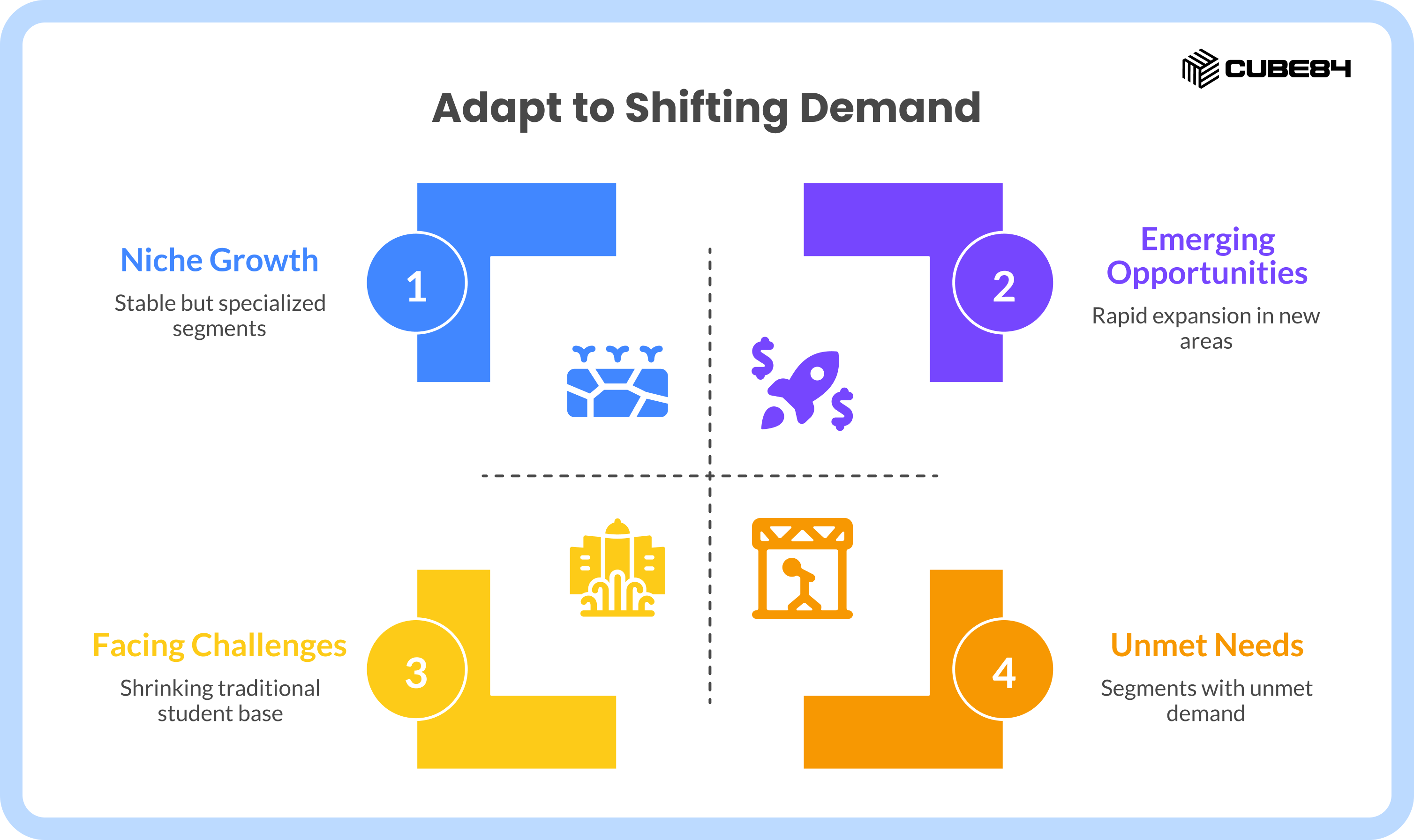
However, there is an important counterpoint to keep in mind. Growth absolutely still exists. We see strong growth in non-traditional learners, short-term credentials, and flexible online formats. Demand has not disappeared, it has shifted toward different segments, formats, and expectations.
What Needs to Replace Traditional Forecasting
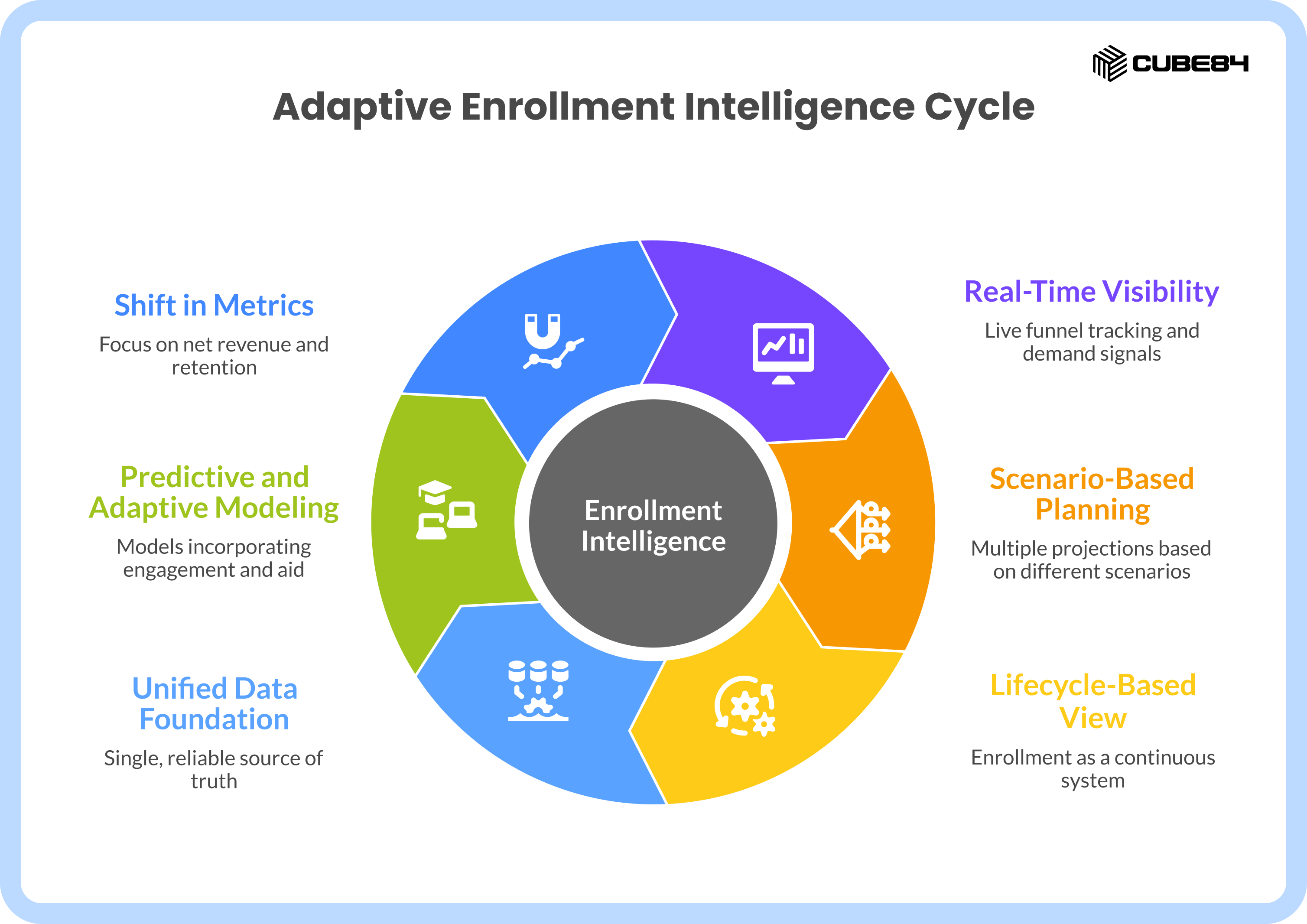
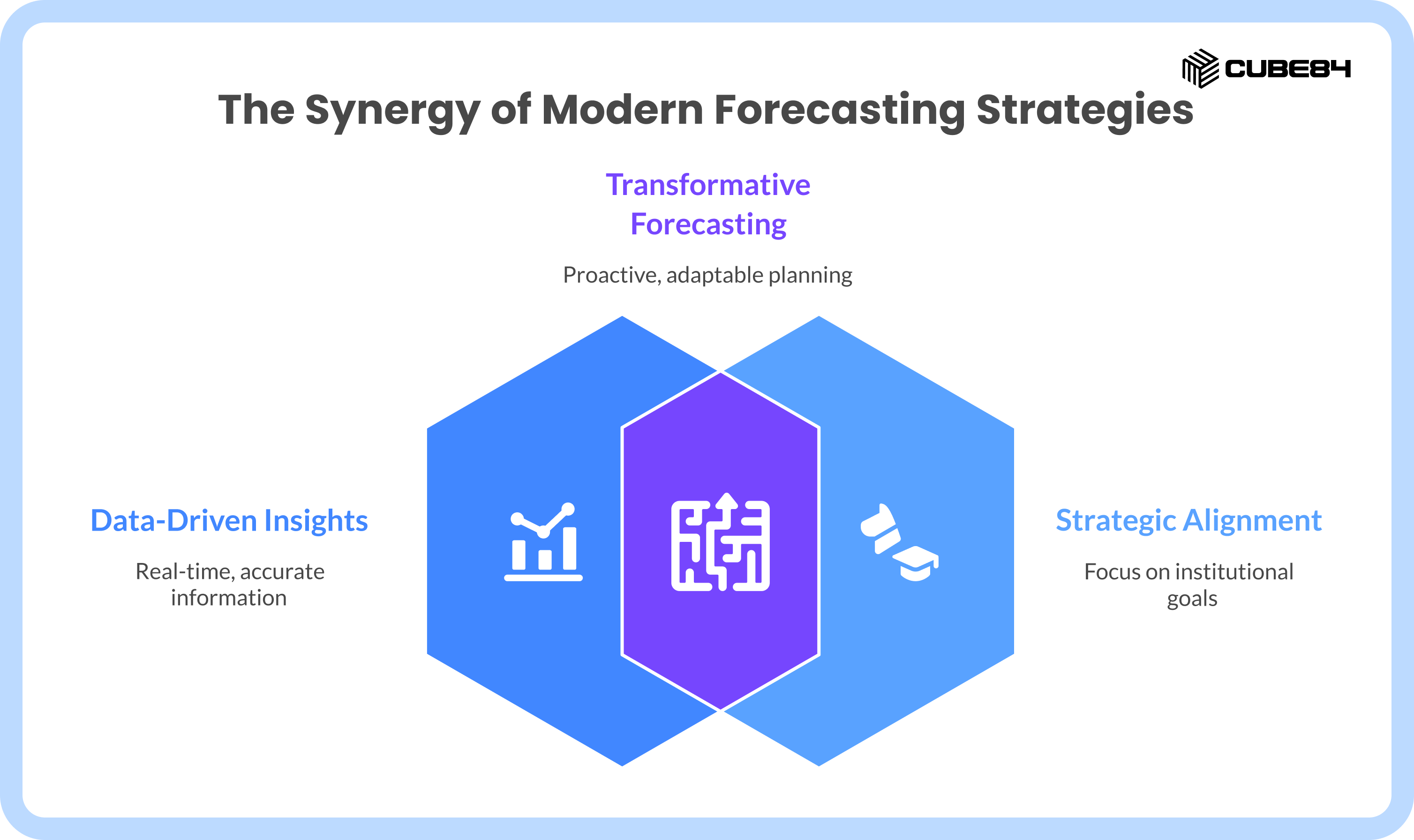
We need to shift from static forecasting to Adaptive Enrollment Intelligence. This means moving away from a single, rigid prediction and moving toward a flexible, data-informed ecosystem. Here is what that looks like in practice.
Real-Time Visibility: You need live funnel tracking, clear signals of demand at the program level, and early warning indicators when a student is disengaging.
Scenario-Based Planning: Instead of relying on one static forecast, teams must create multiple projections based on different scenarios. This requires frequent, ongoing updates instead of one annual planning cycle.
Lifecycle-Based View: Admissions, marketing, enrollment, and retention can no longer operate in silos. Enrollment must be treated as one continuous system.
Unified Data Foundation: Institutions must break down data silos to create a single, reliable source of truth.
Predictive and Adaptive Modeling: Predictive models should be used as helpful support tools, not absolute answers. These models must incorporate student engagement signals, real-time funnel movement, and sensitivity to financial aid offers.
Shift in Metrics: We must move beyond simple headcount. True health indicators include net revenue, student retention, and program-level performance.
Practical Steps to Modernize Your Forecasting
Changing how you forecast can feel overwhelming, so we recommend starting small. Here are the practical steps to modernize your approach.
Audit Current Assumptions: Look closely at your current forecasting process and identify where you are relying too heavily on outdated historical patterns.
Map the Full Funnel: Track every single stage of the student journey and clearly identify where your biggest drop-offs occur.
Track Leading Indicators: Pay close attention to early signals like inquiry trends, email or event engagement levels, and the speed of application progression.
Begin Data Unification: You do not need to fix everything overnight. Start connecting your key systems incrementally.
Move to Rolling Forecasts: Transition away from annual guesses to monthly or quarterly forecast updates.
Introduce Scenario Planning: Build multiple planning models to prepare for best-case, worst-case, and most-likely outcomes.
Align Around New Segments: Focus your growth strategies on adult learners, flexible program structures, and career-aligned offerings.
A great tip from our experience is to start with one high-impact area instead of trying to overhaul your entire campus infrastructure at once.
The Role of Modern Platforms
As institutions work toward a more adaptive approach, technology plays an important role.
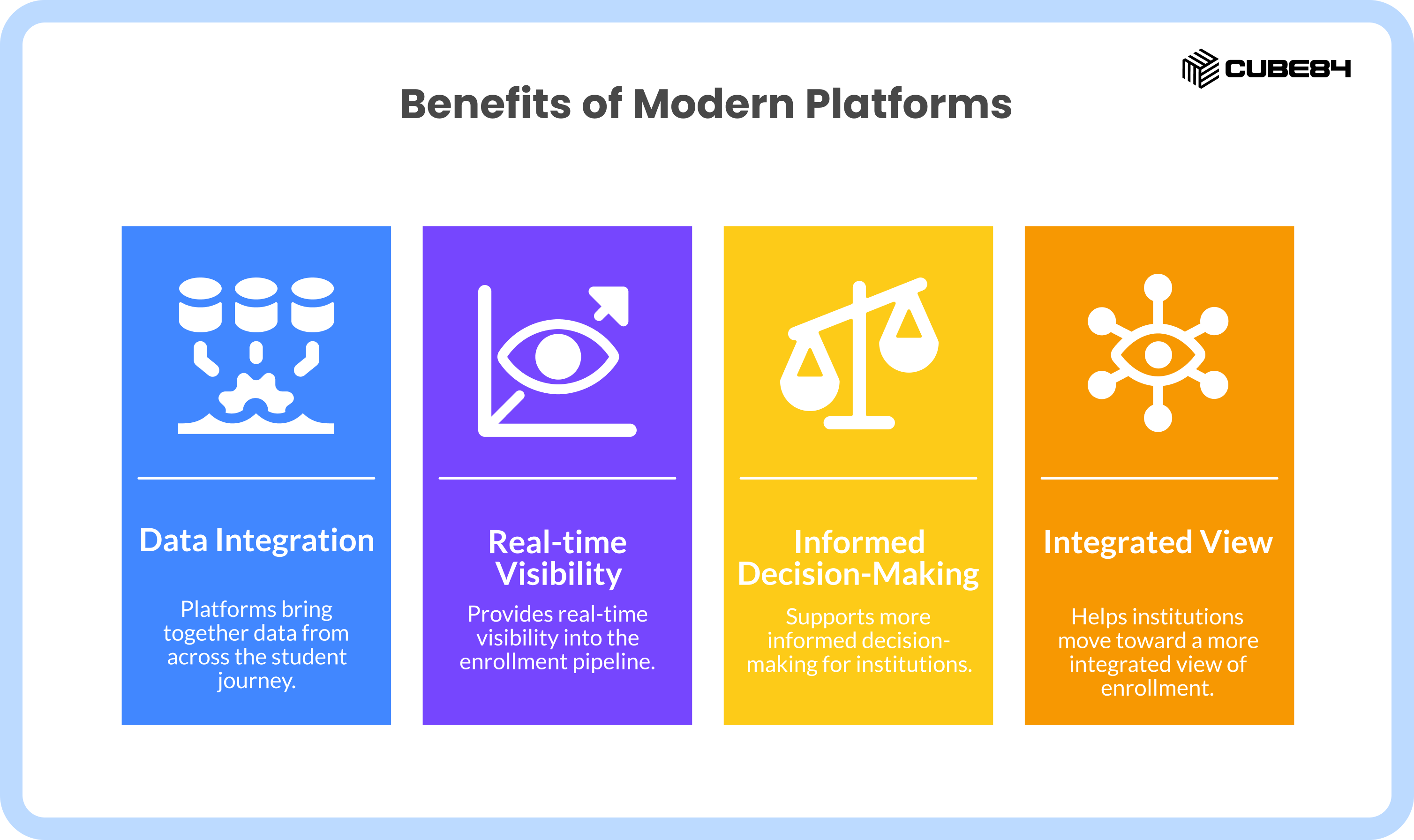
Modern platforms make it possible to bring together data from across the student journey, provide real-time visibility into the pipeline, and support more informed decision-making.
The goal is not just better prediction. It is better awareness and faster response.
Platforms like Salesforce are often part of this shift, helping institutions move away from disconnected systems and toward a more integrated view of enrollment.
Assess Your Readiness
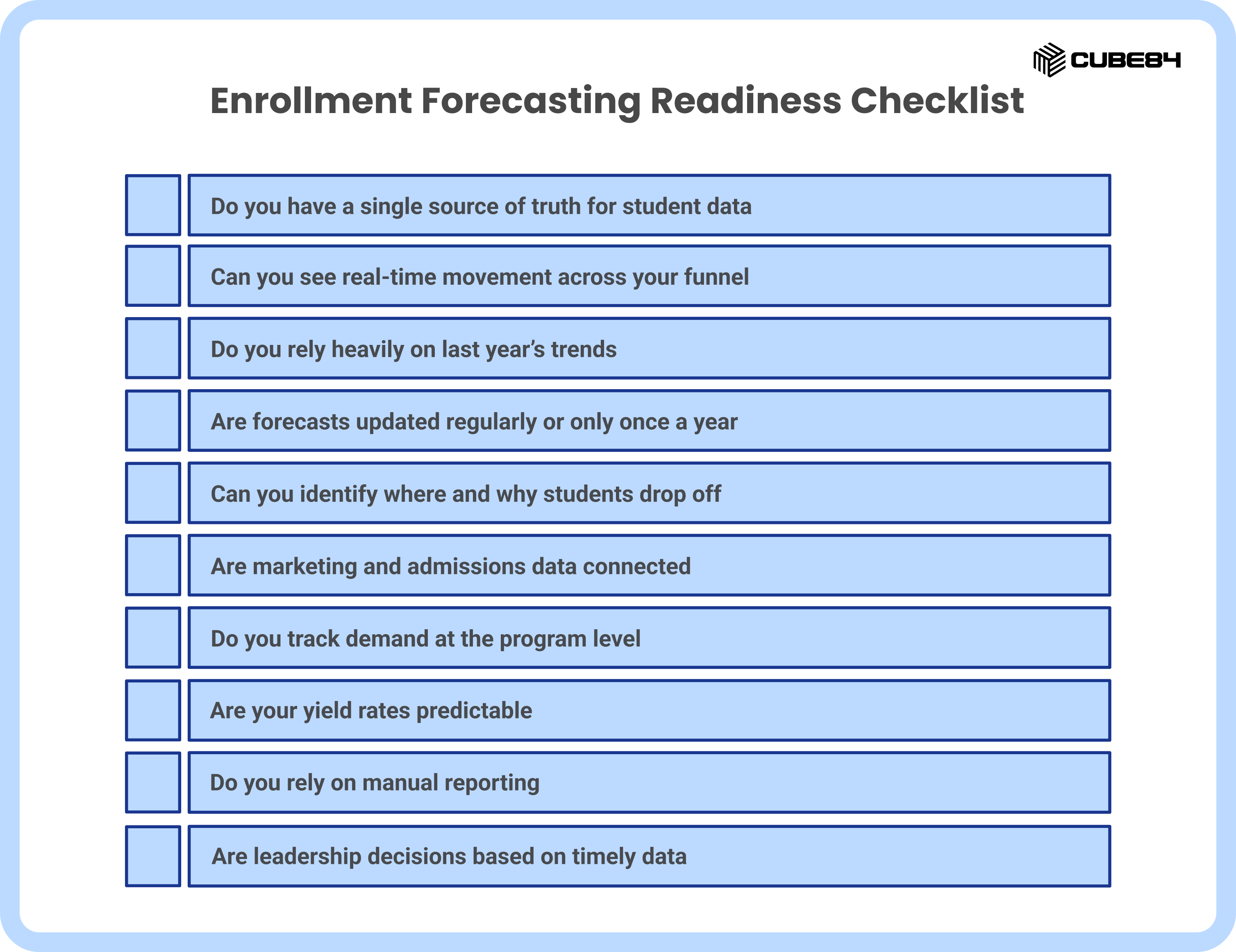
Are you prepared for the next cycle? We have put together an “Enrollment Forecasting Readiness Checklist” to help you evaluate your current standing.
Is your enrollment forecasting built for 2026?
We also want to hear from you.
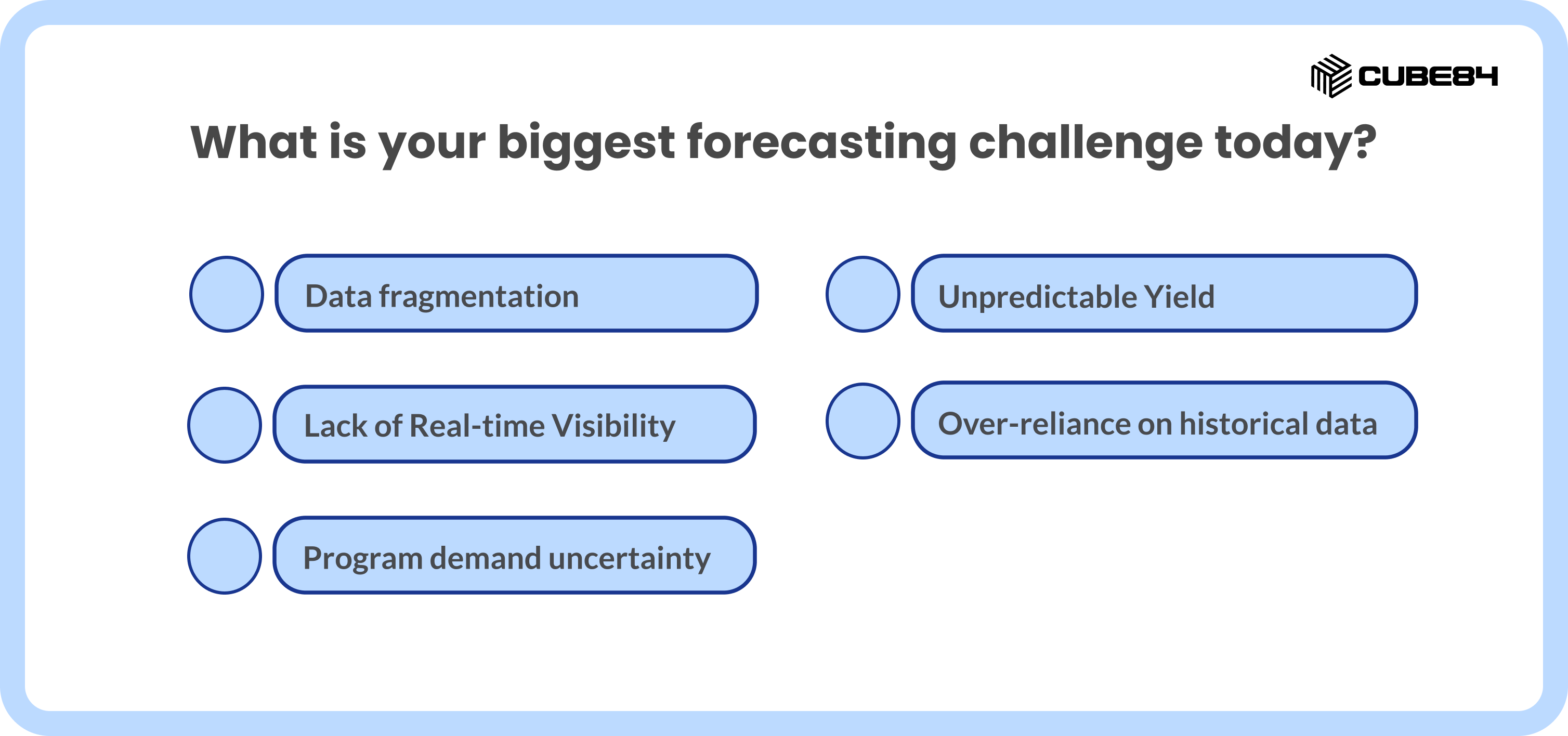
Take our mini poll:
Preparing for the New Enrollment Reality
Enrollment forecasting is under pressure even in institutions with experienced teams and well-established processes. Much of this comes from how the enrollment landscape keeps shifting in ways traditional models struggle to capture. What worked earlier was built on patterns that stayed consistent, while today those patterns vary across segments and are shaped by factors beyond institutional control.
Institutions seeing better outcomes are staying closer to real-time signals, connecting data across the student journey, and adjusting plans as new information comes in. The goal is to respond with clarity as conditions evolve, not to rely on a fixed forecast created at the start of the cycle.
We work with institutions to bring this visibility and adaptability into their enrollment strategy. If this feels familiar, it may be a good time to start a conversation.