


Introduction
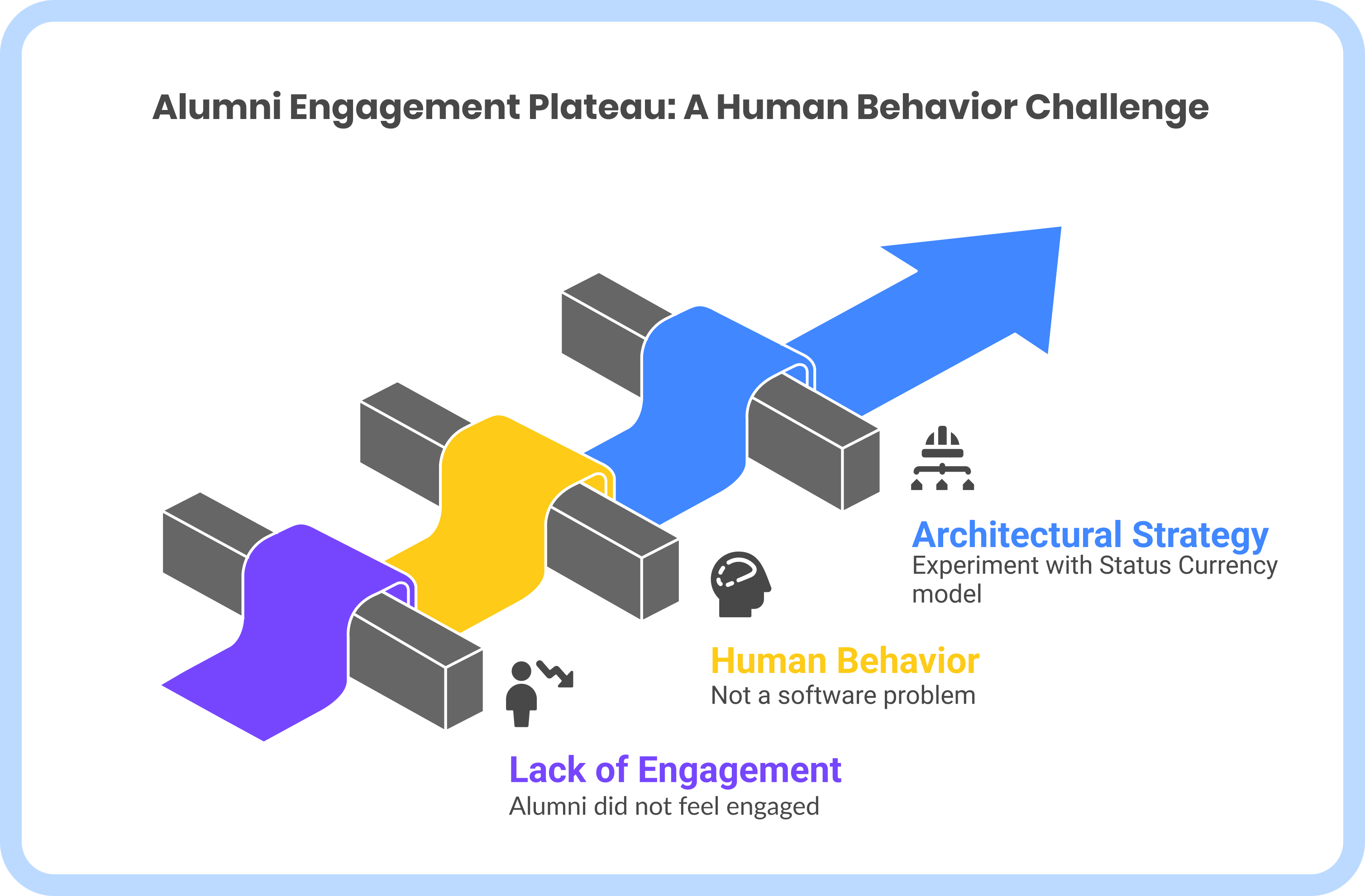
You made the smart move of bringing all your alumni data into one unified platform and ensured everyone is connected. Your website feels intuitive and seamless. You even had a very grand and successful launch of your alumni portal. The participation rates spiked, you saw great initial adoption, and celebrated your highest-ever profile completion rates. What happened after?
About four or five months later, this engagement starts to flatten, like the energy simply evaporated. Such good technology, and yet such low engagement rates?
We’ve seen quite a few alumni platforms follow the same curve. The problem is not the software.
The answer is simple, your alumni did not feel engaged enough to return again.
This article looks at a different way to think about long-term alumni engagement. We understand this is rarely a software problem. It is more about human behavior and architectural strategy.
We’ve put together a framework for how institutions can experiment with a Status Currency model inside Salesforce, supported by real world inspirations.
I. The Engagement Plateau: The Emotional and Strategic Problem
Your alumni eagerly log in, click, and explore, and then the initial curiosity slowly fades. So, what does it take to motivate busy, high-achieving alumni to sustain meaningful contributions over years? Something meaningful that pulls them back.
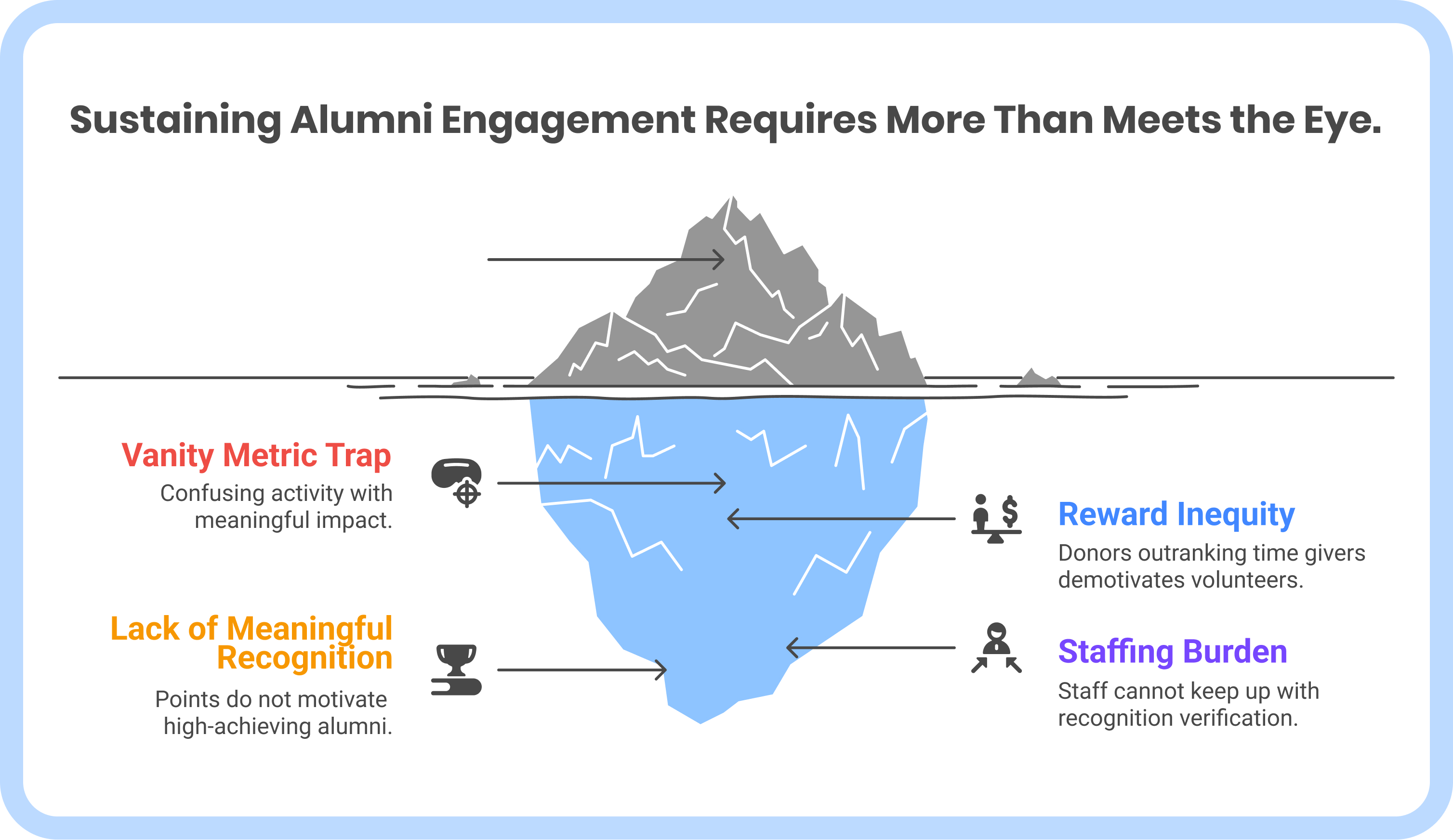
A. The Vanity Metric Trap
We often confuse activity with impact. Logins, views, and likes all look impressive, but they do not translate into meaningful contributions like mentorship completions, student referrals, or leadership involvement. It’s important to distinguish low-value behaviors from high-value behaviors, where only the latter influences an alumni score.
This is where the concept of Reward Inequity shows up. If an alumnus or alumna can earn the top badge by clicking through their profile once a week, they have no motivation to invest their most valuable asset: their time. If your system lets donors outrank time givers, you demotivate the very people who strengthen your talent pipeline.
So, the goal should be to encourage contribution and assign scores based on time and effort, not financial capacity. For example, a volunteer who completes ten verified mentorship sessions should never be outranked by someone who simply donates. Philanthropy is powerful, yes, but it belongs in a different part of the ecosystem and should not be confused with contribution here.
B. Why Points Do Not Motivate CEOs
Stars, badges, and streaks might attract your students, but they don’t work for your high-achieving alumni. They look for something much more meaningful, like influence, authority, and peer recognition. Status is the real currency here because it’s a social signal more valuable than cash for this audience. It transfers across networks and taps natural competitive instincts.
C. The Staffing Burden Behind Recognition
It would be easy for a staff member to review or verify one query or session update, but imagine having to do a hundred or more in a single day along with other work. Your program will stall, and this is not uncommon because staff cannot keep up. This is where automation becomes essential. Shifting to roughly 90 percent automation frees your team to focus on relationship-building and reduces staff burnout while maintaining credibility.
II. Behavioral Strategy: The Engine for Sustained Engagement
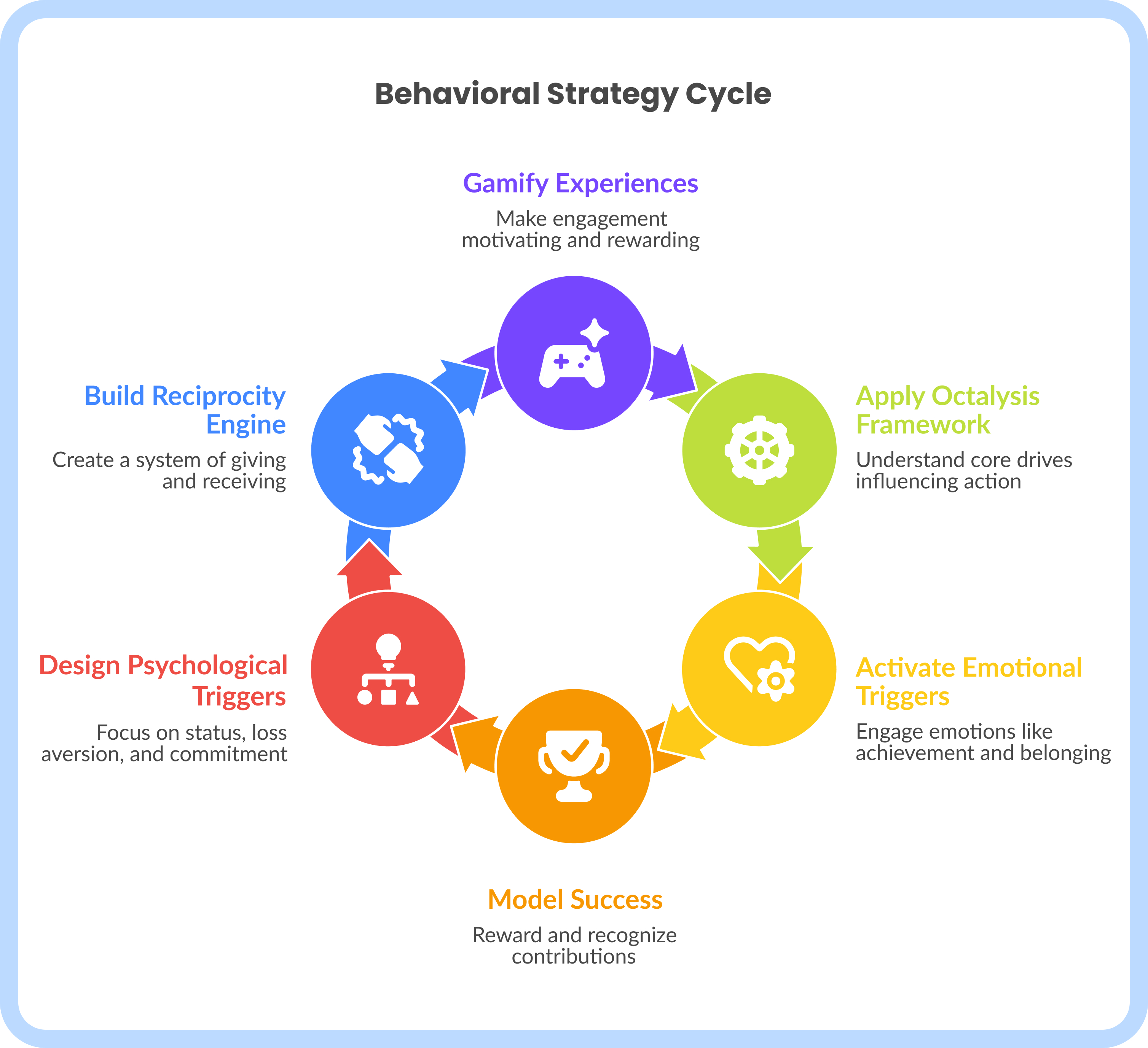
If you observe a pattern in human behavior, you’ll notice how we are drawn toward things that thrill us, excite us, motivate us, or bring value. That is why gamifying experiences can make engagement feel more motivating and rewarding.
Before getting into the Salesforce architecture, let’s look at the behavioral design principles that create long term patterns. The Gamification Framework by Yu kai Chou, called Octalysis, describes eight core drives that influence why people take action. Understanding these drives helps shape a strategy that feels natural rather than forced.
Why Gamification Matters for Human Behavior
The Octalysis framework explains that humans stay engaged when certain emotional triggers are activated, like a sense of achievement, belonging, purpose, or curiosity about what comes next. These triggers are the reason gamification works so well in alumni communities. People naturally gravitate toward activities that help them grow, give them meaning, spark interest, or strengthen social connection. Alumni return because they can see what they have achieved, what they can do next, and how they fit within the larger community. This creates a loop where participation feels enjoyable and meaningful rather than something they need to push themselves to do.
A. Modeling Success: The MVP Program
Microsoft introduced a program called the Microsoft MVP program (Most Valuable Professional) to reward and recognize the non-monetary efforts of tech leaders. These MVPs contribute through speaking, mentoring, code samples, and public answers. The program works because they are rewarded with status, influence, and access to a meaningful community rather than cash.
Drawing parallels from this, we can design a system that aligns with human behavioral patterns, tapping into what drives people to contribute again and again.
This idea also appears in higher education contexts. For example, at a prestigious college in New York, structured contribution loops turned vague mentorship invitations into verifiable actions with high completion rates. This behavior change was not because of technology, but due to the structure.
B. Psychological Triggers Worth Designing For
The Octalysis framework outlines eight core drives, but for a recognition model like this, it helps to focus on three psychological elements that give the system real longevity. These are the forces that keep alumni returning because the experience feels meaningful rather than mechanical.
1. Status and Social Influence
People perform better when they see their peers achieving something. They relate to this and aim to reach the same level. This connects to Octalysis Drive 5. In our case, alumni care about influence and will contribute repeatedly if their actions increase their standing in the community.
2. Loss Aversion
This relates to Octalysis Drive 8, the fear of avoiding something negative. In our case, alumni must maintain annual status renewal or persistent activity, so the potential loss of status motivates continued contribution. The fear of losing status is often more motivating than the reward of gaining it once.
3. Commitment and Consistency
Based on Cialdini, if the system rewards the first small action, the alumnus is more likely to return for a larger one. Reward small actions first to build habits. One verified session today can become three sessions next term.
C. The Reciprocity Engine
When you build something that’s not one-sided, but based on giving something and receiving something in return, it becomes more valued and structured. Here, recognition acts as the key to the Reciprocity Engine.
1. Locked Resources
The idea is to lock key resources like certain forums, leadership groups, and exclusive content until the alumnus completes specific actions. Limited access increases perceived value.
2. Intellectual Reciprocity
Based on Octalysis Drive 4, people are motivated because they feel a sense of ownership. They value access to deeper knowledge, behind-the-scenes content, or curated insights, which connects directly to the psychological drive for ownership.
3. Social Amplification
When the alumni are presented with a credential that’s shareable, like something that they can post on LinkedIn it elevates their professional identity and expands the institution’s brand visibility. Titles like “Verified Mentor” tell a stronger story than “Active Member.”
III. Salesforce Experience Cloud and CRM: A Model Architecture
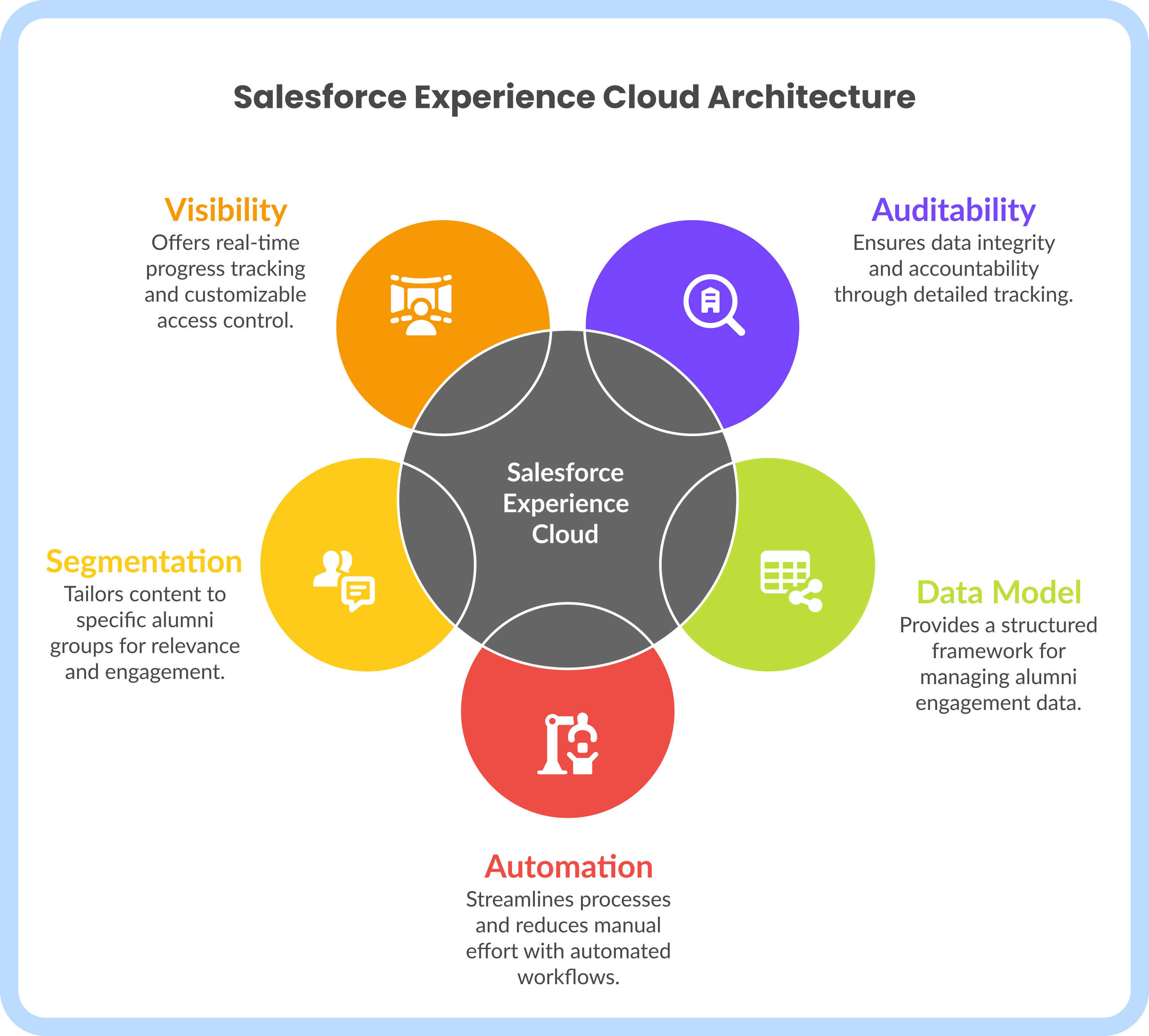
We believe that your strategy is only as strong as the data that supports it. So, we present a reference architecture to be adapted that is scalable, auditable, and largely automated using standard Salesforce tools.
A. The Auditability Imperative
To recognize and reward contributions, you need proof or data that backs it up. If an alumnus disputes their tier or believes an achievement was missed, the CRM must provide a clear record. Salesforce supports this with built in audit features such as Setup Audit Trail.Field Audit Trail is also available for institutions that require longer retention or regulatory grade tracking.
B. A Representative Data Model
We’ve created a data model as a reference schema to show the level of granularity needed for auditability. This is not a fixed model. You can adapt it and build your own based on how your processes work.
Representative Object | Function in Gamification Model | Example Field (Verification) |
Contact (Alumni) | Stores calculated metrics for reporting | Total_Engagement_Score__c, Current_Status_Tier__c |
Mentorship_Session__c | Tracks a high-value action | Session_Completion_Date__c, Verified_By_Student__c (CRUCIAL) |
Engagement_Transaction__c | The ledger of actions | Action_Type__c (e.g., 'Recruit_Review'), Score_Value__c |
With this model, you get a clear view of the total engagement score, the number of completed mentorship sessions, and the alumnus’s areas of interest and expertise, all in one place. This setup provides the foundation for accurate scoring, reporting, and recognition while keeping the system auditable and verifiable.
C. The Automation Engine: Salesforce Flows
With such large volumes of data, manual tracking is not a scalable option so automation is essential. Automation allows complex logic to run efficiently without hitting technical limits.
Record Triggered Flows : These are perfect for validating individual actions. When a mentor session record is marked as verified by the student, a Flow instantly creates the corresponding Engagement Transaction record and assigns the points. This happens automatically in the background so every completed session is captured without manual work.
Scheduled Flows : These work well for calculating aggregate scores, like adding up all engagement points and updating the Total Engagement Score on the Contact record. Scheduled Flows usually run nightly, which helps manage large volumes of data and keeps the process within Salesforce limits.
With automation in place, your staff can focus on relationship-building rather than manually verifying and following up on mentorship details, keeping the system efficient and reliable.
D. Segmentation and Personalization: Making Engagement Relevant
Different alumni are motivated by different things. A recent graduate, someone mid-career, and a senior leader will not respond to the same messages or opportunities. Experience Cloud works best when automation is paired with smart segmentation. For example, you can tailor newsletters, events, or forums based on industry, geography, or interests. When alumni see content that feels relevant to their world, they are much more likely to return on their own.
E. Experience Cloud Components: Visibility and Access Control
With Experience Cloud, you can personalize what each alumnus sees based on their preferences:
1. Audience Targeting for dynamic visibility
2. Permission Sets and Permission Set Groups for tier-based access
3. A custom Lightning Web Component (LWC) to display a live status badge and generate a shareable link or credential
This approach allows alumni to track their progress in real time and decide whether they want their status visible to others, preserving privacy while enhancing engagement.
Remember, automation saves staff time but shifts costs to Salesforce admins who maintain the system, so ongoing management becomes the primary expense.
IV. Designing Tiered Recognition: A Strategic Framework
With a tiered model, you provide the system with a clear structure that simplifies engagement by aligning behaviors with institutional priorities while leaving room for customization.
Below is a sample framework that institutions can use or adapt based on their key priorities and desired alumni actions.
Model Tier | Strategic Goal (Variable) | Illustrative Action/Behavior | Suggested Reciprocity/Reward |
Tier 1: Connector | Platform Adoption & Initial Commitment | Completes full profile, sends first message | Access to basic directory |
Tier 2: Contributor | Validation & Sustained Support | Completes 3 Verified sessions | Access to exclusive webinars and content |
Tier 3: Ambassador | Leadership & Institutional Impact | Recruits 1 student, serves on advisory board | Invitation to private leadership forums |
Expert Insight “Across multiple universities we have worked with, Tier 2 (Contributor) consistently proves to be the most important inflection point in alumni engagement. Alumni at this stage have moved beyond curiosity, but they have not yet fully stepped into a leadership role within the community. What works best at Tier 2 is fast, visible recognition after verified actions like mentorship completion. Clear progression signals, such as showing how close someone is to Ambassador status, help alumni understand what comes next. Reciprocity also needs to feel earned. Exclusive access and early invitations matter far more than decorative badges. Small wins at this stage, including public acknowledgment or curated access, significantly increase the likelihood of alumni progressing to Tier 3 within the next six to twelve months. There are also clear pitfalls to avoid. Overweighting Tier 1 actions like profile completion can make contributors feel their time is undervalued. Promoting alumni to Tier 3 too quickly dilutes the meaning of Ambassador status. And programs tend to stall when staff must manually verify every action. Automation with strong auditability is essential to maintain credibility without burnout.” — Sunil Jith S H, Vice President - Technology and Solutions, CUBE84 |
The Broader Engagement Ecosystem A status model is most effective when it’s part of a larger ecosystem that keeps alumni engaged even when they’re not actively mentoring or recruiting. Features like job boards, professional groups, alumni success stories, events, and curated content help alumni feel connected even when they aren’t taking a major action. These supporting activities keep the engagement loop moving so it doesn’t stall between mentorship activities or status changes. |
V. Governance and Sustainability: The Long View
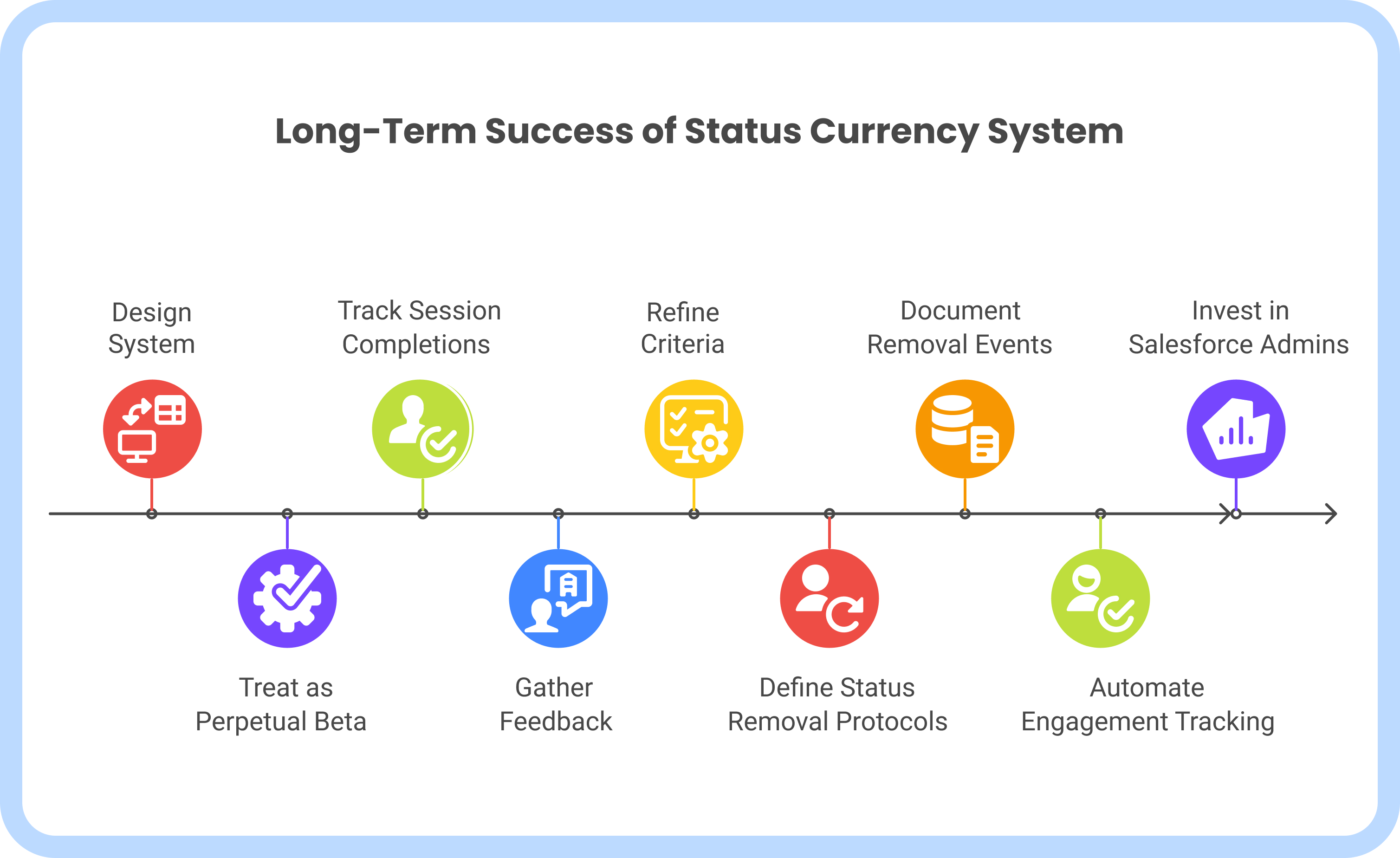
You’ve successfully designed a system, but is that all there is to it? Remember, this is just the beginning. The Status Currency system is not a one-time build. It evolves as the institution evolves. Here’s what to consider for long term success:
Audit and Evolution
Since alumni programs and institutional goals keep evolving, it is best to treat the program as perpetual beta so criteria, weightings, and actions can be adjusted without major disruption.
Analytics and Feedback Loops
A system like this becomes stronger when you measure what’s working. Track session completions, repeat participation, tier distribution, and where users tend to drop off. Consider sending short feedback surveys once or twice a year. These insights help you refine criteria, uncover pain points, and evolve the program more effectively.
Cost of Governance and Status Removal
It is natural that sometimes an alumnus may violate a code of conduct. This is why it is ideal to define status removal protocols ahead of time with Legal and Development before the program launches. Also, make sure every removal event is documented in the CRM audit history so any disputes can be resolved smoothly.
The Total Cost of Ownership
When you automate engagement tracking the cost shifts from manual staff effort to specialized Salesforce admin maintenance. This reduces burnout for program teams, but it requires steady investment in admins who monitor flows, audit transactions, and troubleshoot integration issues. If you want to understand this more clearly you can explore this blog that covers the total cost of ownership in detail: (Link)
Conclusion
Creating a successful alumni platform does not stop at launch day. Institutions that apply frameworks like Octalysis and use real world examples see measurable behavior change. When you focus on what motivates people, your alumni return, your community grows stronger, and the platform delivers on its promise. The key is to keep iterating, listening, and adapting.
If you are looking to build an effective alumni portal or strengthen long term engagement, reach out to us.