


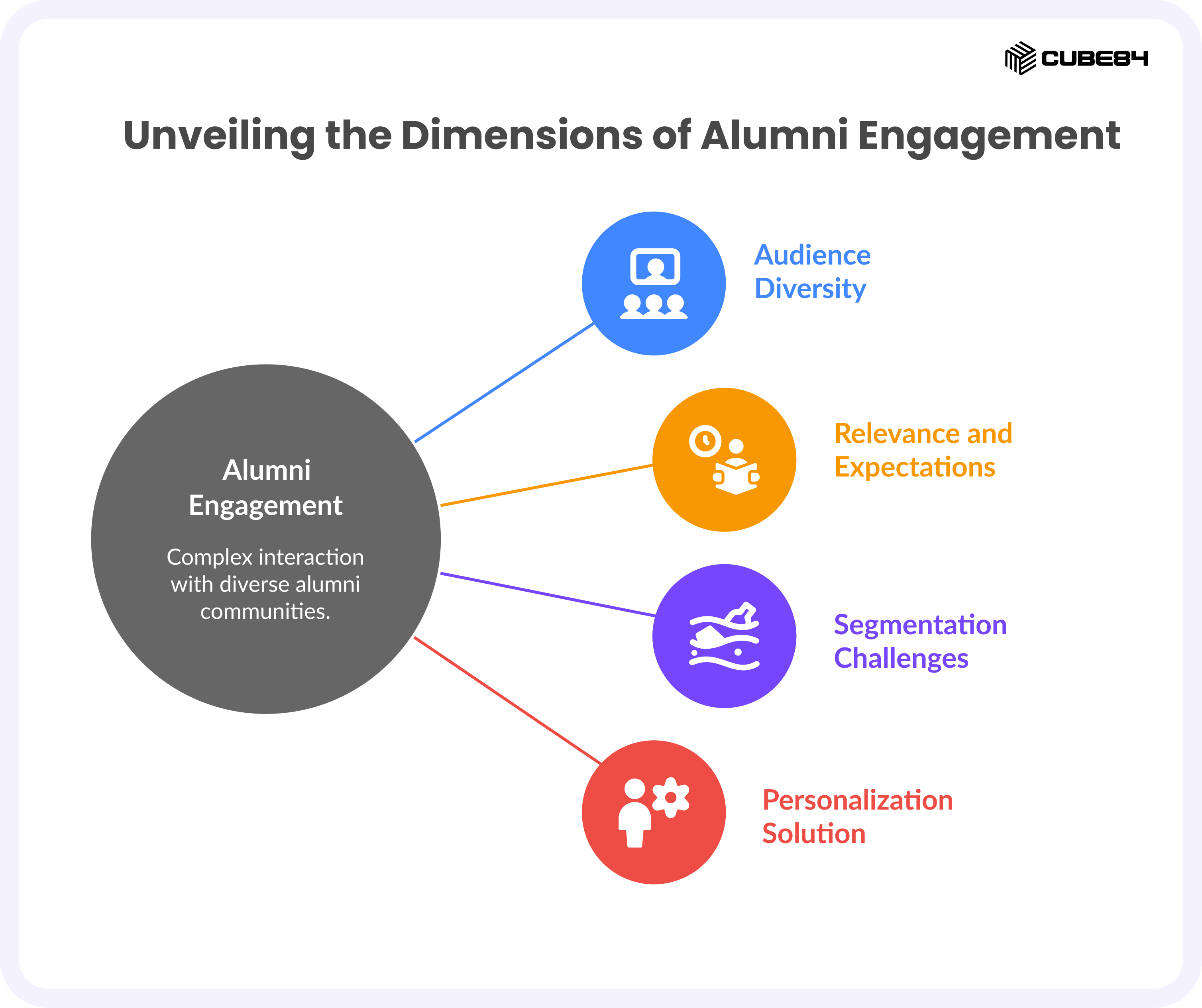
Alumni engagement has become more complex than it used to be. Institutions are no longer speaking to a single, predictable audience, but to communities made up of recent graduates, mid-career professionals, long-time supporters, and alumni whose relationship with their alma mater changes over time.
Most institutions recognize this shift. They understand that relevance matters and that alumni expect experiences that reflect who they are and where they are in their lives. The difficulty comes in translating that understanding into something that works consistently across platforms, teams, and growing datasets.
Too often, alumni portals and communications still rely on broad, static groupings such as class year, degree, or geography. While these attributes are easy to manage, they rarely capture intent or timing. As a result, alumni receive content that technically applies to them, but does not feel meaningful. Over time, this disconnect leads to disengagement, lower participation, and a growing sense of fatigue.
Personalization at scale offers a different way forward. It treats segmentation not as a static exercise, but as an evolving method that combines demographic context with lifecycle stages and behavioral signals. When applied thoughtfully, this approach allows institutions to deliver experiences that feel timely and relevant, without requiring constant manual effort or a complete rebuild of existing systems.
This guide takes a practical look at how institutions can move toward more meaningful personalization, using existing data and systems, without overcomplicating the process.
The Emotional and Strategic Problem
A. The Tone Deaf Communication Crisis
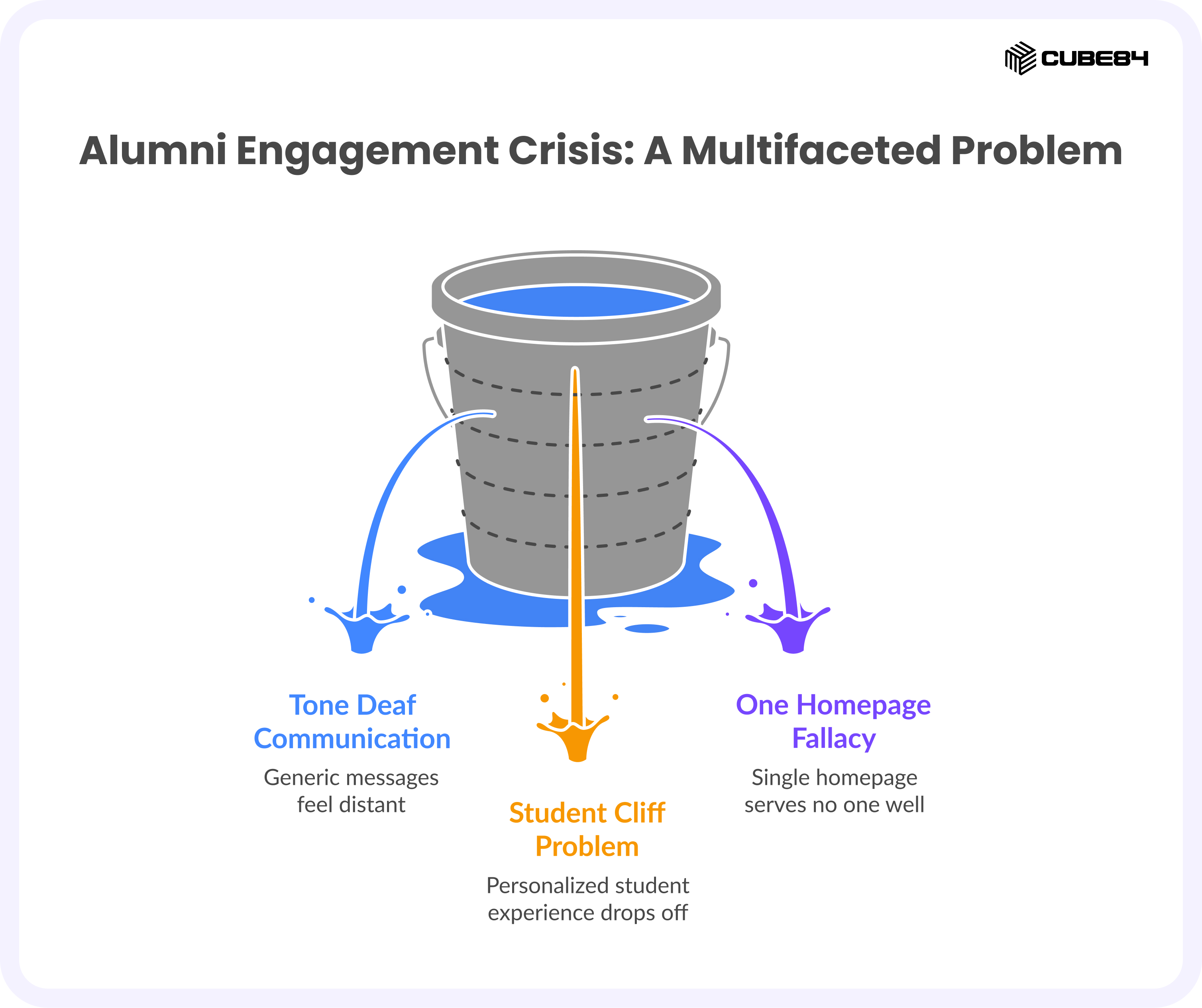
One of the most widespread frustrations in alumni engagement today is a feeling that communications just don’t fit. Alumni receive newsletters, event invites, and fundraising messages that feel distant from who they are now or what they’re interested in. It’s not that institutions aren’t trying. It’s that broad, one-size-fits-all messaging that rarely feels meaningful once graduates leave campus and settle into their own lives.
This pattern is clear when we look at engagement data from the sector. Only about 28% of alumni organizations use personalized content in their communications, even though personalization has been shown to improve engagement when implemented thoughtfully.
When alumni perceive communications as generic or overly focused on fundraising, they are far more likely to disengage. 72% of alumni reported solicitation fatigue from frequent donation asks, and 68% felt they were being asked too often, which weakened their connection to the institution.
These patterns are not surprising when we consider what traditional segmentation looks like in practice. Many advancement teams still rely primarily on static groupings like class year or geography. These attributes can tell you who someone was, but not what they care about right now. When alumni feel that what they see is not relevant, they stop paying attention. That shows up as lower open rates, fewer clicks, and rising unsubscribe rates, not because alumni are uninterested, but because the messages miss their mark.
At its core, this issue is less about frequency and more about relevance. Alumni are not tuning out because institutions communicate too often. They are tuning out because the messages do not feel thoughtful or tailored to their evolving lives and priorities. Research on email personalization and engagement behavior reinforces this pattern, showing that relevance plays a central role in whether audiences continue to engage over time.
B. The Student Cliff Problem
For many alumni, disengagement does not begin with a single email or campaign. It begins with a transition.
As students, individuals interact with their institution through highly connected digital environments. Mobile apps, learning platforms, and student portals are often personalized by program, year, and activity. Content changes as they progress. Services feel responsive. There is a clear sense that the system understands who they are and what they need.
After graduation, that experience often drops off sharply.
Research highlights how student expectations are shaped by personalized and integrated digital experiences during their academic years. When alumni platforms fail to reflect that same level of relevance, the contrast becomes noticeable. What was once dynamic begins to feel static.
This shift is more than cosmetic. Alumni frequently move from environments that adapt to their academic journey into portals that present the same homepage, navigation, and calls to action to every visitor. News, events, and opportunities are often displayed without regard for career stage, engagement history, or expressed interests.
The result is a loss of continuity in identity. Alumni are no longer treated as individuals progressing through a lifecycle, but as a single undifferentiated audience. Over time, this weakens the sense of belonging that institutions work hard to build during the student years.
User experience research reinforces this dynamic, noting that when systems fail to maintain continuity across stages of a user’s journey, engagement declines and trust erodes. People expect digital experiences to evolve with them. When they do not, users disengage quietly.
This is where personalization plays a critical role. Segmentation that reflects lifecycle stage helps bridge the gap between the student experience and the alumni experience. It allows institutions to acknowledge that graduation is not an endpoint, but a transition into a new phase of the relationship.
Without this bridge, alumni platforms unintentionally signal that personalization was temporary. With it, institutions can extend the same sense of relevance and care beyond campus, reinforcing long-term engagement rather than allowing it to fall away.
C. The One Homepage Fallacy
A common response to alumni diversity is to add more content. More announcements. More widgets. More links. The assumption is that if everything is visible, everyone will find something useful.
In practice, the opposite happens.
When a single homepage is designed to serve tens of thousands of alumni with different needs, priorities, and levels of engagement, it ends up serving no one particularly well. Early-career alumni, mid-career professionals, and legacy donors are presented with the same layout, hierarchy, and calls to action, regardless of why they logged in.
This approach runs counter to established user experience principles. Research shows that users struggle when interfaces present too many competing options at once. Instead of exploring, they skim, hesitate, or leave altogether. Relevance is diluted when everything is treated equally.
In alumni portals, this often means critical actions are buried. A recent graduate looking for career resources may have to scroll past planned giving content. A long-time supporter interested in institutional impact may encounter entry-level job postings. The system technically works, but it does not guide.
The problem is not a lack of content or intent. The assumption is that a single experience can accommodate every alum equally. Alumni do not arrive with the same goals, and they should not be met with the same interface.
Effective personalization challenges this assumption. Instead of asking alumni to navigate complexity, it reduces it. By adjusting what is emphasized, hidden, or surfaced based on context, institutions can create experiences that feel simpler and more relevant, even as the underlying content library grows.
The one homepage model prioritizes sameness for the sake of manageability. Personalization at scale is replaced by intentional variation, allowing institutions to serve diverse alumni needs without overwhelming the experience.
Strategic Shift: From Demographics to Lifecycle and Intent

A. The Three Layers of Segmentation
Most alumni segmentation strategies begin and end with demographics. Class year, degree, college, and geography are usually the first fields institutions reach for because they are readily available and easy to apply across systems. While these attributes provide useful background, they offer limited guidance when it comes to delivering relevant experiences.
To move toward meaningful personalization, segmentation needs to be layered.
A useful way to think about this evolution is through three distinct but connected layers. Each layer adds context, and together they create a more accurate picture of an alumnus’s needs at any given moment.
The first layer is demographic segmentation. This includes static data such as graduation year, major, or school affiliation. These attributes change infrequently and are best suited for a broad context. On their own, however, they rarely indicate what an alumnus is looking for right now.
The second layer is lifecycle segmentation. Lifecycle stages reflect where an alumnus is in their professional or personal journey, such as recent graduate, mid-career professional, or retiree. Unlike demographics, lifecycle stages introduce time and progression. They help institutions anticipate shifts in interest, from career exploration and networking to mentorship and legacy engagement.
The third and most powerful layer is behavioral segmentation. Behavioral signals capture what an alumnus actually does. This includes actions such as logging into the portal, viewing career resources, registering for events, or repeatedly engaging with certain types of content. According to Salesforce guidance on personalization and customer engagement, behavioral data is essential for delivering experiences that feel timely and relevant because it reflects intent rather than assumptions.
What makes this layered approach effective is not the complexity of the data, but how it is applied. Demographics establish who someone is. Lifecycle provides context for where they are. Behavior signals what they care about in the moment.
When institutions rely on only one of these layers, personalization remains shallow. When all three are used together, segmentation becomes actionable, allowing experiences to adjust in ways that feel natural rather than forced.
B. The Segment of One Philosophy
As institutions mature their segmentation strategies, the conversation often turns toward the idea of the “segment of one.” The phrase can sound aspirational, or even unrealistic, especially for teams managing large alumni populations with imperfect data.
In practice, the goal is not the literal individualization of every experience. It is perceived as unique.
Personalization succeeds when alumni feel that what they see reflects their context, even if thousands of others share that experience with similar needs. This is a well-established principle in digital experience design. Research shows that users respond positively when systems adapt to their goals and behavior, even when personalization is rule-based rather than fully individualized.
This distinction matters because it reframes what success looks like. Institutions do not need flawless profiles or exhaustive data to begin personalizing effectively. They need enough signal to make reasonable decisions about what to emphasize, deprioritize, or delay.
At the same time, no segmentation strategy operates with complete data. Alumni may have missing job information, outdated locations, or limited engagement history. In these cases, personalization systems must be designed to fail gracefully.
Rather than exposing gaps or showing empty states, the experience should default to a high-quality baseline that still feels intentional. Salesforce documentation on Experience Cloud design emphasizes the importance of fallback logic and default visibility rules to ensure consistent user experiences even when profile data is incomplete.
This fallback is not a compromise. It is a strategic safeguard. A well-designed default experience prevents confusion, maintains trust, and creates opportunities to gather better data over time progressively.
The segment of one, then, is not a technical endpoint. It is a design philosophy. One that prioritizes relevance, resilience, and respect for the alumnus’s experience, while acknowledging the practical realities of institutional data environments.
C. Modeling Success: The Netflix and Amazon Standard
Alumni do not evaluate digital experiences in isolation. Their expectations are shaped by the platforms they use every day.
Services like Netflix and Amazon have conditioned users to expect interfaces that respond to behavior. Recommendations change based on what they watch, search for, or ignore. The experience feels attentive, even though it is driven largely by patterns and rules rather than deep personal knowledge.
This shift in expectation has been widely discussed in digital strategy research. A Harvard Business Review analysis on personalization explains that users increasingly measure relevance by how well systems respond to their actions over time, not by how much information they have explicitly shared. Personalization feels effective when it adapts, not when it attempts to predict everything upfront.
For alumni portals, this comparison is not about entertainment or commerce. It is about familiarity. Alumni arrive with an implicit expectation that content will adjust based on what they engage with. When it does not, the experience feels outdated, even if the information itself is valuable.
This is where behavioral segmentation becomes especially important. An alumnus who consistently views career content, registers for mentoring sessions, or reads industry-focused articles is signaling intent. Surfacing more of that content mirrors the same logic alumni experience elsewhere online.
Salesforce reinforces this approach in its guidance on data-driven engagement, noting that effective personalization relies on observing behavior and responding incrementally rather than relying solely on static profiles.
The takeaway is not that alumni portals should mimic consumer platforms, but that they should respect the same underlying principle. People expect experiences to learn from interaction. When alumni see content adjust in response to their actions, even in small ways, it reinforces relevance and encourages continued engagement.
This expectation sets the stage for how personalization must be implemented technically. Meeting it requires structure, restraint, and a clear understanding of how segmentation logic is applied within the platform.
Technical Architecture: The Salesforce Personalization Engine
A. The Foundation: Audiences versus Visibility
As institutions begin translating personalization strategy into Experience Cloud, one distinction becomes critical early on. Not all segmentation should be implemented the same way.
Salesforce provides two primary mechanisms for shaping personalized experiences in Experience Cloud. Page Audiences and Component Visibility. While both rely on user data, they serve very different purposes, and understanding that difference is essential for scale.
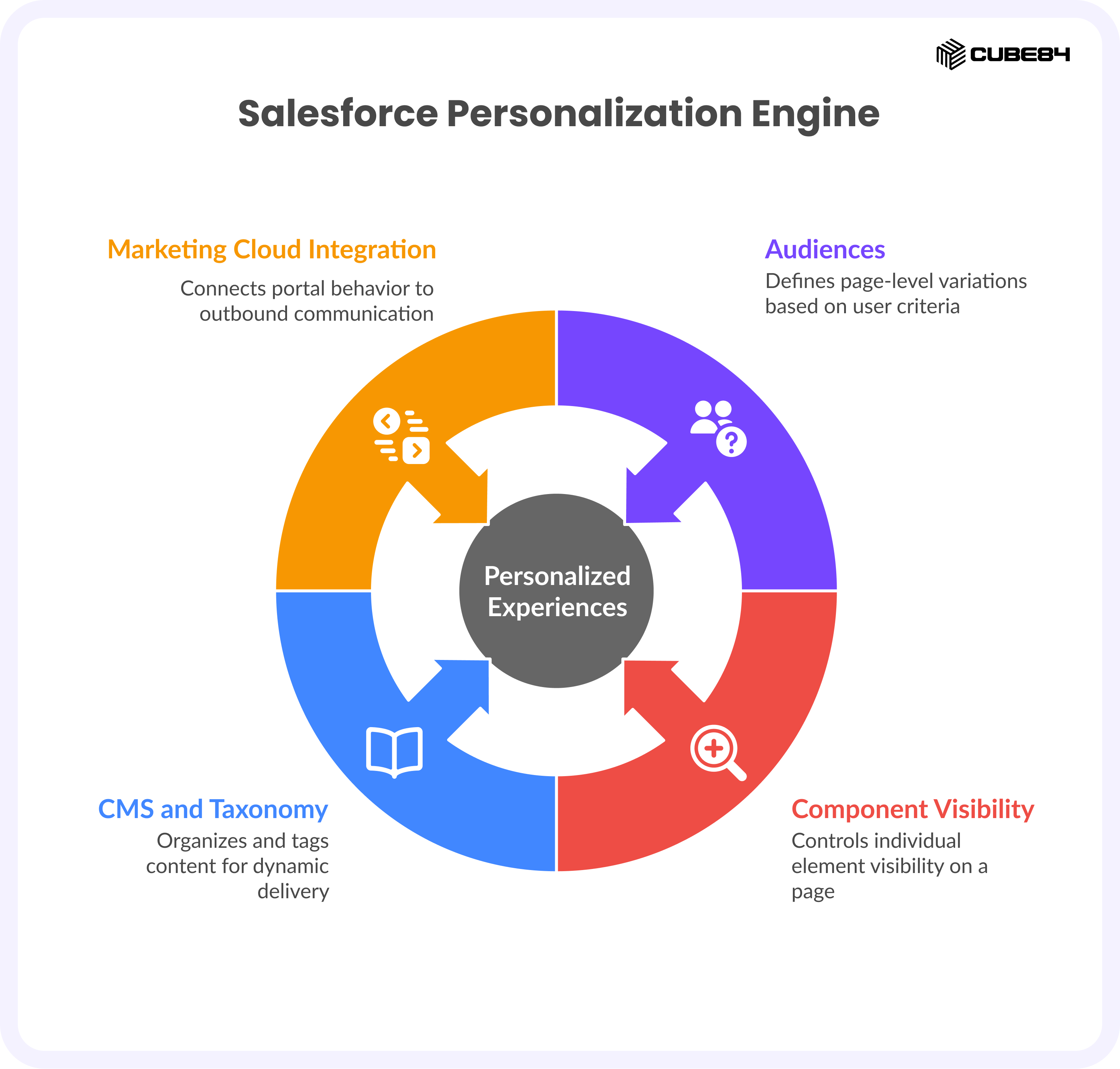
Audiences are designed for macro-level variation. They determine which version of a page or navigation structure a user sees. For example, an institution might create one navigation menu for current students and another for alumni, or a different homepage layout for donors versus recent graduates. Audiences can be used to deliver entirely different page experiences based on user criteria, making them well-suited to large structural differences.
Because Audiences control page-level rendering, they should be used sparingly. Each additional Audience increases complexity and maintenance effort. When institutions attempt to model every micro segment as a separate Audience, they quickly encounter platform limits and operational friction.
This is where Component Visibility becomes essential.
Component Visibility allows individual elements on a page to appear or hide based on user data. A single homepage can display different banners, calls to action, or content modules depending on lifecycle stage, engagement history, or inferred intent. Salesforce outlines this capability as a way to tailor content at the component level without duplicating entire pages, which supports far greater scale.
In practice, this means Audiences should handle broad distinctions that affect overall structure, while Component Visibility should handle precision. Macro first, micro second.
This approach allows institutions to deliver a segment-of-one experience without creating hundreds of page variations. It also aligns with how alumni actually engage. Most differences between alumni are not about navigation or layout. They are about what is emphasized, what is hidden, and what is surfaced at the right moment.
When Audiences and Component Visibility are used together intentionally, Experience Cloud becomes a flexible personalization engine rather than a rigid set of static pages. This foundation makes it possible to scale personalization while keeping governance and performance intact.
B. Dynamic Content via CMS and Taxonomy
Once the experience framework is in place, the next challenge is content relevance. Personalization breaks down quickly if teams are forced to manually curate content for every segment.
This is where Salesforce CMS and content taxonomy become essential.
Rather than deciding which article, event, or announcement belongs on which page, institutions can tag content based on attributes that already exist in alumni data. Common examples include academic discipline, industry, affinity group, geographic relevance, or engagement type. Salesforce CMS supports structured tagging through topics and collections, allowing content to be organized once and reused dynamically across the portal.
When content is consistently tagged, Experience Cloud can filter what is shown to an alumnus based on their profile data. A Biology alum can automatically see Biology-related news and events. An alumnus working in technology can surface industry-specific content without anyone manually assigning it. The system matches content tags to user attributes behind the scenes.
This model shifts personalization from manual decision-making to rule-based delivery. Content teams focus on creating and tagging high-quality material. The platform handles distribution.
Salesforce documentation emphasizes that CMS collections are designed to work with component visibility and user criteria, making them a scalable way to personalize content without custom code. Their overview of CMS personalization capabilities reflects this design intent.
This approach also supports governance. Because content is centrally managed and tagged, institutions avoid duplicating articles or creating segment-specific versions of the same information. A single piece of content can serve multiple audiences appropriately based on context.
Dynamic content delivery through taxonomy is what allows personalization to remain sustainable. As alumni interests evolve and new content is added, the experience adjusts automatically. Personalization becomes a system behavior rather than an ongoing operational burden.
C. Integration with Marketing Cloud The Loop
Personalization does not end at the portal. In many cases, the most effective engagement happens after an alumnus leaves the site.
When alumni browse events, explore mentoring opportunities, or read institutional updates, those actions signal intent. The value comes from responding to that intent in a timely and relevant way. This is where integration with Marketing Cloud becomes critical.
Salesforce enables this connection through Marketing Cloud Connect, which synchronizes data and engagement signals between Salesforce CRM and Marketing Cloud. Salesforce documentation explains how this integration allows Journey Builder to reference CRM data and user activity when triggering email or messaging journeys.
In practice, this means portal behavior can inform follow-up communication. An alumnus who views a mentorship page multiple times but does not sign up can receive a targeted message highlighting mentorship benefits. Someone who registers for an event can receive related content or reminders that reflect their interest rather than a generic newsletter.
It is important to set expectations around timing. Standard CRM to Marketing Cloud synchronization operates in near real time rather than instant response. Salesforce notes that data updates typically sync on a scheduled basis, which is sufficient for most engagement scenarios but may introduce a short delay between action and follow-up.
For institutions with more advanced requirements, Salesforce positions Data Cloud as an accelerator for real-time personalization. Data Cloud is designed to ingest behavioral signals at scale and activate them across channels with lower latency.
That distinction matters for governance and planning. Near real-time is often enough to create thoughtful, responsive engagement without overwhelming teams or systems. Real-time activation becomes valuable when institutions are ready to support more complex orchestration across multiple channels.
When portal behavior and outbound communication are connected, personalization becomes continuous rather than isolated. Alumni experiences feel coherent across touchpoints, reinforcing relevance and reducing the sense that messages arrive disconnected from recent interactions.
Practical Framework: Three Persona-Based Journeys
Strategy becomes meaningful when it can be visualized. To understand how layered segmentation translates into a personalized experience, it helps to look at how different alumni journeys can be supported within the same portal framework.
These examples are illustrative, not prescriptive. They show how lifecycle stage and intent can shape what an alumnus sees, without requiring separate portals or complex custom builds.
The Young Alum, zero to five years post graduation
Strategic goal: Career support and early connection
For recent graduates, the alumni portal often serves as an extension of the student experience. Career uncertainty is common, and engagement is driven by practical value.
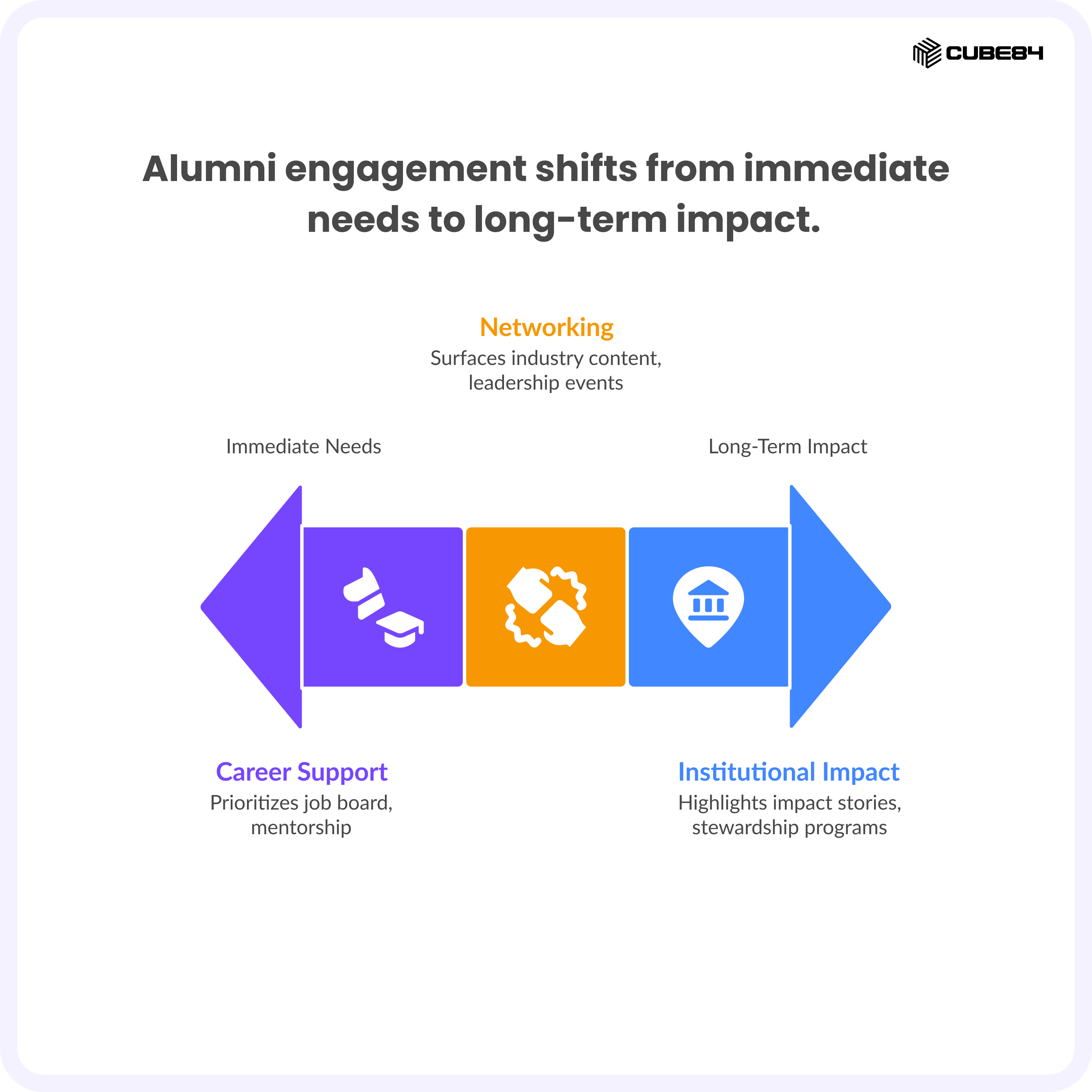
A dynamically configured homepage for this group might prioritize a job board or early career resources in the hero area. Components promoting mentorship programs or resume support would be visible, while content related to legacy giving or board service would remain hidden.
The primary call to action focuses on immediate usefulness, such as updating a resume or connecting with a mentor. The experience signals that the institution understands the transition it is navigating.
The Mid-Career Alum, ten to twenty years post graduation
Strategic goal: Networking and reciprocal value
Mid-career alumni often engage when there is an opportunity to both gain and contribute. Their relationship with the institution becomes more reciprocal.
For this group, the homepage might surface industry-specific content, leadership events, or opportunities to recruit students. Regional chapter activity and peer networking components become more prominent.
Calls to action shift accordingly. Posting a job, speaking at an event, or mentoring students aligns with both their expertise and their available time. The experience reflects professional maturity rather than early career exploration.
The Legacy Alum or Donor, twenty-five years and beyond
Strategic goal: Institutional impact and stewardship
Longer-term alumni and established donors often engage around mission, legacy, and influence. Their interest lies less in services and more in outcomes.
For these users, the homepage may highlight institutional impact stories, leadership communications, or recognition programs. Entry-level career content is hidden to reduce noise. Giving-related components are present, but framed in the context of stewardship rather than urgency.
Calls to action focus on participation at a strategic level, such as joining advisory boards or supporting long-term initiatives. The experience communicates respect for their sustained relationship with the institution.
Governance and Data Hygiene
A. The Preference Center
Personalization only works when alumni trust how their data is being used. Without that trust, even the most well-designed experience can feel intrusive or misaligned.
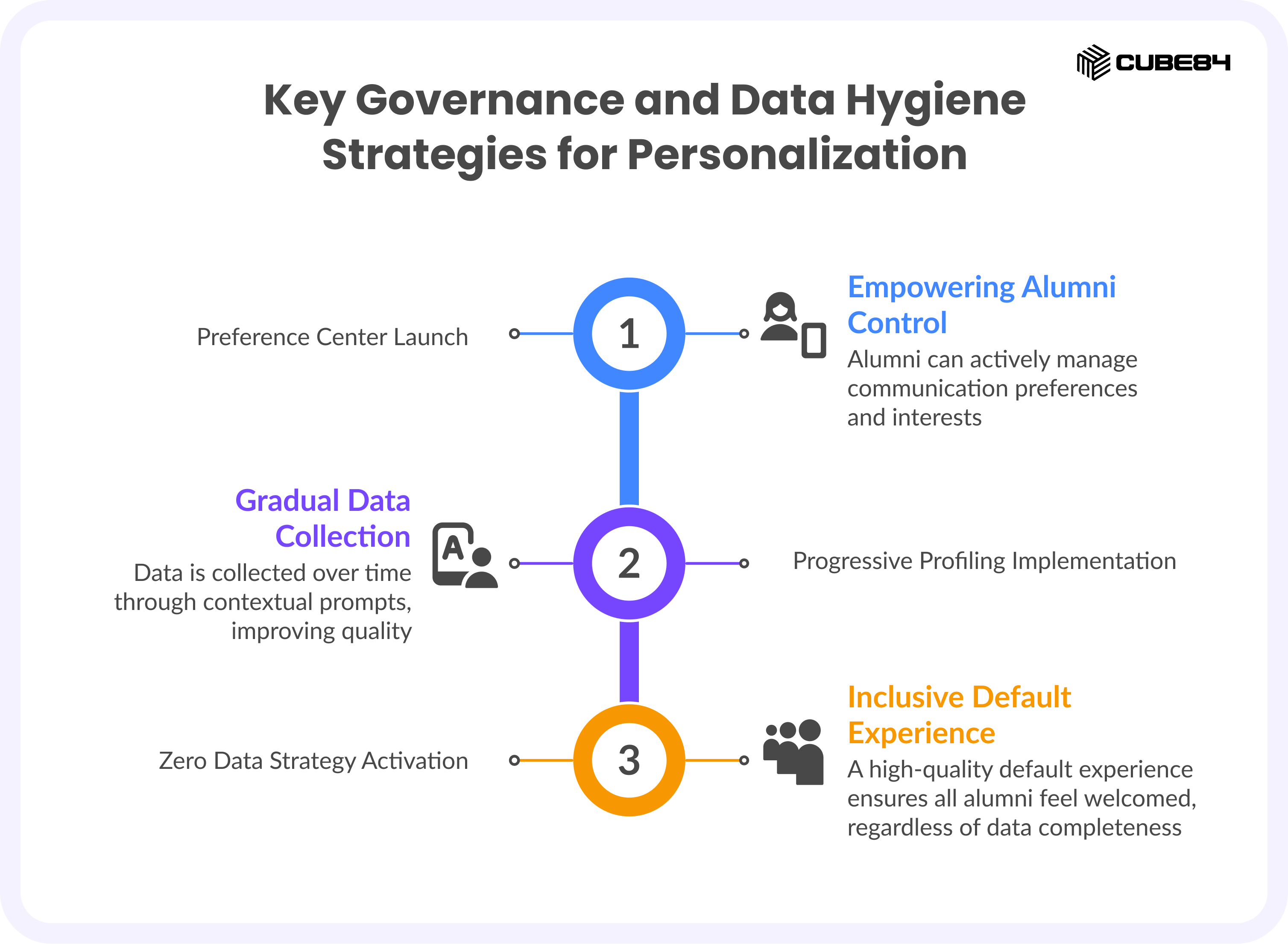
A preference center is the foundation for that trust. It gives alumni visibility into what types of content they receive and control over how they engage with the institution. Rather than forcing segmentation entirely behind the scenes, a preference center allows alumni to actively shape their experience.
Salesforce supports this approach through Experience Cloud pages and standard data models that can store communication preferences and interest indicators. Salesforce guidance on managing subscriber preferences emphasizes that allowing users to control their communication choices reduces unsubscribe rates and improves long-term engagement quality.
From an experience perspective, a well-designed preference center does not overwhelm users with options. Instead, it focuses on clarity. Alumni might be able to indicate interests such as career development, regional events, or institutional updates. These selections can then inform both portal content visibility and outbound communication logic.
This self-reported data plays a critical role in segmentation. It supplements behavioral signals and helps fill gaps where engagement history is limited. More importantly, it shifts personalization from assumption to consent.
A preference center also simplifies governance. When preferences are centralized and clearly defined, teams across advancement, alumni relations, and communications can rely on the same signals. This reduces the risk of conflicting messages and reinforces a consistent experience across channels.
At scale, the preference center becomes more than a settings page. It becomes a shared contract between the institution and its alumni, setting expectations for relevance, respect, and transparency.
B. Progressive Profiling
Even with a strong preference center, alumni data will never be complete. Careers change, locations shift, and interests evolve. The challenge is not eliminating gaps, but improving data quality without creating friction.
Progressive profiling addresses this by spreading data collection over time instead of concentrating it in a single moment. Rather than asking alumni to complete long forms or update dozens of fields at once, institutions request only the small, relevant pieces of information needed.
This approach aligns with established user experience principles. Research shows that users are more likely to complete short, contextual tasks than lengthy forms, especially when the request clearly relates to the value they receive.
In Salesforce, progressive profiling can be implemented using Screen Flows and conditional visibility. Flows can dynamically display questions based on whether data is missing, outdated, or contextually relevant to the user’s current action.
For example, an alumnus logging in to view regional events might be prompted to confirm their current city only if that information is missing or stale. Someone engaging with career content could be asked to update their industry, but only once, and only at a moment when the request feels logical.
This method serves two purposes. It steadily improves data quality while reinforcing relevance. Alumni are more willing to share information when they understand why it is being asked and how it benefits their experience.
From a governance perspective, progressive profiling reduces the risk of bad data. Instead of relying on bulk updates or infrequent surveys, institutions maintain fresher records through continuous, low-effort interactions.
Over time, this creates a healthier segmentation foundation. Behavioral signals, stated preferences, and verified profile data work together, making personalization more accurate without ever feeling intrusive.
C. The Zero Data Strategy
No matter how strong the data model or governance framework, every institution will have alumni profiles with limited or outdated information. New graduates, long inactive users, or alumni who have never updated their details all fall into this category. The risk is not missing data itself, but how the experience responds to it.
When personalization systems rely too heavily on complete profiles, alumni with little data are often met with blank pages, irrelevant content, or inconsistent behavior. This creates confusion and reinforces disengagement at the very moment institutions should be rebuilding connection.
A zero data strategy ensures that personalization always has a safe starting point.
Instead of treating missing data as an error condition, institutions define a high-quality default experience that works for any alumnus. This default is not generic filler content. It is intentionally designed to introduce value, explain available resources, and encourage light interaction.
Salesforce Experience Cloud supports this approach through default audiences and component visibility rules that apply when user criteria are not met. Salesforce guidance on audience targeting explains how fallback logic ensures users always see content even when profile data is incomplete.
From a design perspective, this default experience should prioritize clarity and invitation. Content might focus on campus news, upcoming major events, or simple prompts that invite alumni to personalize their experience. The goal is to create momentum, not demand information upfront.
This strategy also works hand in hand with progressive profiling. A well-designed default experience creates natural opportunities to ask one small question at a time. Alumni are not confronted with missing data. They are gently guided toward filling it in as they engage.
User experience research supports this approach. Research notes that systems that provide clear default paths reduce frustration and increase willingness to explore further, especially for returning or infrequent users.
The zero data strategy acts as a safety net. It protects the experience from breaking, preserves trust, and ensures that personalization remains inclusive rather than exclusive. In doing so, it reinforces a key principle of personalization at scale. Every alumnus should feel welcomed, even before the system knows much about them.
A Practical Next Step: The Alumni Portal Personalization Playbook
Moving from strategy to execution does not require a full rebuild or a long planning cycle. What it does require is structure.
To support institutions at this stage, we have created the Alumni Portal Personalization Playbook, a free, ungated checklist designed to help teams translate segmentation strategy into a working Experience Cloud roadmap.
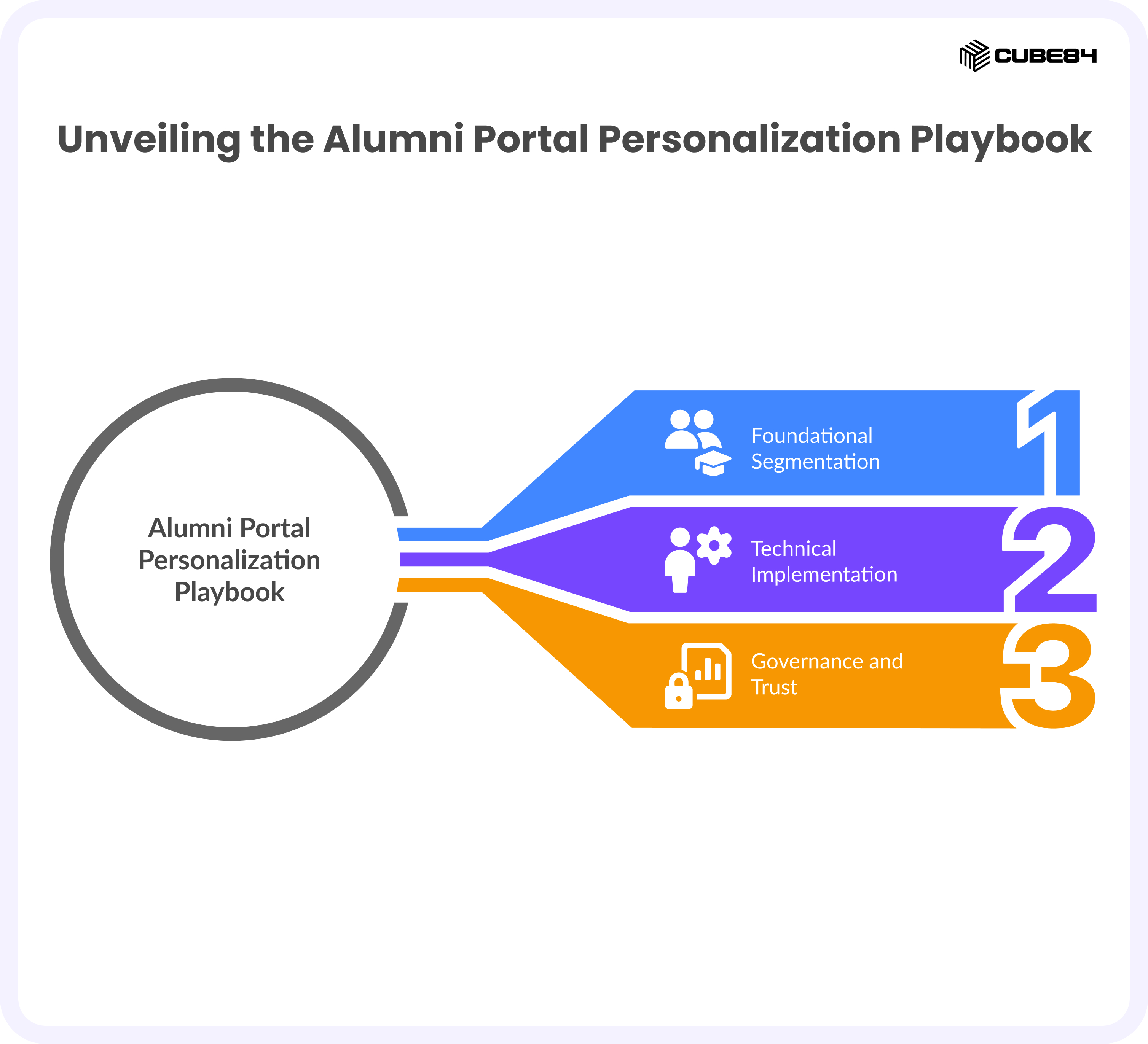
The playbook breaks personalization into three manageable phases. Each phase focuses on using existing data and platform capabilities to progressively increase relevance without introducing unnecessary complexity.
1. Phase one focuses on foundational segmentation, helping teams define high-impact lifecycle and engagement segments using standard CRM and EDA data.
2. Phase two covers technical implementation, outlining how to apply audiences, component visibility, CMS taxonomy, and flows to create dynamic portal experiences.
3. Phase three addresses governance and trust, including progressive profiling, preference centers, and default experiences for alumni with limited data.
The checklist is designed to be practical. It can be used by advancement leaders, alumni relations teams, and CRM administrators as a shared reference point, helping align strategy, technology, and execution without overwhelming any single team.
You can access the Alumni Portal Personalization Playbook directly and use it as a working guide alongside your existing Salesforce investment.
Addressing Technical and Strategic Skepticism
Why do one-size-fits-all alumni portals consistently lead to disengagement and email fatigue?
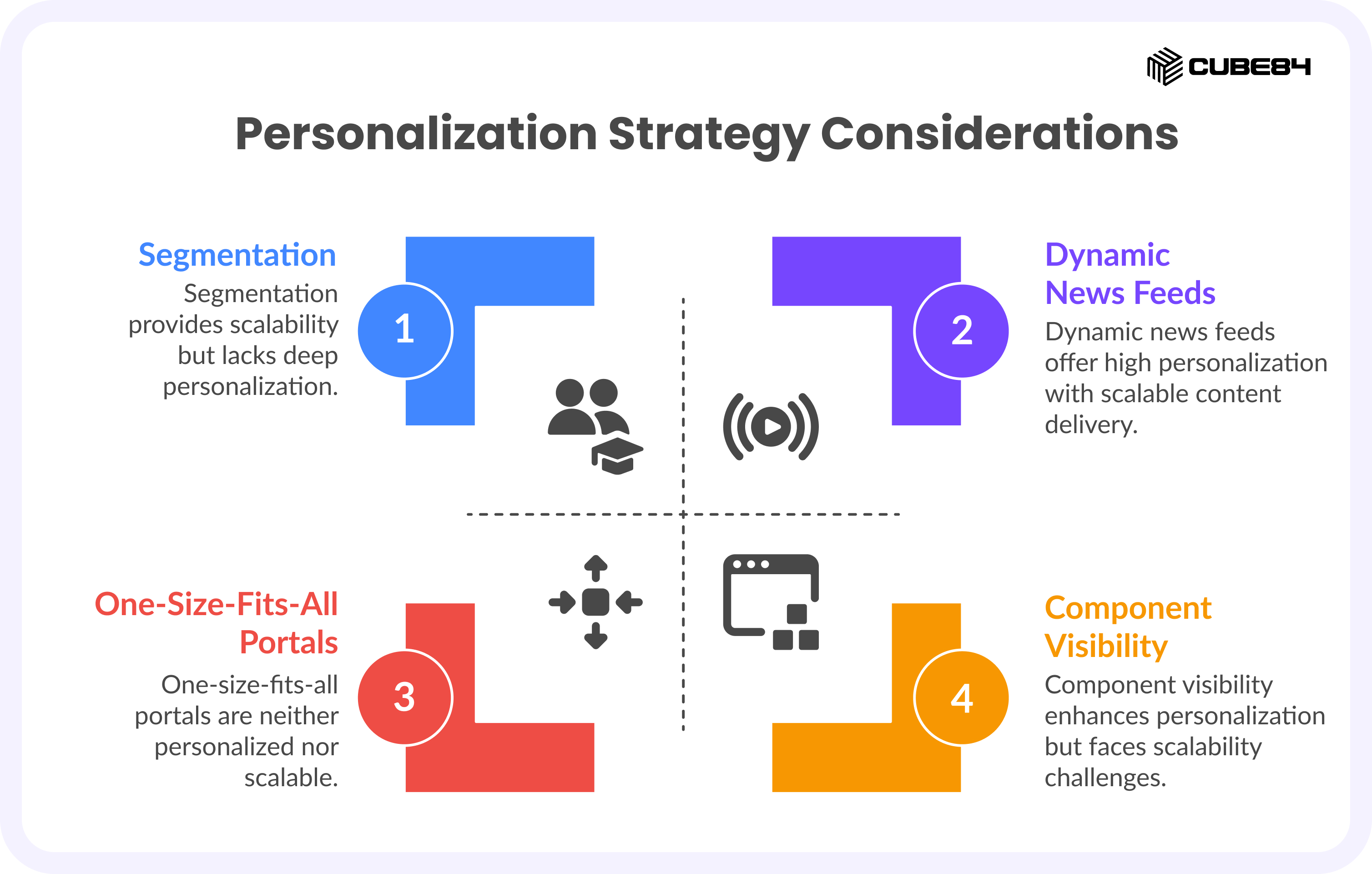
One-size-fits-all experiences assume that relevance can be averaged. In reality, alumni engage for very different reasons depending on their lifecycle stage, interests, and recent interactions. When portals and communications present the same content and calls to action to everyone, most alumni encounter information that does not apply to them in that moment. Over time, this erodes attention and trust. Disengagement is not a response to volume, but to repeated irrelevance.
What is the difference between segmentation and true personalization?
Segmentation groups alumni based on shared attributes such as class year, geography, or role. Personalization uses those groupings, along with lifecycle context and behavior, to shape the actual experience an individual sees. Segmentation is the input. Personalization is the outcome. Without personalization, segmentation remains an internal classification exercise rather than a meaningful experience for the alumnus.
How must content priorities change for a recent graduate versus a legacy donor?
Recent graduates typically engage when content supports transition, career exploration, and early connection. Legacy alumni and donors engage when content reflects impact, stewardship, and long-term influence. Serving both groups effectively requires not just different messages, but different emphasis. Personalization allows institutions to adjust what is surfaced and what is hidden without creating separate portals or content libraries.
How can personalization scale without hitting Experience Cloud Audience limits?
Scalability depends on using the right tool for the right level of variation. Page Audiences should be reserved for major structural differences, such as navigation or page layout. Component Visibility should handle most personalization needs by showing or hiding specific elements based on user data. This approach allows institutions to support many micro-segments without multiplying page variations.
How does Salesforce CMS taxonomy enable dynamic news and content feeds?
CMS taxonomy allows content to be tagged once using consistent topics such as academic discipline, industry, or affinity. Experience Cloud components can then filter content dynamically based on matching user attributes. This means the same content collection can deliver different results to different alumni without manual curation or duplication.
How quickly can Marketing Cloud respond to portal behavior?
With Marketing Cloud Connect, portal activity can inform journeys in near real time through scheduled data synchronization. This timing is sufficient for most follow-up scenarios, such as event reminders or interest-based outreach. Institutions that require faster activation across channels may consider Data Cloud, but near real-time responsiveness is often enough to feel timely and intentional.
What is progressive profiling, and how is it implemented without frustrating alumni?
Progressive profiling collects small pieces of information over time rather than all at once. In Salesforce, this is typically implemented using Screen Flows with conditional logic that only asks for data when it is missing or contextually relevant. Alumni are more willing to respond when requests are minimal and clearly tied to the value they receive.
What happens when an alumnus has missing or stale data?
A well-designed personalization strategy always includes a default experience. When data is missing, alumni should see a high-quality baseline homepage rather than empty or broken content. This default experience introduces value and creates natural opportunities for engagement, which can then improve data quality gradually.
What are the best practices for building a preference center that supports trust?
An effective preference center is clear, accessible, and limited to meaningful choices. Alumni should be able to indicate interests and communication preferences without navigating complex settings. These preferences should inform both portal content and outbound communication so alumni can see the impact of their choices. Transparency and consistency are key to maintaining trust.
Personalization That Respects Both Alumni and Institutions
Personalization at scale is often framed as a technical challenge. In reality, it is a design and governance challenge first.
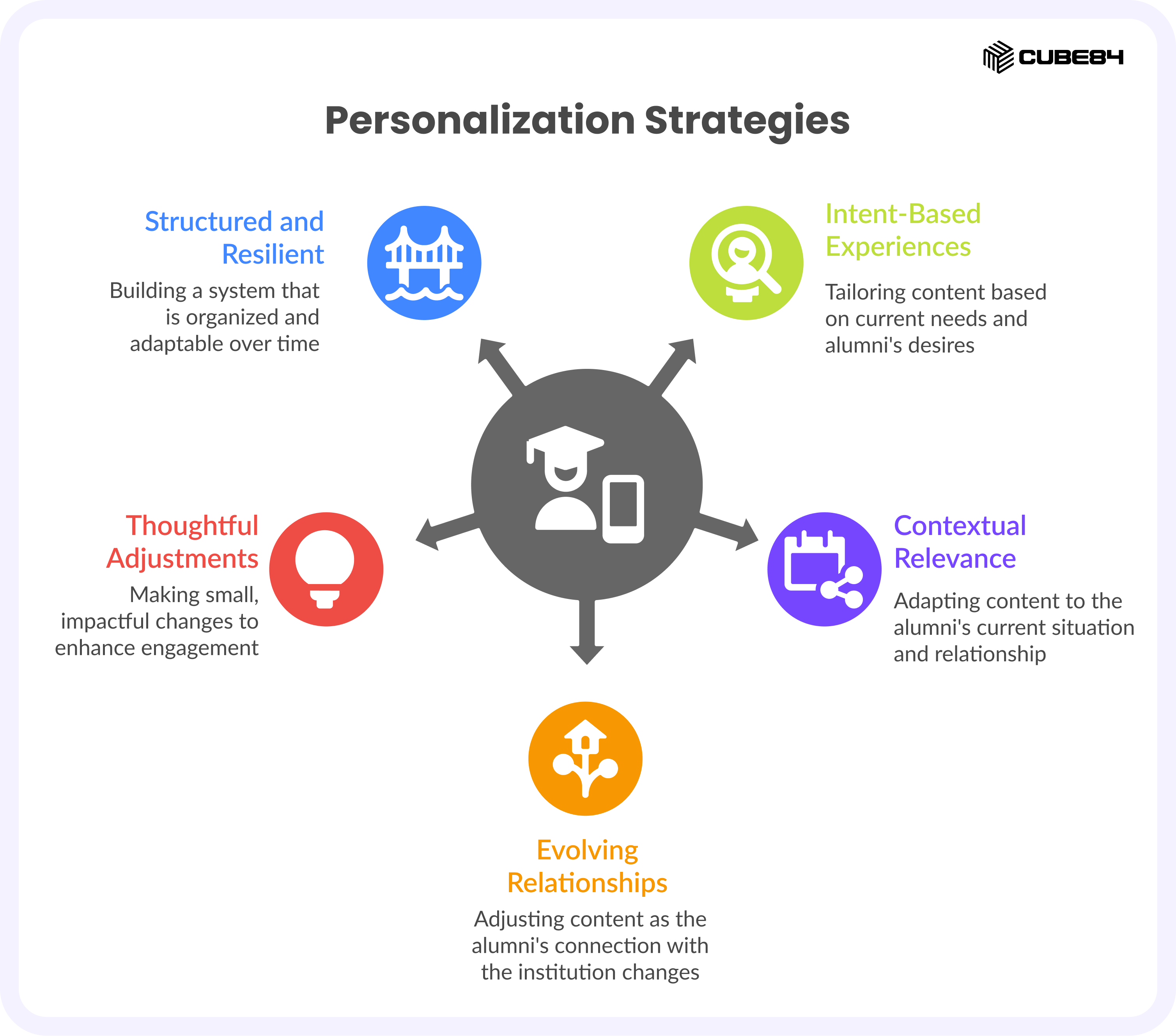
Alumni do not expect institutions to know everything about them. They expect experiences that reflect intent, respect context, and evolve as their relationship with the institution changes. Segmentation makes this possible when it moves beyond static groupings and becomes a living framework grounded in lifecycle and behavior.
What matters most is not how advanced the technology is, but how intentionally it is applied. Small, thoughtful adjustments in what alumni see, when they see it, and how they are invited to engage can have a meaningful impact on long-term connection and participation.
Personalization does not need to be perfect to be effective. It needs to be structured, respectful, and resilient enough to grow over time.
If your institution is exploring how to move from broad segmentation to more meaningful personalization within Salesforce Experience Cloud, and you want to understand what that could look like in your specific context, please feel free to reach out. We are always happy to talk through use cases, constraints, and practical next steps.