


Introduction
Many of the successful public figures we admire give back generously to their alma mater. Philip H. Knight, founder of Nike, donated 400 million dollars to Stanford University, where he earned his MBA in 1962. Michael Bloomberg, former mayor of New York City, donated a record 1 point 8 billion dollars to Johns Hopkins University for financial aid. This gift remains the largest ever to a US college or university. That is the power of alumni for any institution.
You are a university defined by excellence, and your alumni are accomplished global leaders, innovators, and philanthropists. Yet when you look at your official alumni network, you often see only a fraction of that prestige reflected in your engagement metrics.
Are they all connected? Yes, but on platforms like LinkedIn or private groups rather than through your official alumni community. Why is that?
The issue is not a lack of institutional effort. It is a mismatch between what alumni expect and what the university delivers. When many institutions build an alumni directory, it often ends up unused, outdated, untrusted, or avoided because of concerns about unwanted solicitations. Alumni expect personalized and meaningful connections while still keeping their information discreet.
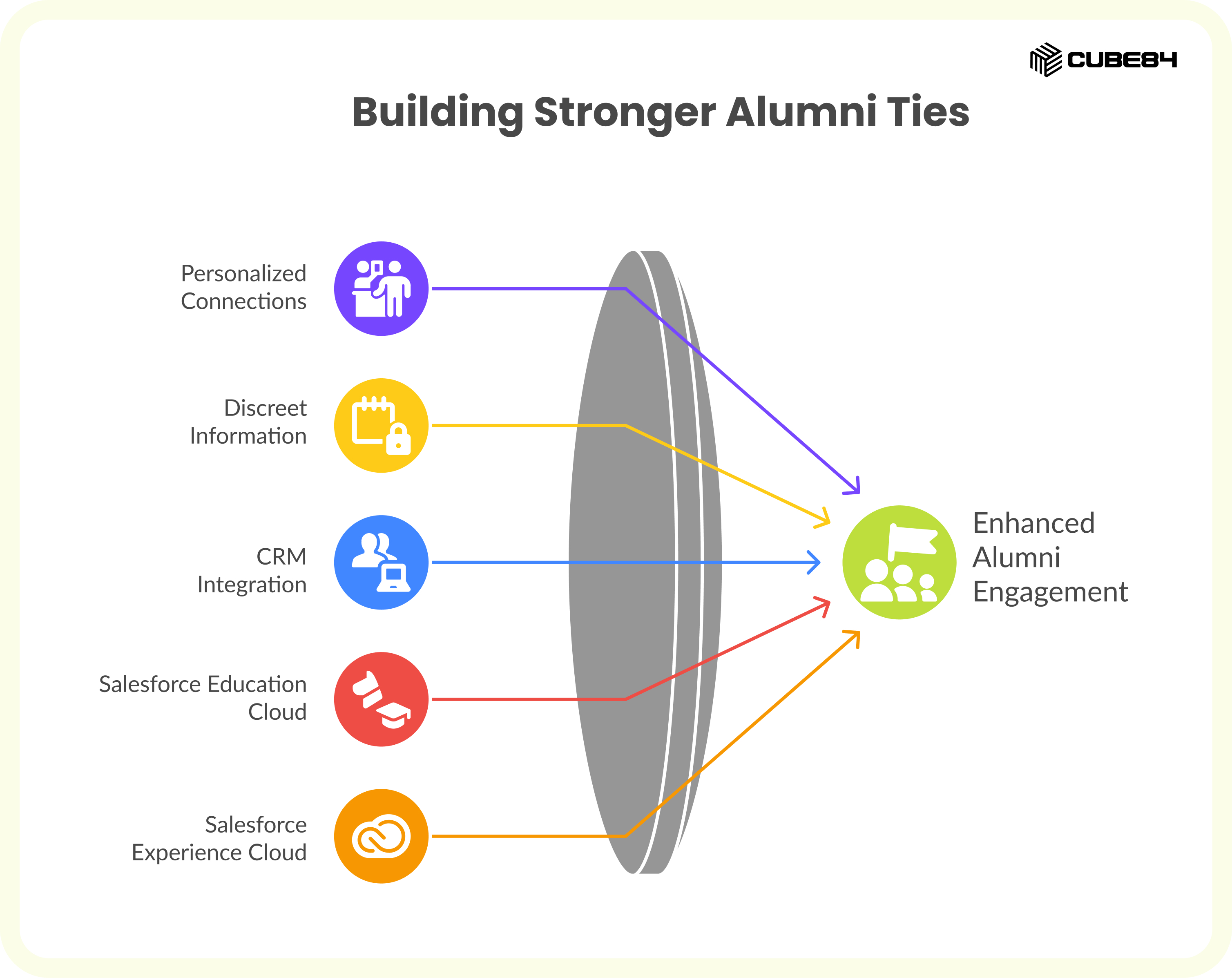
We understand your situation. A room full of data and teams that are disconnected. The solution is a CRM. The industry is also shifting toward CRM based alumni engagement, and with Salesforce Education Cloud and Experience Cloud, you can turn your alumni into an institutional asset that strengthens Advancement, Career Services, academic programs, and long term governance. That is exactly what we will cover in this blog.
For a closer look at how institutions apply this approach in practice, see our guide on alumni management and fundraising in education
The State of Alumni Relationships: Why the Elite Directories Fail
An Alumni Record or Just a Digital Phonebook
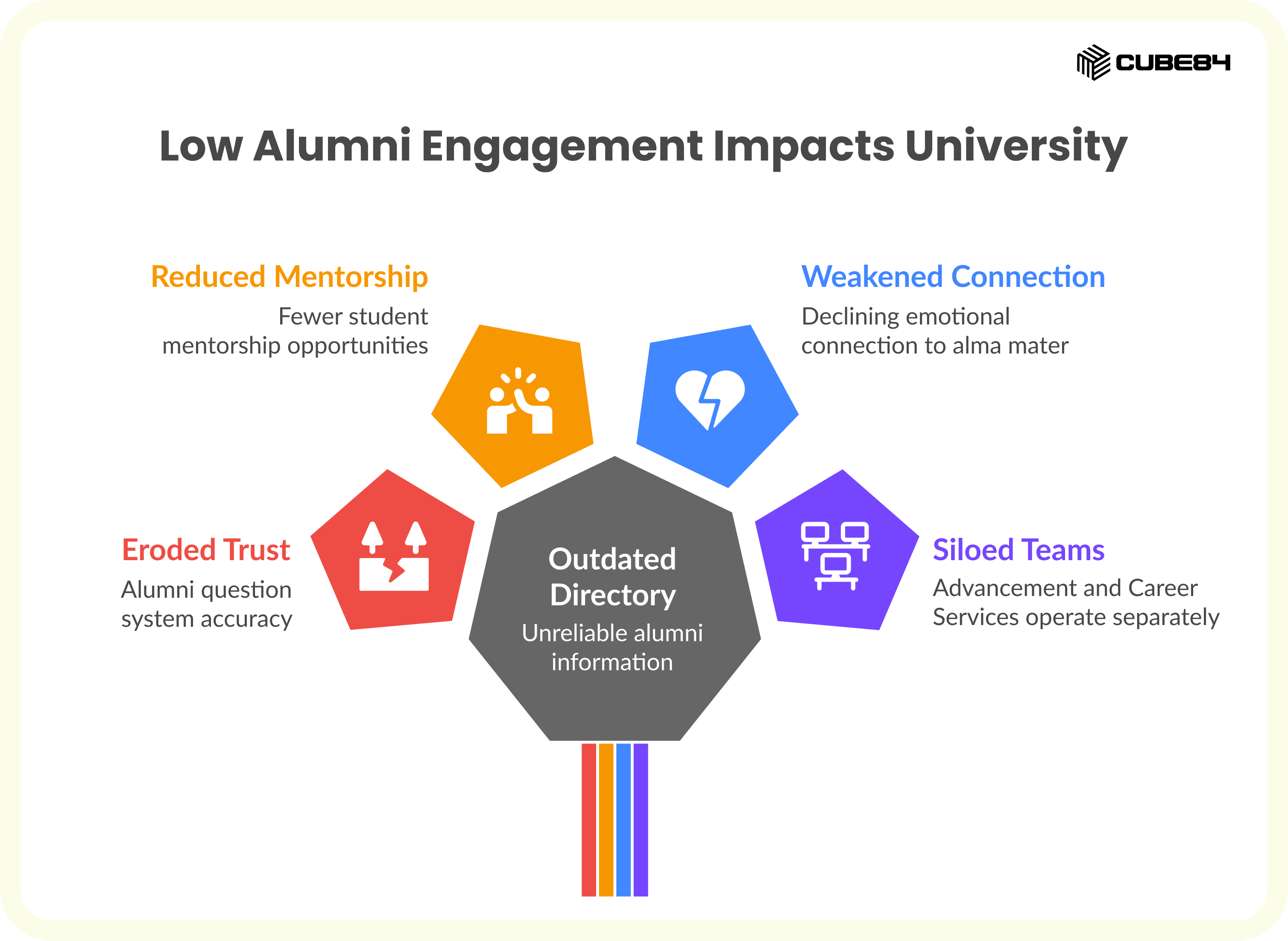
If your institution treats alumni data as nothing more than a digital phonebook with names, degrees, and contact information, your alumni lose interest immediately. Nothing sets it apart from what they can find on public platforms. It fails to offer the dynamic, exclusive connectivity they expect from a lifelong community, and it feels like an incomplete reflection of their professional and social stature.
Let’s Get Connected, but on LinkedIn
Imagine you are searching for jobs on LinkedIn and click on a company page. You immediately see suggestions like “people you can reach out to” and often they are alumni from your own university.
Would you not feel a sense of belonging and trust that they might help?
Now ask yourself an important question. Should your students reach out to alumni on public platforms, or should they be doing it through your official alumni community?
Your alumni already use LinkedIn. They volunteer, mentor, donate, and participate in professional groups. But they avoid the institution’s directory because it often feels outdated or unhelpful.
According to the 2025 CASE Insights data, only 19 percent of contactable alumni engaged in any meaningful communication with their institution. This highlights a clear pattern. Alumni still want to stay connected, but the tools they are given do not encourage regular use.
Institutional directories must balance exclusivity and utility. They must offer a curated, trusted environment that supports meaningful professional and personal relationships rather than replicating generic public platforms.
High Data Churn and Erosion of Trust
There is constant change in your alumni’s lives. They switch jobs, relocate across continents, move into new industries, or take on roles that are hard to track. When your directory cannot keep up with these updates and repeatedly displays outdated or incorrect information, the experience feels unreliable. Over time, alumni begin to question the accuracy of the system, and this slowly erodes trust.
The Cost of Low Engagement
At the beginning of this blog, we saw the power alumni have to give back to their alma mater. Yet across higher education, this number has declined. This is not due to a lack of generosity. It is a sign of weakening emotional connection.
When an elite alumni network underperforms, the consequences are serious. Low engagement affects:
• student mentorship opportunities
• internship and referral pipelines
• visibility into rising leaders
• the strength of future board candidates
• momentum for long term fundraising
As the VP or Director of Advancement, you cannot afford a dormant alumni network. You need a system that cultivates and strengthens your community.
Advancement and Career Services operate in silos
You have a room full of data, but your Advancement team is focused on philanthropic relationship management, stewardship, and lifetime value. Career Services is focused on student placement, mentorship matching, and employer relations. The data feels scattered, and each team has partial information and different KPIs. The result is duplicate outreach, inconsistent records, and multiple official alumni lists. Because of this, many teams fail to identify prospects who can both give and mentor, and they cannot segment outreach effectively.
If everything you read so far feels familiar in any way, do not worry. We have a strategic and proven solution for you.
The Strategic Solution: Shifting to a Vetted Relationship Platform
Your alumni network is an asset with lifelong value, and institutions need to stop treating it like just another communication channel. If not, you end up with systems that operate in isolation from Advancement and Career Services.
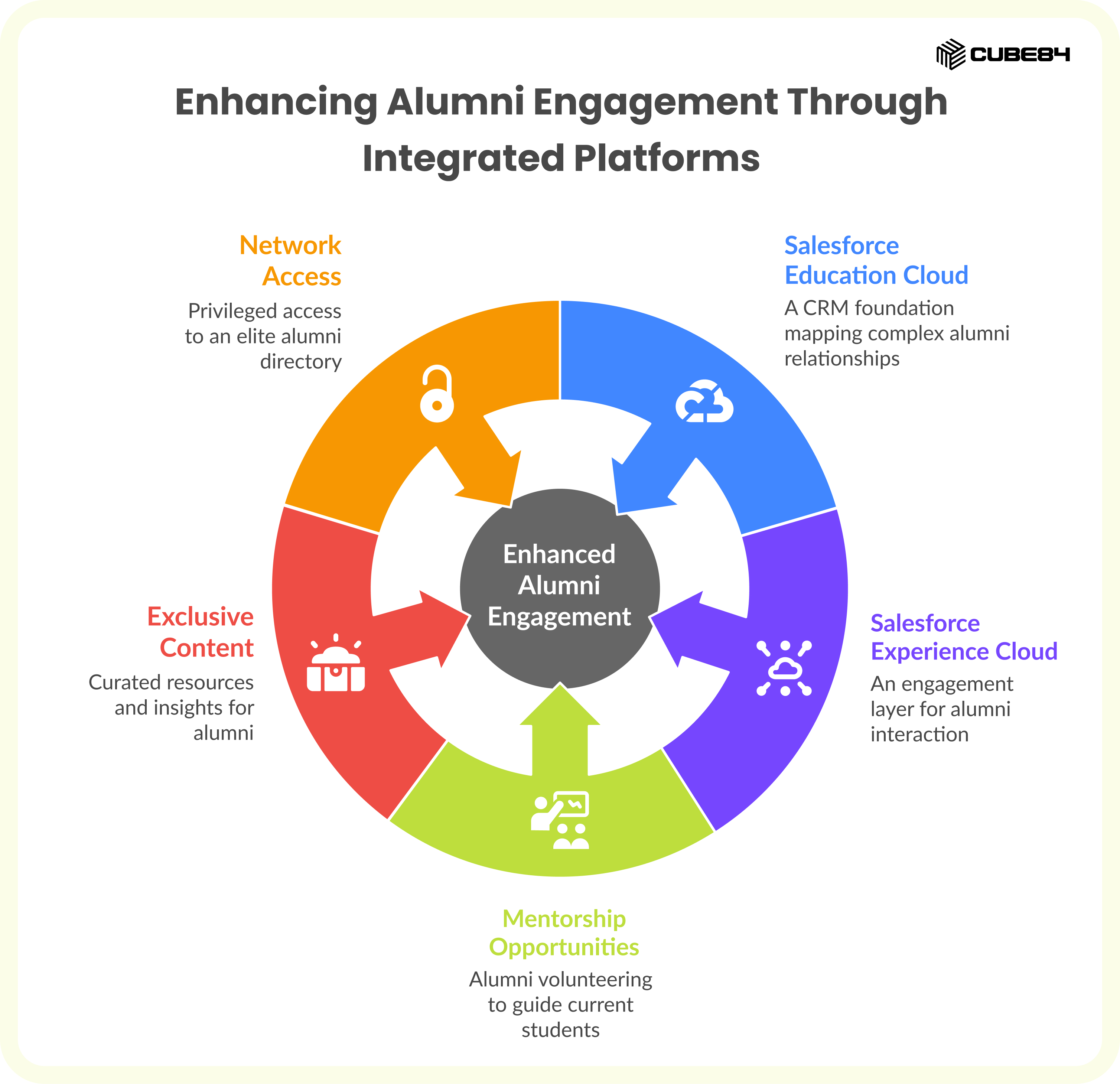
The way to unify all your data is by shifting to a single CRM foundation that maps complex relationships such as multiple degrees, joint programs, donor history, past mentorship interactions, and current career status. This level of insight is only possible with Salesforce Education Cloud built on the Education Data Architecture (EDA). Institutions typically approach this through a phased rollout, which we outline in our step-by-step guide to implementing Salesforce Education Cloud for universities
Salesforce Experience Cloud then provides the engagement layer where alumni interact through self service, mentorship requests, job boards, affinity groups, and curated recommendations.
When both layers work together, your institution can offer something public platforms cannot replicate. The result is a network your alumni want to participate in.
Defining Reciprocal Value
Your alumni are already well placed and successful, you may need their support in some way, but what is in it for them?
Alumni give their time and expertise when they see meaningful value in return.
This includes:
1. Giving Back Through Mentorship: Alumni want to contribute through volunteer mentorship and expect professionally rewarding, respected networks in return.
2. Access to Exclusive Content and Connections: Alumni engage more when the platform provides curated professional resources, industry insights, and exclusive event invites.
3. Earning Network Access: The directory becomes an earned privilege, which reinforces the institution’s elite brand and protects alumni privacy.
Exclusivity as a Feature
Your institutional brand is powerful. Positioning the platform as the definitive, vetted professional domain of the university builds pride, belonging, and trust. Experience Cloud supports role based visibility, custom profiles, and affinity groups, allowing you to create layers of exclusivity that match your alumni community’s expectations.
Core use cases your alumni network must support Alumni engagement affects three measurable institutional outcomes that your Board cares about. Fundraising performance and ROI Student outcomes and placement Reputation and institutional partnerships If you design a network that solves only one problem, you will fail. A modern alumni network must support a minimum set of non negotiable use cases. Verified alumni directory • Clean profiles with verified employment and role history • Authority to patch data from SIS and external sources Mentorship matching • Rules based matching by industry, career stage, skills, and availability Career and recruiting pathways • Job boards, employer relationships, and internship pipelines tied to student cohorts Volunteer and event workflows • RSVP management, wait lists, and post-event engagement tracking Gift management and prospect pipelines • Donor lifecycles, pledge management, and a single donor profile used by Advancement Secure, personalized portal experience • Branded login, consent management, and role based access for high profile alumni Data privacy and consent first governance • Field level consent and retention rules embedded in your operating model Leadership reporting and forecasting • Dashboards that combine fundraising, volunteerism, and career placement KPIs |
The Salesforce Advantage: A Single Source of Truth
You have two practical needs:
(A) a single source of truth for constituent data, and
(B) a secure, branded experience your alumni will use.
That is why Salesforce Education Cloud plus Salesforce Experience Cloud are commonly deployed together.
Education Cloud provides the CRM foundation. Experience Cloud provides the portal interface. With both working together, you eliminate data silos across Advancement, Career Services and individual departments. Coupled with the Education Data Architecture, the system accurately maps complex alumni relationships including multiple degrees, joint appointments, philanthropic histories and mentorship ties.
Key architectural reasons to choose this
Education Data Architecture (EDA)
Education Data Architecture is a community driven data architecture that maps academic history, degrees, faculty relationships, household connections, donor affiliations and job history. Without EDA, institutions struggle to map complex alumni identities. With EDA, the foundation is stable, accurate and prepared for long term engagement.
Single profile, multiple permission sets
A single profile can be surfaced differently to Advancement and Career Services through role based permission sets and sharing rules. This lets you present the same truth while enforcing separation of duties. Instead of creating separate versions of the same alumnus record for different departments, Salesforce lets you maintain one clean source of truth.
Consent first and data governance
The institution is responsible for honoring alumni preferences about how their data is used. With Salesforce’s built in tools, you can track consent, manage opt ins and opt outs, and apply these choices consistently across emails, events and the alumni portal.
No copying, just integration
With Salesforce you do not need to move all your data into the CRM. You connect systems so each one keeps the information it is best at storing. For example, your SIS remains the source for academic records, and Salesforce stores engagement, mentoring activity, job updates and portal interactions.
The integration brings in only the data that is needed when it is needed. This avoids duplication, reduces migration risk and keeps the CRM clean.
Scale and ecosystem
Salesforce is flexible and not a locked or rigid system, so it can grow as your alumni strategy grows. You can configure it, extend it and integrate partner apps for consent management, communities, data cleanup and custom portal experiences. You can also tailor it to your institution’s rules, brand and governance policies.
Since both Advancement and Career Services work with the same records but with controlled access, the two departments no longer struggle over ownership of data or create duplicates.
Salesforce Experience Cloud: The Platform
With each year, your alumni and student data will continue to grow as you accommodate students from different ages and generations. Your website will act as the digital brochure. How do you provide all of these people with an easy and engaging community? The solution is Experience Cloud.
With Experience Cloud, you can create different portals where alumni can log in, find each other, connect, mentor, recruit, and engage with your institution. It is identity driven, personalized, and tied to CRM profiles.
It serves as the engagement layer that integrates seamlessly with Education Cloud, Advancement, and Career Services, keeping data consistent across all departments.
This is also a highly cost-effective choice for large alumni populations, since the Experience Cloud license model is specifically structured for scalable external user access.
But why is this level of engagement necessary?
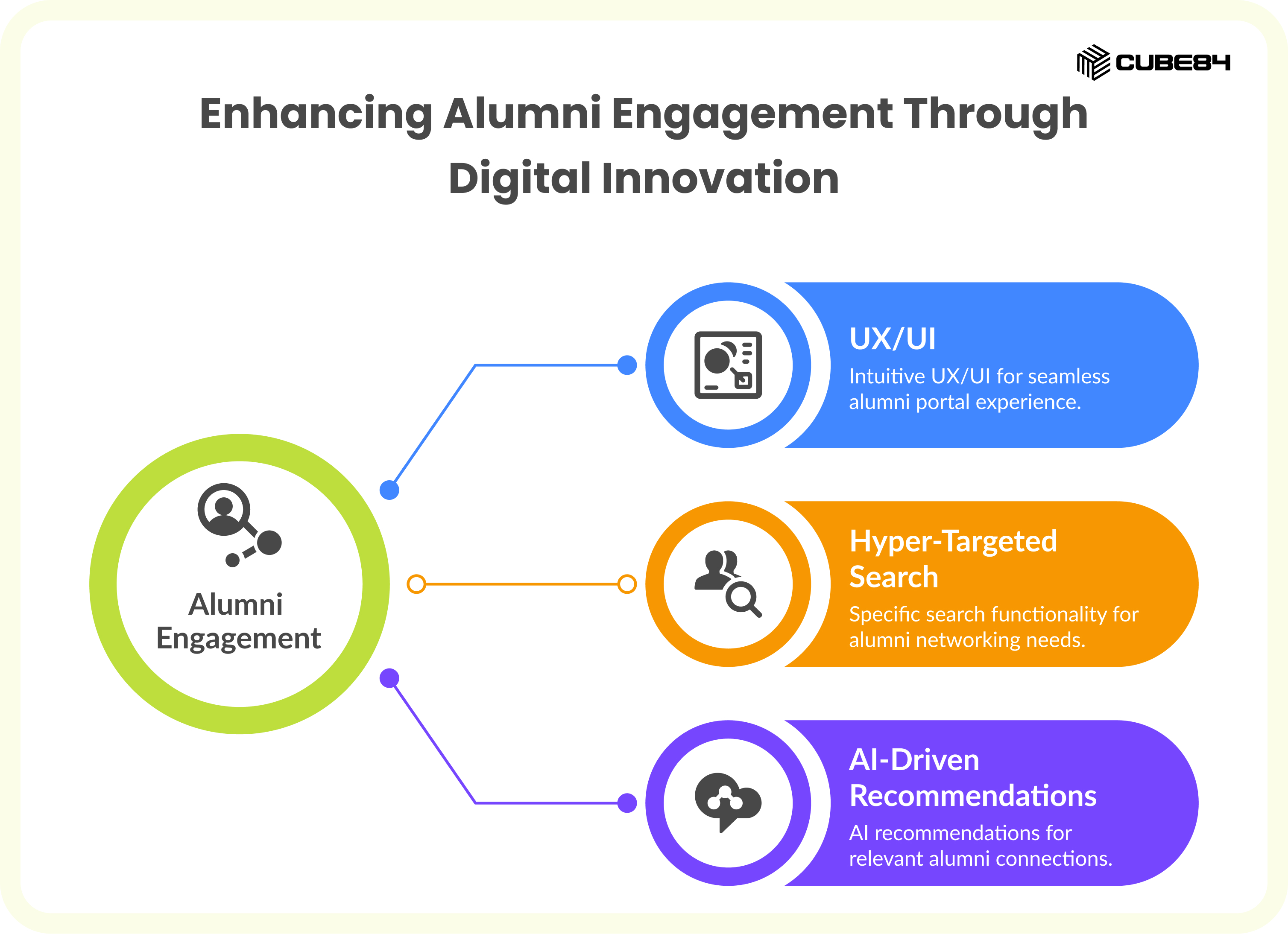
The Importance of UX/UI
It is very likely that alumni will compare your portal to the apps they use daily. Your UX must be intuitive, with simple navigation, quick search, mobile responsiveness, and easy profile editing. Login should be fast and take only seconds, and profile updates should feel effortless. With Experience Cloud, you get customizable templates, theme styling, and component-based design that make all of this simple.
Hyper-Targeted Search
The core utility of your directory is to help alumni find people they can help or who can help them. Your search must therefore be highly specific.
AI-Driven Recommendations
Data Cloud or CRM Analytics can surface non-obvious connections, such as two people who were in the same sports club a decade apart. AI also supports automated matching for mentorship and networking groups. These capabilities increase relevance and reduce the time alumni spend searching.
Driving Deep Connections: The Core Modules
Your alumni engagement is only meaningful when your platform supports real, impactful connections and interactions. Below are a few modules that create tangible value.
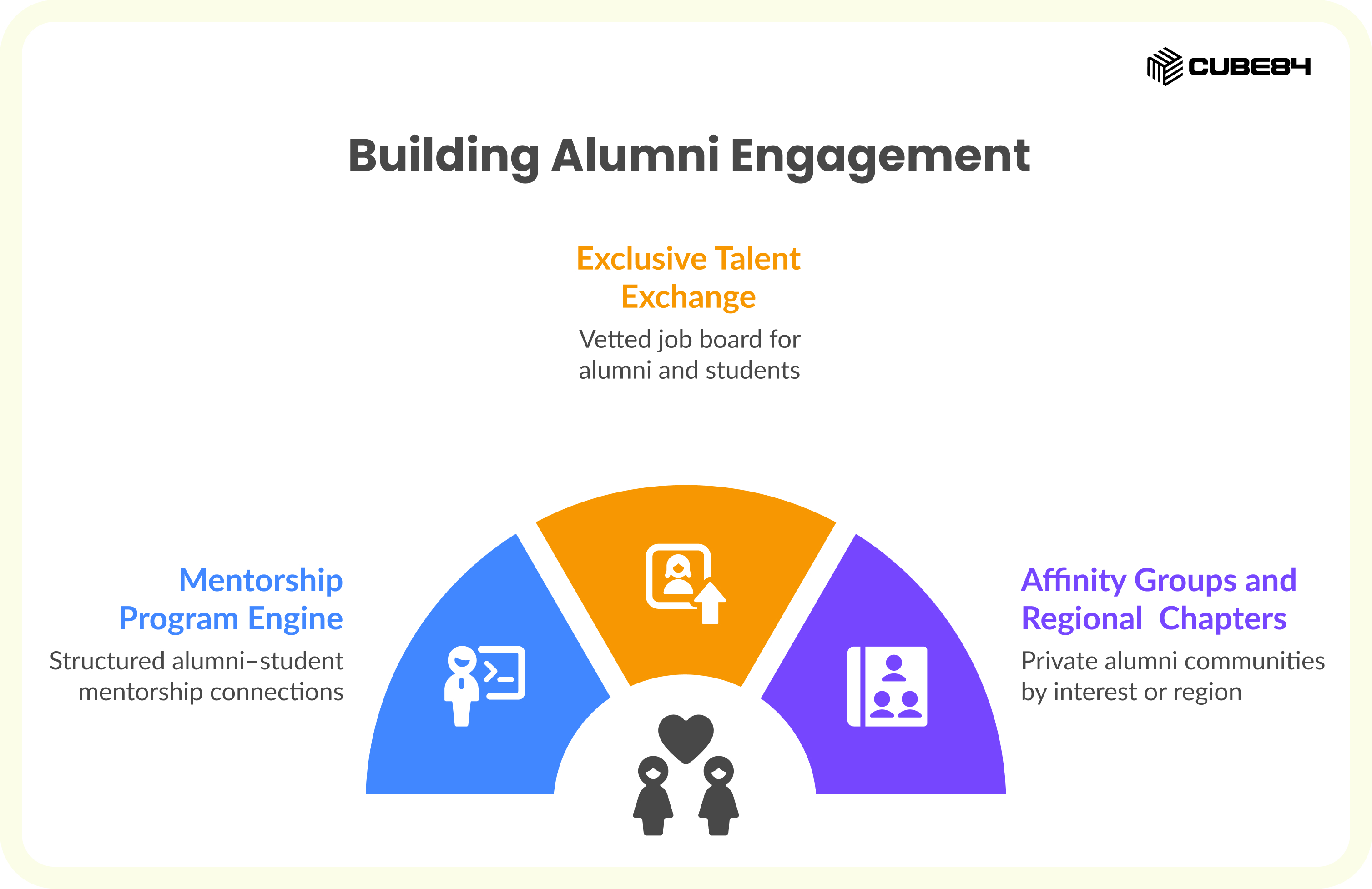
A. Mentorship Program Engine
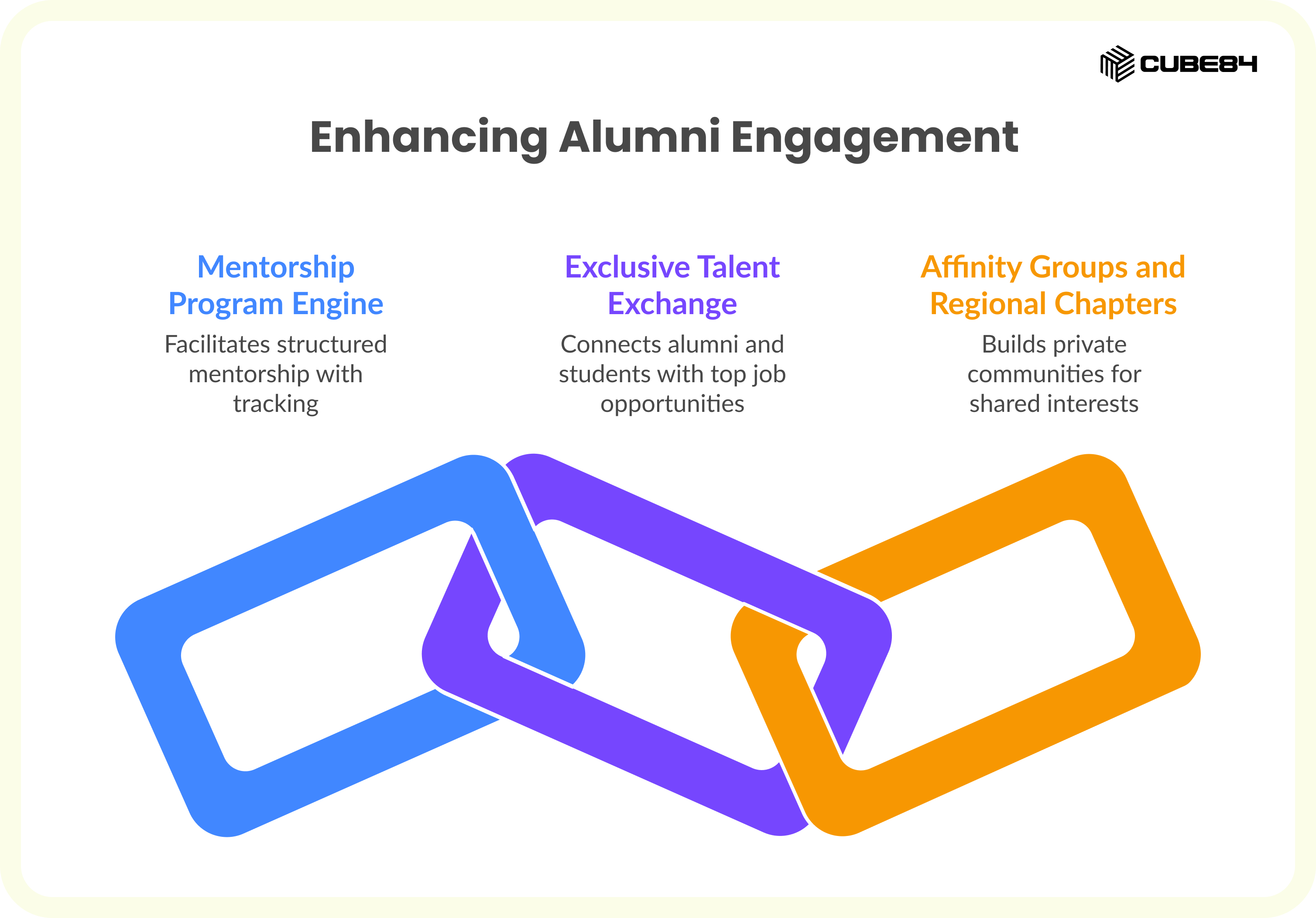
Mentorship drives the highest engagement in alumni communities. Alumni enjoy helping students when the process is structured and efficient. Utilizing Salesforce Flows and custom objects, institutions can:
1. Pair alumni mentors with mentees aligned on goals and industries
2. Track mentorship progression with scheduled check-ins
3. Measure impact beyond initial connections to tangible outcomes
Let’s take a prestigious college in New York as an example we recently worked on at CUBE84.Their campus is known for strong relationships and a close knit liberal arts environment, yet their alumni portal did not live up to that standard. The issue was not the data in their CRM, the institution already had reliable Salesforce records. The real barrier was the front end experience. Alumni could not find each other easily, actions took too many clicks, and the portal no longer reflected the community they valued.
This is where Experience Cloud became the strategic layer that unlocked the value of the data the institution already had.By implementing a modern, intuitive interface on top of their existing Salesforce foundation, the College finally had a platform where profiles that organize academic, professional, community, and giving information surfaced in one place, along with associations and contribution history.Fast search, simple filtering, and organized layouts turned their directory into something alumni actually wanted to return to.
The strategic value was clear. With the right experience built on top of the right data, the institution could offer meaningful connections without rebuilding its CRM from scratch.Their phased rollout now gives the team room to introduce new community features in a steady, structured way, including a future mobile app that brings the full portal to smartphones.
B. The Exclusive Talent Exchange
Alumni often prefer to recruit from their alma mater because they trust the quality of candidates. The job board functions as an exclusive, vetted recruitment channel connecting alumni and students with top-tier opportunities.
Value for Recruiters: The job board serves as the primary, vetted channel for alumni to recruit other alumni and current students. This guarantees candidate quality and instills confidence in hiring alumni that they are accessing a top-tier pipeline.
Value for Job Seekers: Job seekers gain access to roles that are often only posted internally or specifically earmarked for your institution’s talent.
C. Affinity Groups and Regional Chapters
Experience Cloud Groups allow you to build private, moderated communities for industry sectors, regions, or shared interests. These groups keep alumni engaged throughout the year. Moderation rules ensure the space remains professional and respectful.
US Higher Ed Imperatives: What Leadership Cares About Most
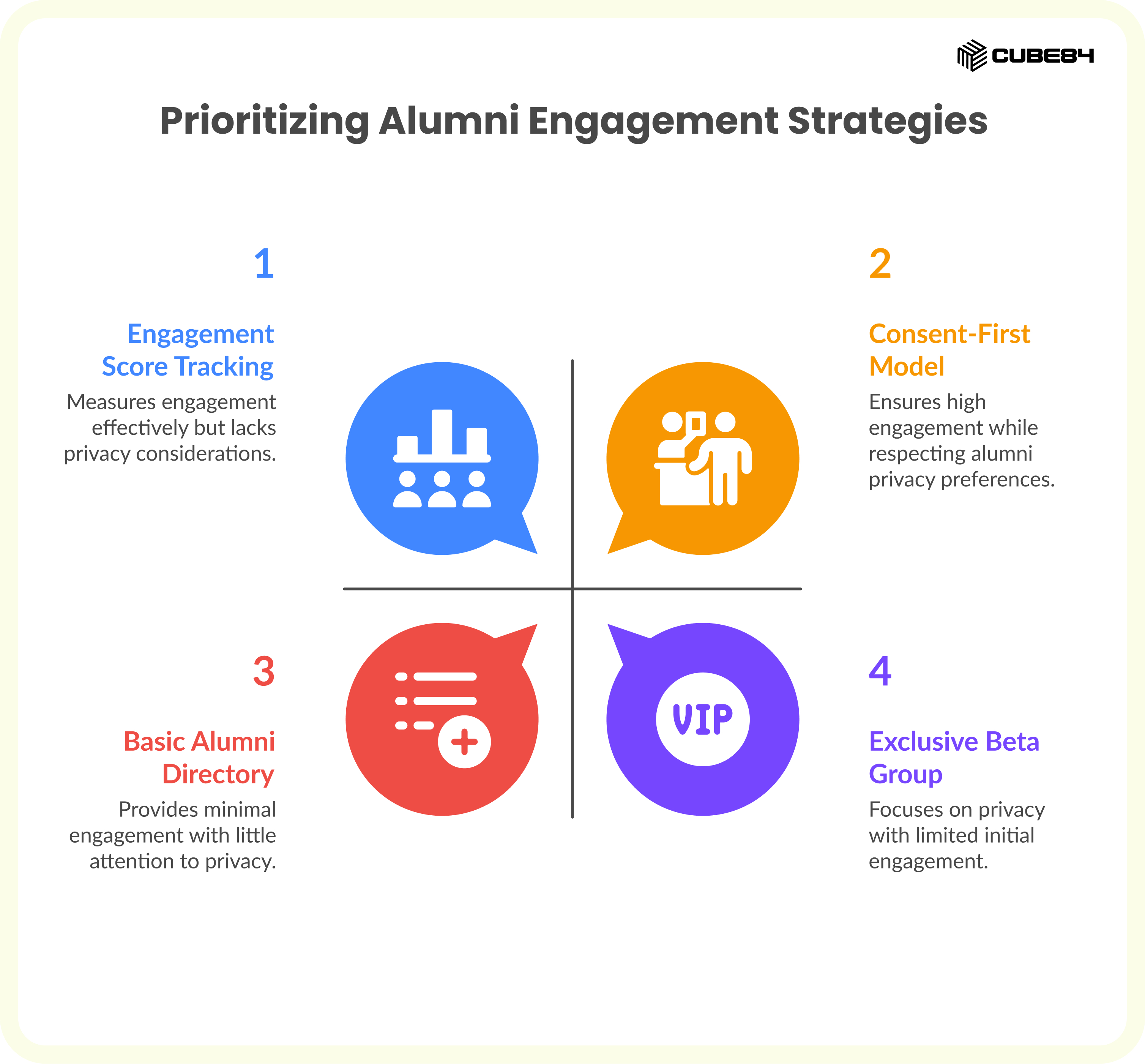
1. Security and Privacy
The primary concern for any high-profile alumni population is privacy and data security. Experience Cloud supports field-level visibility, consent records, and approval workflows.
Consent-First Model
Your platform must be built on a Consent-First Model. This means your alumni directory only uses information that an alumnus has chosen to share. Alumni decide what to show, who can see it, and what stays private. This ensures compliance with modern privacy regulations and respects the preferences of high-net-worth or high-profile alumni who value discretion.
2.Engagement Score
Since leadership wants metrics they can measure and compare, alumni engagement can be tracked through a simple scoring model that converts platform activity into clear, reportable indicators.
We define the Alumni Engagement Score (S) as a weighted total of the key interactions alumni complete inside the Experience Cloud portal.
S = w1(L) + w2(M) + w3(R) |
Where:
• L represents login frequency and overall portal usage
• M represents mentoring participation and related interactions
• R represents recruiting behavior such as posting jobs or viewing candidates
(Additional metrics can be included based on your institution’s goals, so the model remains flexible as your engagement strategy evolves.)
The w values are the weights assigned to each interaction based on your priorities. If mentoring is more important for your alumni strategy than logins, you assign a higher weight to w2.
This template gives institutions a clear, measurable way to track meaningful engagement over time.
3. Go-to-Market Strategy: Quality Over Quantity
Invite-Only Mentality
Launch the platform with a focus on exclusivity and utility. Start with an exclusive Beta group of highly influential alumni who can validate the user experience and provide immediate, powerful testimonials.
ETL and Data Integrity
You need a dependable way for data to move between your CRM and your Student Information System (SIS). ETL is the process that moves and cleans this data.
You should never replace or change the original records in the SIS without first checking and matching them. This protects accuracy and prevents corrupted or duplicated data.
Beyond the Search Box: Future Proofing the Directory
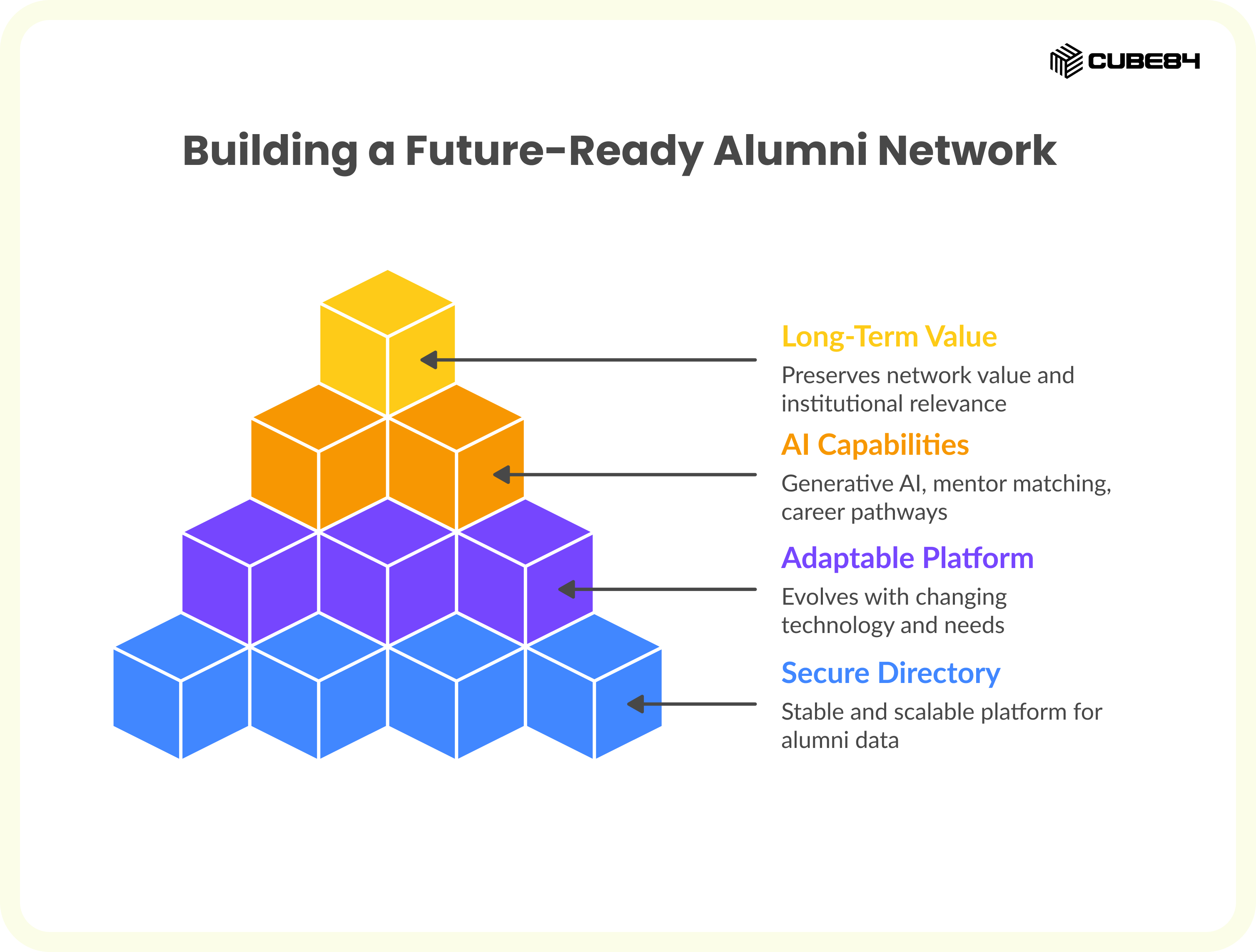
Your alumni are your living legacy. With every graduating class, your community grows, and so does the responsibility to maintain a secure, stable, and scalable directory that truly reflects the strength of your institution. The most effective way to achieve this is by adopting a platform that can evolve with you.
With Salesforce, your directory becomes a modern, adaptable digital extension of your network. You can update, personalize, and expand the experience without rebuilding from scratch. As the world changes and the ways people learn and connect shift, your institution stays current.
Future-ready capabilities include:
• Generative AI summaries of alumni profiles
• Automated mentor match suggestions
• Predictive career pathways for students and alumni
• AI-powered introduction drafts for easier outreach
• Integrations with event technology for smoother in-person networking
A Salesforce-based directory keeps your institution relevant over time and preserves the value of your network for the long term.
Again, your alumni are your living legacy, and the strength of your network reflects the excellence of your institution. Connect with CUBE84 to design a secure, scalable, and engaging alumni platform that brings your community together and maximizes its lifelong value.