


Search for grant management software and much of what comes back is built for the organizations handing money out. Foundations, community trusts, corporate giving programs. Their problem is choosing who gets an award and watching what happens next. Your problem runs the other direction. The money has already arrived, it came with conditions attached, and somebody on your team has to prove those conditions were met before the next cycle opens.
For a housing or homeless services nonprofit, that proof is close to the whole game. Restricted funding means every dollar is spoken for the moment it lands, and getting the accounting wrong sends money you have already earned back to the funder. Buying here is really a decision about how defensible your spending looks two years from now, to somebody reading it cold.
Much of the Grant Management Market Is Built for Foundations Giving Money Away
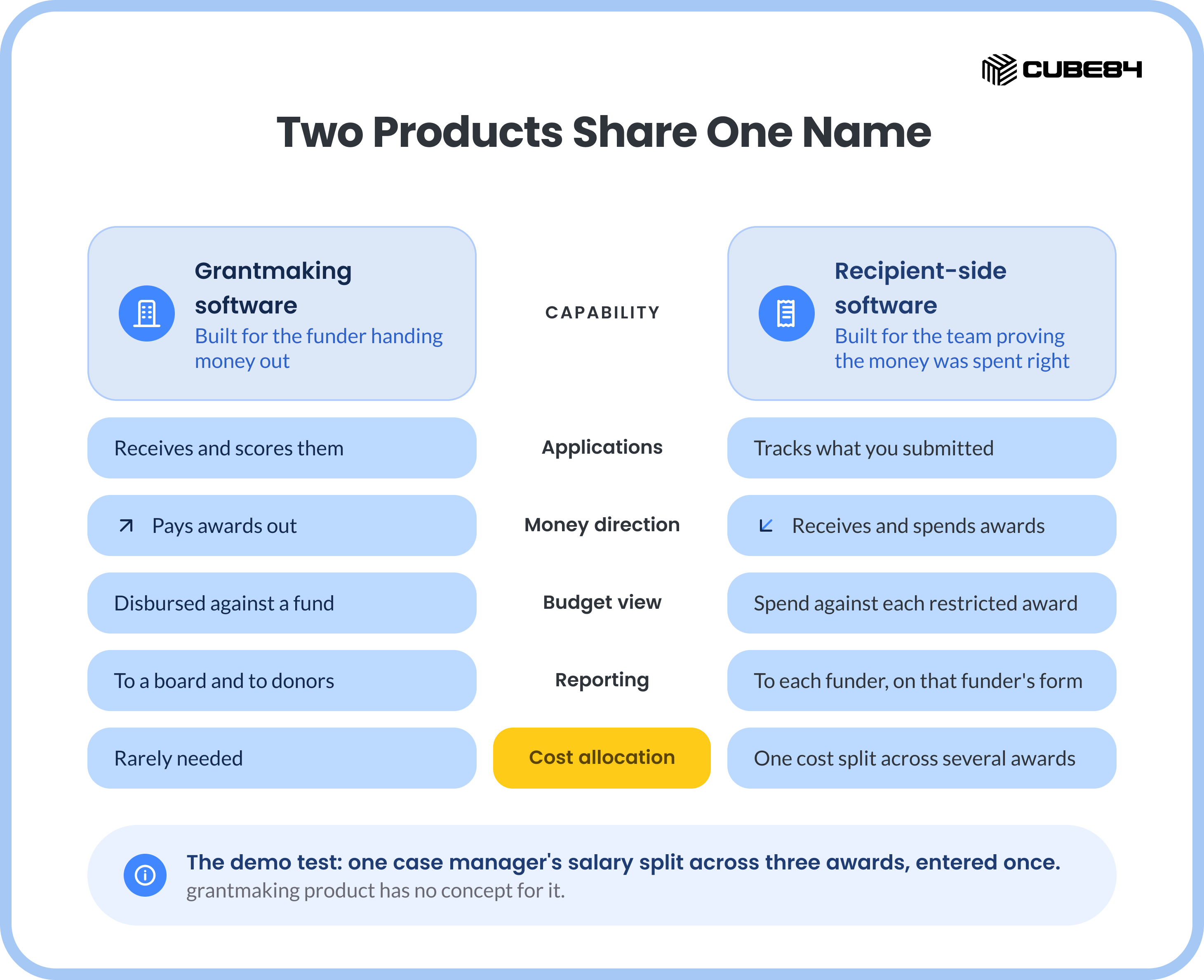
Two genuinely different products share one name. Grantmaking software runs an application portal, scores submissions and performs due diligence on the organizations receiving the money. Recipient-side software, sometimes sold as post-award or grant lifecycle management, does the opposite work: it tracks what you applied for, sets up each award you win, holds spend against the restricted budget, watches the report calendar and keeps the documentation an auditor will ask for.
The confusion is expensive because the first ten minutes of a demo look identical. Both open on a dashboard of grants, a calendar and a document library. The difference appears the moment you ask for something specific: show me one case manager's salary split across three awards, entered once. A grantmaking product has no concept for that, because the organization it was designed for never allocates a cost across the grants it hands out.
Read the vendor's homepage before the demo and see which side the language serves. Applicant, reviewer, portfolio and disbursement describe a funder. Award, drawdown, allowable cost, period of performance and subrecipient describe you.
Restricted Funding Means Every Dollar Arrives With a Name Attached
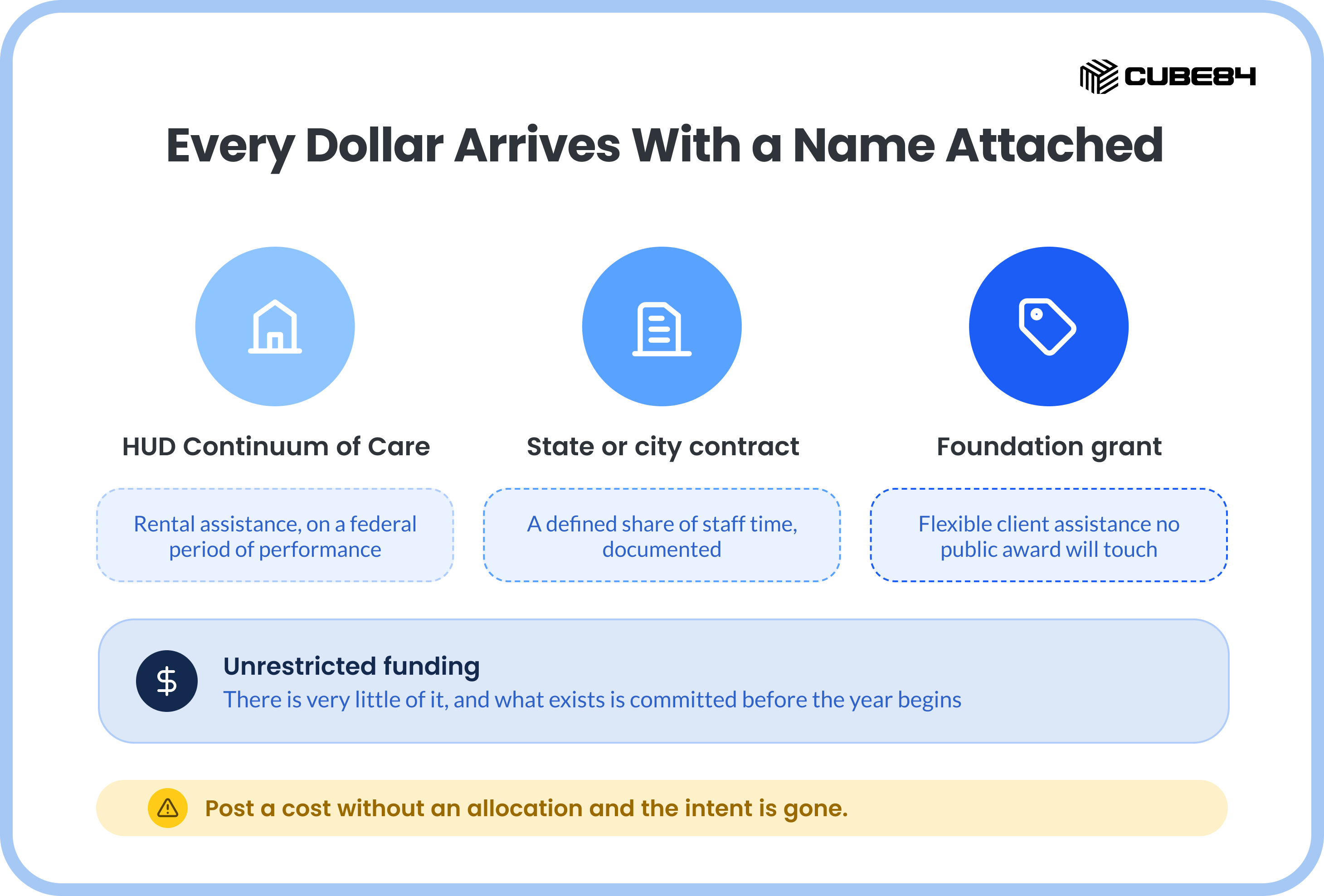
A HUD Continuum of Care award, a state or city homelessness contract and a foundation grant all arrive with the same structural condition. Each names what it may pay for, over what period, with what documentation, and reserves the right to ask for the money back if the answer disappoints. Unrestricted funding exists, and in most housing organizations there is very little of it. What there is tends to be committed before the year begins, covering the gaps between awards and absorbing whatever a funder declines to pay for. It is rarely a cushion anyone can spend against a plan.
The consequence for software is direct. A recipient-side system has to keep the boundary between awards visible at the moment somebody commits a cost, rather than three months later when finance is closing a quarter. Once an expense is posted without an allocation, recovering the intent behind it means reconstructing a decision from memory, an email thread and a calendar. That reconstruction is where disallowed costs come from, and it has the same shape as the data cleanup that swallows a reporting cycle, a pattern CUBE84 examined in a webinar on why housing systems get built to report rather than to run.
One Program, Three Grants, Three Different Reporting Shapes
Take a single rapid rehousing program. A HUD renewal grant pays rental assistance and nothing else. A state line item pays a share of staff time. A foundation grant pays flexible client assistance, the deposits and arrears and bus passes no public award will touch. One program, one team, one set of clients, and three separate sets of rules about what each dollar may do.
Each award carries its own period of performance, and they do not start or end together. A cost incurred four days before an award's start date is unallowable, however reasonable it looked on the day. A system that treats grant dates as reference information rather than as a constraint on posting will let that happen quietly and surface it at monitoring.
So the software has to hold three things at once: an allocation rule attached to the cost itself, a period against each award that governs what can post to it, and a way to amend a budget mid-year without losing what was already posted under the previous rule. Amendments are normal here. A system that handles one by asking finance to restate history will eventually be overruled by a spreadsheet.
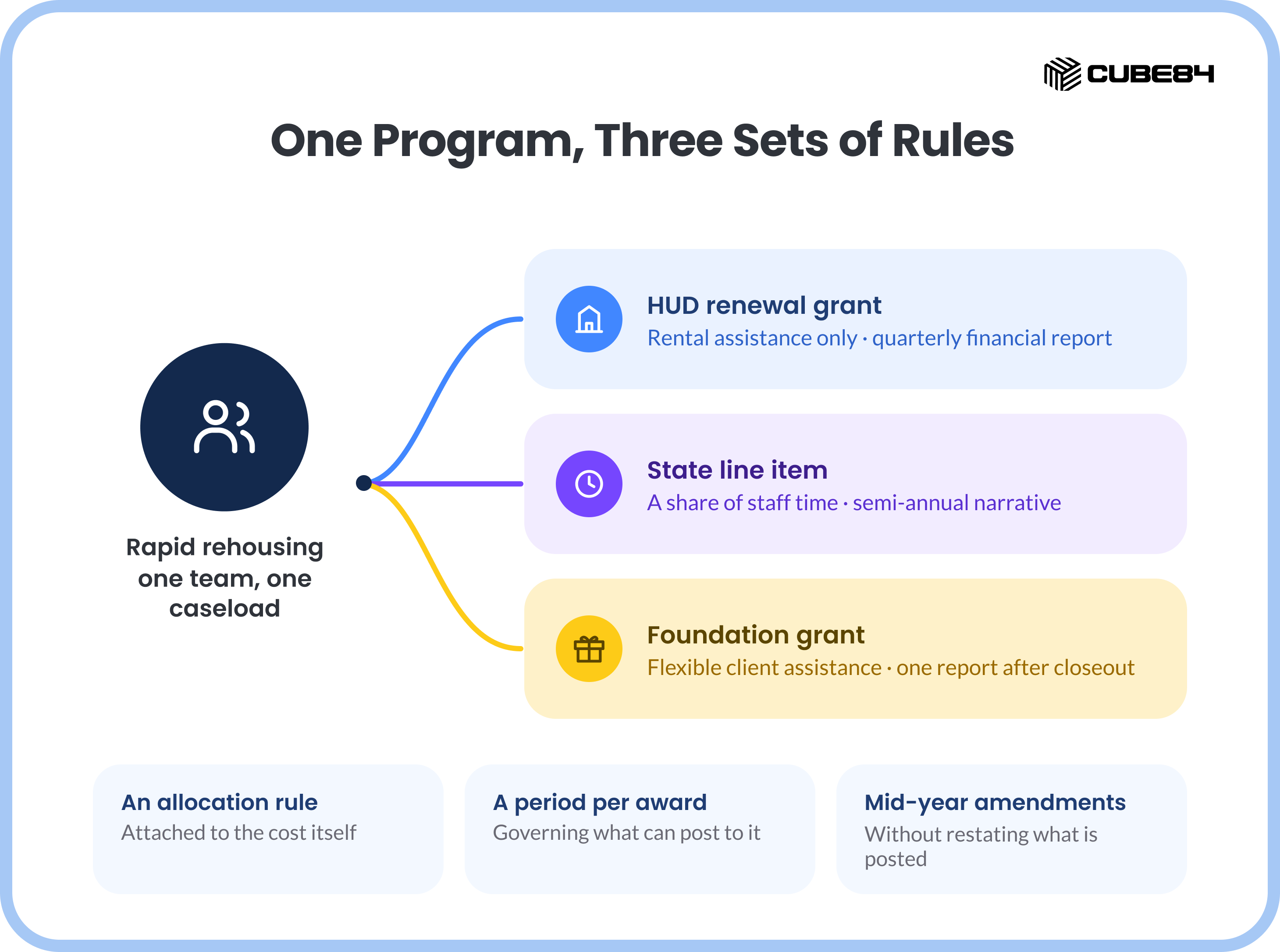
Illustrative example, not drawn from a specific organization. Three awards, three sets of allowable-cost rules, three reporting calendars, one program and one team. Each award also runs its own period of performance. The preview renders this as a diagram.
Every Award Brings a Reporting Calendar That Ignores Your Fiscal Year
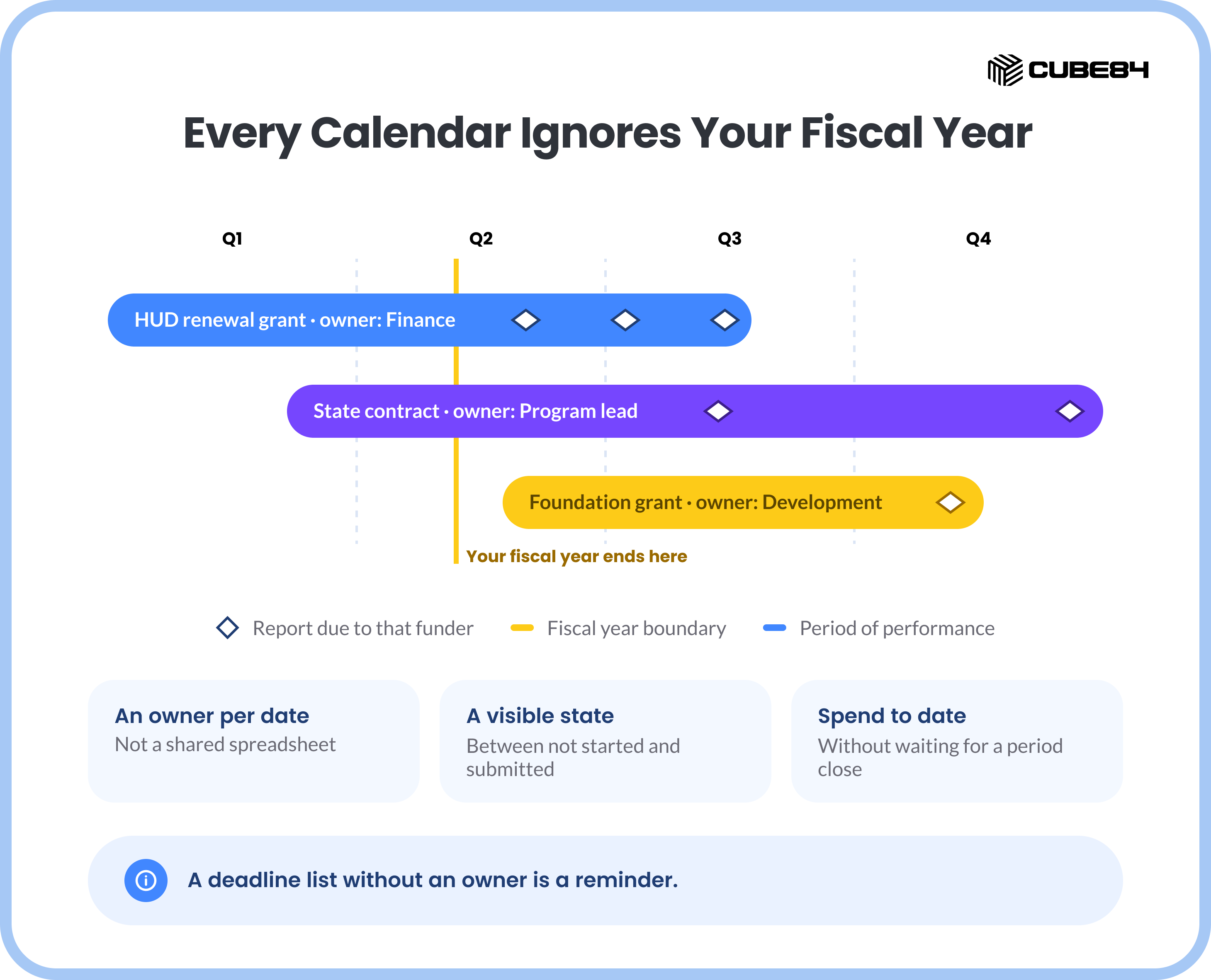
A quarterly financial report to one funder. An annual performance report to another. A semi-annual narrative somebody in programs has to write. A final report due after the period of performance closes, by which time the staff who ran the program may have moved on.
Most organizations manage this in a shared spreadsheet, and it works right up until the person who maintains it takes two weeks off. The failure is structural: a deadline list without an owner and a status is a reminder, and reminders do not survive a busy month. What a system adds is an owner against every date, a visible state between not started and submitted, and the ability to show a funder where their money stands without waiting for a period close.
What Grant Management Software Does That HMIS and Case Management Do Not
Three systems sit in most housing organizations and each answers a different question. Your HMIS answers what happened to this person and what HUD requires reported about it. A case management system answers what happens next and who owes what by when. Grant management answers which award paid for that, and whether the answer will hold up.
The overlap that catches buyers is the count of people served. Funders routinely ask for spend and service numbers on the same report, and those numbers come from different systems that have to agree. Ask a vendor which system holds the authoritative count, and how it reaches the funder report without a person retyping it at quarter end. Two reports that disagree, filed to the same funder in the same month, generate a follow-up you will spend a week answering.
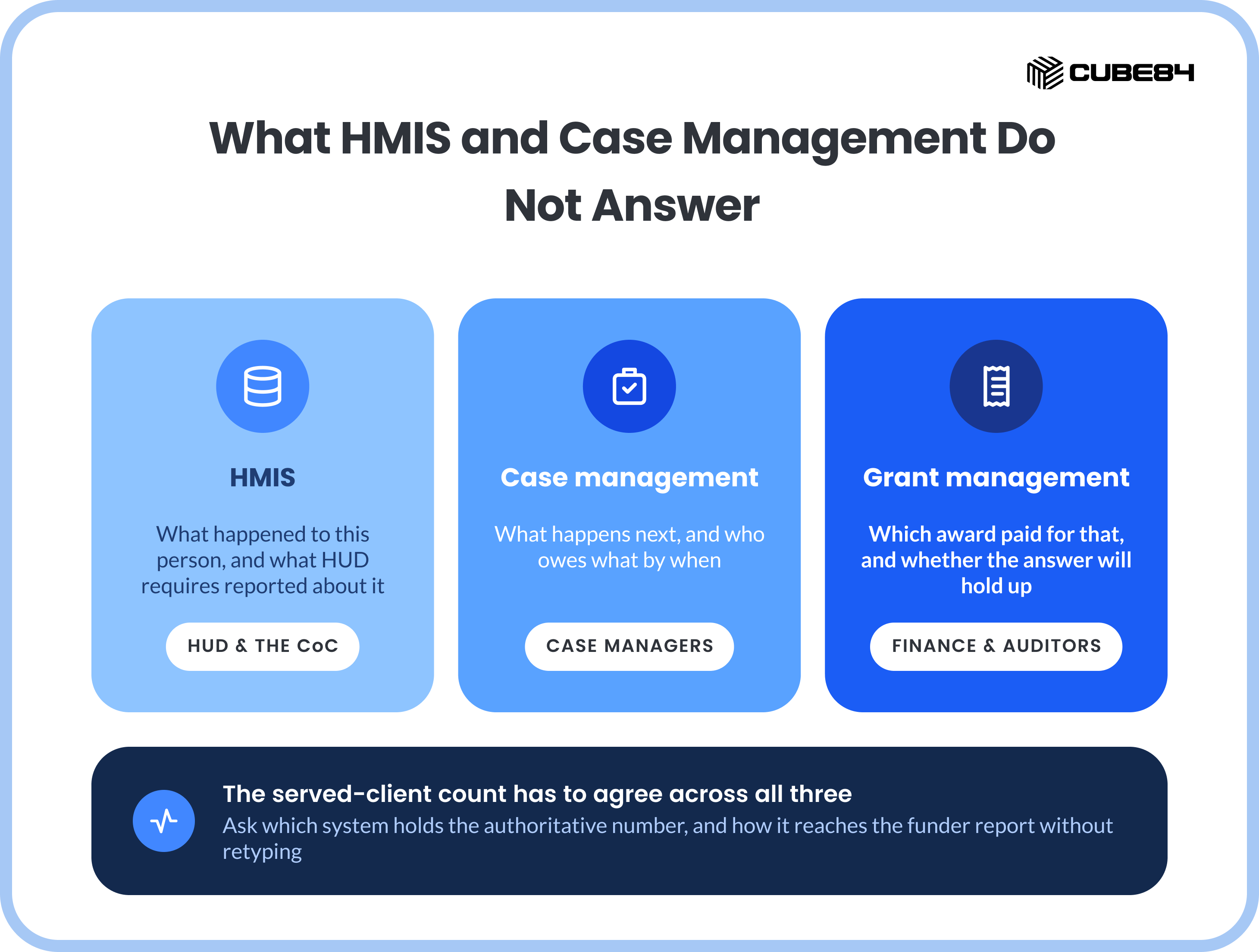
Grant management replaces neither of the other two, and a vendor suggesting otherwise is describing a migration you did not ask for. HUD participation obligations do not move because you bought accounting software.
Nine Questions to Ask a Grant Management Vendor Before Signing
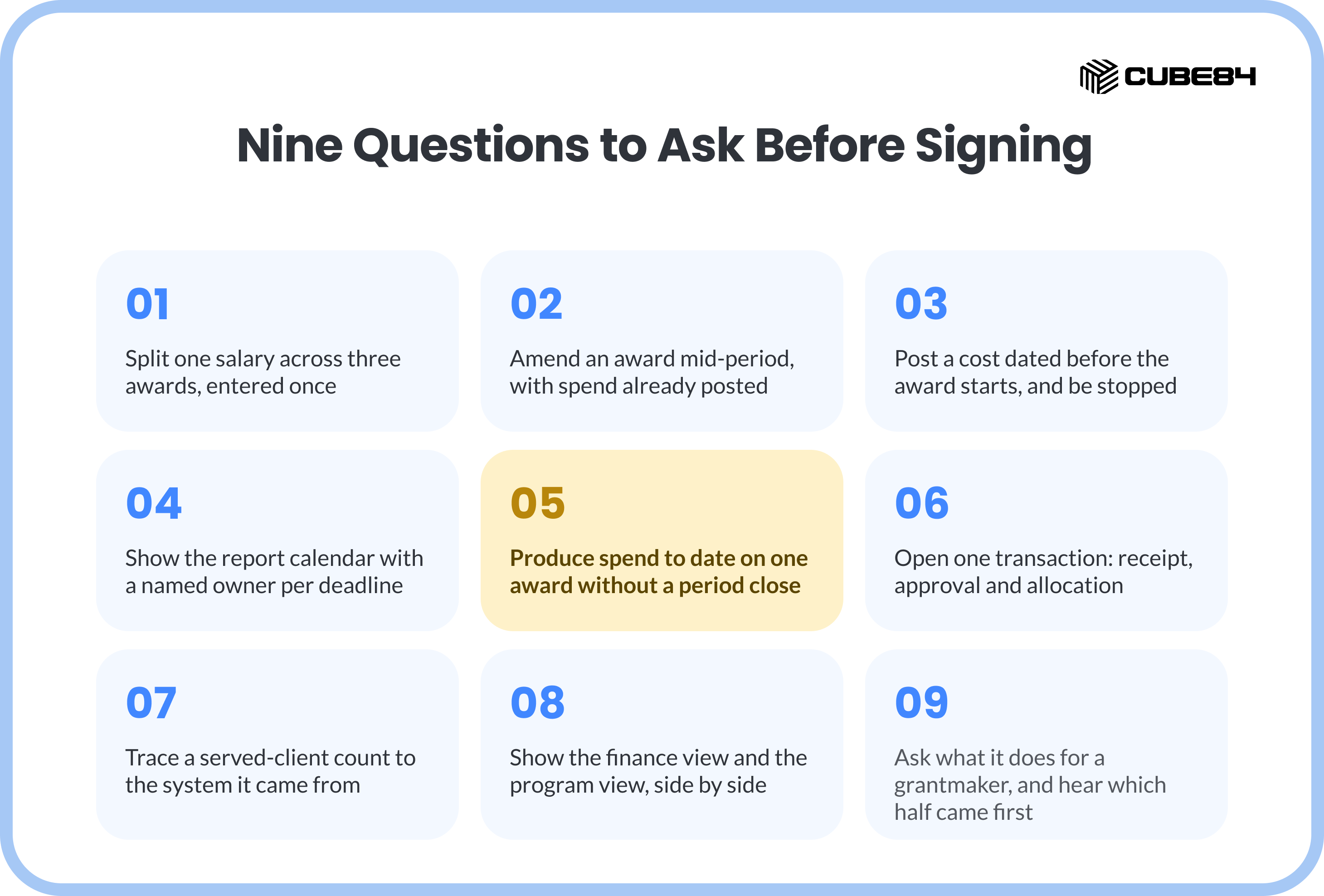
Bring these to the demo and ask for each to be performed rather than described. A capability in a roadmap and a capability in the product look identical on a feature matrix and behave very differently in March.
Split one salary across three awards, entered once. Show whether the split is a stored rule or a manual adjustment somebody repeats monthly.
Amend an award mid-period. Show what happens to spend already posted under the old budget.
Post a cost dated before an award's start date. Show whether the system stops it.
Show the reporting calendar with a named owner against each deadline, and what changes when one slips.
Produce spend to date on a single award without running a period close.
Open one transaction and show the receipt, the approval and the allocation from that record.
Show how a served-client count reaches a funder report, and name the system that number came from.
Show what a finance lead sees and what a program lead sees, and whether either can work without the other's help.
Ask what the product does for a grantmaker. A detailed answer is worth hearing, because it tells you which half was built first.
Grant Management Protects Money You Have Already Earned
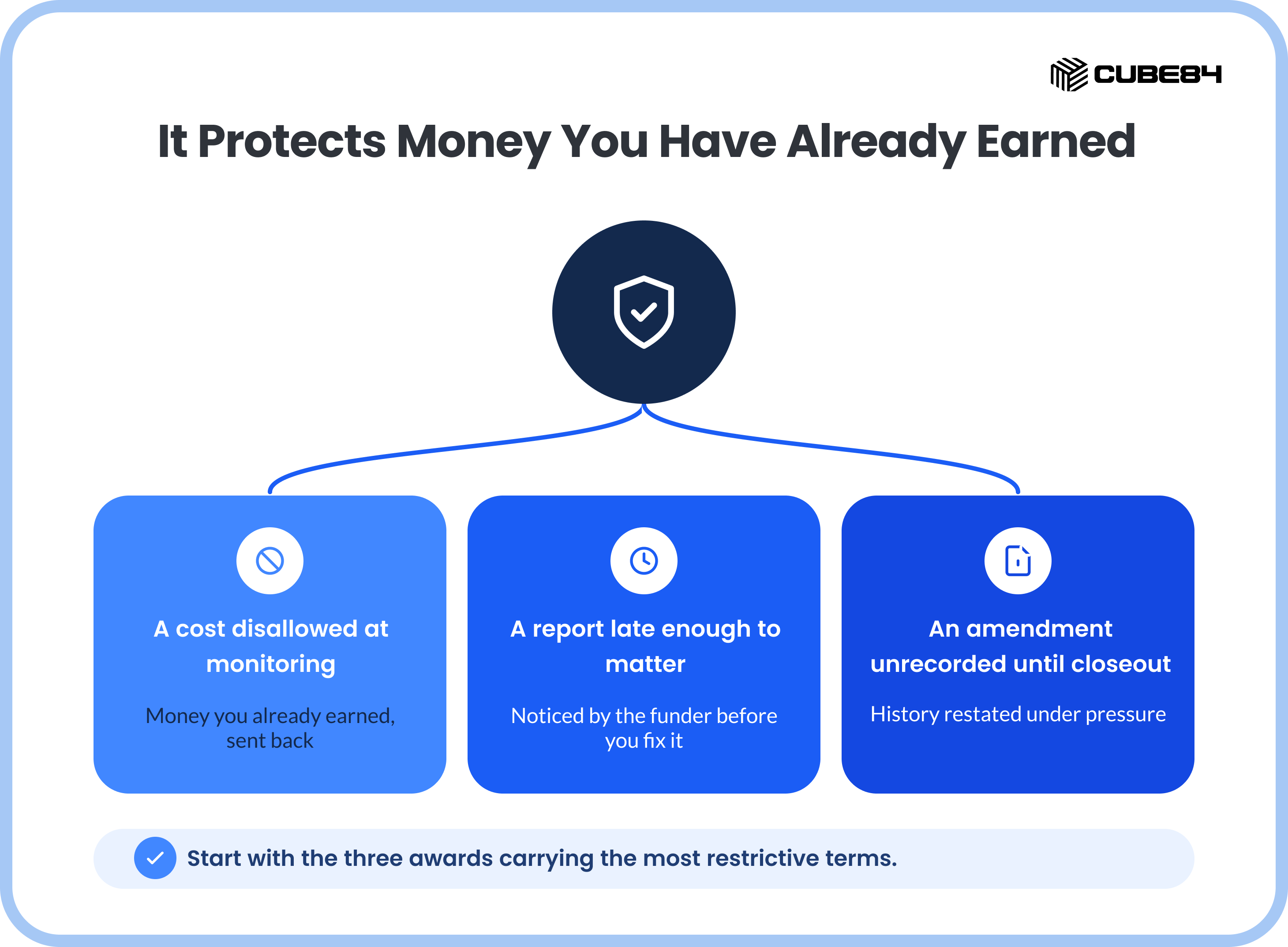
This category does not grow revenue, and buying it as though it might is a mistake. What it protects is funding already awarded, against a cost disallowed at monitoring, a report arriving late enough to matter, or an amendment unrecorded until closeout. Those events cost a housing nonprofit real money, and they stay quiet until they are not.
Judged that way the evaluation gets simpler. A system earns its cost if it moves the allocation decision to the point of spending, keeps every report on a calendar somebody owns, and answers a funder's question without a week of reconstruction. CUBE84 builds that layer for housing and homeless services organizations alongside Housing360, our HMIS, so the grant record and the client record stop living in two places that get reconciled by hand.
Start with the three awards carrying the most restrictive terms, walk one cost through each of them end to end, and see which system survives the walk.