

How to Vet a Salesforce Developer in the AI Era
For the engineering or business systems manager running the technical interview.
The technical screen for a Salesforce developer has a familiar shape. Governor limits. How to bulkify a trigger. What with sharing does and when it matters. You listen for the right answers, and a strong candidate gives them.
Then the work starts. The pull requests arrive faster and longer than the ones you are used to reading, and they read well. Somewhere in the third week a trigger queries inside a loop, and it surfaces as a failed nightly load rather than as a review comment.
An assistant that writes Apex changes what a developer spends the day doing. Composition gets quicker. Judgment about code that already exists, produced by something that has never seen your org, becomes the expensive part. The skill you are hiring for is review.
So put review in the interview. Hand the candidate a working, AI-written trigger with flaws planted in it, and watch what they find.
Why the Standard Apex Interview Stops Short
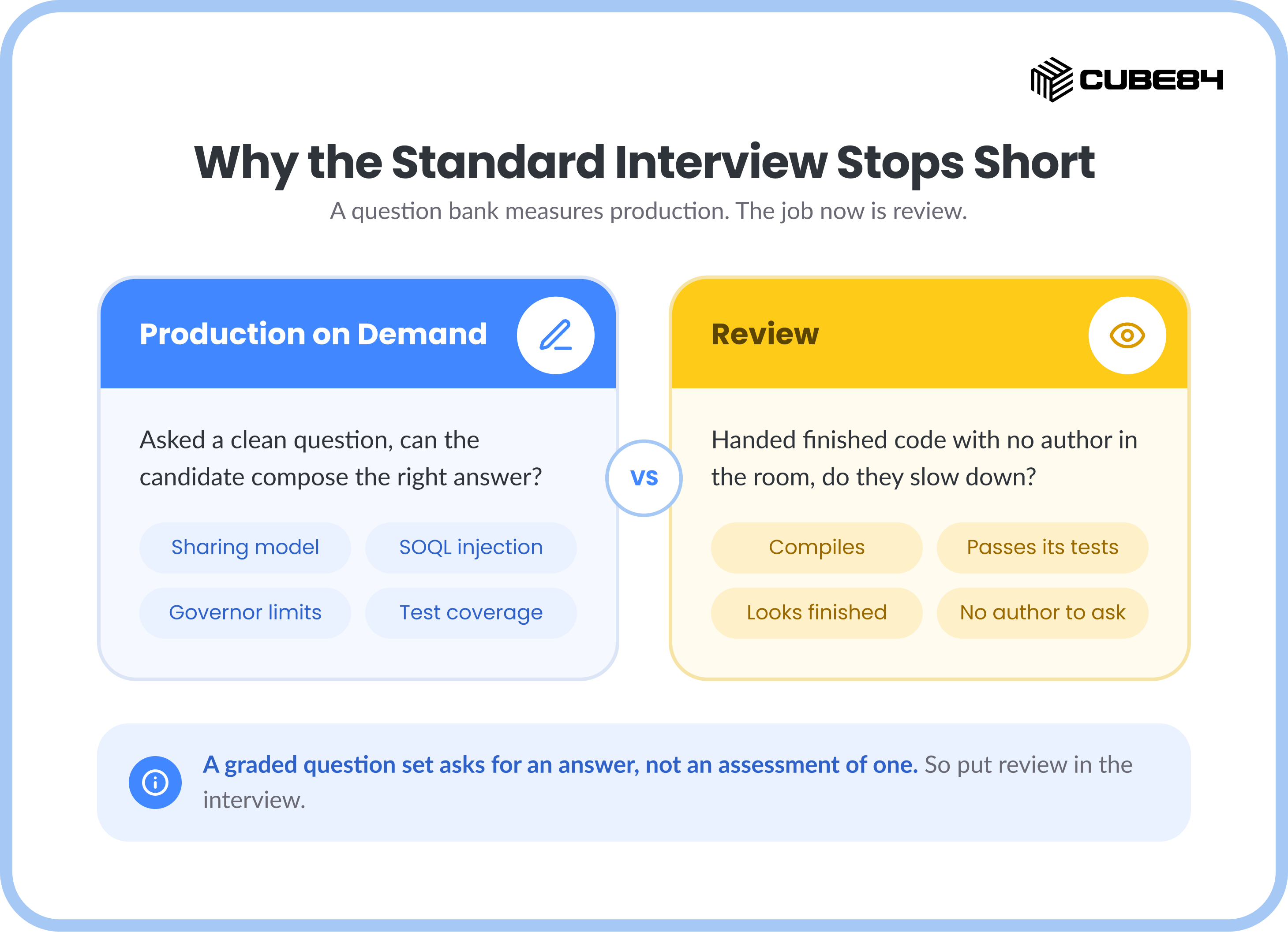
Start with what the standard screen gets right. The published Salesforce developer interview questions that technical assessment platforms sell ask about the sharing model, SOQL injection, governor limits and test coverage. Those are four of the places Salesforce code goes wrong at scale, and a candidate who cannot discuss them should not reach a final round. Certifications do similar work, telling you what a developer studied and roughly when, which is a narrower signal than it is usually read as.
What a graded question bank measures is production on demand. Asked a clean question, can the candidate compose the right answer. That is a real skill and it is worth measuring.
Review is a different motion. The candidate is handed something that already exists, looks finished, compiles, passes its tests and has no author in the room to interrogate. The question is whether they slow down in front of it. A graded question set is not built to show you that, because it asks the candidate to produce an answer rather than to assess one.
Hand the Candidate a Flawed AI Build
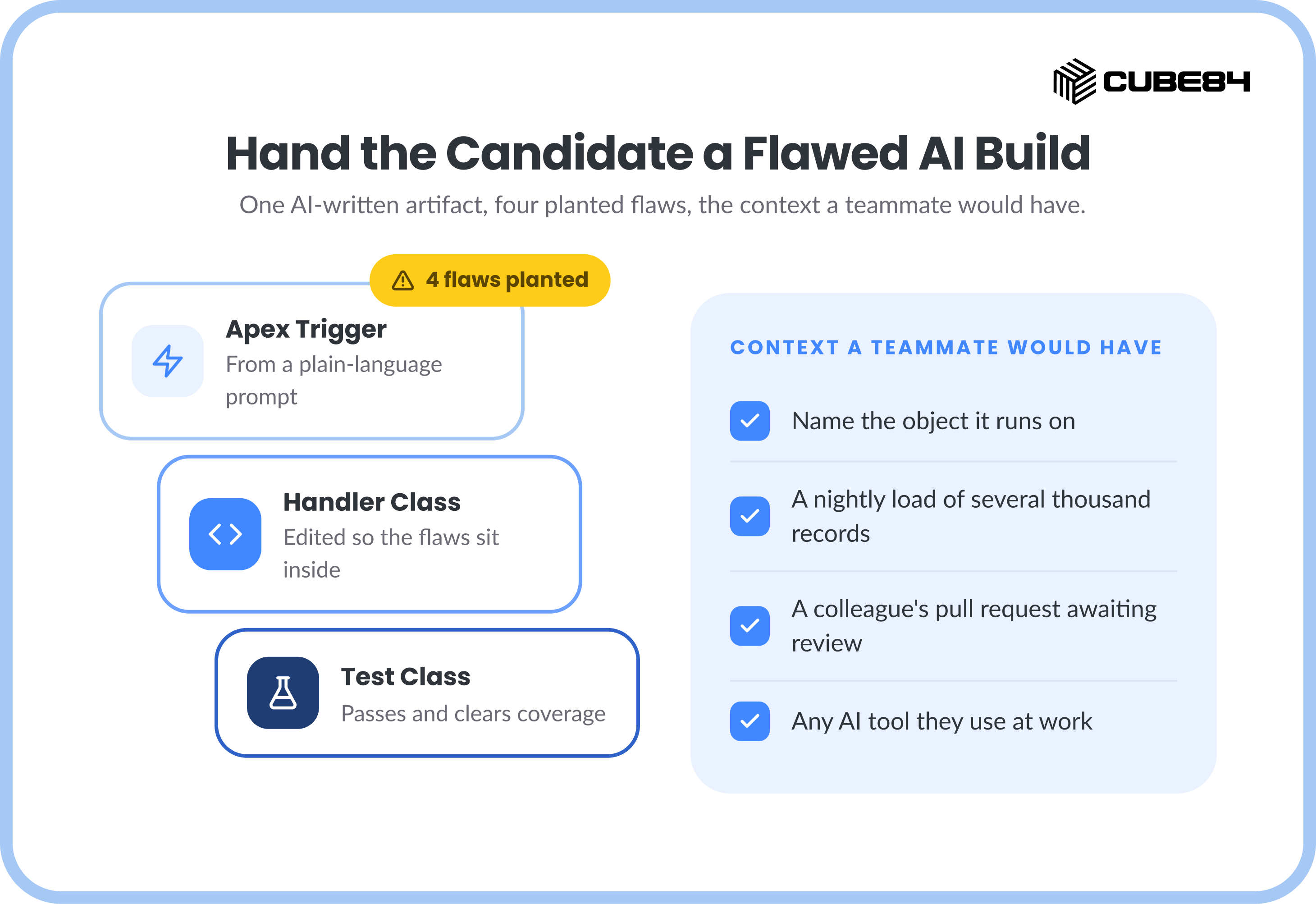
If you already run a code review round, keep it and change what the candidate reviews. The provenance is the point: code an assistant produced, carrying the kind of flaw an assistant plausibly leaves.
Prepare one artifact: an Apex trigger, its handler class and a test class, generated by an assistant from a plain-language prompt and then edited so that four specific flaws sit inside it. Give the candidate the context a teammate would have. Name the object, say the org runs a nightly data load of several thousand records, and say the code is a colleague's pull request waiting on their review.
Tell them they may use whatever AI tool they use at work. Watching someone review with an assistant open tells you more than watching them review without one, because you see which answers they accept and which they go and check.
The Four Flaws Worth Planting
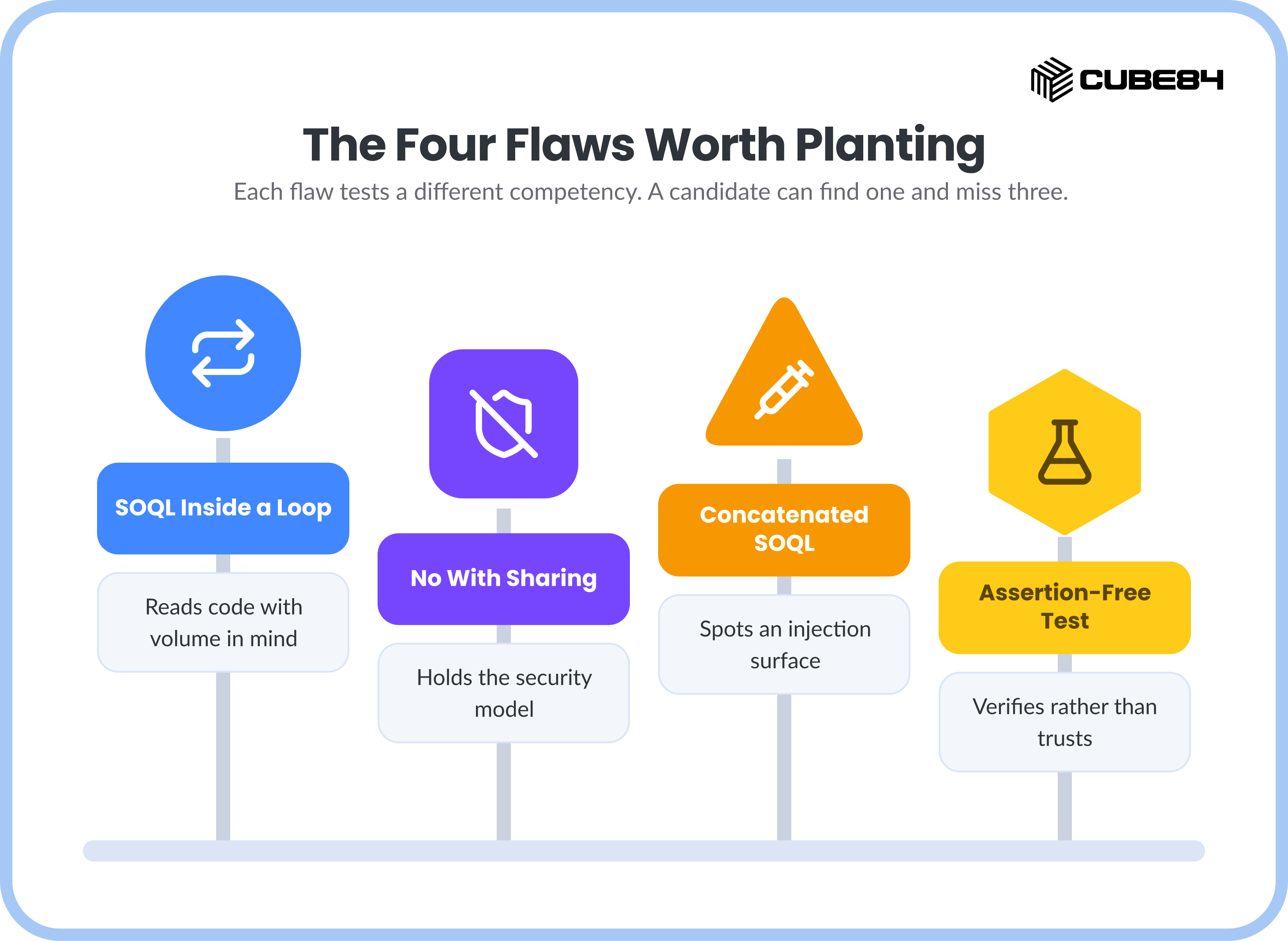
Each flaw tests a different competency, and a candidate can find one while missing the other three. That is the point of planting four.
The loop has the shortest path to a visible failure. A SOQL query inside a for loop over Trigger.new runs once per record, so the class behaves perfectly in a sandbox of ten records and breaks when a data load pushes two hundred through it. Ask what the candidate would do instead, and listen for a map keyed on the field they need rather than a reflex "move it outside the loop."
The sharing declaration is quieter. A class declared without with sharing runs in system context, so a user can see rows the sharing model was meant to keep from them. Missing CRUD and field-level checks before a DML sit in the same category. Neither throws an error, neither shows up in a test run, and both are what an assistant leaves out when nobody puts them in the prompt.
Dynamic SOQL concatenated from an input value has the shortest fix and the longest consequence. A reviewer should reach for a bind variable, or for escaping the input, without being pointed at it.
The test class is worth planting last, because it is the easiest one to read past. It exercises the trigger, clears the 75% coverage Salesforce requires for a production deployment, and asserts nothing. Coverage records that lines ran. An assertion records that the result was right. A candidate who reads that test and says it would still pass with the logic inverted has told you what you needed to know.
How to Run the Review Session
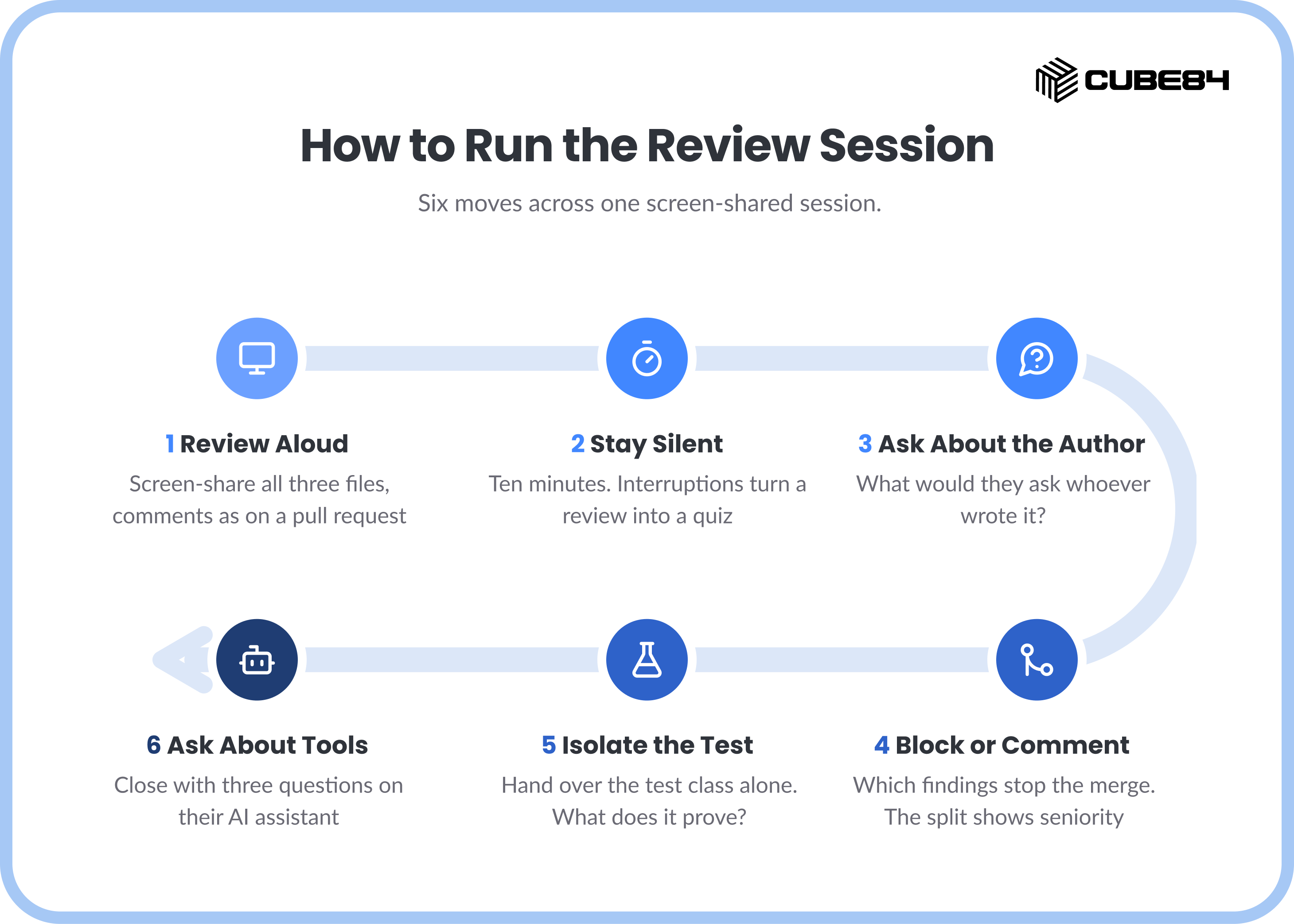
Share the trigger, handler and test class on a screen share and ask the candidate to review aloud, as if writing pull request comments.
Say nothing for the first ten minutes. Interruptions turn a review into a quiz.
When they stop, ask what they would ask the author.
Ask which findings would block the merge and which would be a comment. The split is where seniority shows.
Hand them the test class on its own and ask what it proves.
Close with the three questions below.
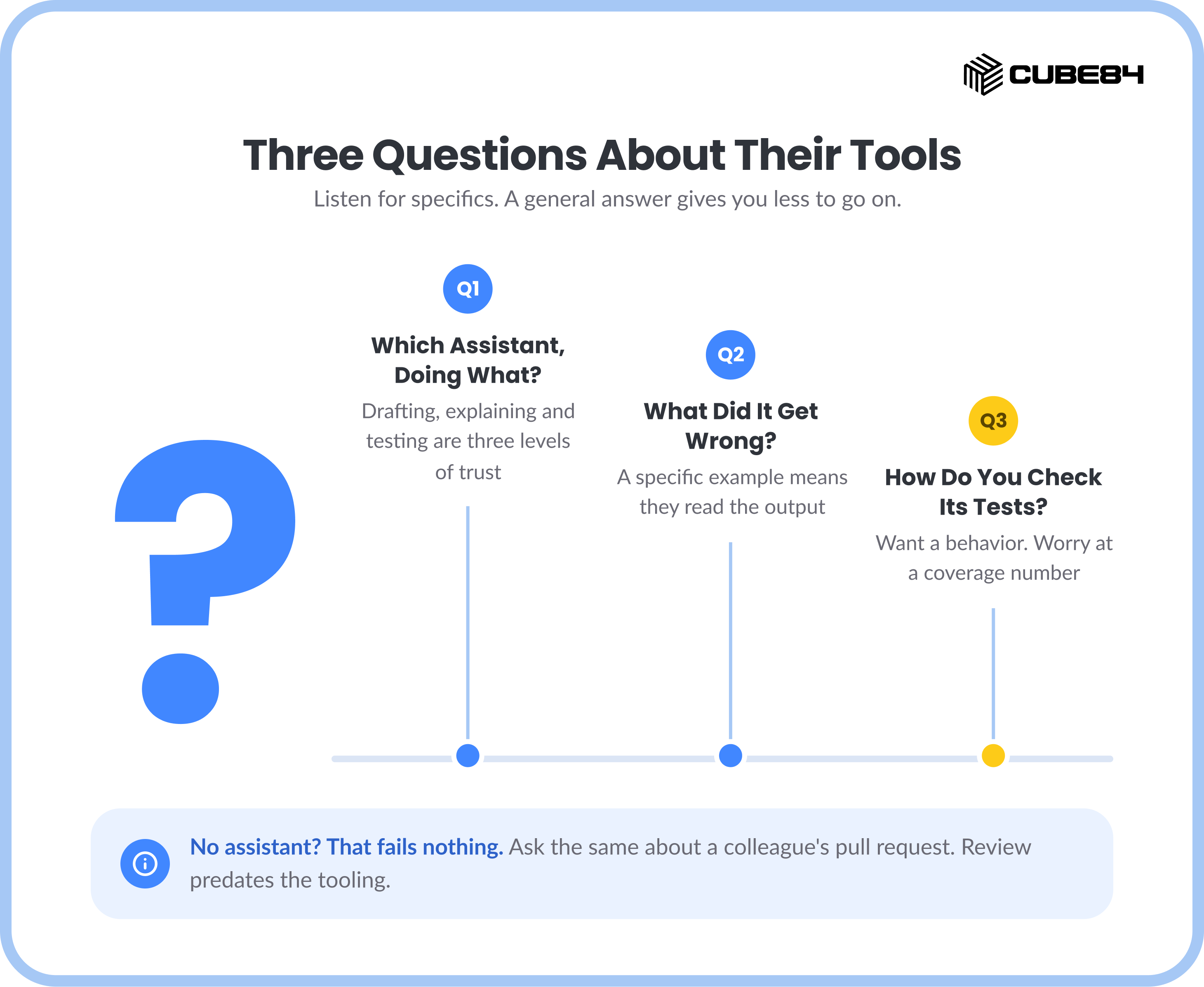
Three Questions About the Candidate's Tools
Ask which assistant they use and what they have it do. Drafting a first pass, explaining unfamiliar code and writing tests are three different levels of trust, and a developer who can say which of the three they allow has thought about where the boundary sits.
Ask them to describe something the tool got wrong recently and what they did about it. A developer who produces a specific example has been reading the output. A developer who reaches for a general answer has given you less to go on.
Ask how they check a test the assistant wrote. The answer you want describes a behavior: changing an input and confirming the test fails, or writing the assertion first and letting the tool fill in the setup. The answer that should worry you is a coverage number.
A candidate who does not use an assistant has not failed anything. Ask the same questions about a colleague's pull request and score the answers the same way. The exercise is about review, and review predates the tooling.
How to Score a Code Review Exercise
Score it as a profile rather than a pass mark. Two of the four flaws are about access and two are about proof, so where a candidate lands says more about what to pair them with than a total out of four does.
Source: CUBE84 review framework. The two axes move independently, so a candidate can be strong on access and light on proof. The design reference in this folder renders the same four profiles as a quadrant diagram.
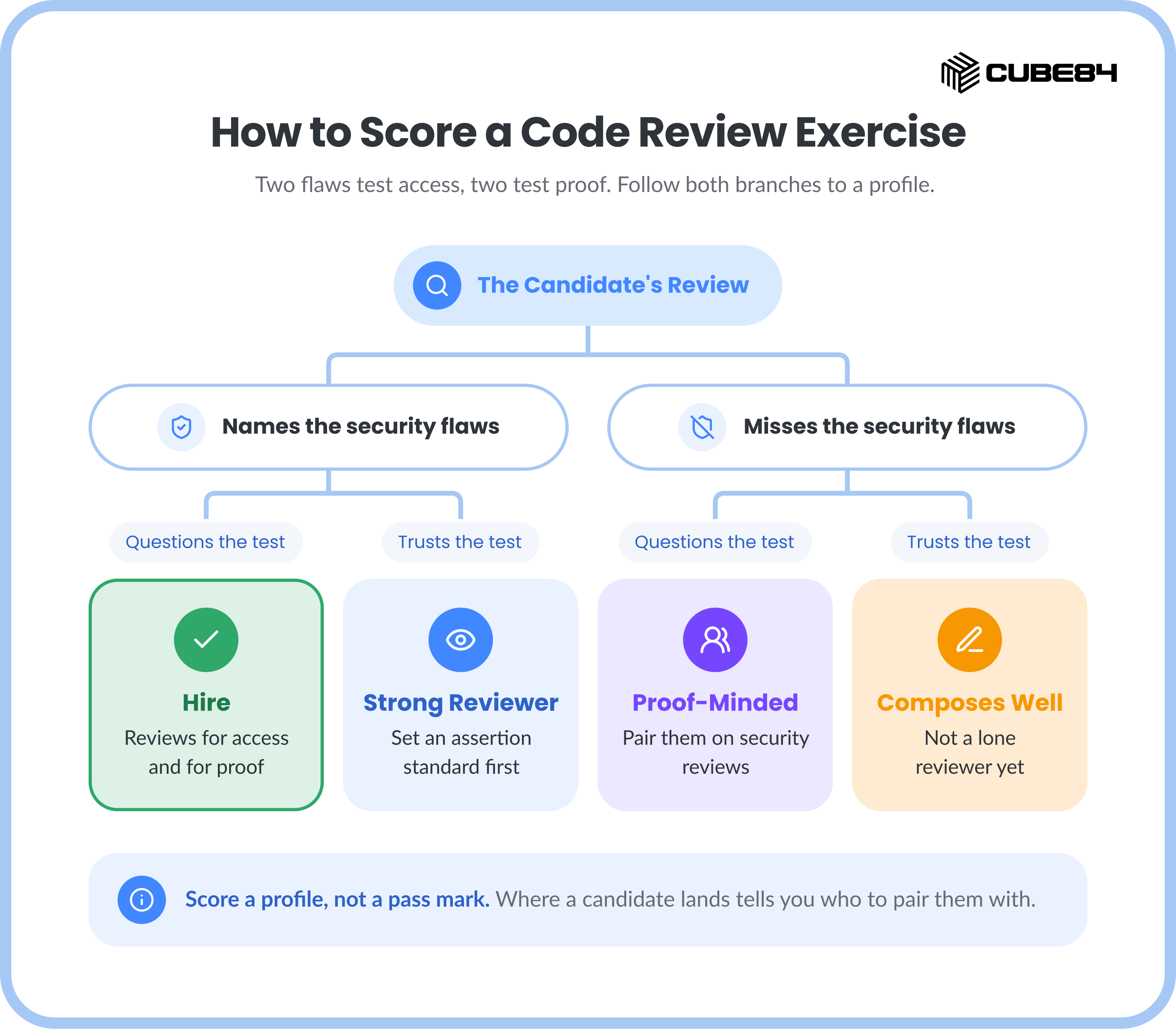
A candidate who asks about record volume before reading a line is thinking about the org rather than the file, and that question is worth more than any single finding. A candidate who rewrites the code instead of reviewing it will struggle on a team where most of the code arrives from somebody else. A candidate who offers the coverage number as evidence that the test works is a blocker for a senior role.
Whatever the profile, write the standard down afterwards. A review exercise finds the gap; a written rule about what you ship and who governs it keeps it from reopening on the third sprint.
Hire the Reviewer
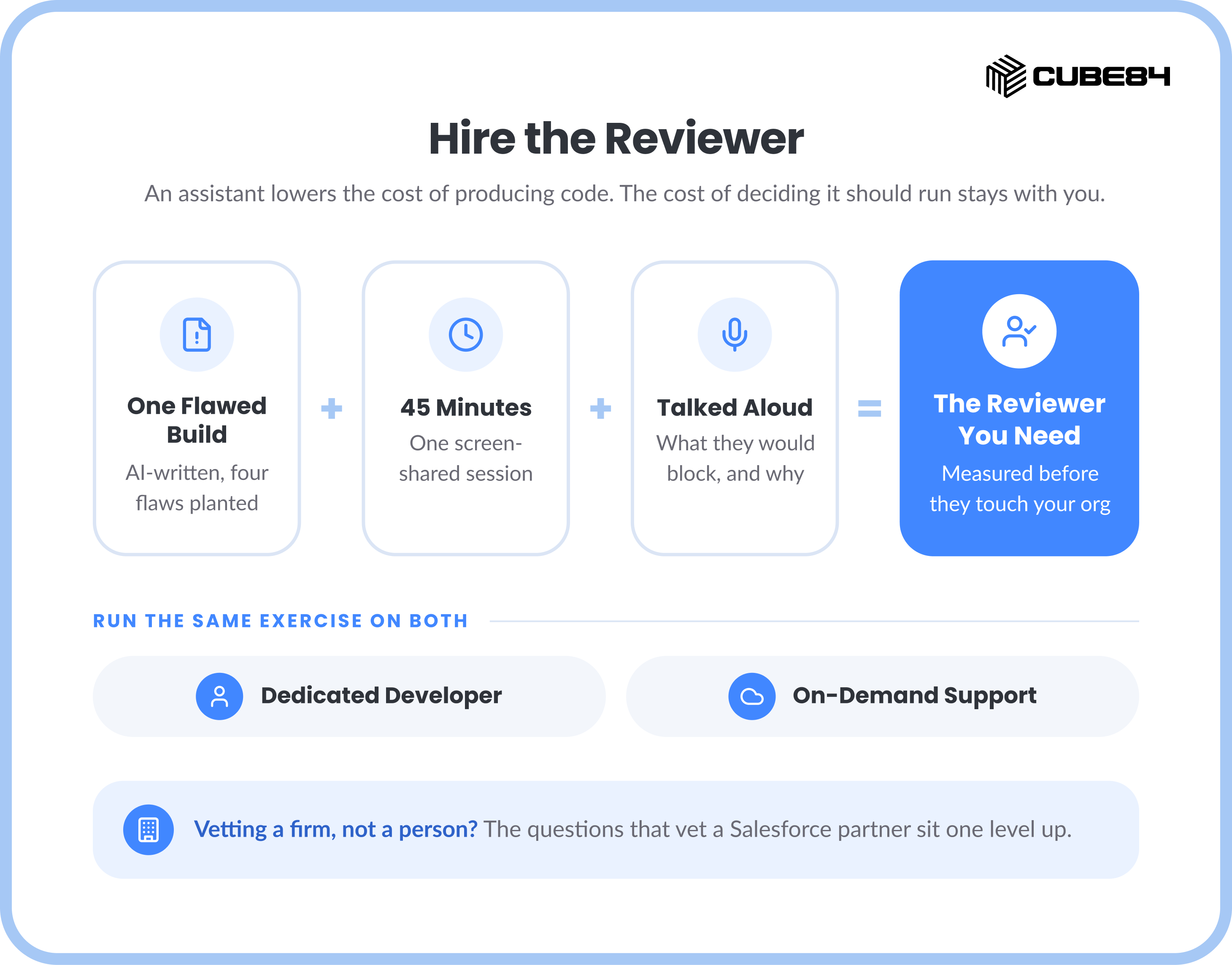
An assistant lowers the cost of producing Salesforce code and leaves the cost of deciding whether that code should run. The second cost lands on your org, your sharing model and your nightly load, and an interview can still measure it directly. One flawed build, forty-five minutes, and a candidate talking through what they would block.
If you are choosing between a dedicated developer and on-demand support, run the same exercise on both. The engagement model changes who carries the work. The skill you are testing for stays the same. And if the decision is about a firm rather than a person, the questions that vet a Salesforce partner sit one level up and run alongside it.
Outbound Links
The following external sources were referenced in or are relevant to this blog. These links are available for outreach.
Salesforce Trailhead, Get Started with Apex Unit Tests — Salesforce's own statement that at least 75% of Apex code must be covered by passing tests before deployment; the source for the coverage rule in The Four Flaws Worth Planting.
Salesforce Ben, How to Safely Deploy AI-Written Code in Salesforce — June 12, 2026, by a Gearset technical author; finds AI-written unit tests tend to stop at happy paths, which is the flaw the planted test class tests for.