

Introduction
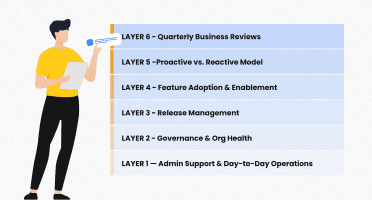
You’re familiar with Salesforce, which means you’re most probably familiar with Salesforce Managed Services too. If you aren’t, then in simple terms, Managed Services is essentially outsourcing your ongoing Salesforce support to an expert team. Think of it as long term maintenance for your Salesforce environment.
You get a team that works like an extension of your own, helping you with all the support, such as continuously improving your setup, managing releases, filling skill gaps, and guiding you on how to use Salesforce more effectively.
Let’s say you are a CIO or a team lead and you know your team needs Managed Services. You are trying to find the right one among a sea of providers. You have already sat through too many demo calls and polished pitches that all claim to be the bestMost people who look for Managed Services are not usually Salesforce experts, so it is natural to feel unsure about who is actually skilled.
It is not easy to tell whether a service provider understands Salesforce until you have already invested time and money. So the question is, how should you choose?
This is where certifications and badges help. They act as a fast screening tool. They do not guarantee excellence, but they help you filter partners who meet a verified minimum skill level.
What do Salesforce Certifications represent?
Certifications are proof of skill, and companies like Salesforce, HubSpot, and Pardot issue them to individuals who complete their training and pass the required assessments.
When you are evaluating an MSP for Salesforce, it is best to look for certifications issued by Salesforce itself, since these act as direct validation of the provider's capability and credibility. |
Analysts and Salesforce experts have consistently shown that certified consultants deliver faster implementations, reduce errors, and create long-term ROI.
Individual certifications vs. partner-level badges
Salesforce looks at skills on two levels, and both matter when you’re choosing an MSP.
1. Individual Certifications
2. Partner level Badges
Salesforce Certifications and what they mean
Associate or Foundation Certificates :
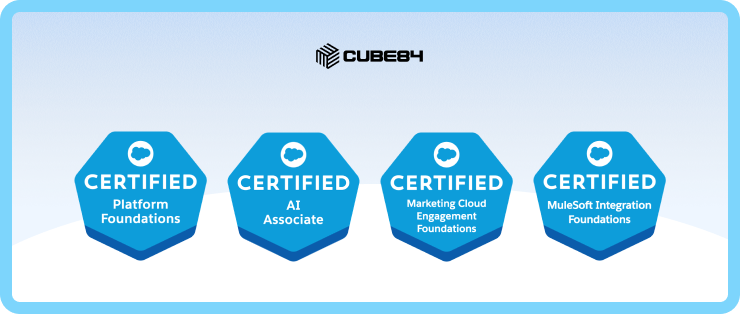
As the name suggests, these are entry level credentials meant for beginners who are new to Salesforce and want to step into the ecosystem.
They do not represent or require technical expertise. They cover fundamental concepts and basic platform understanding.
• Platform Foundations Associate : basic understanding of Salesforce data, setup, reporting, and core platform features.
• AI Associate :foundational knowledge of AI concepts and how AI is applied safely inside Salesforce.
• Marketing Cloud Engagement Foundations : beginner level understanding of marketing automation concepts inside Marketing Cloud.
• MuleSoft Integration Foundations : basic awareness of APIs, integrations, and how systems connect through MuleSoft.
Why this matters:
They show that a consultant understands the basics and is serious about entering the Salesforce ecosystem. They help you identify beginners who have taken the right first step and are building a strong foundation before moving into more technical roles.
Admin and Specialist Certifications:
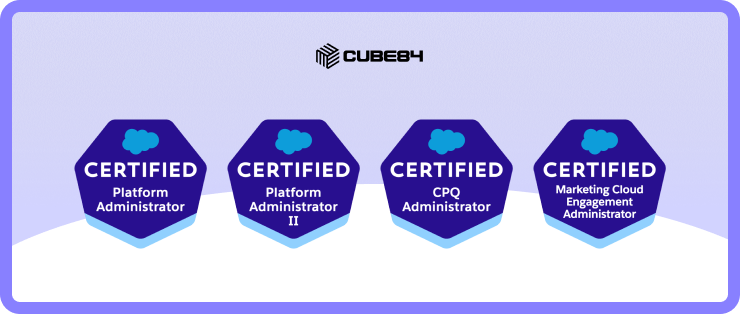
Administrators are the backbone and the day to day caretakers of Salesforce. They create and manage users, maintain data quality, configure the system, test changes, and make sure the org stays stable after every update.
• Platform Administrator : manages users, security, data, automation, and core org setup.
• Platform Administrator II : handles complex configuration, advanced automation, and scalable security models.
• CPQ Administrator: manages pricing, product rules, quote configuration, and CPQ setup.
• Marketing Cloud Engagement Administrator : manages Marketing Cloud setup, data, permissions, and configuration.
Why this matters:
Admins keep the system organized, secure, and running smoothly. This daily hygiene prevents bigger issues down the road.
Consultant Certifications:
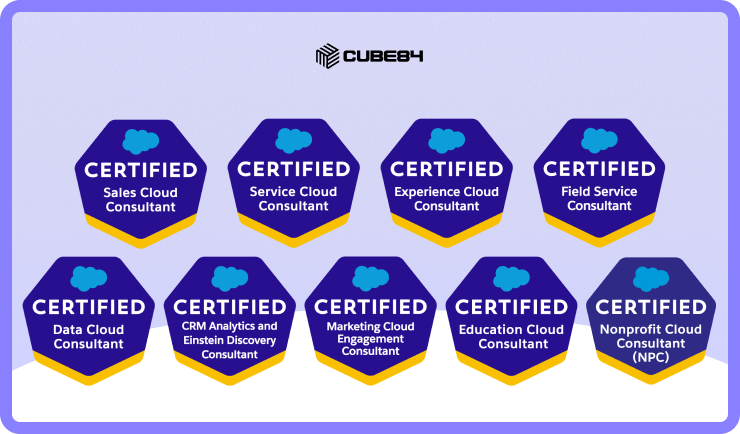
These people act like the bridge, translating tech and business. They understand how your departments work together, then recommend the Salesforce features that best fit your structure and workflows. They help refine the idea, shape the solution, and guide you through execution.
• Sales Cloud Consultant : ability to design and implement solutions using Sales Cloud to improve sales processes.
• Service Cloud Consultant : Capable of deploying Service Cloud functionalities for improved customer service and support.
• Experience Cloud Consultant : Proficient in creating and managing Experience Cloud portals and communities or digital-experience sites using Experience Cloud tailored to customer or partner needs.
• Field Service Consultant : expertise in designing and configuring field-service operations
• Data Cloud Consultant : ability to implement enterprise-level data solutions, data modeling and integrations using Data Cloud.
• CRM Analytics and Einstein Discovery Consultant : Capable of building analytics dashboards and AI-driven insights using CRM Analytics / Einstein tools for data-driven decision making.
• Marketing Cloud Engagement Consultant : designs the overall marketing automation setup so journeys, data and messaging work together to support business goals.
• Education Cloud Consultant : Specialized for educational institutions: validates skill in implementing Salesforce solutions tailored to education-sector use cases.
• Nonprofit Cloud Consultant : Focused on nonprofit organizations: validates ability to implement and adapt Salesforce solutions for nonprofit workflows and needs.
Why this matters:
Certified consultants shape Salesforce around your business so the system supports how you work, not the other way around.
Architecture & Platform Certifications:
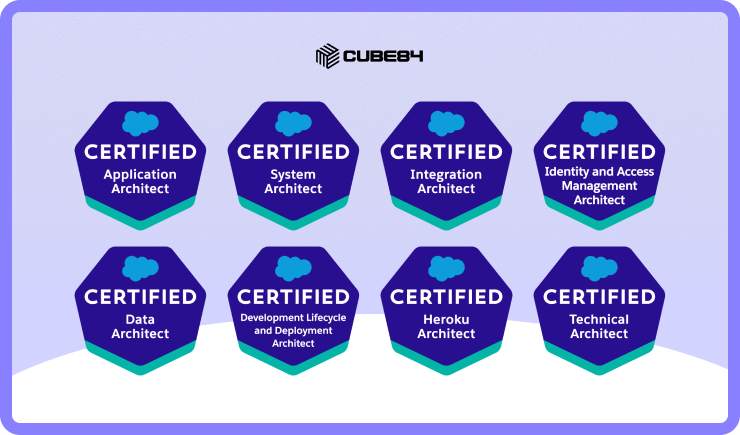
These team members design the overall system and make sure every feature works together in a stable and scalable way. They shape the data model, plan integrations, and guide long term structure.
•Application Architect : designs how data, security, automation and apps fit together inside Salesforce.
• System Architect : focuses on integrations, scalability, identity and system level structure.
• Integration Architect, plans how Salesforce connects with other systems and manages data movement.
• Identity and Access Management Architect : sets up secure access, authentication and user identity across systems.
• Data Architect : designs data models, storage, sharing, and data governance for large or complex orgs.
• Development Lifecycle and Deployment Architect : manages release strategy, DevOps processes and environment structure.
• Heroku Architect : plans and manages apps and experiences built on Heroku that extend Salesforce.
• Technical Architect : leads the overall end to end architecture for complex environments and makes the highest level design decisions.
To earn CTA, professionals must complete both the Application Architect and System Architect paths, then clear a rigorous board review.
Why this matters:
Architect level skills help prevent structural issues, reduce rework, and keep your system ready for future growth.
Developer Certifications:
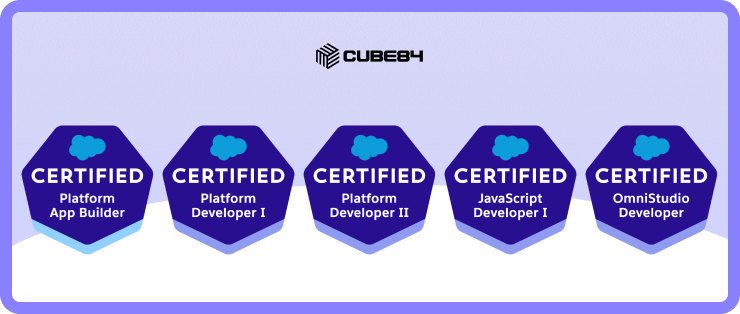
These team members build the actual functionality inside Salesforce. App Builders create custom apps using clicks, objects, flows, and UI tools. Developers write code, build custom components, solve complex logic, and create features that cannot be handled with clicks alone.
• Platform App Builder: builds custom apps with declarative tools like objects, flows, and UI configuration.
• Platform Developer I: develops business logic with Apex and builds custom components using Lightning.
• Platform Developer II: handles advanced Apex, complex integrations, and scalable custom development patterns.
• JavaScript Developer I: proves strong front end skills for Lightning Web Components and custom UI work.
• OmniStudio Developer: builds guided flows, data tools, and digital interactions using OmniStudio components.
Why this matters:
These people build reliable, scalable Salesforce features that run smoothly now and grow with your business without breaking.
Designer Certifications :
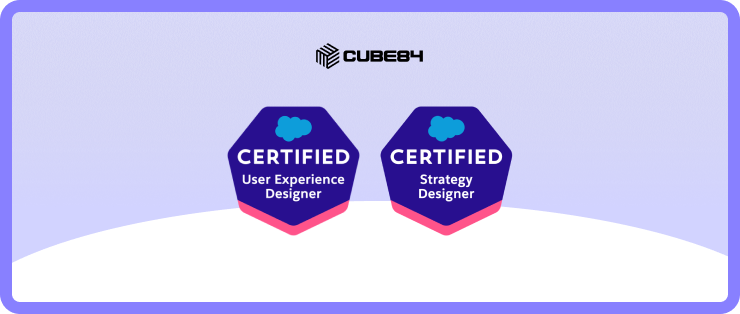
These professionals focus on creating user-friendly Salesforce experiences by designing how information is presented and simplifying complex ideas for real users. Their goal is to ensure apps are simple, accessible, and easy to adopt across teams while aligning with business goals.
• User Experience Designer : improves layouts, navigation, screens and interactions so users work faster with fewer clicks.
• Strategy Designer : shapes the overall experience strategy, aligns workflows with business goals and removes friction from processes.
Why this matters:
Good design makes the experience easy, which helps your users navigate and engage more naturally with your process.
Marketing Certifications :
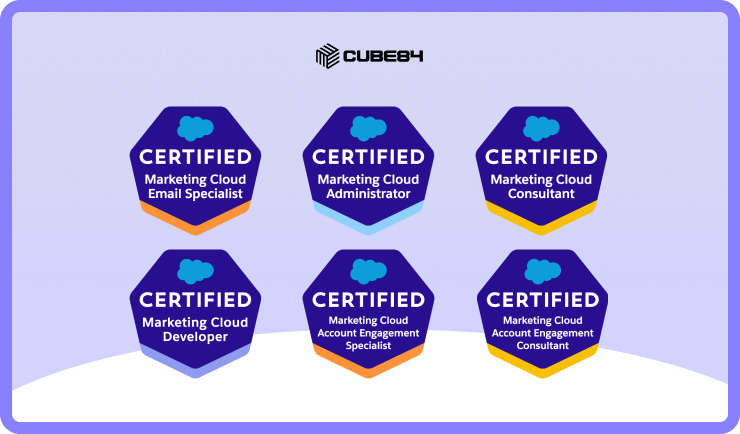
These are the people who set up campaigns inside your marketing cloud. They segment audiences, personalize emails, SMS, and push messages, automate customer journeys, analyze performance data, and optimize engagement across channels to drive leads and retention.
• Marketing Cloud Email Specialist
Shows skill in email marketing basics, subscriber data, and strong send practices.
• Marketing Cloud Engagement Administrator
Covers setup, configuration, data structure, and platform management.
• Marketing Cloud Engagement Consultant
Designs and implements multi channel marketing journeys for business needs.
• Marketing Cloud Engagement Developer
Builds custom scripts, integrations, and advanced technical configurations.
• Marketing Cloud Account Engagement Specialist
Validates core Pardot skills like automation, segmentation, and lead workflows.
• Marketing Cloud Account Engagement Consultant
Implements Pardot for businesses, aligning workflows with marketing goals.
Why this matters:
Strong marketing and data skills help your business make strategic decisions by creating campaigns that reach the right audience, track the right metrics, and turn marketing spend into measurable revenue impact.
Specialty/Product-Focused & Emerging Tech Certifications:
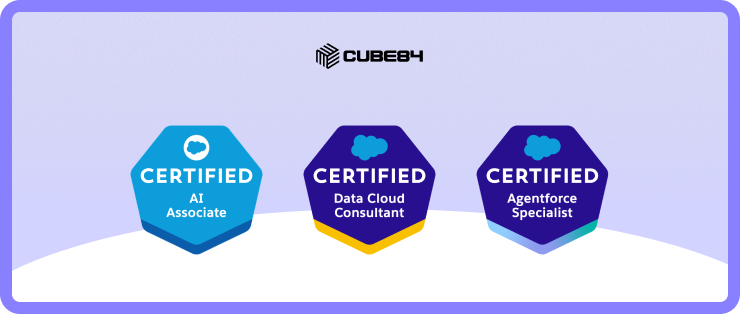
AI Associate : Shows foundational understanding of Salesforce AI features, prompt use, and responsible AI practices.
Data Cloud Consultant : Covers how to unify customer data, set up data models, connect sources, and activate insights across channels.
Agentforce Specialist : Focuses on using Agentforce tools to build AI powered service experiences that boost agent productivity and automate support tasks.
Why this matters:
These credentials show that your MSP stays current with modern Salesforce needs, using AI and data to improve efficiency, personalization, and overall business results.
In another case, a nonprofit client evaluating a move from NPSP to Nonprofit Cloud faced uncertainty around data model changes, licensing implications, and future scalability. A Nonprofit Cloud certified leader at CUBE84 guided the client through the decision by mapping their real-world workflows to Salesforce’s evolving nonprofit architecture which is only possible when consultants stay deeply aligned with Salesforce’s latest product direction. This is where certifications truly matter. They shorten the path from problem to solution, reduce risk, and allow our leaders to make informed decisions that directly improve client outcomes. |
Salesforce groups all consulting and MSP partners into four main tiers: Base, Ridge, Crest, and Summit |
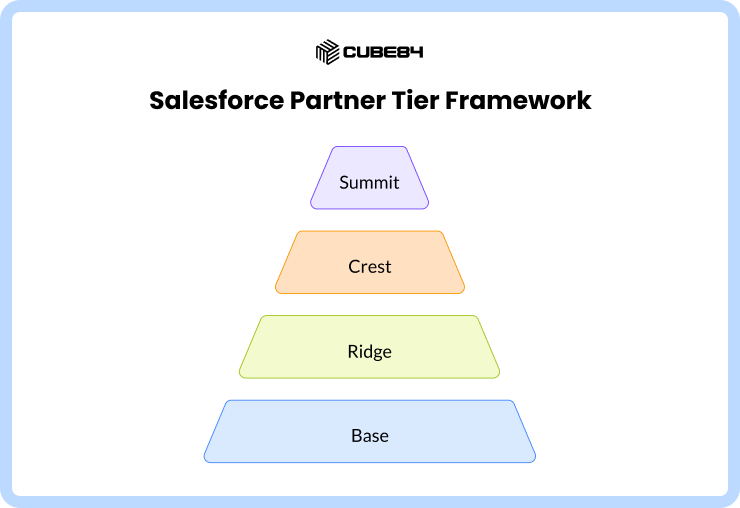
Base: Entry level. The partner has joined the program and has basic alignment with Salesforce.
Ridge: Shows growing experience and more consistent engagement with Salesforce.
Crest: Indicates strong experience, more certified people, and a solid track record.
Summit: The top tier. Reserved for partners that show high levels of expertise, strong customer results, and consistent success across projects.
These tiers are not decided by marketing claims. Salesforce assigns them using a scorecard that evaluates customer success, certified staff, project delivery, and overall growth.
For an MSP, a higher tier (Crest or Summit) generally means: More experience with real implementations Better access to Salesforce resources and guidance A track record that Salesforce itself has reviewed |
What are Navigator Badges and how are they awarded?
Salesforce Navigator badges are a form of partner-level recognition issued by the Salesforce Partner Program to the company as a whole. A partner earns them only when they have delivered consistent, high quality work across Salesforce projects in specific clouds or industry specializations such as Sales Cloud, Nonprofit Cloud or Financial Services Cloud. These badges are designed to show that a partner has real-world expertise, not just theoretical knowledge.
A Navigator badge is awarded when a partner demonstrates two things:
1. Expertise
The partner has a sufficient number of Salesforce certified professionals aligned to that specific cloud or industry specialization.
2. Customer success
They have completed a required number of real customer projects, submitted evidence, and maintained strong CSAT scores.
Once this criteria is met, the partner earns a Navigator badge for that cloud or specialization, such as Marketing Cloud Specialist or Nonprofit Cloud Expert.
Navigator badges also come in levels: Specialist (entry), Cloud Expert (advanced), and Implementation Expert (highest).
Check the FY26 Salesforce Partner Program
Let’s say a partner has completed enough successful Marketing Cloud projects with certified staff and strong CSAT, they earn a Marketing Cloud Specialist badge. To reach Cloud Expert, they need more projects and stronger proof of delivery.
This does not affect overall Partner tiers (Base, Ridge, Crest, Summit). Navigator badges measure specialization and cloud or industry expertise, while partner tiers measure overall firm strength across certifications, project success, growth, and ecosystem engagement.
Navigator badges measure specialization and cloud level expertise. They show what a partner is specifically good at. Partner tiers measure overall firm strength and breadth. They look at certifications, total successful projects across clouds, growth, customer success, and how well the partner engages across the ecosystem. |
Can Individuals earn salesforce badges?
Yes, they can. Just like certificates, individuals can earn badges from Salesforce. But these are different from what an organization earns as a whole. They work more like a digital award that individuals collect as they learn Salesforce skills through hands-on modules and projects. They show practical learning, curiosity, and steady skill building. They are not formal certifications, but they help teams stay current, build confidence with new features, and gain real platform familiarity.
Types of individual badges
Basic Trailhead badges: Show learning of specific topics like data, automation, or security.
Superbadges: Hands-on, project style challenges that test real problem solving skills.
Role based or cloud specific badges: Focus on areas like admin tasks, marketing, or service scenarios.
Skill based badges: Cover new abilities like AI usage, data modeling, or integration basics.
Navigator Badges vs Individual Trailhead Badges
Aspect | Navigator Badges | Individual Trailhead Badges |
Who earns it | Partner companies | Individual learners |
Purpose | Shows proven project delivery, expertise, and customer success in a specific cloud | Shows learning progress and completion of modules or hands-on challenges |
Evaluation | Based on certified staff, number of projects, CSAT, and specialization | Based on completing Trailhead modules and quizzes |
Impact | Signals partner capability to customers | Signals personal skill growth and readiness to take on roles or certifications |
Recognition level | Firm-level achievement | Individual-level achievement |
How Certificates and Badges Help Distinguish MSPs from Salesforce Partners
We understand your thoughts when you are the head of CRM or the CTO and you need to find the right MSP, or when you are worried about the poor performance of your existing service provider and cannot take any chances. This is not a simple choice. It is not like picking a shirt that you can replace if it does not fit. You are accountable for using the budget wisely and making decisions that impact your entire organization.
You are not going to leave any stone unturned to find the right fit. We understand that, and we are here to help you make the right call.
Certificates and badges act as proof of capability. Anyone can claim to be a Salesforce Managed Service Provider, but only a Partner can show certified talent, verified delivery, and cloud specific strength through Navigator badges and Partner Tiers. Certifications prove individual skill, while Navigator badges prove company level performance. Together, they separate basic providers from experienced MSPs who deliver consistent outcomes, lower risk, and improve ROI.
Factor | Basic Salesforce Partner | MSP with Strong Certs and Navigator Badges |
Skill Proof | Limited or unclear | Certified staff with role based expertise |
Project Quality | Not always verified | Proven delivery through Navigator requirements |
Risk Level | Higher uncertainty | Lower due to trained teams and validated methods |
Customer Confidence | Based on claims | Backed by Salesforce-verified results |
Impact on ROI | Hard to measure | Faster delivery, fewer mistakes, better adoption |
Do Salesforce Certificates Expire?
Just like your driver's license or passport, Salesforce certificates come with an expiry date. Salesforce updates its platform three times a year, and because of these constant changes, every certified professional must renew their credential annually by completing a maintenance module on Trailhead. Partner distinctions also expire after their validity period, and if a partner does not re-earn them before they expire, the badge moves into legacy status.
Category | Do They Expire | Key Notes |
Individual Certifications | Yes | • Must be maintained through regular release exams. • Lapse if not kept current. |
Individual Badges (Trailhead badges + Superbadges) | No | • Do not expire. • Show hands on skill, learning progress, and specific capabilities. |
Navigator Badges (Partner level badges) | Yes | • Require ongoing proof of certified staff. • Need active projects, CSAT, and experience points. • Reviewed by Salesforce to stay valid. |
How to verify a partner's certificates and badges
We often meet CRM leaders who ask how they can verify whether a partner truly has the certifications or Navigator badges they claim. It is easy. If you want to check whether an individual consultant holds an active certification, you can use the Salesforce Certification Verification Tool . If you want to validate a partner’s company-level capability, including their Navigator badges and cloud expertise, you can look them up on the Salesforce Partner Finder. These two sources help you confirm everything before you make your decision.
How to evaluate the strength of a certificate and ask the right questions
A certificate is important, yes, but it is also only the starting point, not the full story. When evaluating an MSP or partner, look beyond the badge logo and understand the depth behind it. Strong teams know that theory and practice go together. They pair certifications with real project experience, cross cloud expertise, consistent CSAT scores, and a proven ability to solve problems that match your business needs. The goal is to see whether the certified talent can apply their skills in real situations, work well with your team, and deliver outcomes you can trust.
So, here is a quick checklist of questions you can ask your MSPs:
1. How many certified people will actually work on my account?
(Helps you avoid partners who showcase certificates but assign junior staff, so ask for names and cross verify their certs.)
2. How recent are their certifications and maintenance updates?
(Shows whether the team stays current with Salesforce releases.)
3. Can you share real project examples related to my use case?
(Validates hands on experience instead of surface level knowledge.)
4. Do your consultants hold Superbadges or advanced role based certs?
(Signals deeper problem solving capability.)
5. What Navigator badges does your company hold in the clouds I use?
(Confirms proven delivery experience, CSAT performance, and ongoing capability.)
6. How do you ensure certified talent stays involved throughout the engagement?
(Reveals delivery structure and quality control.)
7. What is your CSAT score and how often is it updated?
(Backed by Salesforce, this shows how satisfied other clients are.)
What changes can a good certified MSP bring to your Organisation?
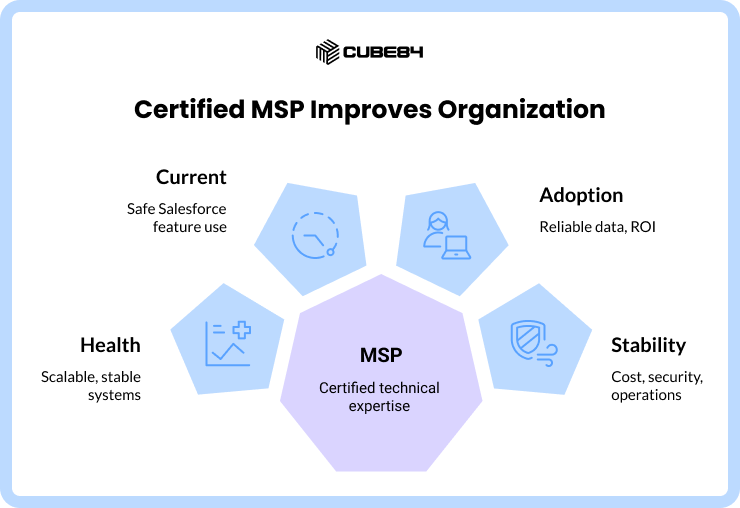
1. Technical Health, Scalability, and Long Term Stability
Many internal or uncertified teams think about managed services only after a problem has occurred. This reactive approach is what creates most of the confusion you see in orgs. It leads to messy configurations, inconsistent workflows, and long term technical debt that slows the system down.
With a certified MSP you can expect:
• Governance and best practices guided by certified architects
• Cleaner workflows, fewer bugs, and faster system performance
• Lower long term cost because you avoid rebuilds and repeated fixes
2. Staying Current and Using New Salesforce Features Safely
Salesforce releases happen three times a year, and most internal teams struggle to keep up. This results in missed capabilities and outdated configurations.
With a certified MSP you can expect:
• Faster and safer adoption of new AI and automation features
• Immediate use of relevant release updates that improve your org
• A modern, efficient CRM that stays competitive
3. Adoption, Performance, and Real Business Value
When systems are not designed well, users avoid them, data becomes unreliable, and ROI drops. This usually happens when solutions are built without a clear understanding of business processes.
With a certified MSP you can expect:
• User friendly workflows that match how your teams actually work
• Better adoption, higher data quality, and stronger day to day efficiency
• Faster time to value because the platform supports real business needs
4. Cost, Security, and Operational Stability
Recruiting, training, and retaining Salesforce talent is expensive and unpredictable. Uncertified setups also create risks in security, access control, and compliance.
With a certified MSP you can expect:
• Predictable monthly cost with access to certified roles on demand
• Stronger security posture supported by regular system health checks
• Better compliance alignment so your data stays protected
The value of real experience vs certificates
Let’s say you are planning to hire a car driver. You will definitely look for someone with a valid license. But if you travel long distances often, drive through hilly areas, navigate heavy traffic, or deal with rough roads, will a newly licensed driver be enough? The license proves they can drive, but it may not mean they are experienced enough to handle the real situations you face.
It works the same way with Salesforce. You have seen the certifications and the important ones to look for. But what if the service provider earned them recently with very little hands-on experience? Certifications tell you that a consultant knows the platform. Experience tells you whether they can apply that knowledge in real business situations.
A certified MSP that has worked with different industries, team sizes, and technical setups will solve problems faster, make better architectural choices, and prevent issues you may not even see coming. This combination of skill and experience is what brings real value to your org. Certifications and experience are not opposites, they actually support each other.
Conclusion
No organization wants to gamble with its CRM, and you should not have to. Certifications give you a clear way to understand who knows the platform deeply and who can guide you in the right direction.
They show that the people working on your system have invested time, effort, and discipline into staying current. Combined with real experience, they ensure you partner with a team that can deliver.
Your Salesforce environment is a long term asset, and choosing the right MSP is one of the smartest decisions you can make for its future.