For COOs and founders of small and mid-size firms who have read the vibe-coding stories
The story arrives as a forwarded link. A firm cancels its Salesforce contract, builds a CRM with Claude in weeks, and reports a saving large enough to get the leadership team's attention. Somebody asks the obvious question: could we do that?
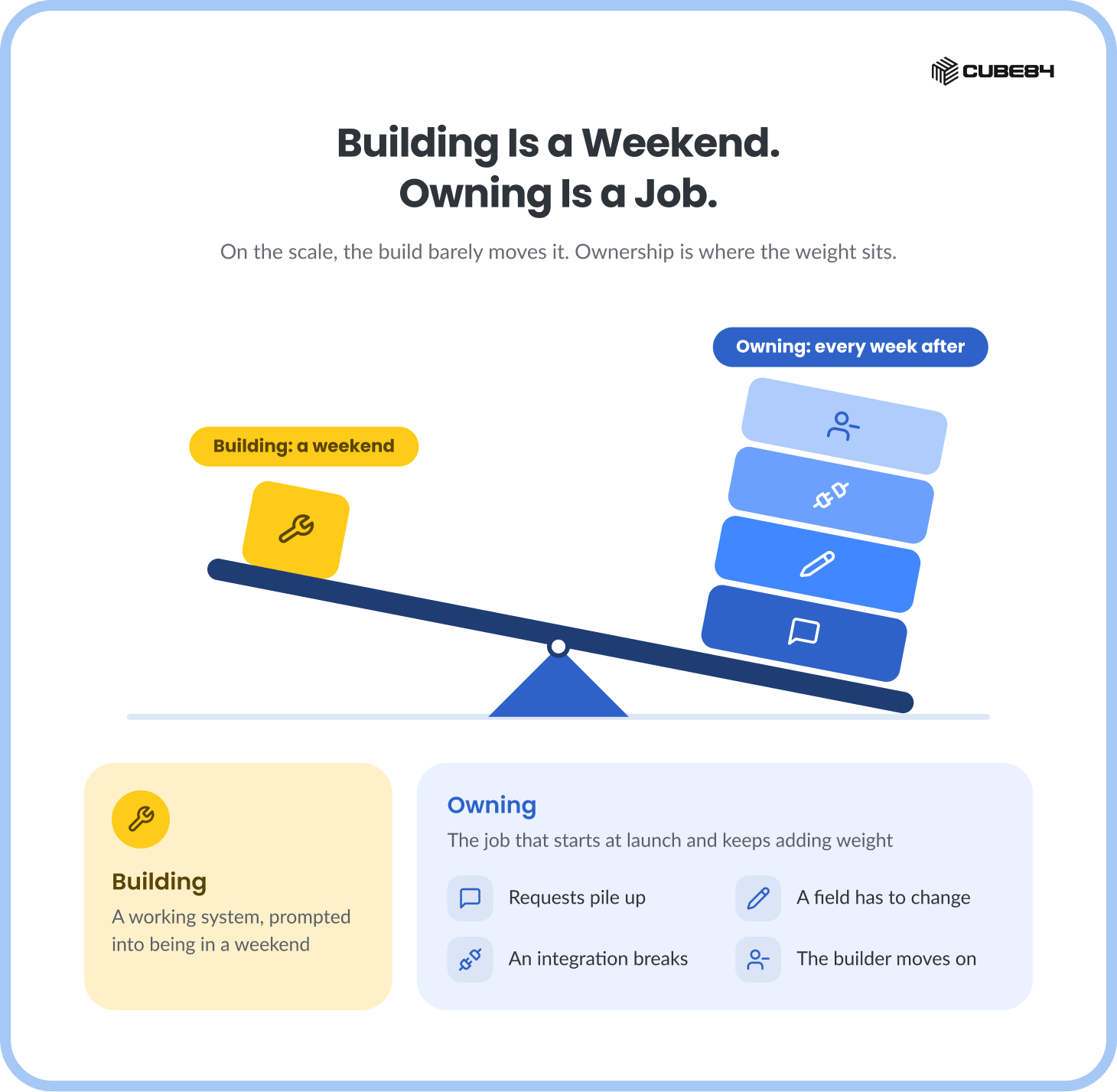
The question carries an assumption, which is that the hard part is the build. The firms that have reported doing it describe working systems in weeks or months. What decides whether the replacement holds is who owns it at month nine, when a field has to change, an integration breaks, and the person who prompted the system into existence has moved on to other work.
Building it is a weekend. Owning it is a job.
For a small team with one committed owner, leaving Salesforce is sometimes the right call. Five conditions tell you whether you are that team, and for everyone else, a third option keeps the system of record in place and changes how people use it.
What the Replacement Stories Actually Show
Start with what Salesforce and its partners say, because much of it is right. Salesforce's own small business blog on vibe coding a CRM lists five risks: accumulated technical debt, fragile data architecture, security and compliance gaps, integration roadblocks, and the lack of official support. When a homegrown workflow breaks in a busy quarter, in the blog's words, “there’s no help desk to call.” Each item on that list is a real cost.
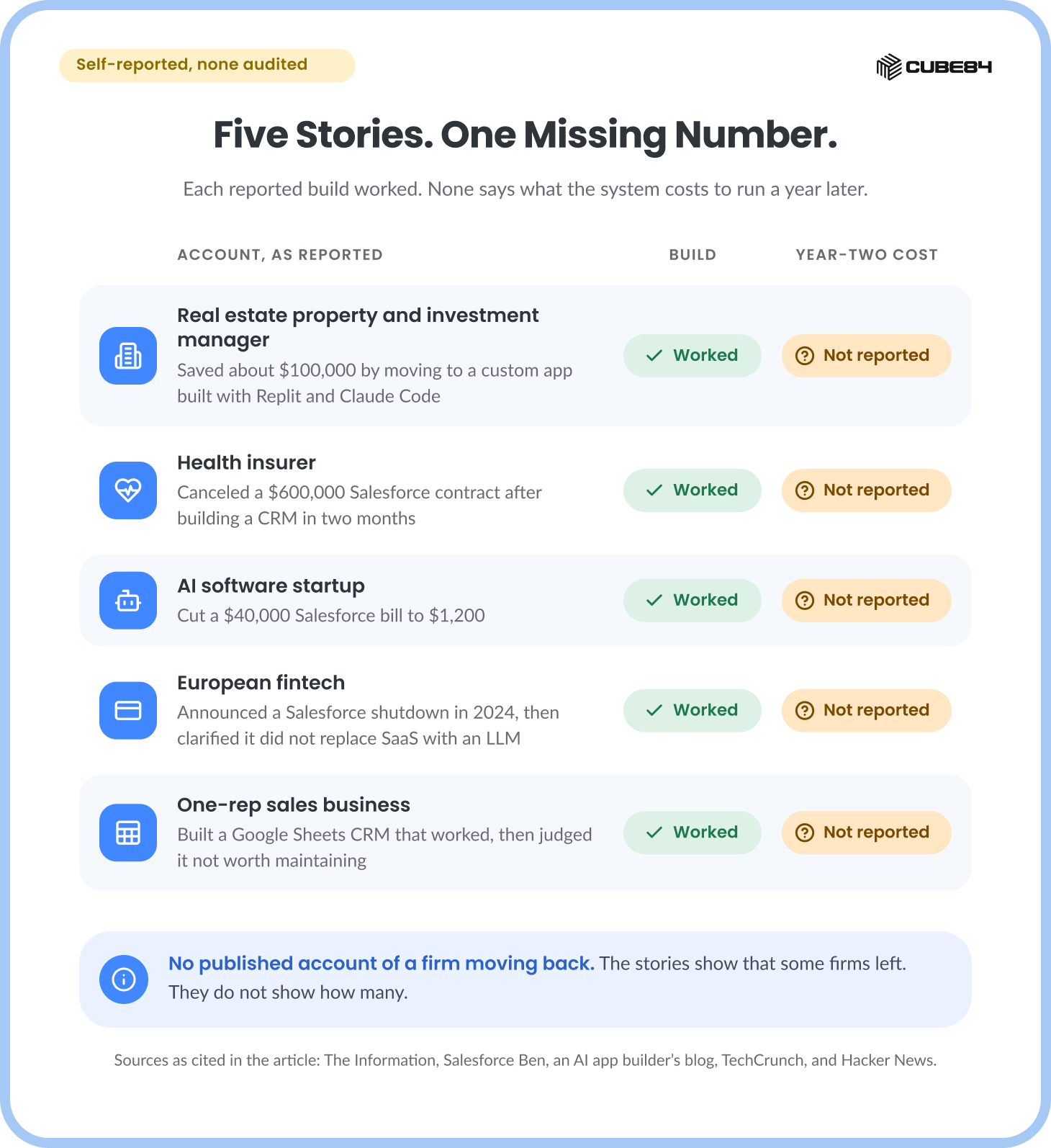
The stories are real too. Below are five public accounts, each described by the type of organization involved. All five are self-reported, and none has been audited.
Five public accounts of replacing a CRM, as reported
Read across the five and a pattern shows. Each reported build worked. None of the five describes what the system costs to run a year later, and the account with the longest public record is the one whose CEO later clarified what had happened. In TechCrunch, the fintech's CEO explained that the company had built an internal stack to bring data from many SaaS tools together, and added: “I don’t think it is the end of Salesforce; might be the opposite.”
The Hacker News commenter asked the month-nine question of their own build. Did the spreadsheet CRM work? “Yes.” Was it worth their time to maintain and scale it with the company, rather than outsource that to a CRM company? “Not at all.” These accounts show that some firms, small ones among them, have left Salesforce. They do not show how many, and we found no published account of a firm that moved back.
The Case for Keeping Salesforce
The strongest argument for staying deserves its full weight. Salesforce is complex because the job is complex. Permissions, audit trails, field history, sharing rules, sandboxes, and a stable API represent years of engineering that a fast build does not reproduce. In the same Hacker News thread, one engineer pointed out that Salesforce “literally has its own query optimizer.” Salesforce Ben reported that Anthropic, the company that makes Claude, is hiring Salesforce developers.
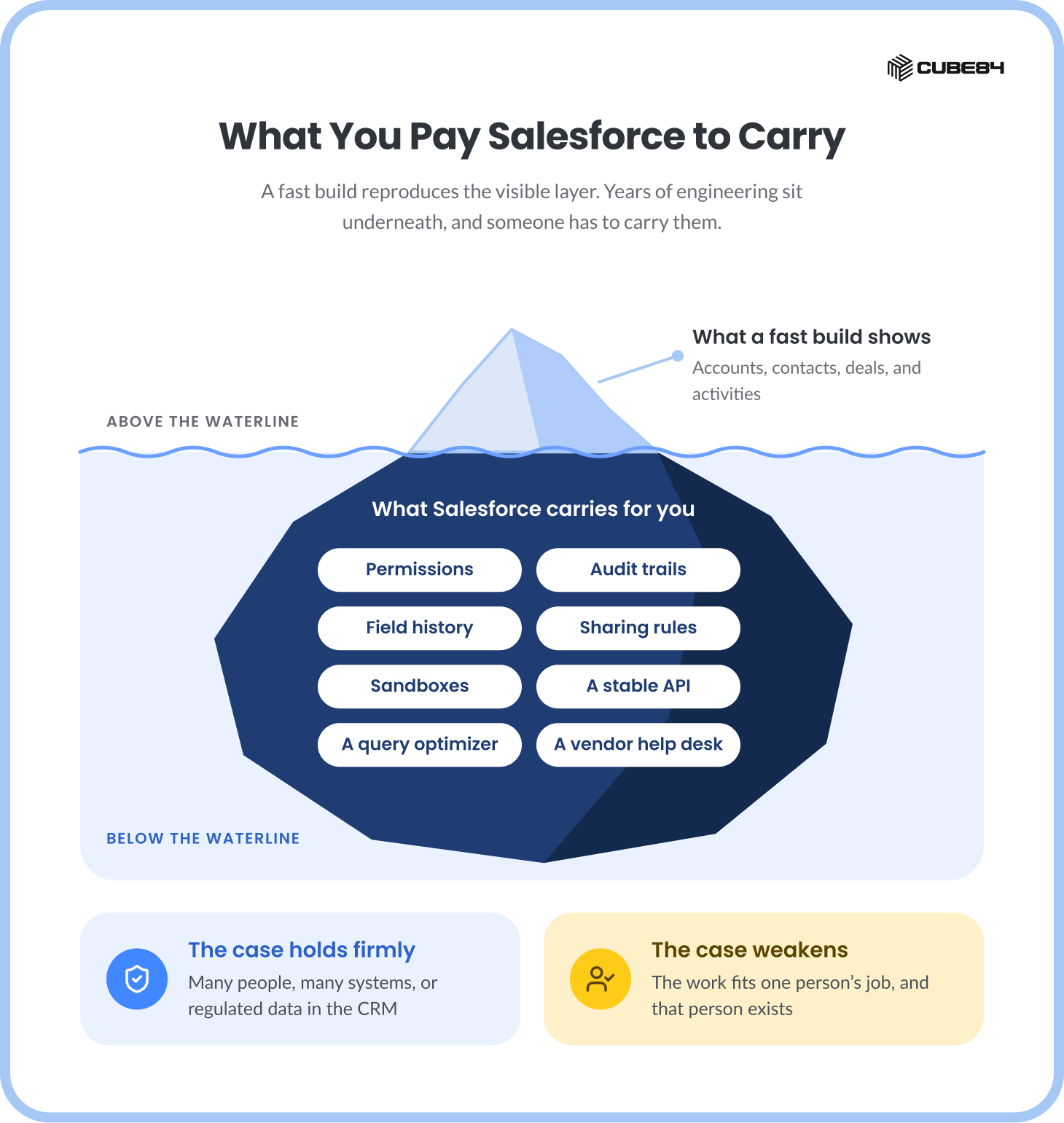
Every point in that case is about who carries the work. A permission model, a query optimizer, and a vendor help desk are what you pay Salesforce for, so that nobody on your team has to carry them. The case holds firmly for any firm whose CRM touches many people, many systems, or regulated data.
It weakens in one situation: when the work is small enough to be one person’s job, and that person exists. The commenter who replied to the query optimizer point made the scale argument directly: an optimizer “only matters once you have an established business with large customers.” At that size, the help desk is a named colleague, and the decision becomes whether to pay for that person’s time or for licenses.
Five Conditions for Leaving Salesforce
Leaving makes sense only when all five of these hold. Each is a question about who carries the work after launch.
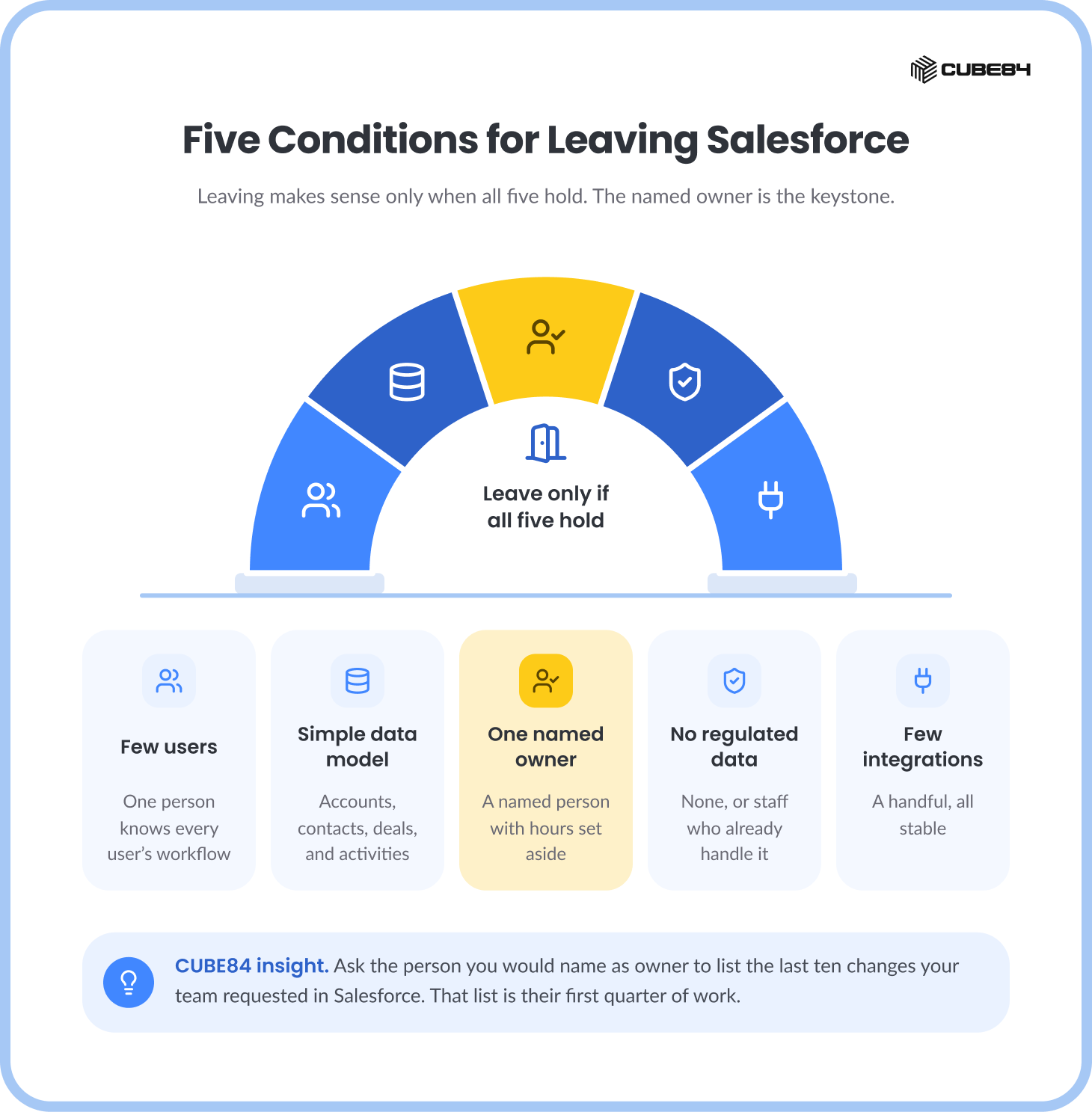
Few users. The team is small enough that one person knows how every user works the pipeline. Once that stops being true, change requests arrive faster than one owner can answer them.
A simple data model. Accounts, contacts, deals, and activities, with little beyond them. Each custom object is something the owner has to understand, migrate, and keep consistent.
One named owner. A person, by name, who agrees to maintain the system and has hours in their week to do it, at month nine as well as at launch. The other four conditions depend on this one. Our Salesforce TCO guide argues that Salesforce is budgeted as CapEx but functions as OpEx, and a homegrown CRM behaves the same way. The license line falls to zero, and the owner’s time becomes the line that grows. Put it in the comparison before you cancel anything.
No regulated data, or the staff to handle it. An organization with its own security and engineering people can take on compliance work. A firm whose CRM owner is an operations manager would be taking it on alone, and security is where Salesforce’s warnings land hardest.
Few integrations. Each connection to email, billing, or marketing tools is code the owner now maintains, and every upstream API change becomes their problem.
The five-condition test
Claude on Top of Salesforce
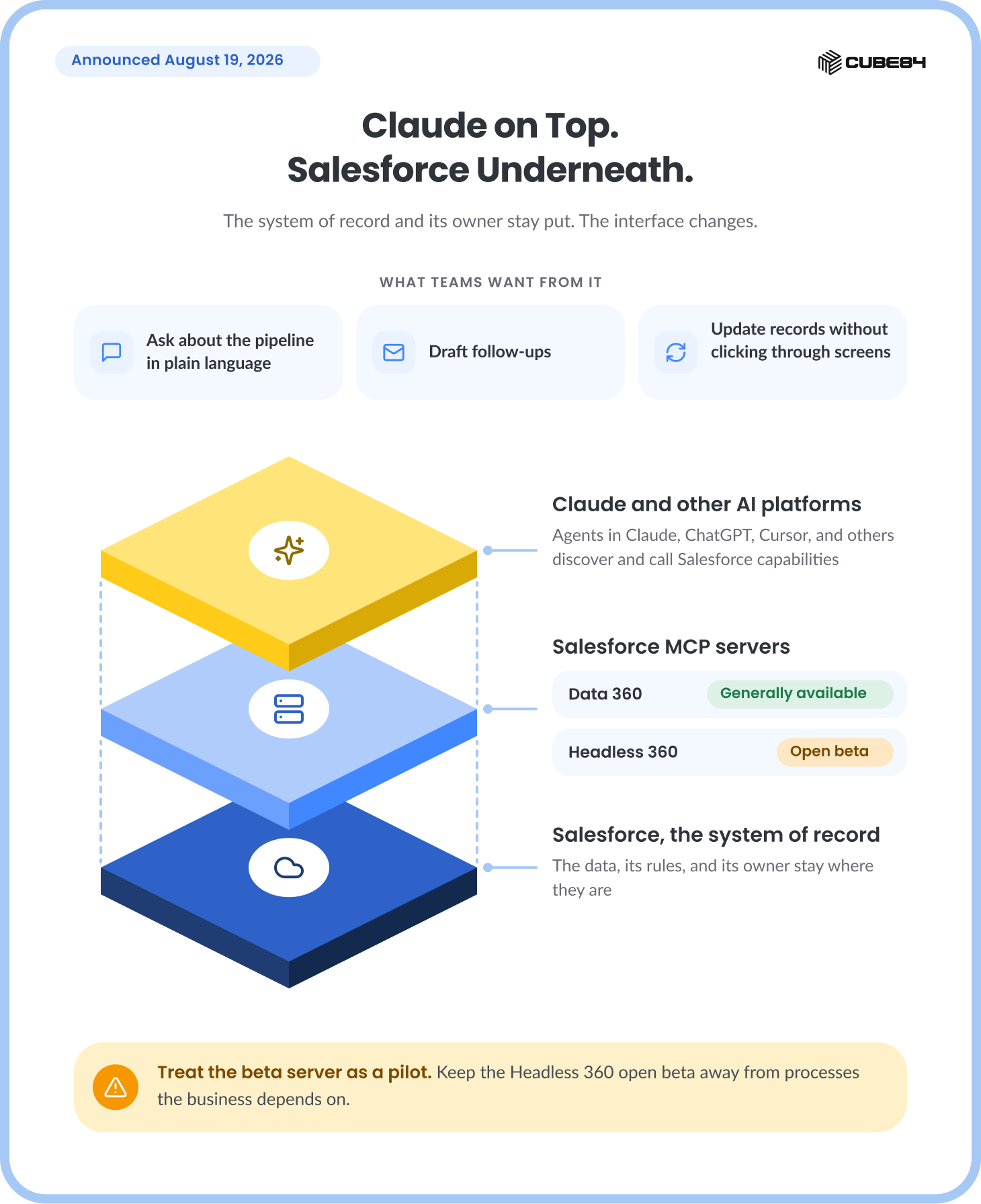
Firms that fail the test still want what the stories promised: plain-language questions about the pipeline, drafted follow-ups, and records updated without clicking through screens. Salesforce has begun making that possible without leaving. On August 19, 2026, Salesforce announced that agents running in Claude, ChatGPT, Cursor, and other AI platforms can discover and call Salesforce capabilities through its MCP servers. In that announcement the Data 360 MCP Server was generally available, and the Headless 360 MCP Server, which fronts the wider platform, was in open beta. Treat the beta server as a pilot and keep it away from processes the business depends on.
This path keeps the system of record and its owner where they are, and changes the interface. It also keeps you honest about why the CRM disappoints. If the real gap is missing decision rules, a new front end inherits it, which is the feature trap our piece on CRM strategy versus tools describes. And if Claude surfaces a need for new code, the configure, buy, or build discipline in our guide to custom Salesforce development still applies.
Put the test and this option together and four outcomes follow. A firm that passes all five conditions can leave, once the owner’s time is in the budget. A firm that fails only on the owner should wait, because a build without one is the case the spreadsheet builder judged not worth the time. A firm that fails on integrations, regulated data, or scale should stay and pilot Claude on Salesforce. And a firm whose real complaint is the bill has a licensing and usage question, which a TCO model answers faster than a rebuild.
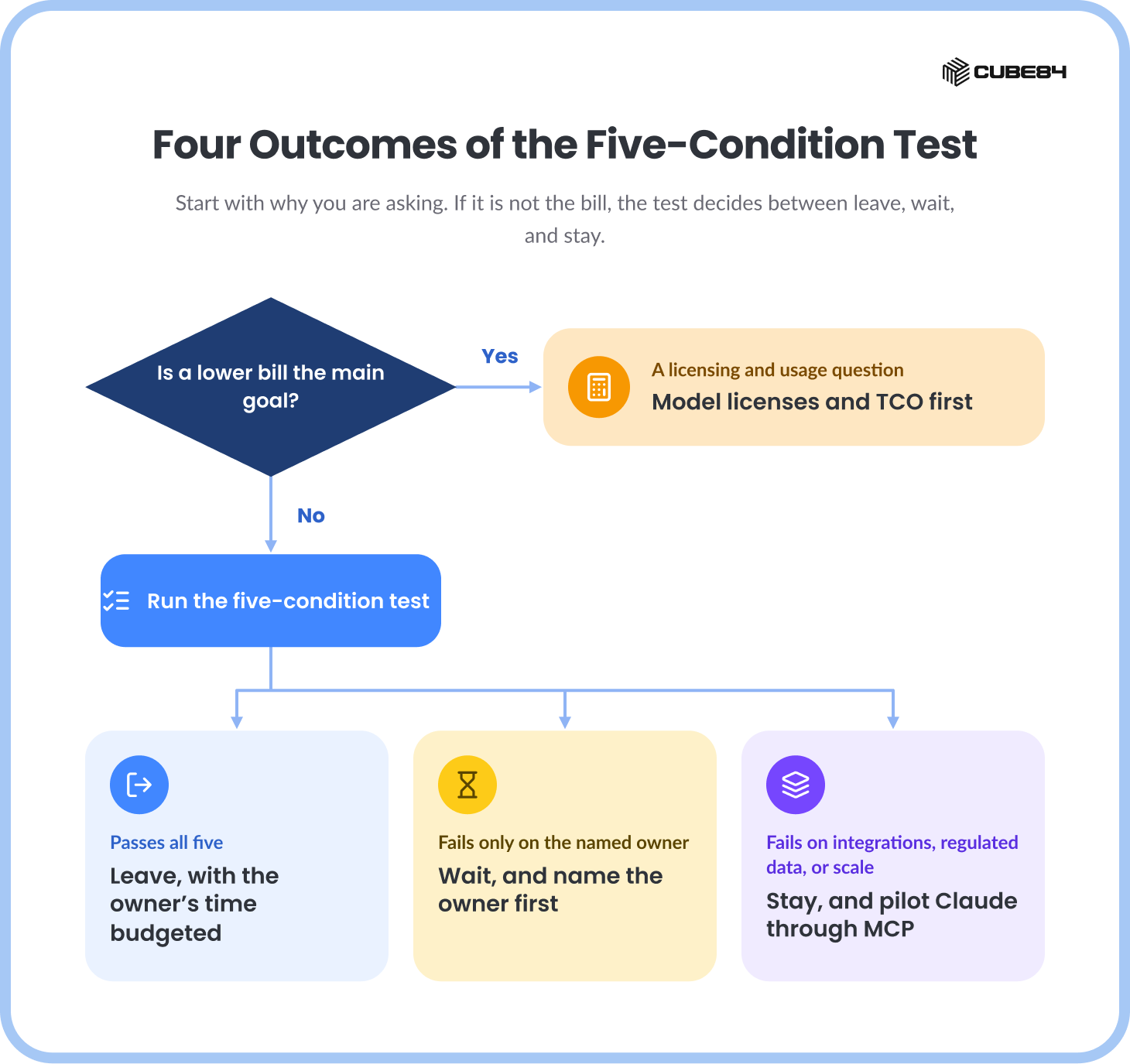
Four outcomes of the five-condition test. The HTML preview draws this as a decision chart.
Name the Owner Before You Cancel
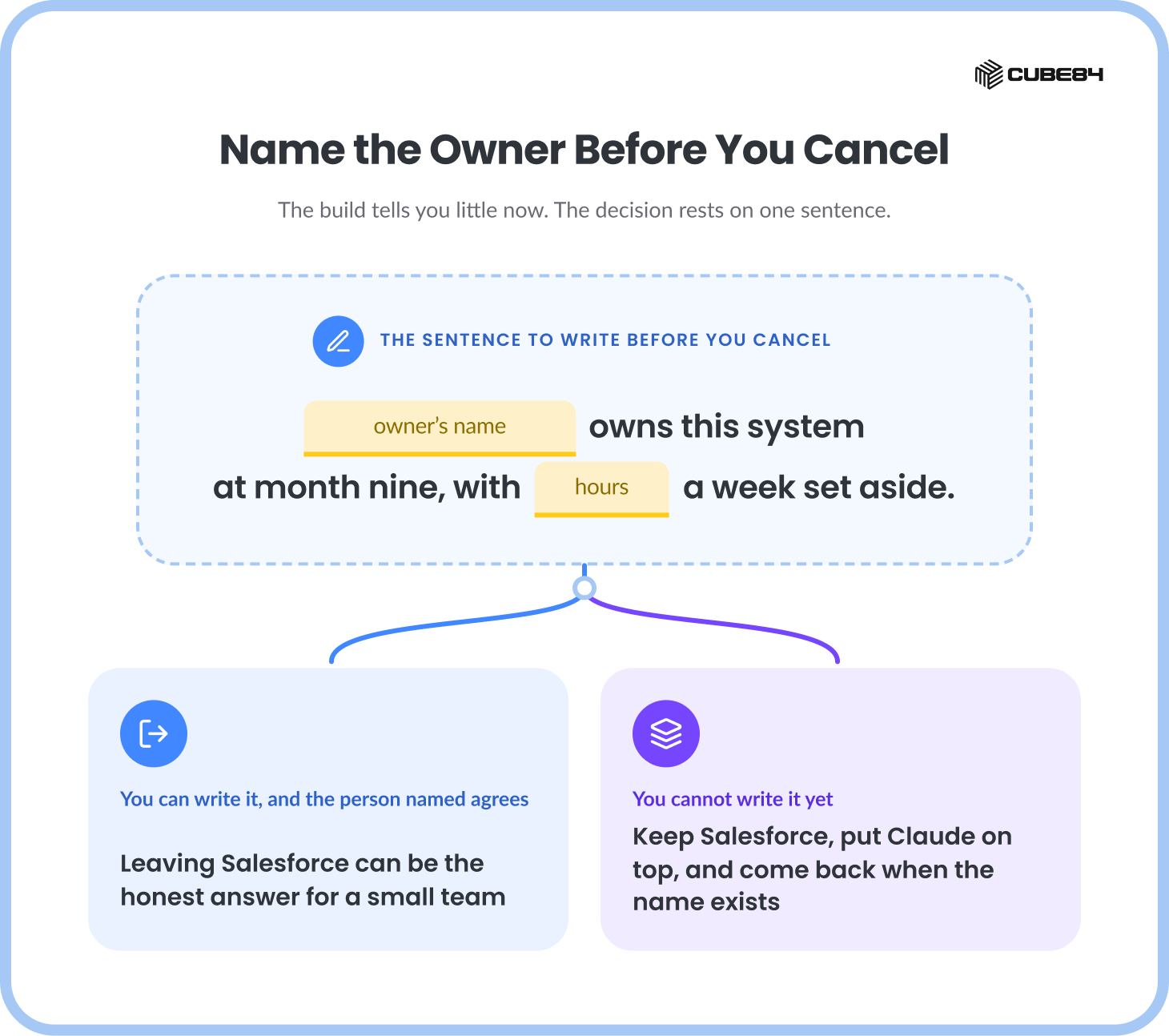
Building a CRM with Claude is now easy enough that the build tells you very little. The decision rests on one sentence you can either write or not: the name of the person who will own this system at month nine, and the hours they will give it.
If you can write that sentence, and the person named agrees with it, leaving Salesforce can be the honest answer for a small team. If you cannot, keep Salesforce, put Claude on top of it, and come back to the question when the name exists.
Outbound Links
The following external sources were referenced in or are relevant to this blog. These links are available for outreach.
Salesforce Ben: Salesforce SMB Customers Switch to Vibe-Coded CRMs (July 7, 2026). Relays The Information's reporting on small firms replacing Salesforce with AI-built apps, including the real estate manager's reported saving.
Salesforce Ben: Why Vibe-Coded CRMs Are Not the End of Salesforce (July 27, 2026). The health insurer and AI startup accounts, Salesforce's warnings, and the report that Anthropic is hiring Salesforce developers.
TechCrunch: CEO doubts that other companies will replace Salesforce with AI (March 4, 2025). The fintech CEO's own clarification that the company did not replace SaaS with an LLM.
Hacker News: comment thread on building a CRM in Google Sheets (February 2026). Practitioner comments on maintaining a homegrown CRM, and on Salesforce's complexity.
Salesforce Newsroom: Expanding Headless 360 Enterprise Capabilities (August 19, 2026). Release status of the Data 360 and Headless 360 MCP servers, and Claude named among supported agent platforms.
Salesforce Blog: Thinking of Vibe Coding Your CRM? Here's The True Cost (March 30, 2026). Salesforce's own list of five risks in vibe-coding a CRM.