
For the CFO or COO approving Salesforce staffing spend.
A Salesforce staffing decision can reach finance as a row of hourly rates. Three quotes arrive, someone lines them up, and the lowest number looks like the saving. The assumption underneath is simple: the rate is the price.
Then someone checks the market and finds rate tables that disagree, sometimes on a single page. One rate page puts a US mid-level Salesforce developer at $85 to $135 an hour as a freelancer, and at $165 to $275 an hour through an agency, per SecondTalent. Same seat, same page.
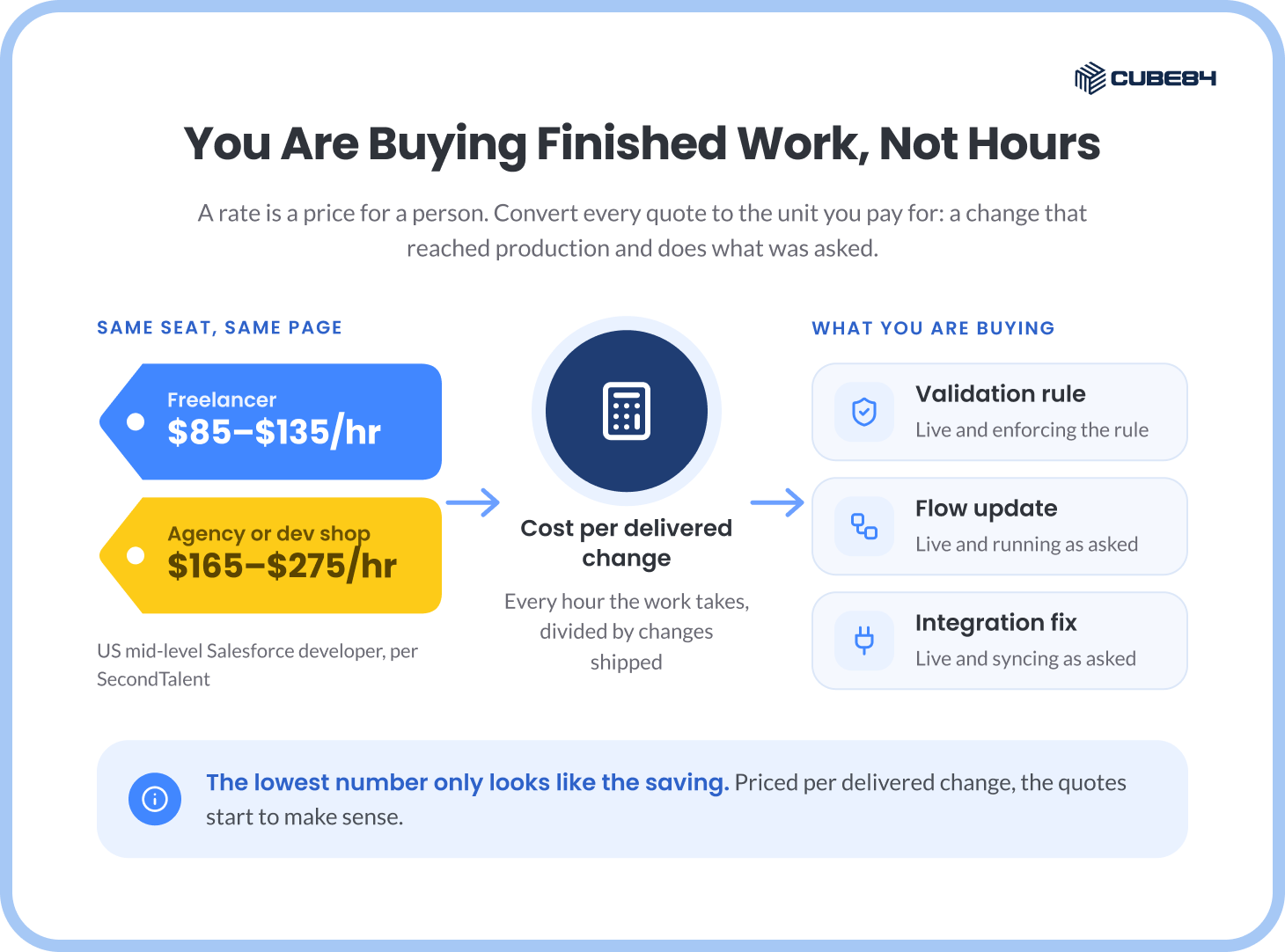
The rate tables read for this piece disagree because each one prices a different thing, and even a perfect table tells you only what an hour of a person costs. Finance needs to know what the finished work costs.
What you are paying for is the delivered change.
A delivered change is a piece of work that reached production and does what was asked: a validation rule, a Flow update, an integration fix. Every quote can be converted to that unit, and once it is, the rates start to make sense. A rate is a price for a person. You are buying finished work.
Why Salesforce Rate Tables Disagree
The rate pages that rank for this search are useful. They show that region and seniority move price, and the better ones explain how they were built. SecondTalent says its US band starts from a published developer salary and adds employer costs from Bureau of Labor Statistics data. KORE1 models its bill rates from BLS wage data with a 24% employer burden, and it separates what a staffing firm invoices from what the contractor is paid.
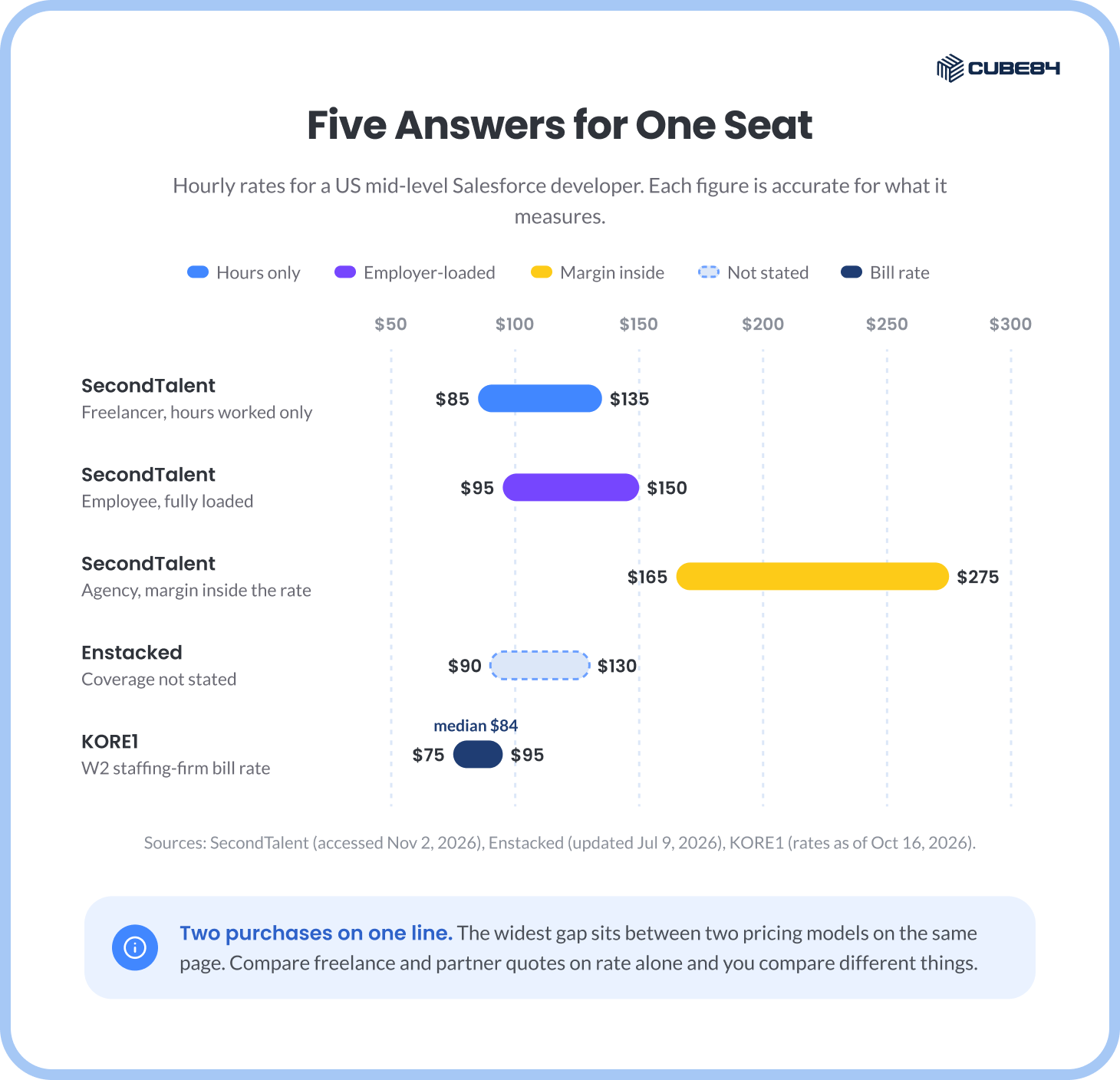
Read side by side, three pages give five answers for one seat, a US mid-level Salesforce developer.
Source: SecondTalent (accessed November 2, 2026), Enstacked (updated July 9, 2026) and KORE1 (rates as of October 16, 2026). The widest gap is between two pricing models on the same page. The preview renders this table as a range chart.
Each of these figures is accurate for what it measures. The freelance figure covers hours worked and nothing else, so code review, testing and coordination stay with your team. For the agency figure, SecondTalent notes that "margin sits inside the rate." The KORE1 figure is an invoice with payroll taxes, insurance and the firm's own costs already inside it. Enstacked's table does not say which of these it measures.
So a freelance quote and a partner quote compared on rate alone are two different purchases on one line.
What a Salesforce Developer Rate Includes
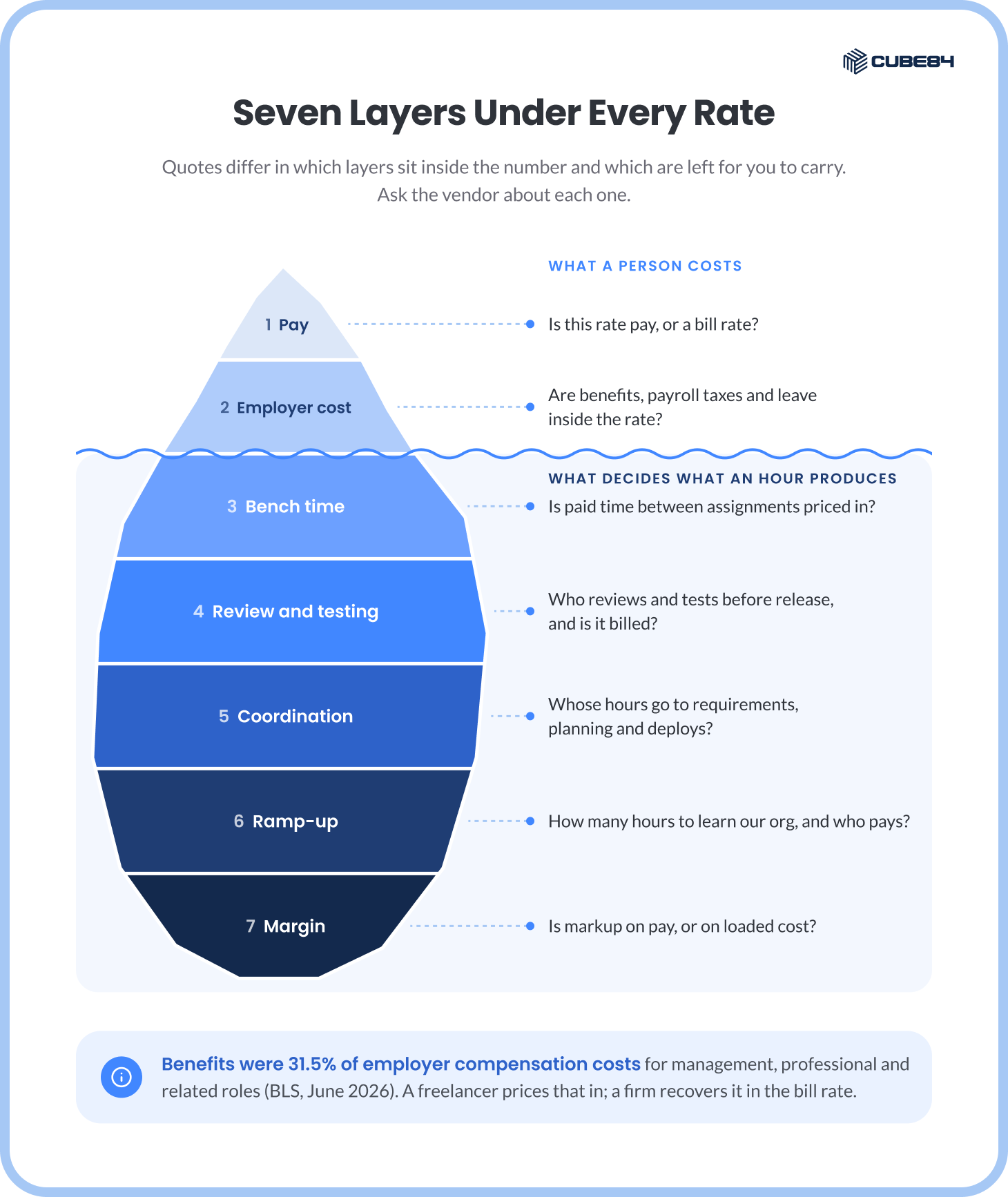
Whether a quote is labeled a Salesforce consultant hourly rate or a developer rate, it is built from some combination of the same seven layers. Quotes differ in which layers sit inside the number and which are left for you to carry.
The first layer is pay. The second is employer cost: benefits, payroll taxes and paid leave. For private-industry management, professional and related occupations, benefits made up 31.5% of employer compensation costs in June 2026, according to the BLS Employer Costs for Employee Compensation release. A freelancer carries that layer personally and prices it in. A firm carries it and recovers it in the bill rate.
Then come the layers that decide what an hour produces: bench time between assignments, code review and testing, requirements and coordination, the ramp-up spent learning your org, and the firm's margin.
Fixed-price project quotes add layers of their own, such as project management overhead and platform usage costs, which our breakdown of Salesforce implementation cost and its hidden fees covers.
How Region and Expertise Level Move a Rate
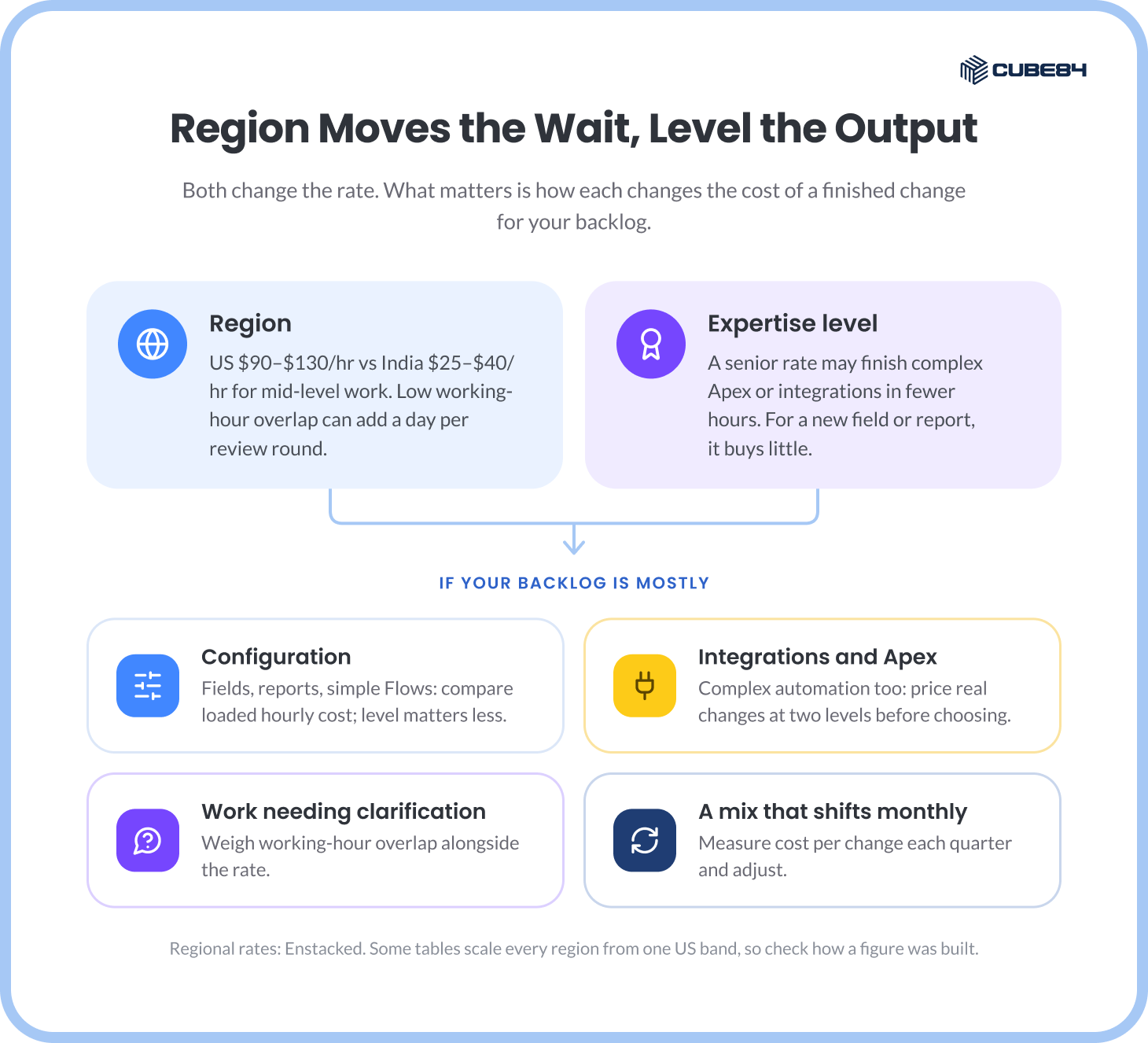
Regional tables show large spreads. Enstacked lists a US mid-level developer at $90 to $130 an hour and an India-based one at $25 to $40. Read how a regional figure was produced before relying on it. SecondTalent says each of its regional figures is its US band scaled by that market's published compensation ratio, so those figures are estimates derived from one number.
Region also changes cost per change in a way the rate cannot show. When a developer's working day barely overlaps yours, an afternoon question waits until morning, and each review round can add a day.
Expertise level changes what an hour produces. A senior developer costs more per hour and may finish a complex integration or Apex change in fewer hours, with less review from your team. For a new field or a report, the higher rate buys little. Which of those holds for your backlog is a question your own changes can answer.
Convert a Salary Into a Loaded Hourly Cost
Before comparing outside quotes, price the option you control: an employee. Four steps turn a salary into an hourly figure you can set beside any quote.
Start with base salary for the role you would hire.
Divide by the wage share of compensation. For private-industry management, professional and related occupations, wages and salaries were 68.5% of employer compensation costs in June 2026, per BLS.
Divide by the hours of project work you expect in a year, after meetings, leave and support duties.
Add what the formula leaves out: recruiting, equipment, software and the time of whoever manages the role.
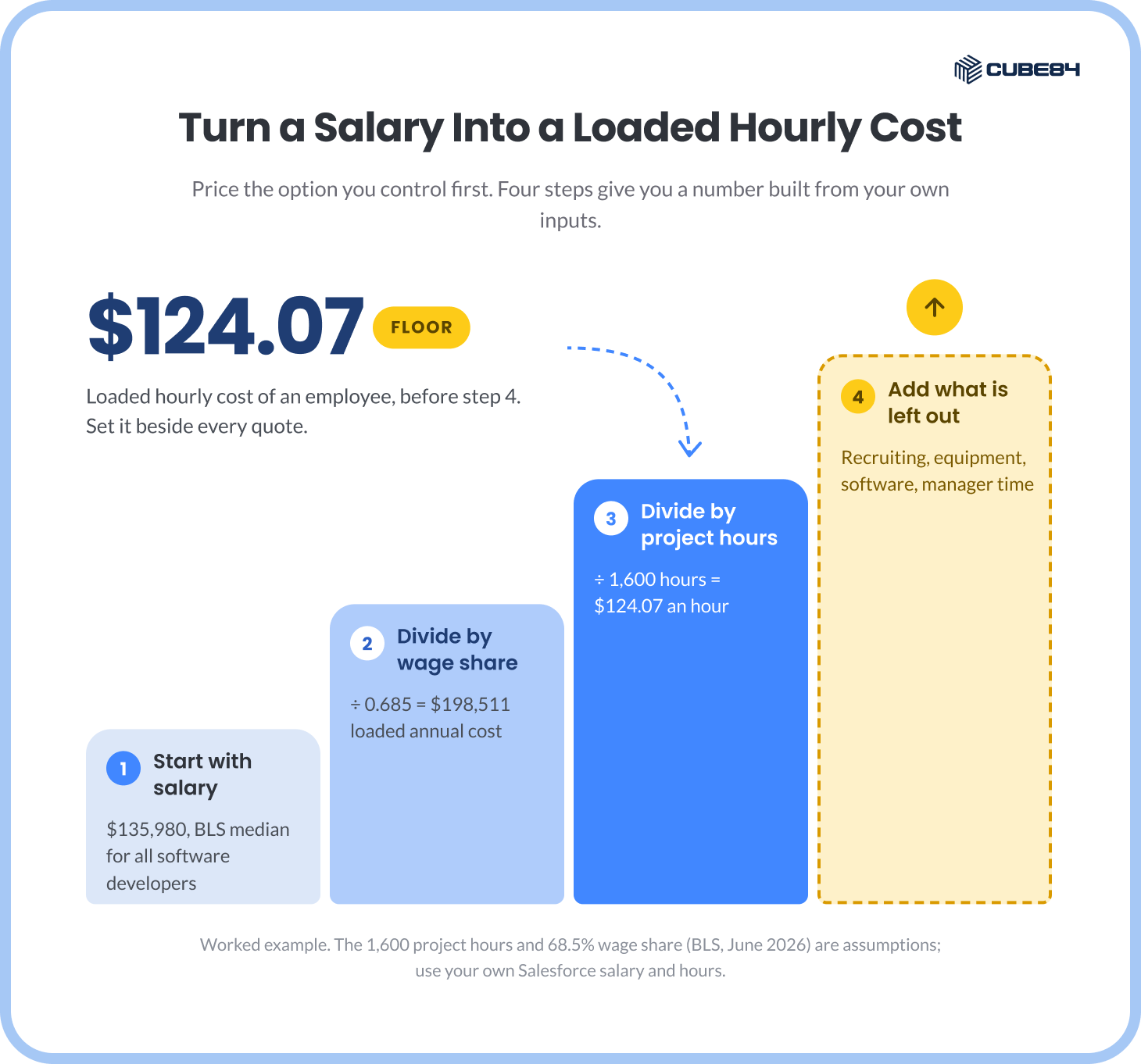
A worked example. The BLS Occupational Outlook Handbook reports a median annual wage of $135,980 for software developers in May 2025. That figure covers software developers in every specialty, so treat it as a placeholder for your own Salesforce salary figure.
The 1,600 hours is an assumption for the example; use your own. The 68.5% share is an average across a broad occupational group, and step four is not in the table, so read the result as a floor. That floor gives you a number built from your own inputs to set beside every quote. For the same effort-to-cost conversion applied across internal staff, contractors and managed services, see our Salesforce TCO guide.
Compare Quotes on Cost per Delivered Change
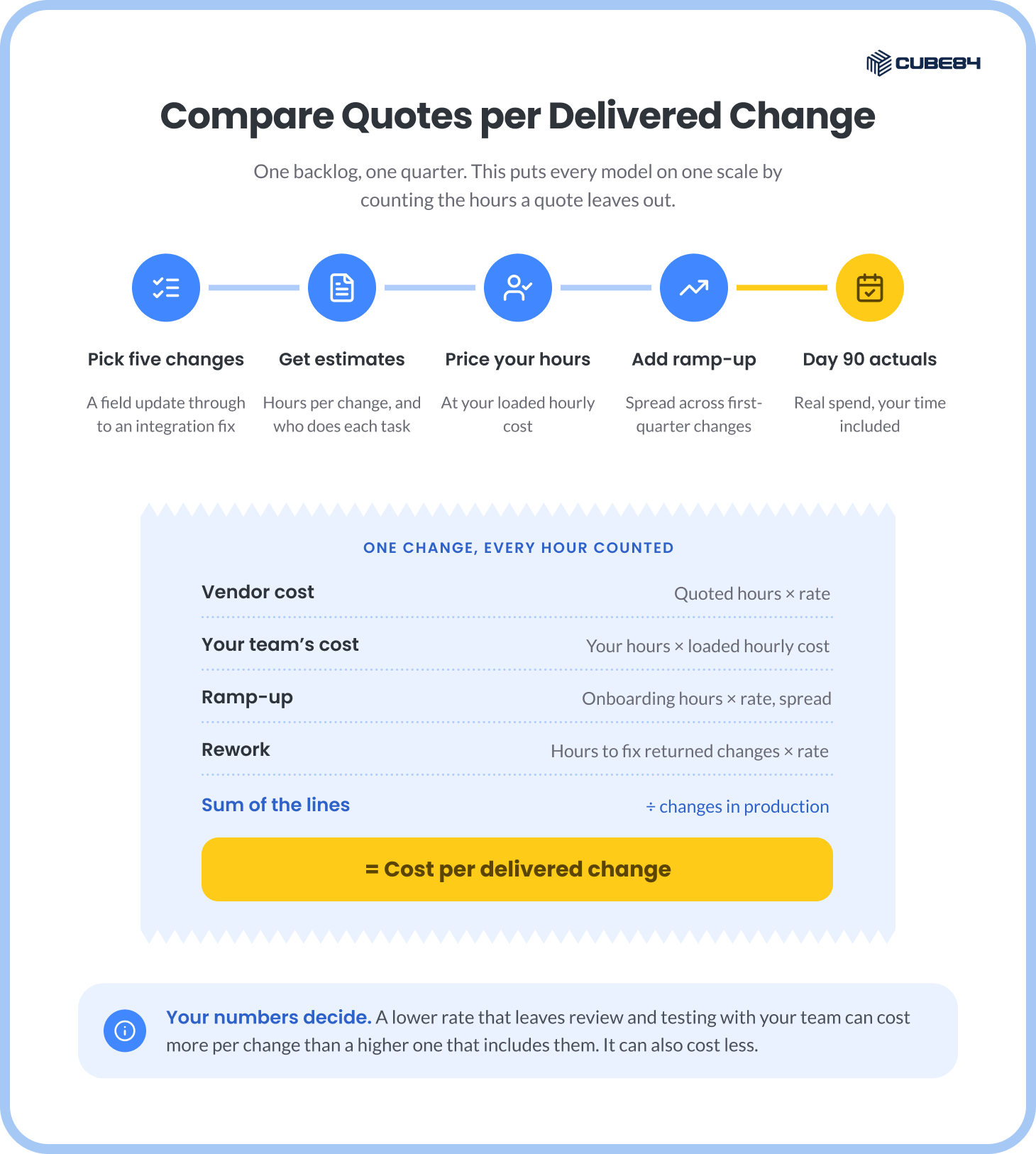
Cost per delivered change puts every model on one scale, because it counts the hours a quote leaves out: your team's review time, ramp-up and rework. The method takes one backlog and one quarter.
Pick four or five real changes from your backlog, from a simple field update to an integration fix.
Ask each vendor to estimate them: hours per change, and who writes the requirement, reviews the code, tests and deploys.
Price your own team's hours at the loaded hourly cost from the previous section.
Add ramp-up, spread across the changes you expect in the first quarter.
After 90 days, measure the real figure: total spend, including your team's time, divided by changes in production.
A lower rate that leaves review and testing with your team can cost more per change than a higher rate that includes them. It can also cost less. Your numbers decide.
If the comparison points toward a different engagement model altogether, our comparison of Salesforce managed services and staff augmentation sets out how each one divides the work.
Five Questions Before Approving Salesforce Staffing Spend

Which layers are inside each rate we have been quoted, and which are left for us?
Who on our team writes requirements and reviews code, and what does their hour cost?
How many ramp-up hours does each vendor assume, and who pays for them?
What happens to our cost per change if the developer changes?
What did our last 90 days of Salesforce changes actually cost, each?
Published rate tables tell you what an hour of a person costs in a given market. The decision in front of you is what a finished change costs your organization, and only your own backlog can answer it.
CUBE84 Insight: Ask every vendor to price the same five changes from your backlog. The quote that shows its review, testing and ramp-up hours is the one you can compare.
To set your current support cost beside an outside quote, the Salesforce managed services cost calculator compares internal, hybrid and managed approaches using your own inputs.
Outbound Links
The following external sources were referenced in or are relevant to this blog. These links are available for outreach.
U.S. Bureau of Labor Statistics, Occupational Outlook Handbook: Software Developers — Median annual wage of $135,980 for all software developers, May 2025; the salary input in the worked example.
U.S. Bureau of Labor Statistics, Employer Costs for Employee Compensation, Table 4, June 2026 — Wages at 68.5% and benefits at 31.5% of compensation for private-industry management, professional and related occupations; the loading factor.
SecondTalent, Cost to Hire a Salesforce Developer — Freelance, in-house and agency ranges for the same US mid-level seat, with a stated method; the clearest example of one page pricing three things.
Enstacked, Salesforce Developer Hourly Rate in the US — Region-by-level rate table with no stated rate type; used as an attributed regional example.
KORE1, Salesforce Contractor Bill Rates 2026 — Staffing-firm bill rates modeled from BLS wages, separating bill rate from pay.