


Student involvement predicts alumni giving. Most institutions lose the data at graduation.
Who at your institution can tell you which of your alumni were student athletes? Not which students are. Which alumni were. At many institutions nobody can answer that, and it is not because the systems fail to integrate. They integrate. The involvement record just never makes it into the fields that move.
Prabitha Ravichandran, VP of Service Delivery, CUBE84
The short answer. Involvement predicts giving. Institutional giving records show varsity sport, Greek, and campus leadership participants more than twice as likely to give six to nine years after graduation. Gallup's national sample found 54% of Greek-affiliated alumni gave in the past year, against 10% of unaffiliated alumni. Most institutions cannot act on either finding, because the graduation handoff carries name, degree, major, and class year, and leaves the involvement history behind.
Take one graduate. Four years on the swim team, two of them as captain. Student body treasurer senior year. Forty hours a semester at the career center.
Twelve years later she is assigned to a relationship manager who knows her name, her degree, and her last known address.
Everything else is still sitting on campus, in systems that work fine.
Does student involvement predict alumni giving?
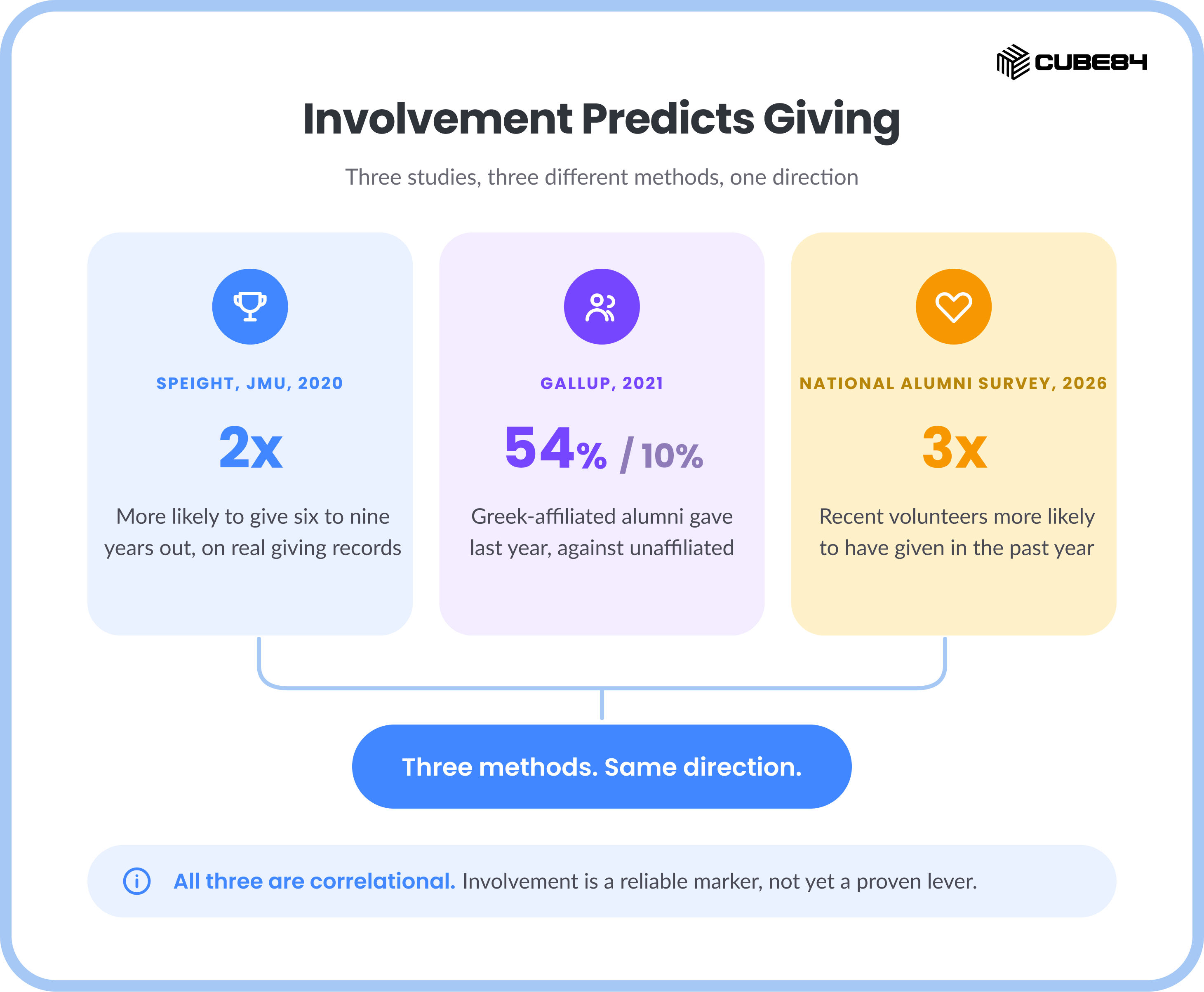
Yes. Three sets of evidence, three different methods, same direction.
That last part matters more than any single number. Each of these studies has a weakness you could argue with. They do not share the same weakness.
Three lines of evidence on involvement and giving
All three linked at the end.
Speight is the strongest of the three, because he used real donation records rather than asking anyone what they gave. Eight activity types, tested against giving six to nine years out. Involvement in any of them raised the odds. Sport, Greek, and campus leadership each more than doubled them. One campus, so read it as directional for yours.
Gallup fixes the scope problem and produces the widest gap in the literature. 54% of affiliated alumni gave last year. 10% of unaffiliated alumni did. Self-reported, and funded by the fraternal sector, so treat the size of the gap as directional and the direction as solid.
Gallup's wider alumni work sharpens why this is worth the effort. Its Big Six experiences include being extremely active in extracurricular activities, and only 20% of graduates strongly agree they had that. Only 18% are emotionally attached to their alma mater.
So the group that gives is small, identifiable, and you already have the list.
The 2026 National Alumni Survey brings it current. Recent volunteers were three times more likely to have given in the past year. Only 35% of alumni gave at all, and among younger alumni that drops to 13% against 32% for older generations.
One caveat on all three. This is correlation. Students who join things may already be the type who affiliate and give, which makes involvement a reliable marker and an unproven lever. Worth holding onto when you decide what to do with the data.
Read conservatively, your swimmer was several times more likely to give than a classmate who joined nothing. Nobody is acting on that.
Dollars are up. Donors are down.
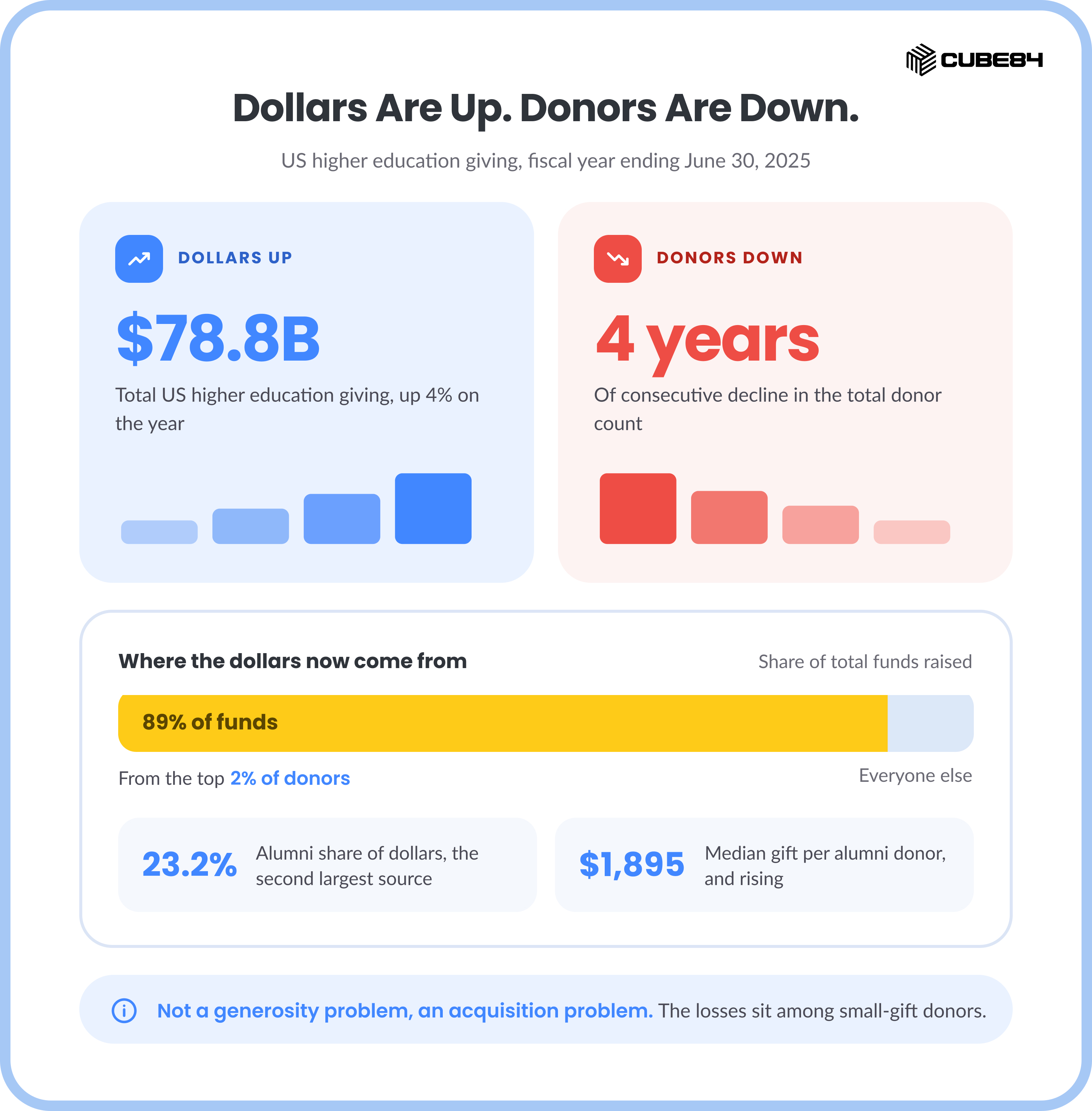
Which is why this matters now more than it did five years ago.
US higher education giving, fiscal year ending June 30, 2025
Source: [CASE Insights on Voluntary Support of Education, 2025](https://www.case.org/resources/insights-voluntary-support-education-2025), based on 670 responding US institutions.
CASE calls it dollars up, donors down. Totals hold because a narrower, higher-capacity group is carrying them.
The losses sit among smaller-gift donors. That is the pool your major gifts come from in 2038. A $250 donor today is how a $250,000 conversation starts later.
So this is not a generosity problem. It is an acquisition problem, and acquisition needs a signal about who to call and what to say.
You collected that signal for four years.
Four technical breaks, and one that explains them all.
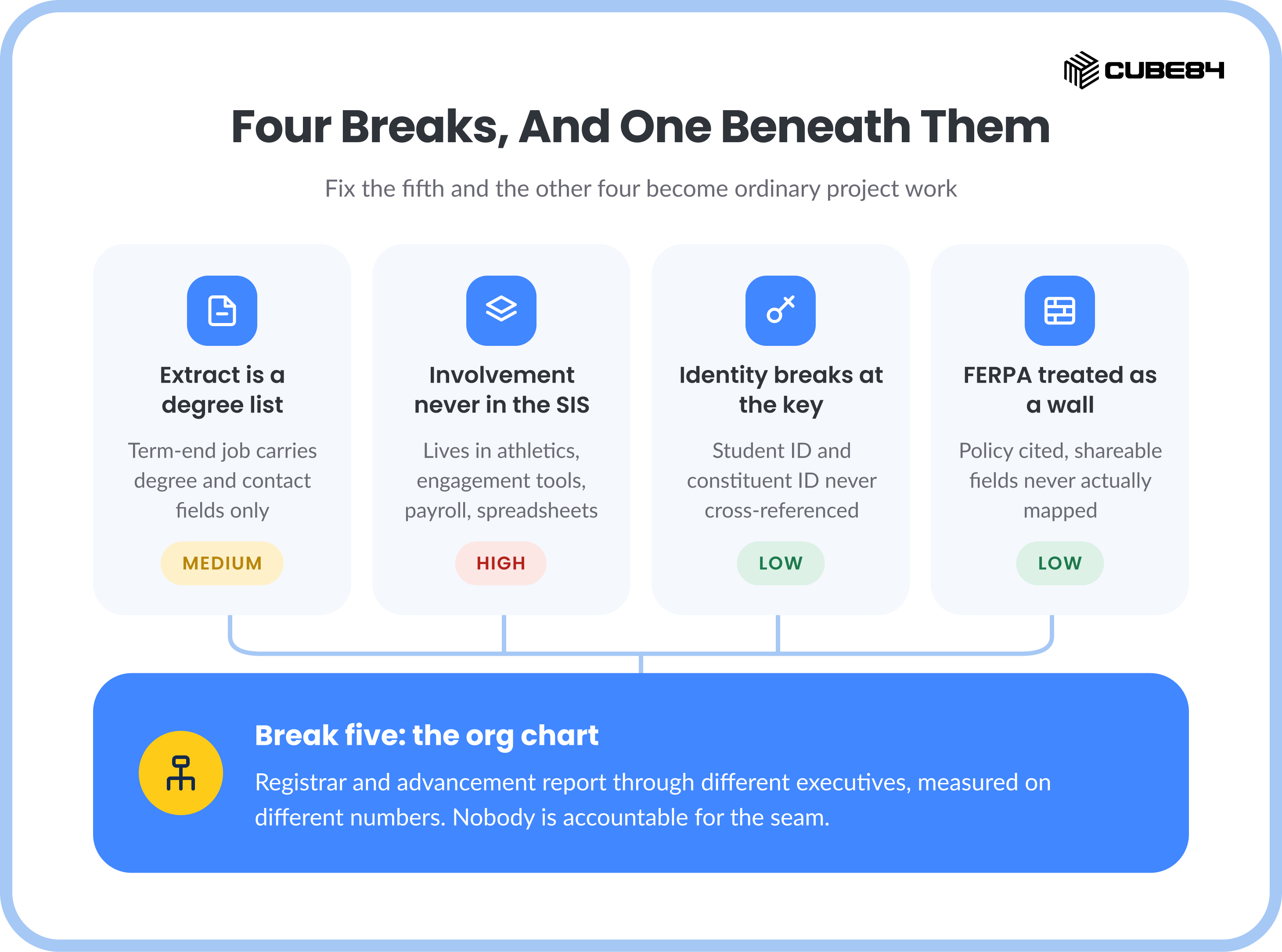
Start with the fifth, because it is why the other four survive every strategy reset. Fix that one and the rest become ordinary project work.
Break five: the org chart
Registrar and student affairs report through academic affairs. Advancement reports through a separate vice president, often through a separately incorporated foundation. Each side is measured on its own numbers, retention and completion on one, dollars and participation on the other.
Nobody is accountable for the seam. So it never becomes anyone's priority.
Breaks one through four
One note on these numbers
The CASE and Gallup figures in this piece are sourced and linked. The break count, the effort ratings above, the source estimate below, and the 90-day timings are our own judgment from this work, not published benchmarks. Test them against your own environment.
Start with the two marked low. The identity cross-reference is the cheapest thing on the list and everything else depends on it. Once your swimmer updates her email in the alumni portal, name and class year matching is all you have left.
Some of this is already structured, which makes part of the job a mapping exercise rather than a data creation exercise. Ready Education CampusGroups records co-curricular involvement and keeps a co-curricular transcript of leadership and participation. CUBE84 LOOP, our own student engagement product built on Salesforce Education Cloud, holds involvement as native Salesforce records.
What can you carry forward?
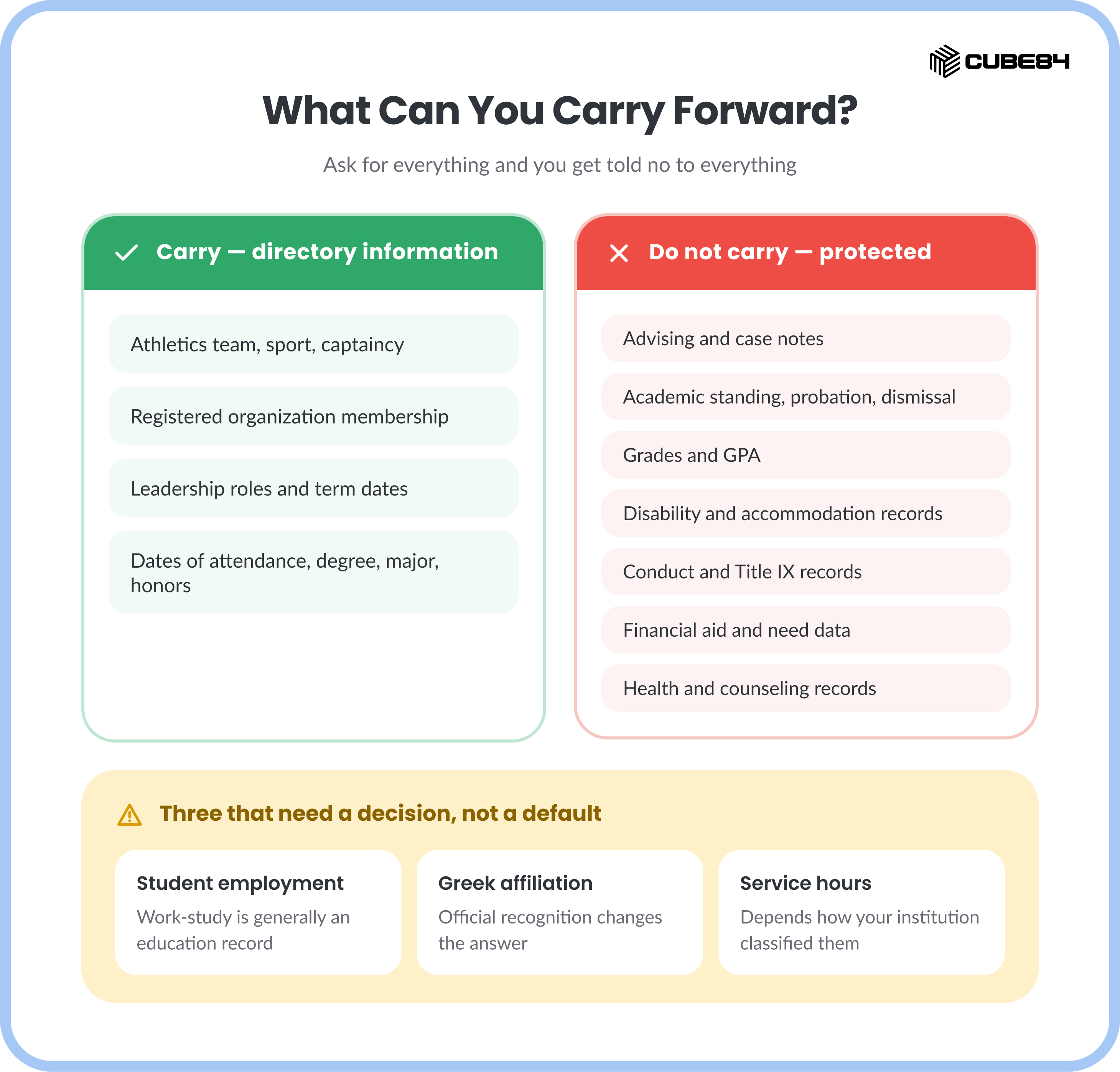
Involvement, roles, and dates. Not academic history, and not anything a counselor wrote down.
Getting this line right is what decides whether your registrar becomes a partner or a blocker. Ask for everything and you get told no to everything.
Carry and do not carry
Every yes is conditional on your own directory information designation and your opt-out handling.
Three fields sit in the middle and need a decision rather than a default:
Student employment. Records of a student employed because of their student status, work-study being the clear case, are generally education records rather than employment records. Usable, but as a policy decision.
Greek affiliation. Whether the organization is officially recognized changes the answer.
Service hours and co-curricular transcript entries. Often eligible, depending on how your institution classified them.
The temptation runs the other way, so let me name it. If your swimmer had struggled sophomore year and recovered with one advisor's help, a gift officer knowing that would have a warmer opening than any club membership.
That opening is not available. Advising notes and academic standing are protected education records with no directory information route, and reaching for them is the fastest way to lose your registrar, your counsel, and the project.
Does FERPA allow this?
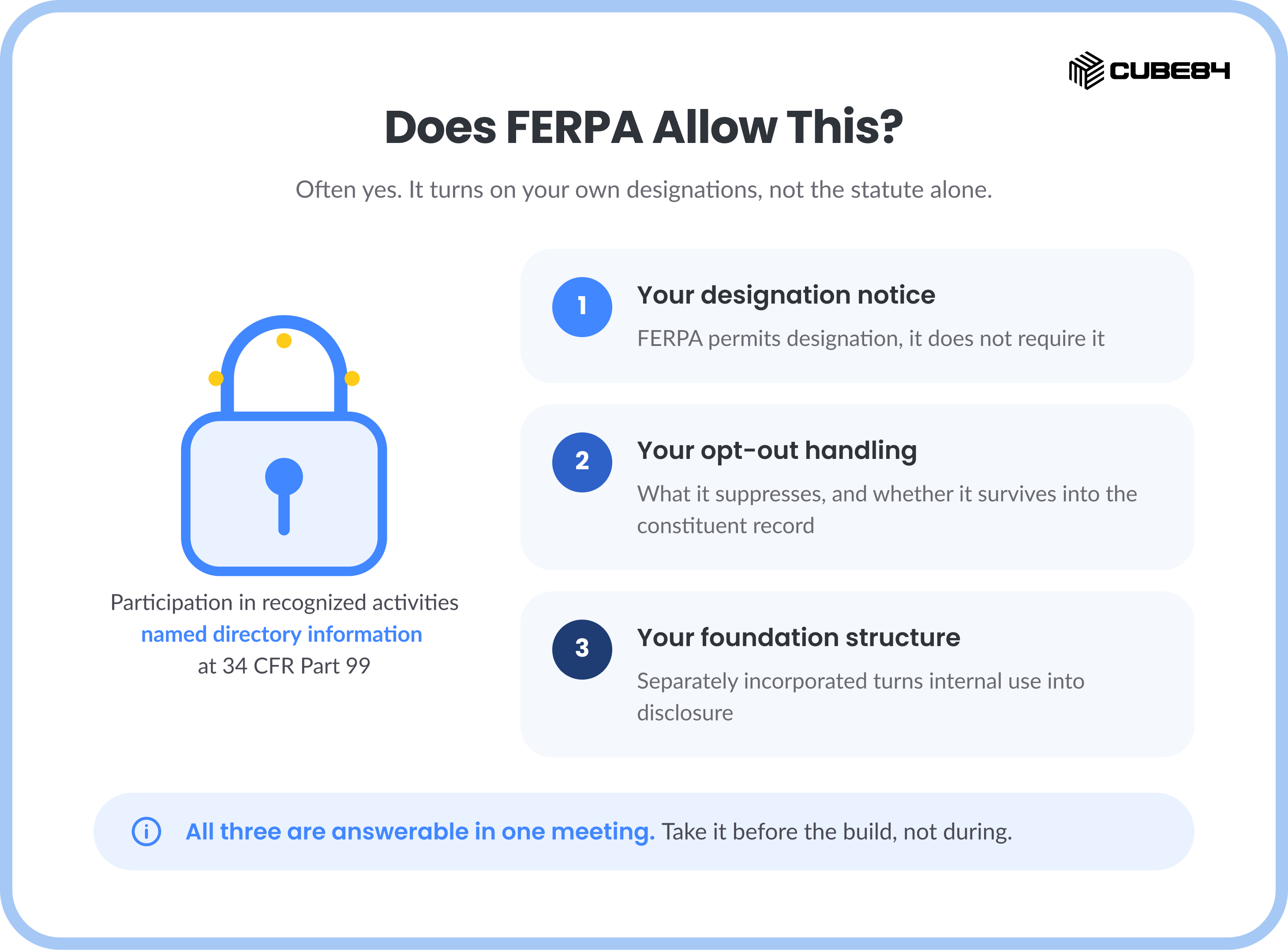
Often yes. It turns on your own designations, not on the statute alone.
Participation in officially recognized activities and sports is expressly included in the FERPA definition of directory information, alongside name, address, major, dates of attendance, and degrees received (Congressional Research Service on FERPA, 34 CFR Part 99). Directory information can be disclosed without consent, if your institution designated it in its annual notice and the student has not opted out.
Three things decide it on your campus.
Your designation notice, because FERPA permits designation and does not require it. Your opt-out handling, meaning what an opt-out suppresses and whether it survives into the constituent record. And your foundation structure, because a separately incorporated foundation turns an internal use into a disclosure.
All three are answerable in one meeting. Take it before the build, not during.
Does your CRM choice change the work?
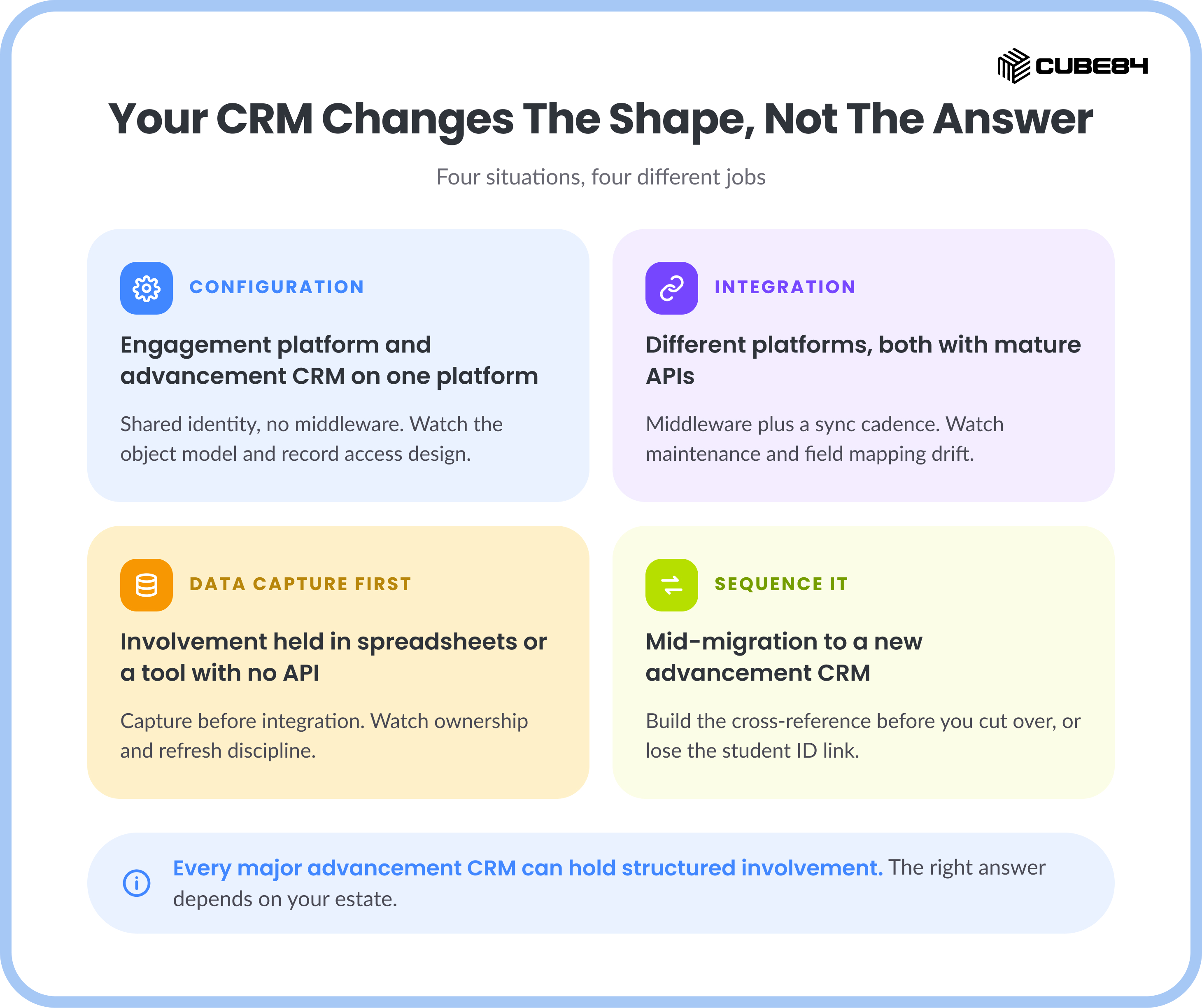
It does not change whether this is possible. It changes the shape of the job.
Every major advancement CRM can hold structured involvement records. What varies is whether your engagement platform and your advancement CRM sit on the same underlying platform.
If, then
Blackbaud Raiser's Edge NXT, Ellucian CRM Advance, Kindsight ascend, Salesforce Education Cloud, and Salesforce Nonprofit Cloud all show up across the sector on this problem. The right answer depends on your estate, not on a product ranking. If you are on Salesforce Nonprofit Success Pack today, it remains supported and no longer receives new features, so plan the cross-reference around your migration timeline rather than after it.
Start with identity. The rest depends on it.
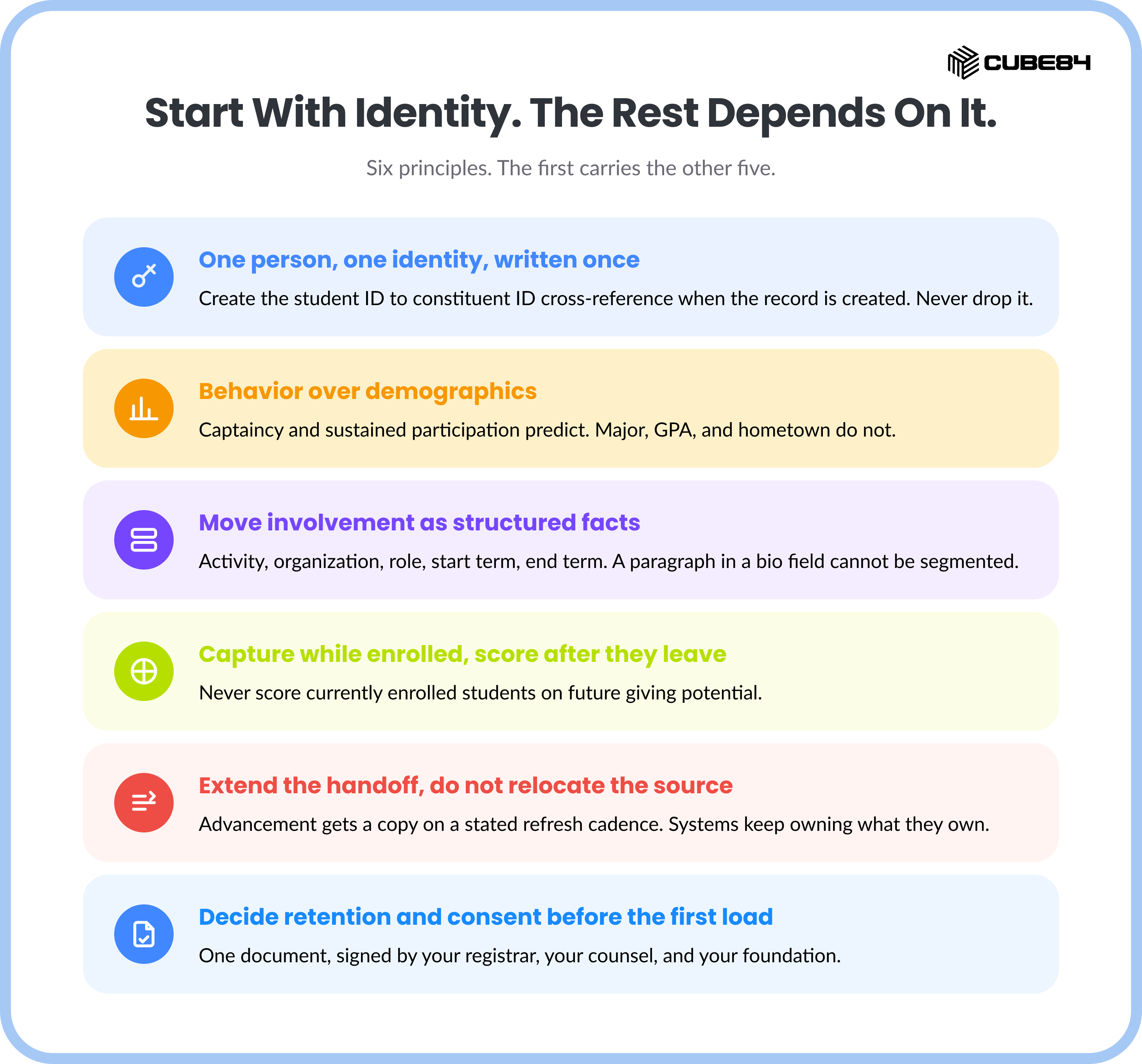
Six principles. The first carries the other five.
One person, one identity, written once
Create the cross-reference between student ID and constituent ID at the moment the constituent record is created. Never drop it.
Behavior over demographics
Major, GPA, and hometown are weak predictors of future giving. Team captaincy, club leadership, work-study role, and sustained participation in one program are not. Build around the fields the research supports, not the fields that export easily.
Move involvement as structured facts
Activity type, organization, role, start term, end term. A paragraph in a bio field cannot be segmented, cannot be counted, and will not survive your next migration.
Capture while students are enrolled, score after they leave
Involvement recorded as it happens arrives already populated, instead of being rebuilt years later from memory and LinkedIn.
One guardrail. Capture involvement, do not score currently enrolled students on future giving potential. That is a reputational exposure you do not need.
Extend the handoff, do not relocate the source
Your SIS keeps enrollment and degree. Your engagement platform keeps club membership. Advancement gets a copy on a stated refresh cadence.
Decide retention and consent before the first load
What you keep, for how long, what an opt-out suppresses, who approves an exception. One document, signed by your registrar, your counsel, and your foundation.
Principles are not a plan. Here is the calendar.
What do you do in the first 90 days?
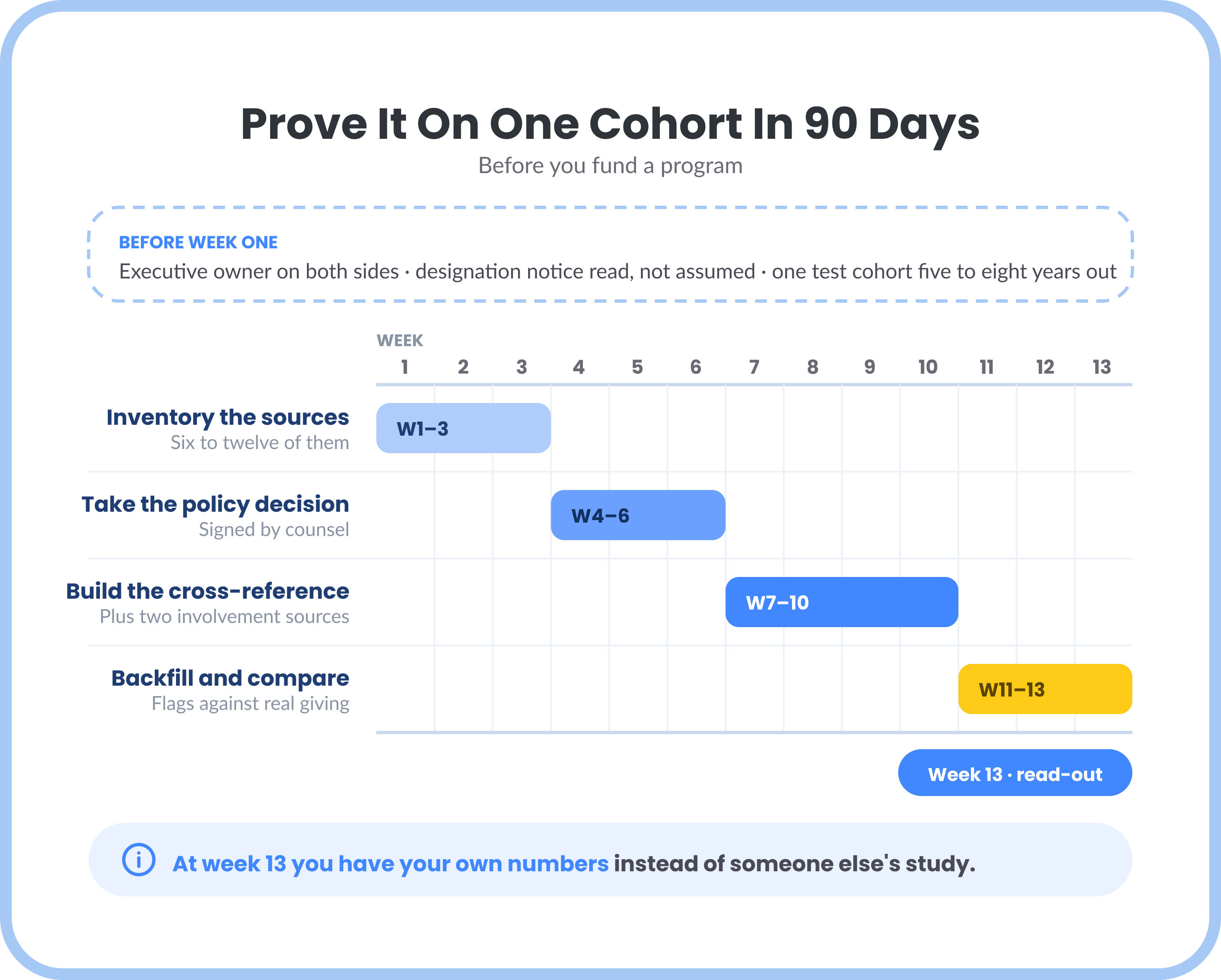
Prove it on one cohort before you fund a program.
Before week one
Executive owner named on the academic affairs side and the advancement side
Your current directory information designation notice read, not assumed
Opt-out handling documented, including whether it carries into the constituent record
Foundation structure confirmed as internal or separately incorporated
One test cohort chosen, five to eight years out
Success measure agreed before the first load
Weeks 1 to 3. Inventory every system holding involvement data. Owner, student identifier used, refresh frequency, and whether records survive graduation. In our experience that is six to twelve sources.
Weeks 4 to 6. Take the policy decision. Designation, opt-out handling, foundation structure, retention period, and your carry list against the do-not-carry list, signed by counsel.
Weeks 7 to 10. Build the cross-reference table and one involvement object in your advancement CRM. Load two sources only, usually athletics and student organizations.
Weeks 11 to 13. Backfill the test cohort. Compare involvement flags against actual giving. Report what correlated on your campus and what did not.
Where the line sits
Your registrar and general counsel own what is carryable. Nobody outside your institution should make that call. Your advancement services team owns the cross-reference, because they own the constituent record. An implementation partner builds the involvement model and the integration, and hands both over documented.
At week 13 you have your own numbers instead of someone else's study.
Why involvement data changes your outreach
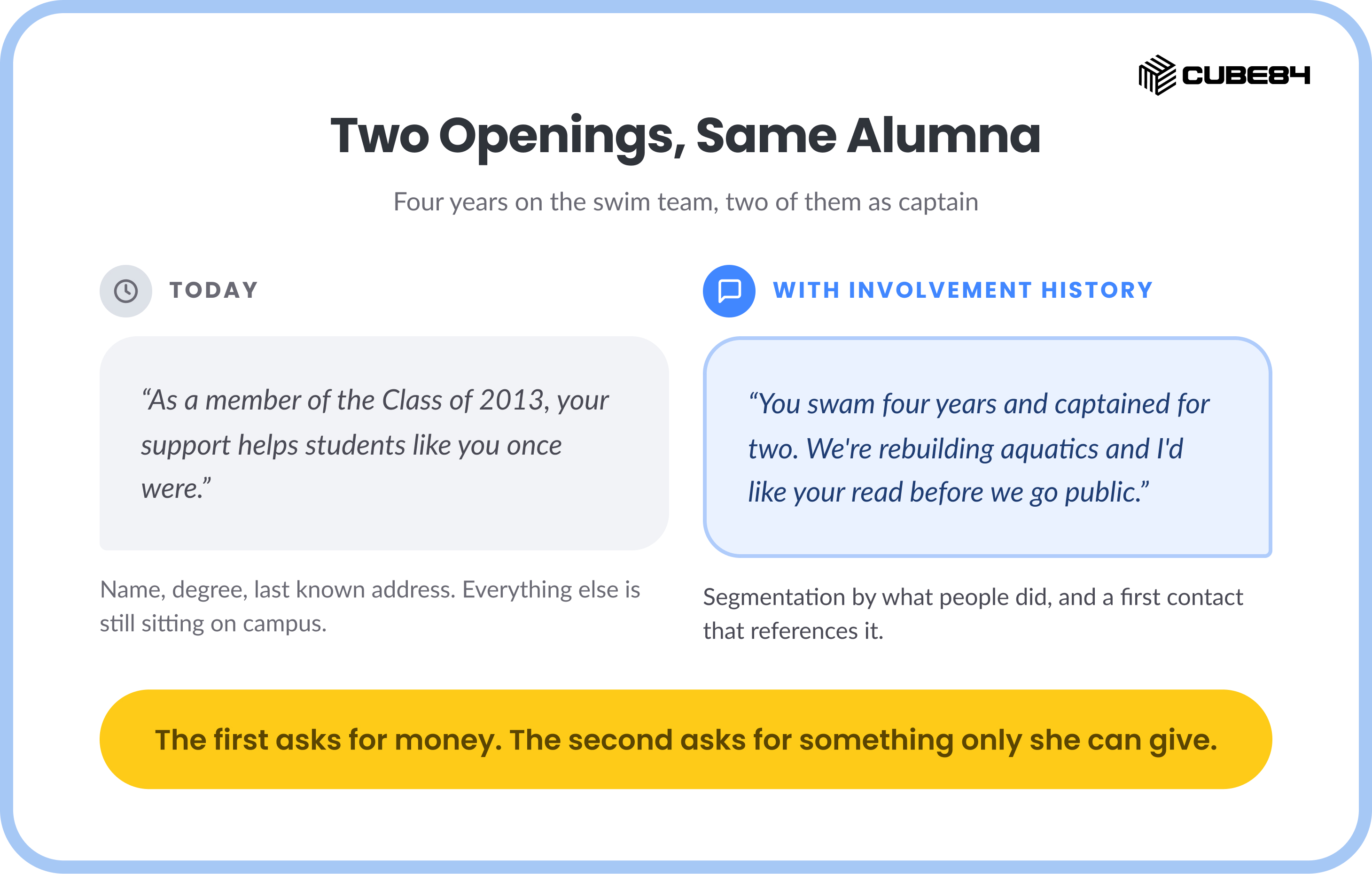
You get segmentation by what people did, and a first contact that references it.
Not a giving score. Involvement predicts giving, and nobody has shown that adding these flags lifts response rates. Anyone selling you a propensity model on this is overselling.
What changes is that you can build lists by athlete, club officer, or student employee instead of only class year and geography. And every ask can reference something true.
Your swimmer's relationship manager has two openings.
Today
"As a member of the Class of 2013, your support helps students like you once were."
With involvement history
"You swam four years and captained for two. We're rebuilding aquatics and I'd like your read before we go public."
The first asks for money. The second asks for something only she can give.
You are not short of prospects. You are short of context you already collected and threw away.
Sources
Every claim in this piece traces to one of the following. All are open access unless noted.
Speight, Analysis of Alumni Giving Based on Student Activity Involvement (James Madison University, 2020). Tests eight student activity types against actual institutional giving records six to nine years after graduation. Source of the more-than-twice-as-likely finding. Full text available.
Gallup, Fraternities and Sororities: Experiences and Outcomes in College, Work and Life (2021). National sample comparing affiliated and unaffiliated alumni. Source of the 54% against 10% giving gap. Funded by the fraternal sector, which is why the piece treats the figure as directional.
Gallup, Big Six College Experiences Linked to Life Preparedness. Defines the six undergraduate experiences, including extracurricular involvement, and reports that only 20% of graduates strongly agree they were extremely active.
Gallup, Alumni Attachment and Giving Linked to Undergraduate Experience. Source of the finding that only 18% of US graduates are emotionally attached to their alma mater, and that attached alumni are more likely to be donors.
Washburn McGoldrick and PeopleGrove, National Alumni Survey 2026. Third annual national survey. Source of the volunteer giving multiple and the generational participation split. Vendor-sponsored.
CASE Insights on Voluntary Support of Education (2025). Sector benchmark covering the fiscal year ending June 30, 2025, based on 670 responding US institutions. Source of every figure in the giving table.
Congressional Research Service, FERPA and Its Exceptions. Plain-language summary of the directory information definition at 34 CFR Part 99 and the disclosure exceptions. The basis for the carry and do-not-carry table.
Weerts and Ronca, Profiles of Supportive Alumni (International Journal of Educational Advancement, 2007). Peer-reviewed corroboration on the link between alumni involvement, giving, and volunteering. Included as further reading. Abstract open, full text paywalled.
Do you know what your graduation extract is actually carrying?
Most institutions have never looked. It takes one query against your SIS and one against your advancement CRM to find out, and the answer usually surprises people. We will walk your handoff with you and tell you where it breaks.