


Many nonprofits have invested in Salesforce with the belief that a centralized CRM will solve reporting challenges.
And technically, it often does.
Records are created. Activities are logged. Dashboards are configured. Data lives in one place.
Yet for many nonprofit organizations, reporting still feels uncertain.
When funding season approaches, confidence dips. Reports require manual reconciliation. Metrics need explanation. Small inconsistencies surface in moments that demand clarity.
The data exists.
But it does not feel defensible.
This distinction matters more than it appears.
Salesforce Implementation vs. Grant-Ready System Design
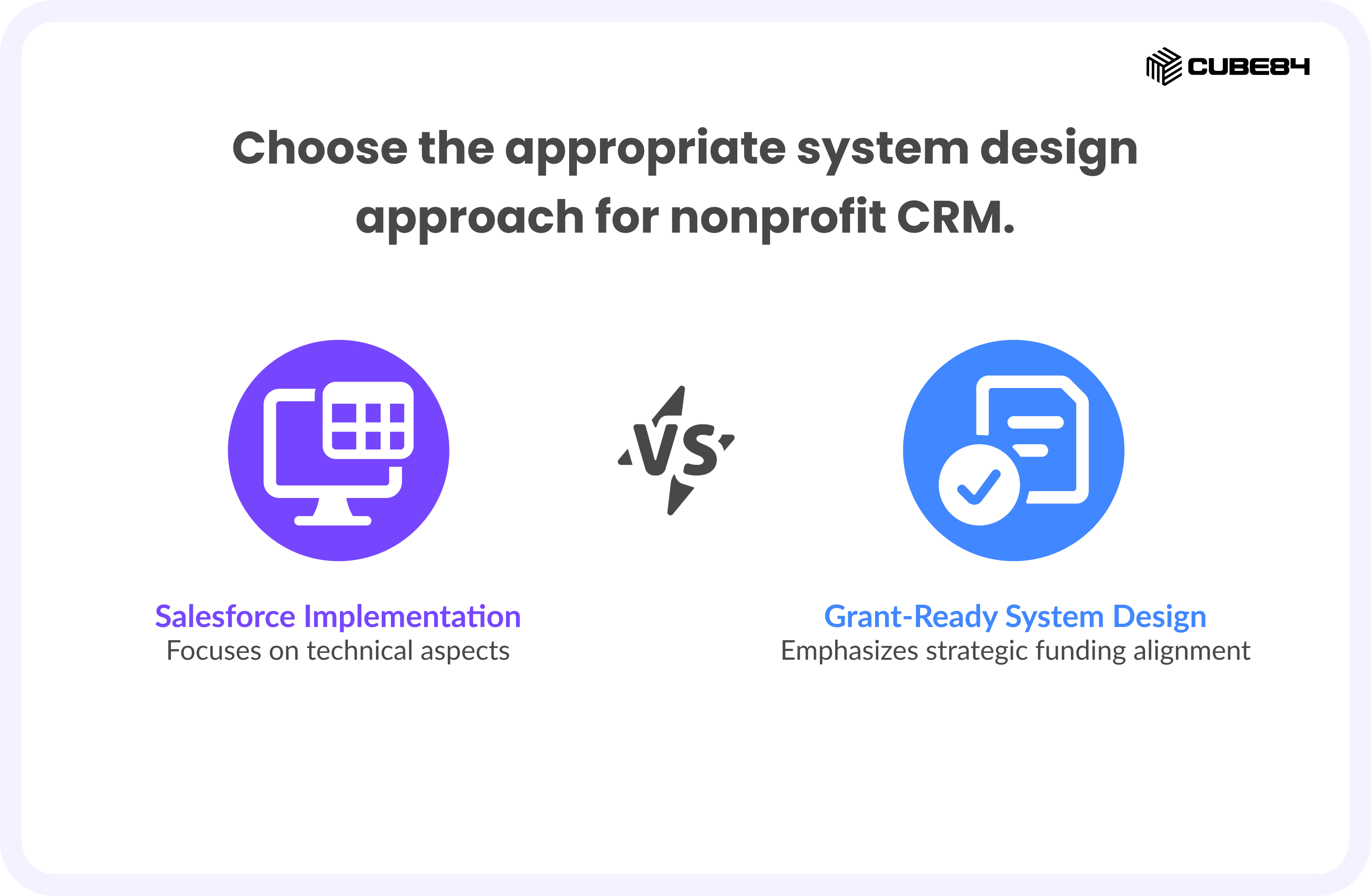
There is an important difference between implementing Salesforce for a nonprofit and designing a system that is funding-aligned.
A Salesforce nonprofit implementation typically focuses on:
• Data migration
• Object configuration
• Basic reporting
• User training
• Go-live
But grant-ready system design requires a different starting point.
It begins with a more strategic question:
What must this organization be able to prove to funders, auditors, and boards - without manual reconstruction?
That shift in perspective changes everything.
In a recent conversation with Sheala, a Salesforce Training Consultant and Strategic Adoption Partner with over fifteen years in the nonprofit space, she articulated a tension that surfaces repeatedly across organizations:
“Program staff are people, people. They didn’t enter this field to manage data. But without strong data, they can’t secure the dollars that fund their mission.”
This insight captures the structural challenge facing many nonprofit CRM environments.
Why Nonprofit Salesforce Data Often Feels Fragile
Most nonprofit staff are mission-driven operators. They are social workers, case managers, volunteer coordinators, and program directors.
Their primary objective is service delivery.
Data entry becomes secondary - particularly in environments where teams are already stretched thin.
At the same time, modern funding environments demand measurable outcomes.
Grant reports require structured metrics. Foundations require traceability. Government funding requires audit defensibility.
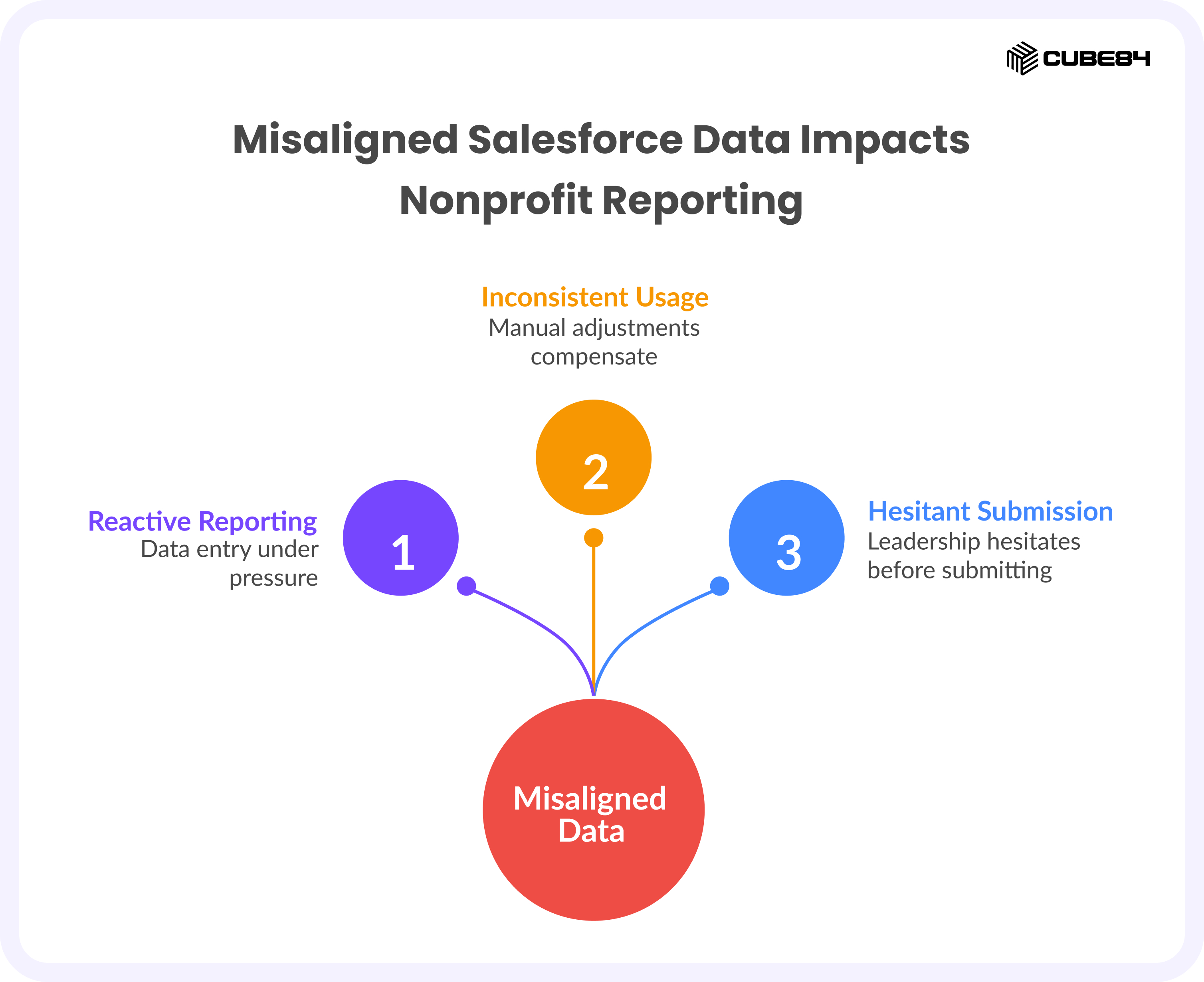
When these realities are not intentionally aligned inside Salesforce, reporting becomes reactive.
Fields are completed under pressure. Notes are entered retrospectively. Manual adjustments compensate for inconsistent usage. Reports technically exist, but leadership hesitates before submitting them.
This is not a technology failure.
It is a system design misalignment.
What Makes Salesforce Data “Grant-Ready”?
From a Salesforce nonprofit consultant’s perspective, grant-ready data is not defined by volume. It is defined by defensibility.
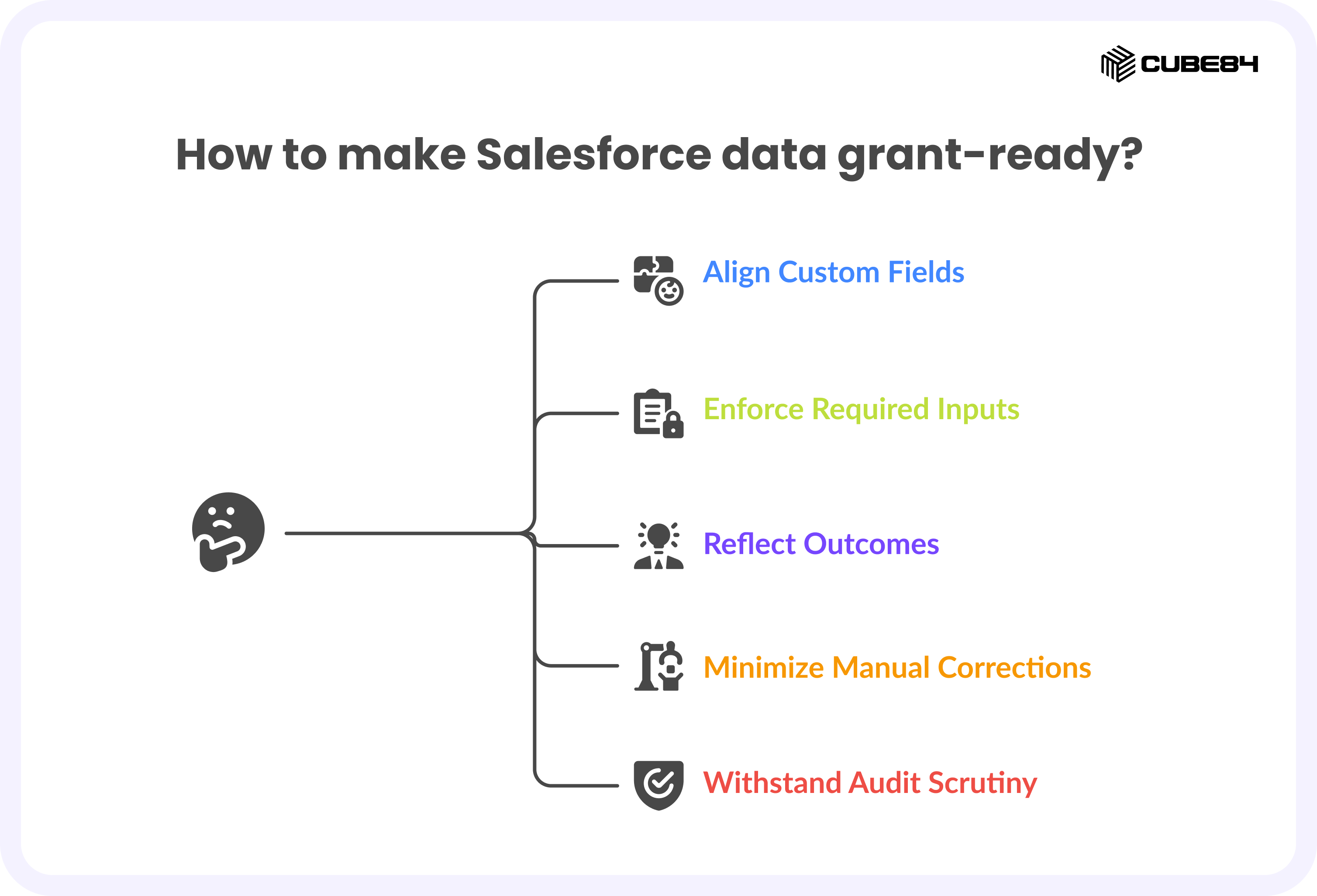
Grant-ready Salesforce data:
• Aligns custom fields directly to funding requirements
• Enforces required inputs before reporting season
• Reflects outcomes, not just activities
• Minimizes reliance on manual spreadsheet corrections
• Can withstand audit scrutiny without explanation
This does not require complex automation.
It requires clarity about the end goal.
When reporting expectations are defined before configuration, the CRM becomes a strategic asset rather than an operational burden.
The Hidden Risk in Nonprofit CRM Consulting
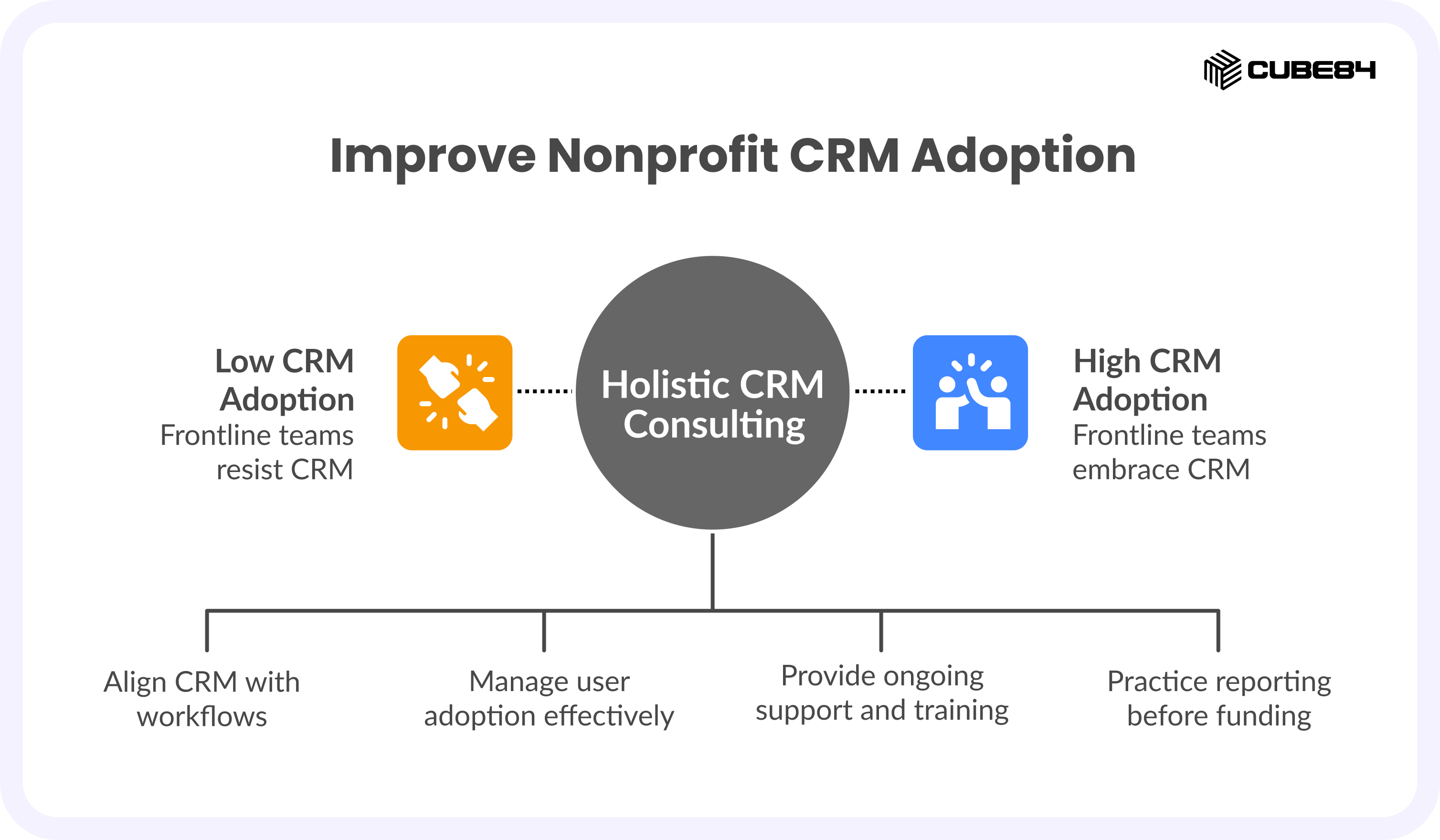
In many nonprofit Salesforce consulting engagements, system configuration is completed before adoption risk is addressed.
Executives define requirements. Consultants configure the system. Training is delivered. The system goes live.
But frontline teams were not deeply involved in the design conversation.
From the field, the CRM may feel imposed rather than integrated.
Adoption resistance rarely appears immediately. It surfaces months later - during high-pressure reporting cycles.
This is why Salesforce nonprofit consulting must extend beyond configuration.
It must include:
• Operational alignment
• Change management
• Post-launch reinforcement
• Reporting rehearsal before funding season
Go-live is not completion. It is a transition.
From Data Entry to Data Confidence
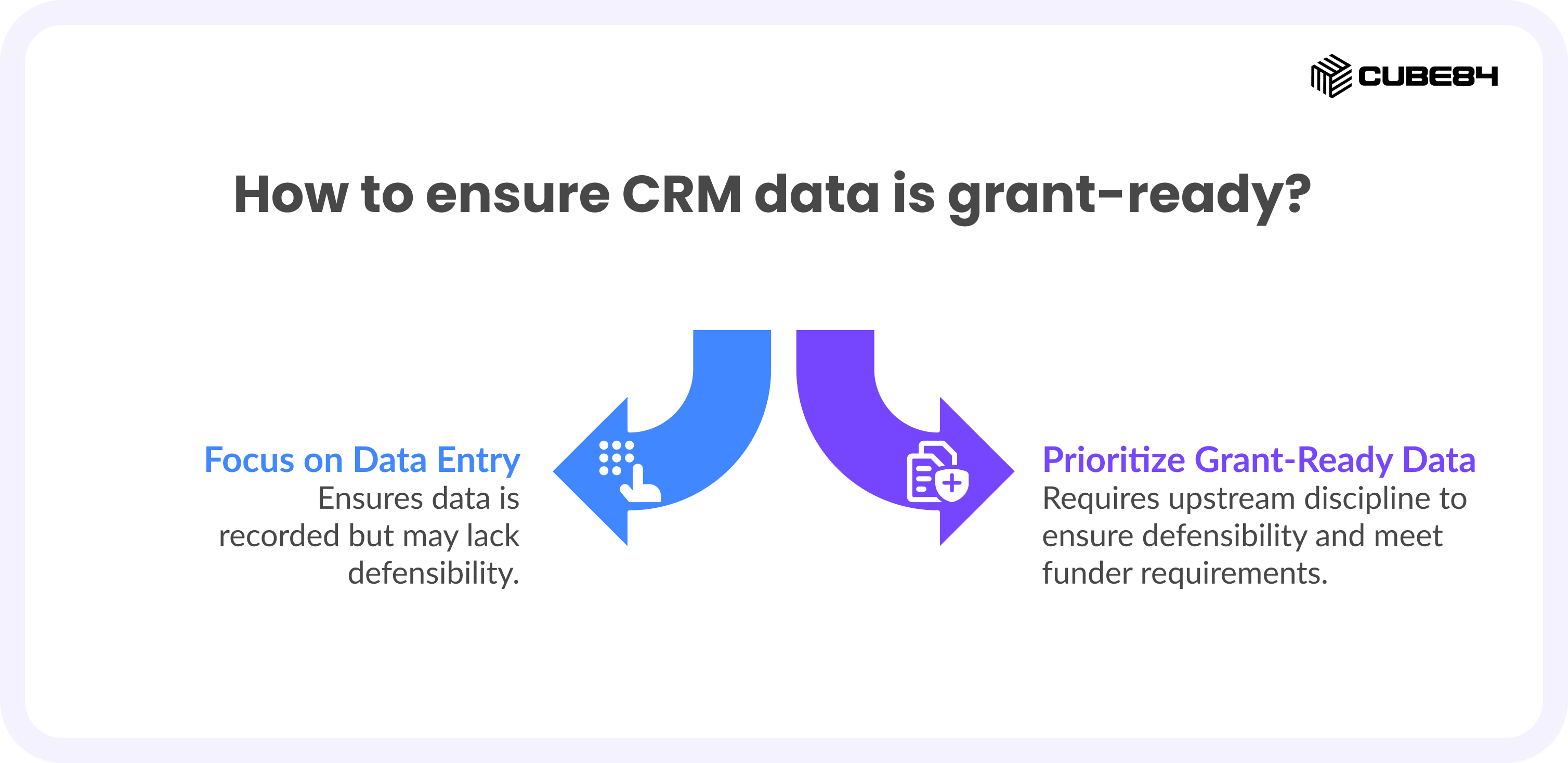
The difference between entered data and grant-ready data is subtle but significant.
Entered data answers the question: “Was something recorded?”
Grant-ready data answers the question:
“Can we defend this confidently to a funder?”
The latter requires upstream discipline.
What must be defensible during an audit?
What metrics are funders evaluating?
Which outcomes must be traceable to individual records?
Are frontline workflows realistic under pressure?
When these questions guide nonprofit CRM consulting strategy, reporting becomes stable.
Confidence replaces reconciliation.
A Broader View of Nonprofit Data Risk
Nonprofit organizations operate in constrained environments.
Funding cycles shift. Political climates influence budgets. Staff turnover impacts data consistency. Resources are limited.
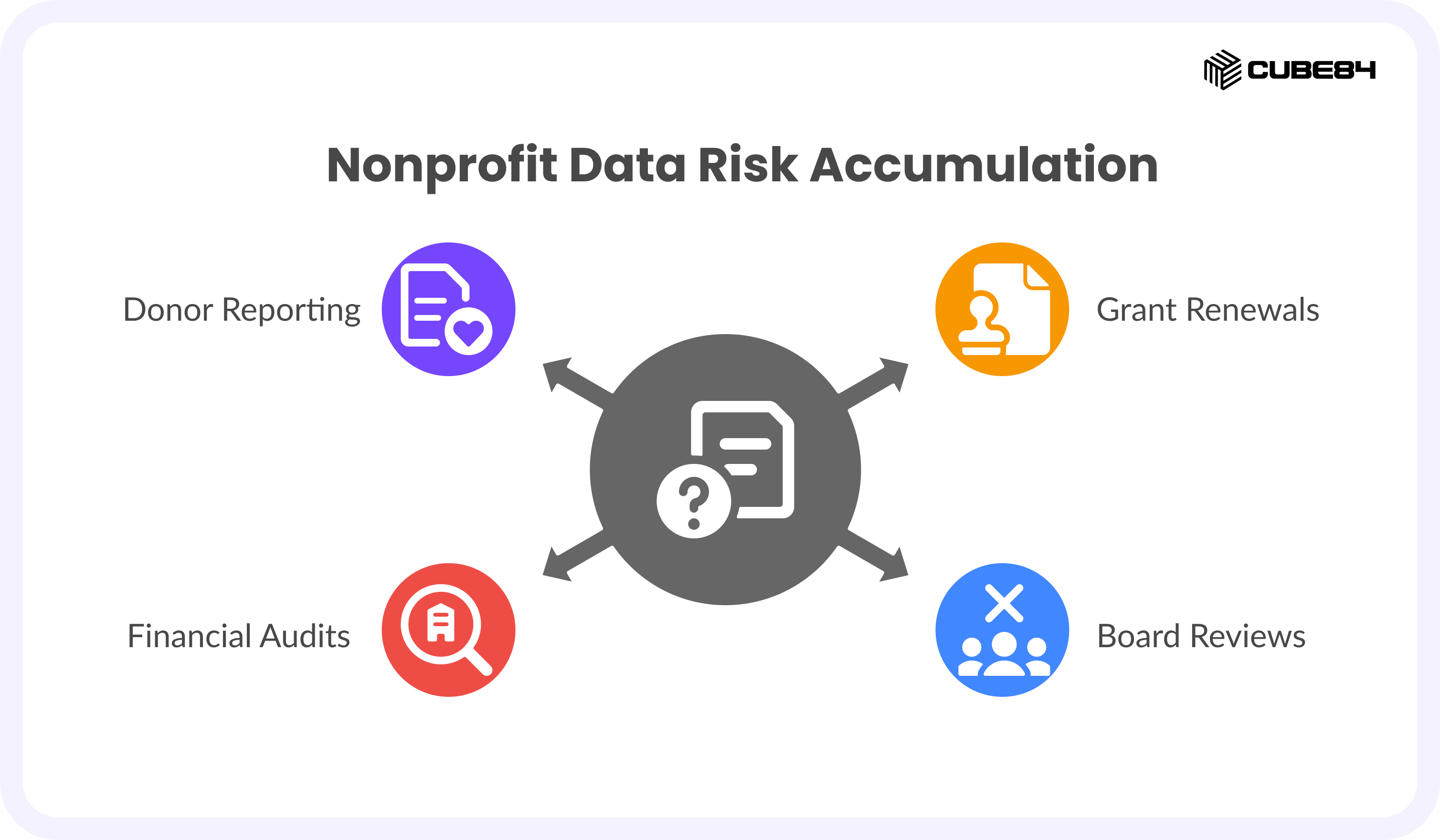
Under these conditions, small reporting inconsistencies accumulate quietly.
They may not impact day-to-day operations.
But they can surface during:
• Grant renewals
• Board reviews
• Financial audits
• Donor reporting cycles
Data risk is rarely catastrophic. It is cumulative.
And cumulative risk is difficult to detect without a structured review.
A Practical Starting Point
For nonprofit leaders evaluating their Salesforce environment, the question is not:
“Is our CRM working?”
A more useful question might be:
“If we were audited tomorrow, how much manual reconstruction would be required?”
That gap between live system reporting and manual correction is often where data risk lives.
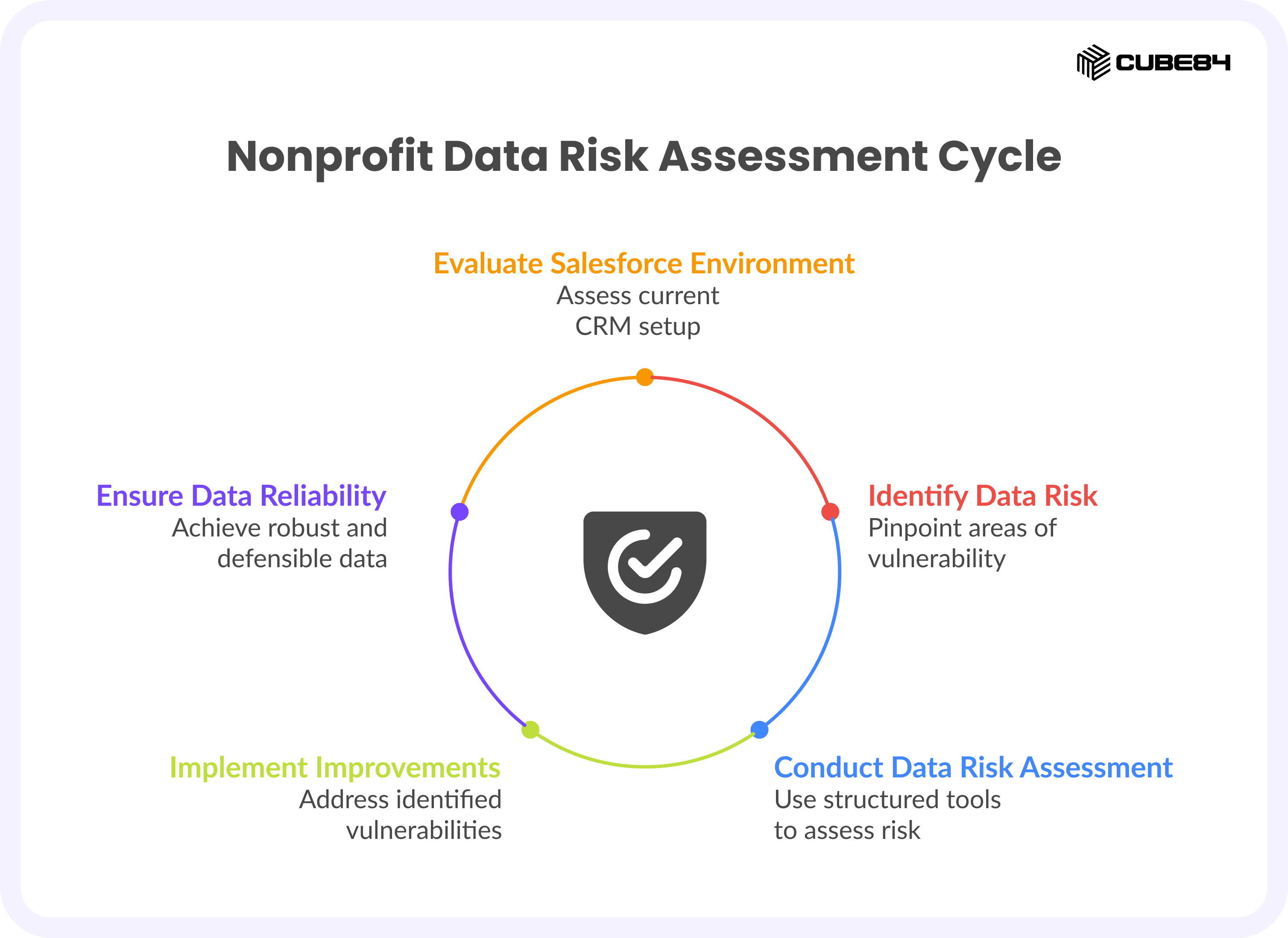
For organizations seeking clarity around this issue, we have created a structured Nonprofit Data Risk Assessment to help identify areas of reporting vulnerability and system misalignment.
It is not an implementation review.
It is a defensibility review.
Salesforce is a powerful platform for nonprofit organizations.
But power alone does not create reliability.
Grant-ready data emerges when system design begins with funding alignment, when frontline experience shapes configuration, and when adoption extends beyond launch. Technology centralizes information. An intentional consulting strategy makes it defensible.
If you would like to evaluate how defensible your current reporting structure is, you can explore our Nonprofit Data Risk Assessment here.
FAQs:
1. What makes Salesforce data grant-ready for nonprofits?
Grant-ready Salesforce data is structured specifically to meet funding and audit requirements. It aligns custom fields and reporting logic with grant outcomes, enforces consistent data entry before the reporting season, and minimizes reliance on manual spreadsheet adjustments. The difference between entered data and grant-ready data is defensibility - whether the information can be confidently presented to funders, boards, or auditors without reconstruction.
2. Why do nonprofit Salesforce implementations fail after go-live?
Many nonprofit Salesforce implementations focus heavily on configuration and training but overlook adoption and operational alignment. Go-live marks the beginning of real-world usage, not the completion of change. Without frontline involvement in design and continued reinforcement after launch, reporting discipline weakens under pressure. Adoption gaps often surface months later during funding or audit cycles.
3. How can a Salesforce nonprofit consultant reduce data risk?
A Salesforce nonprofit consultant reduces data risk by aligning system design with funding requirements from the outset. This includes mapping grant outcomes to CRM fields, reviewing reporting defensibility, identifying manual correction patterns, and involving operational staff in configuration decisions. The goal is not just system functionality, but reporting reliability and audit readiness.
4. What is nonprofit data risk in a CRM system?
Nonprofit data risk refers to structural misalignment within a CRM that leads to inconsistent reporting, incomplete outcome tracking, or reliance on manual adjustments. It often accumulates gradually through shortcuts taken under time pressure. While daily operations may continue without disruption, data risk becomes visible during grant renewals, board reporting, or audits.
5. How do nonprofits align Salesforce with grant reporting requirements?
Alignment begins by identifying what must be defensible to funders before configuring objects, fields, and reports. Grant reporting requirements should shape data models, required fields, and workflow design. When reporting expectations are defined early and reinforced through an adoption strategy, Salesforce becomes a funding-aligned system rather than a record-keeping tool.