

Data problems? We all know the stakes when it comes to enterprise technology.
Data is the absolute center of gravity for your entire business. Your organization knows this all too well. It feeds your marketing campaigns, directs your sales teams, and dictates whether your customer experience feels seamless or deeply broken. When you mess up that foundational data layer, you do not simply get a few bad reports. You break absolutely everything built on top of it.
Right now, your team already has enough on its plate. You are navigating shifting privacy laws, trying to hit aggressive revenue targets, and figuring out how to roll out AI tools like Agentforce without risk. A stalled, budget-draining Salesforce Data Cloud implementation should not be added to that list.
The excitement around Data Cloud is massive, but out in the field, we see a very different reality playing out. We walk into rescue projects where teams burn through consumption credits in the first few months, deal with broken integrations, models that are difficult to maintain, and struggle while ROI keeps slipping.
Many teams assume Data Cloud will organize a chaotic database. In reality, it works with what you bring into it. Messy data quickly becomes an expensive liability that ruins your unified audiences and AI initiatives. These failures do not come from the platform itself. They trace back to five critical setup decisions. Here is what we have learned and how to keep your project out of the rescue zone.
Section 1: The Harsh Reality of Data Cloud Implementations Today
When an implementation goes sideways, the symptoms are almost always the same. Teams experience budget overruns almost immediately, user adoption drops to zero, and the unified profiles look so messy that the marketing team refuses to use them.
The business impact here is severe. Campaign launches get delayed, personalization stops working, and campaign efficiency drops and acquisition costs tend to rise. Furthermore, any grand plans for Agentforce or AI struggle to move into production because the data foundation is unreliable.
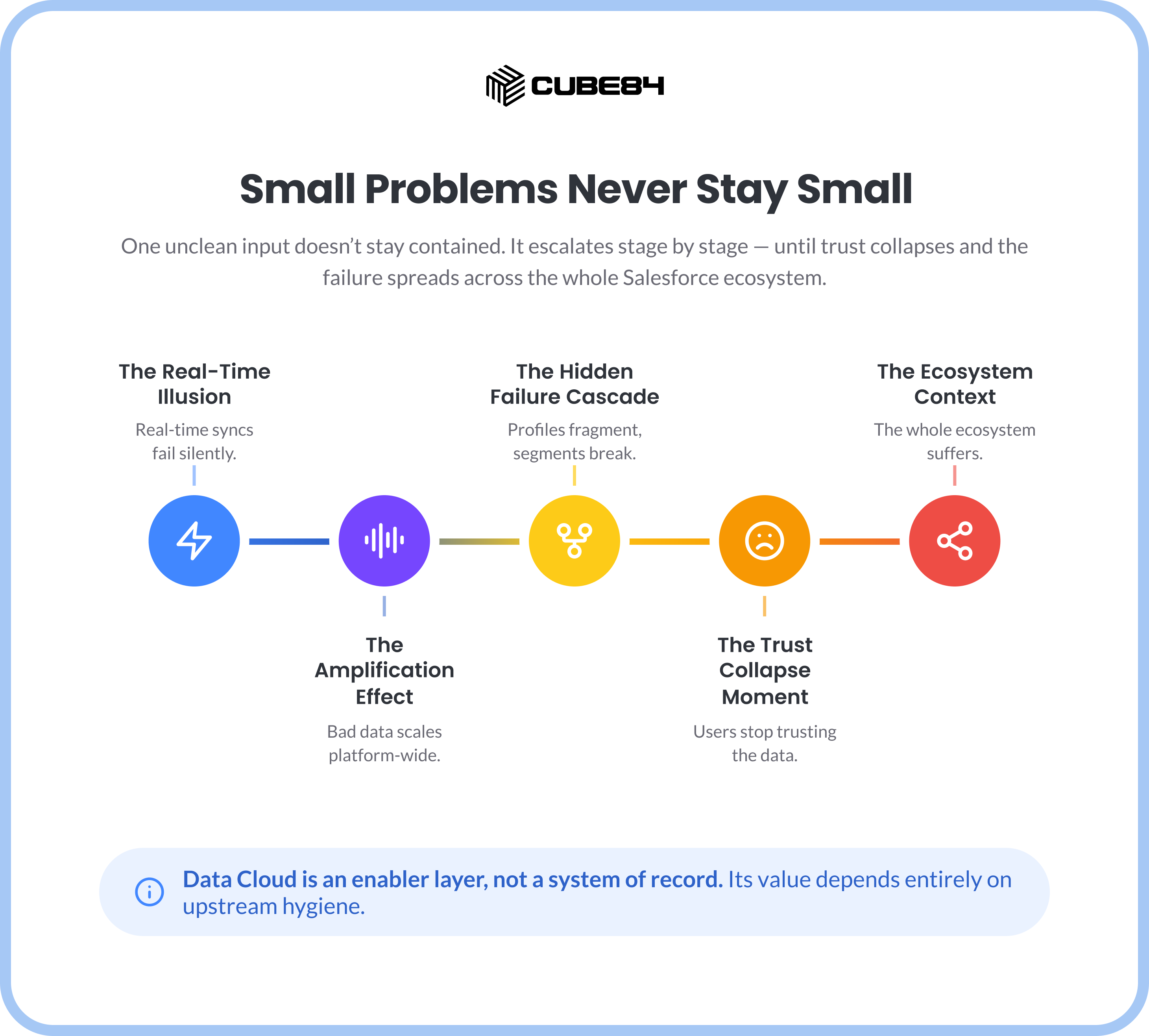
Data Cloud is an enabler layer, not a system of record. Its value depends entirely on your upstream Salesforce hygiene, your use-case clarity, and your foundational architecture decisions.
The Real-Time Illusion
Everyone wants instant data activation. The reality is that "real-time" syncs often suffer from silent failures. An expired authentication token or a slight schema mismatch between systems can block data from moving downstream. When this happens, there is often no clear alert, and teams notice only after something breaks. The result is missed engagement windows, broken customer journeys, and campaigns that simply do not perform.
The Amplification Effect
Poor data quality does not stay contained in one part of your system. Once it enters Data Cloud, it starts affecting how profiles are built and how audiences are defined. If you feed bad data into Data Cloud, it negatively impacts identity resolution accuracy and breaks AI grounding. Targeting goes off. Conversion drops. And the reporting stops making sense.
The Hidden Failure Cascade
Small issues upstream always expand downstream. If you have duplicate or inconsistent records in your core Sales or Service systems, those turn into fragmented unified profiles in Data Cloud. Those fragmented profiles then show up as inconsistent or incomplete segments during activation. This translates directly to wasted marketing spend, duplicated outreach, and a highly degraded customer experience.
The Trust Collapse Moment
The biggest failure we see is not technical at all. It is a collapse of trust. When users stop trusting the data, adoption drops entirely. Marketing teams will revert to pulling manual CSV files, and your ROI stalls out. You are left with an underutilized platform, slower decision-making, and the return of shadow IT systems.
The Ecosystem Context
You also have to consider the broader Salesforce ecosystem. If you chase "real-time everything" without foundational discipline, your Sales Cloud readiness, Marketing Cloud activation, and Tableau insights all suffer. The business impact is a fragmented customer view and AI outputs that lack basic business context.
Section 2: Top Pain Points, Root Causes, and Broader Impacts
Let us look at the actual pain points we see in the trenches, the root causes behind them, and the early warning signs you need to watch out for.
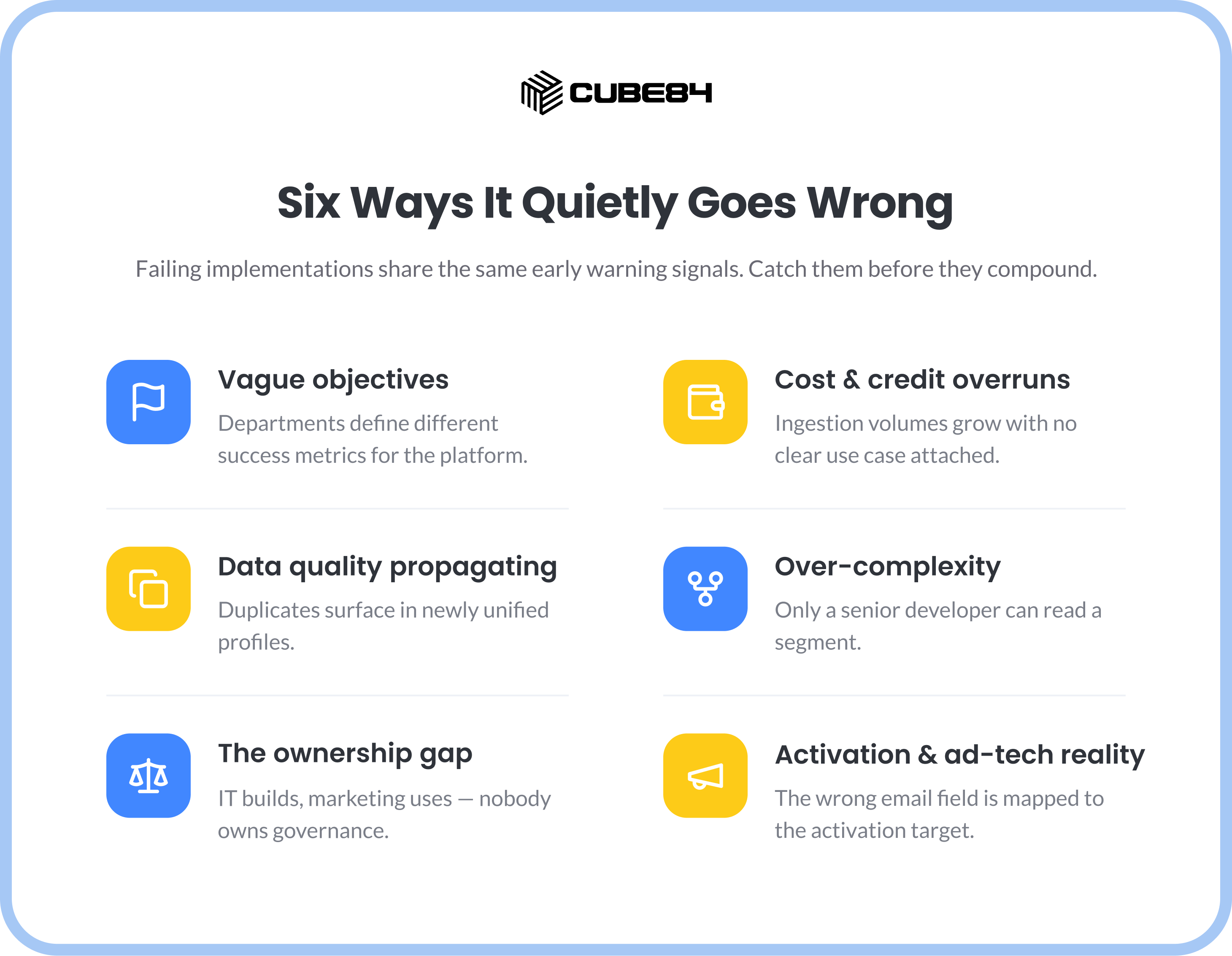
Vague Objectives and Misaligned Use Cases
An early signal of trouble is when multiple departments define different success metrics for the platform. If IT wants data centralization but Marketing wants faster email sends, you have a problem. This leads to unclear ROI, misaligned investments, and features that get built but never adopted.
Cost Overruns and Poor Credit Visibility
Data Cloud runs on consumption credits. An early warning sign is ingestion volumes growing without a clear use-case attached to them. Identity Resolution rules, high-frequency streaming, and poorly scoped data models act as massive credit multipliers. Pricing does not just increase with data volume. It increases with frequency, complex table joins, and recalculations. The result is budget exhaustion within months and an inability to scale.
Data Quality Issues Propagating
If you see duplicate or incomplete records showing up in your newly unified profiles, your upstream data is contaminated. What starts as a small issue in CRM quickly turns into unreliable segments and poor personalization decisions.
Over-Complexity Killing Usability
If your segments and insights can only be understood by a senior developer, the platform will fail. Marketing becomes entirely dependent on engineering, campaign execution slows to a crawl, and platform adoption dies.
Governance and The Ownership Gap
Often, IT builds the pipelines, Marketing is expected to use the outputs, but nobody actually owns the shared governance. This lack of alignment between schema design and business usage means you have a technically complete system that nobody uses. Post-go-live, data quality gradually degrades, usage patterns become inconsistent, and long-term value is lost.
Activation and Ad-Tech Reality
Activating an audience is not just pushing a sync button. It depends heavily on consistent identifiers, exact subscriber key alignment, and match rates across platforms like Meta or Google. If you map the wrong email field, your audience match rate plummets, resulting in underperforming campaigns and wasted ad spend.
You also have to navigate legacy systems, data silos, skill gaps on your team, and massive compliance implications. For example, merging records with conflicting consent statuses can trigger compliance risks very quickly if not handled correctly.
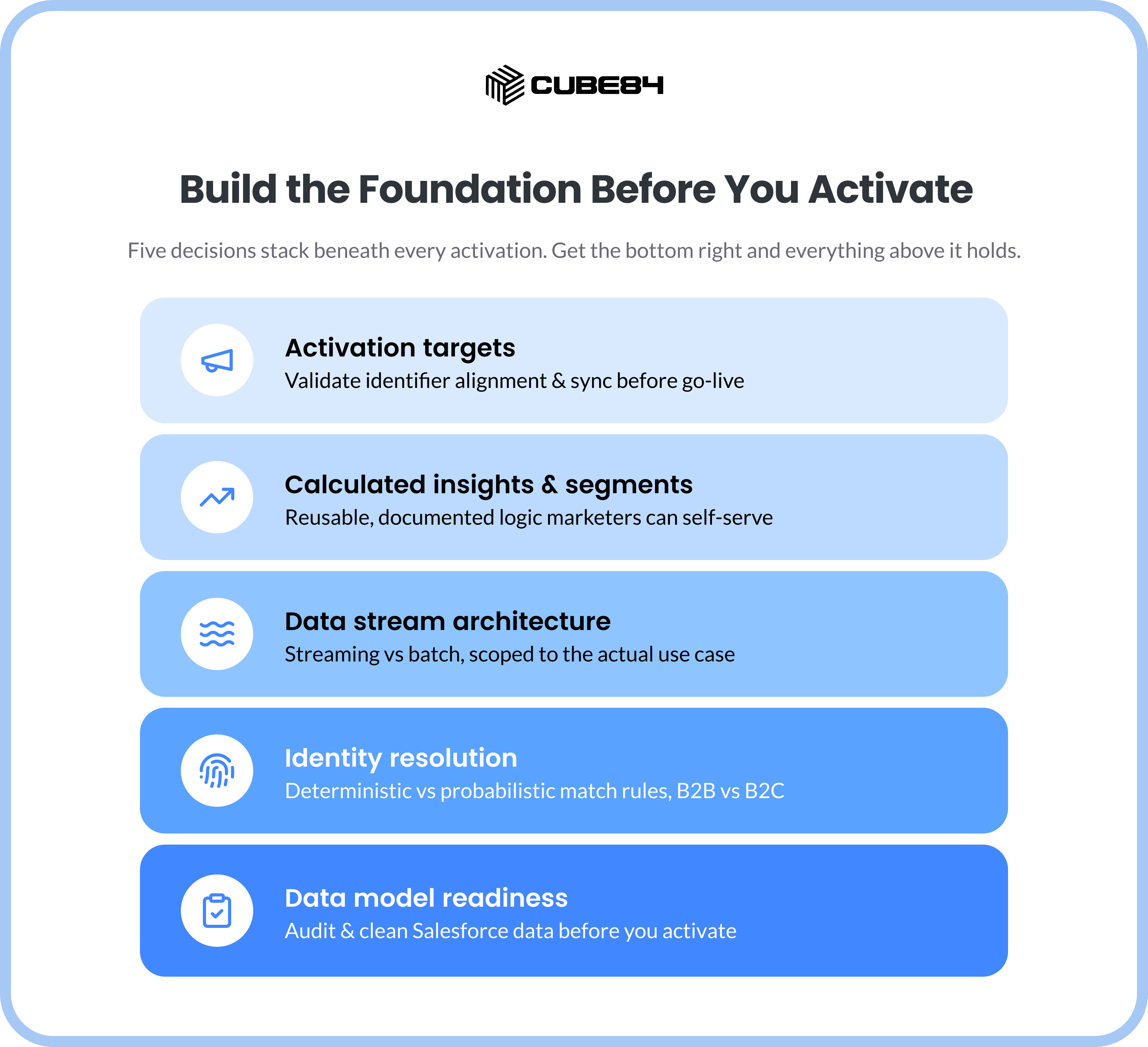
Section 3: The 5 Critical Setup Decisions
These are the exact decisions that dictate whether your implementation succeeds or becomes a rescue project.
1. Data Model Readiness Before Activation
Activating Data Cloud on top of unclean Salesforce data compounds issues at the unified profile level. Data Cloud will expose your inconsistencies faster than ever before.
You must run a strict pre-activation audit. We recommend looking at several concrete checks. You need acceptable duplicate thresholds for Contacts and Accounts. You must normalize field standardization for emails, phone numbers, and key identifiers. Ensure required fields are actually populated for segmentation rules. Validate referential integrity between Accounts, Contacts, and Opportunities. Archive low-value historical data before ingestion, enforce validation rules at the source, and always run a sample unification test on a controlled dataset before turning the system fully on. Clean inputs lead to accurate profiles and much faster activation timelines.
2. Identity Resolution Configuration
Over-merged or under-merged profiles destroy trust. This becomes especially visible in shared identifier scenarios or household-level data. If you merge a husband and wife into one profile, or create fifty profiles for the same customer, your activation accuracy is ruined.
If your match rules are vague, identity resolution will drift over time. Understand the difference between deterministic matching (finding an exact match like a shared email address) and probabilistic matching (using fuzzy logic to match similar names and zip codes). Account for the massive differences between B2B and B2C data models. B2B relies on account and domain matching, while B2C needs strict individual logic.
Identity Resolution is one of the largest credit consumers in the platform. Frequent reprocessing or overly complex rules will increase your costs significantly.
3. Data Stream Architecture
Streaming every single piece of historical data increases cost and complexity for no reason. Just because you can stream everything does not mean you should.
You have to decide between streaming and batch processing based on the actual use case. For a Phase 1 scope, prioritize core objects and limit your ingestion. Expand in Phase 2 only based on proven ROI. High-frequency streaming dramatically increases your consumption, especially on high-volume objects. Optimizing this architecture directly reduces your cost and improves platform performance.
4. Calculated Insights and Segment Design
A lack of clear business logic creates unmaintainable assets. If your business users cannot understand how a segment is built, they simply will not use it.
If this is not documented upfront, it usually breaks later when teams try to reuse or scale the logic. Build a reusable insight library so marketers can drag and drop foundational metrics without calling IT. Establish a strict governance and review process. Remember that Calculated Insights and segment refresh frequency directly impact your cost. Complex joins and massive datasets increase compute consumption rapidly.
5. Activation Target Configuration
There is often a massive misalignment between Data Cloud and your activation systems. A segment might show 50,000 people in Data Cloud, but only 10,000 show up in Marketing Cloud.
Before go-live, you need to validate identifier alignment, run sync testing, and do audience validation. Monitor your segment population against your refresh cycles. The most common failure patterns are empty audiences, mismatched subscriber keys, and delayed syncs. If activation fails, the rest of the system loses its value, campaigns fail to execute, and direct revenue is impacted.
Section 4: Cross-Functional Reality, Governance, and Ecosystem Considerations
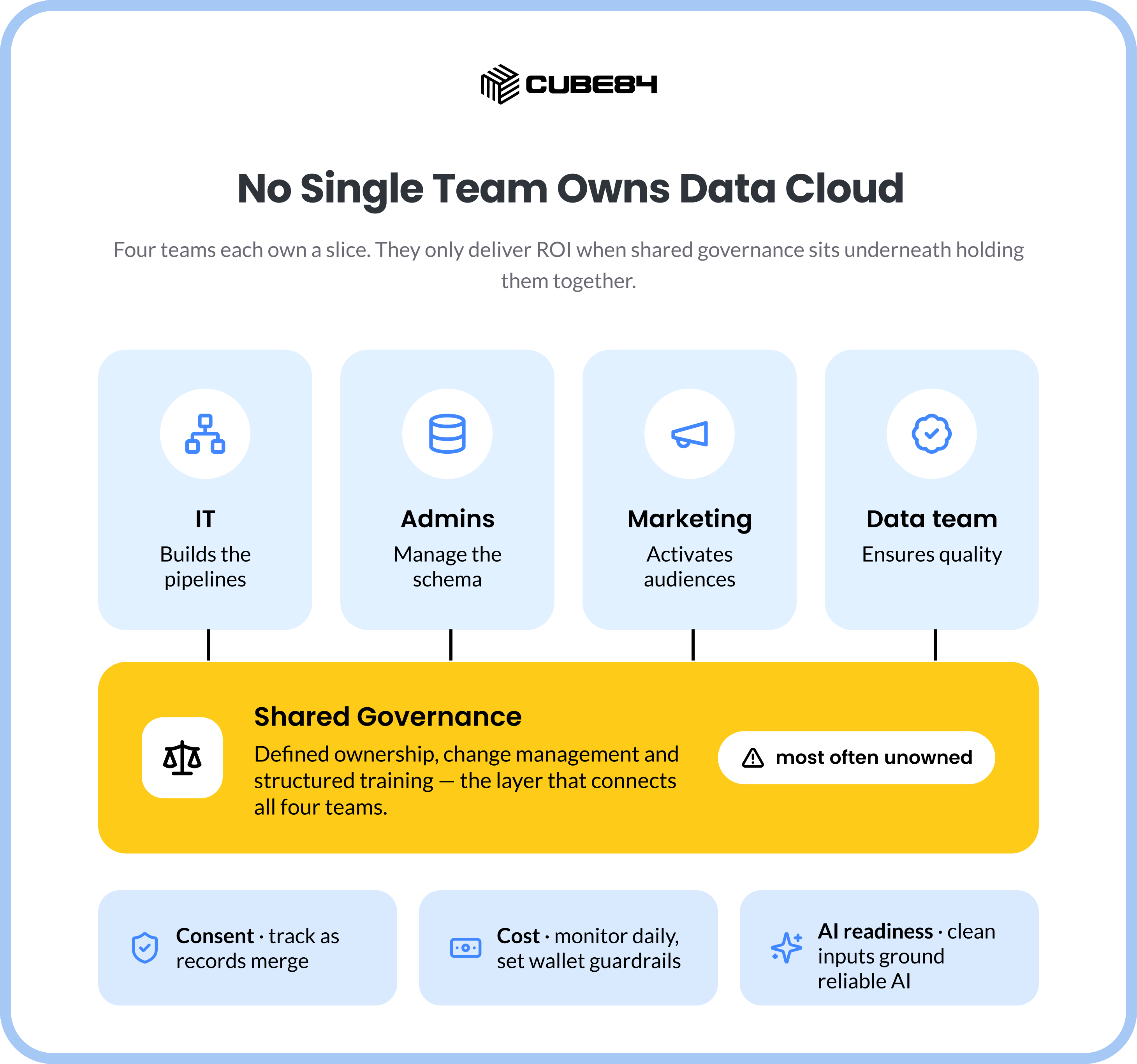
Data Cloud is absolutely not a single-team system. IT builds pipelines, admins manage the schema, marketing activates the audiences, and data teams ensure quality. A lack of alignment here leads to delayed ROI. You need strong change management, defined ownership, and structured training.
You must also navigate consent complexity. Consent becomes messy quickly once records begin merging across systems. There is a high risk of combining records with conflicting permissions, which brings compliance risks and reputational damage. You need policy-driven governance to manage this.
Cost governance is equally critical. You must implement forecasting techniques, monitor consumption daily, and set digital wallet guardrails to ensure predictable spend and sustainable scaling.
As you look toward scaling to AI and Agentforce, remember that data quality directly impacts AI grounding. When inputs are inconsistent, AI outputs become unreliable and difficult to trust in real use cases. You also need to plan for long-term maintenance, continuous monitoring, and avoiding post-go-live decay so your system sustains its value over time.
Section 5: Data Cloud Implementation Readiness Assessment
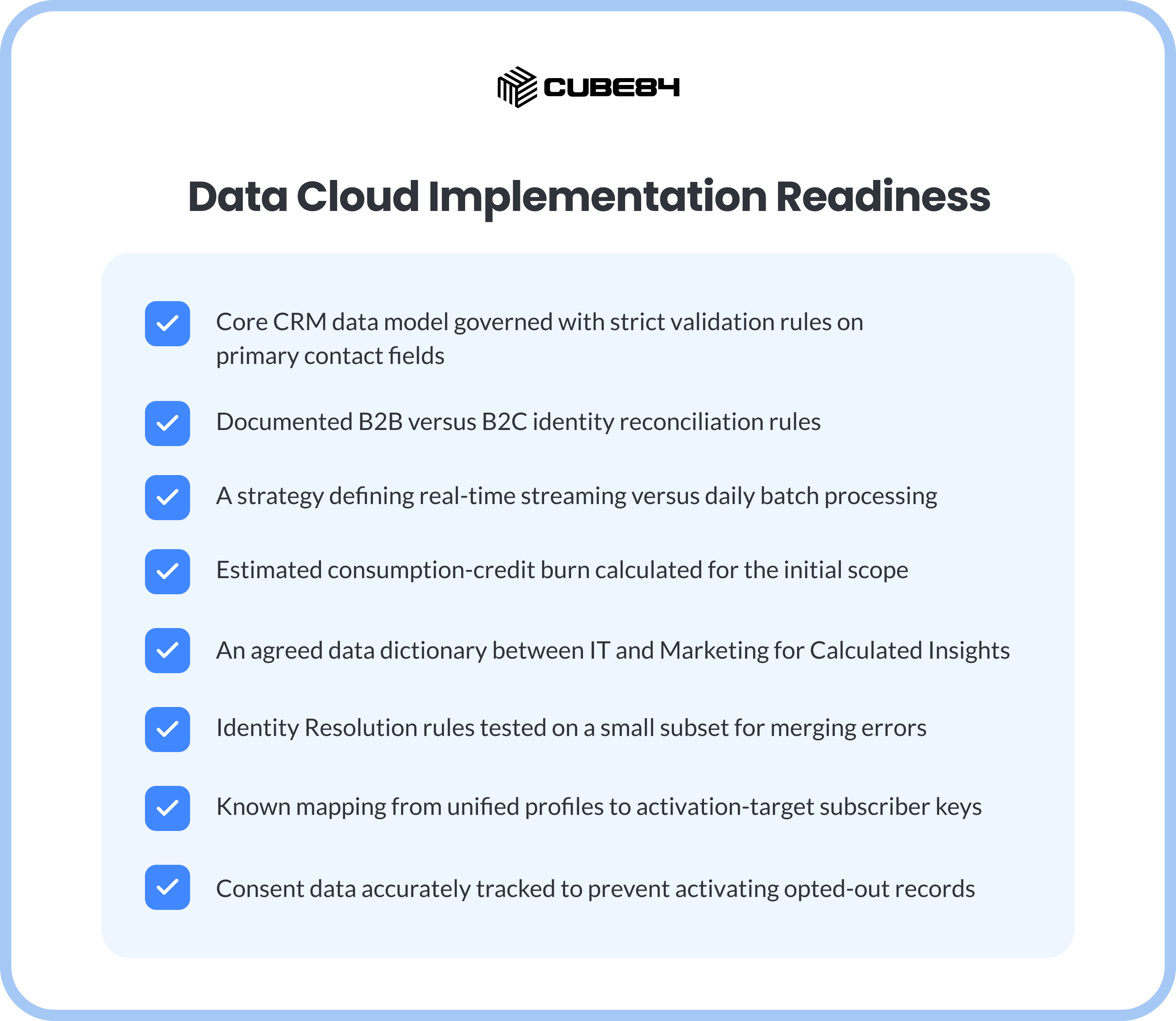
Before you activate, ask your team these eight questions. If you score low, pause your activation and fix your foundations. If you score high, proceed with a phased rollout.
Is your core CRM data model governed with strict validation rules on primary contact fields?
Have you documented your specific B2B versus B2C identity reconciliation rules?
Do you have a strategy defining what requires real-time streaming versus daily batch processing?
Have you calculated your estimated consumption credit burn based on your initial scope?
Is there an agreed-upon data dictionary between IT and Marketing for Calculated Insights?
Have you tested Identity Resolution rules on a small data subset to check for profile merging errors?
Do you know exactly how Data Cloud unified profiles will map to your activation target subscriber keys?
Is your consent data accurately tracked to prevent activating opted-out records?
We always recommend the "Thin Slice" approach over a "Big Bang" deployment.
Connecting everything at once is a high-risk pattern. Start with a focused use case, prove the value, and expand incrementally. Phased execution reduces your risk, improves adoption, and speeds up your time to value.
Turning the Key on Data Cloud
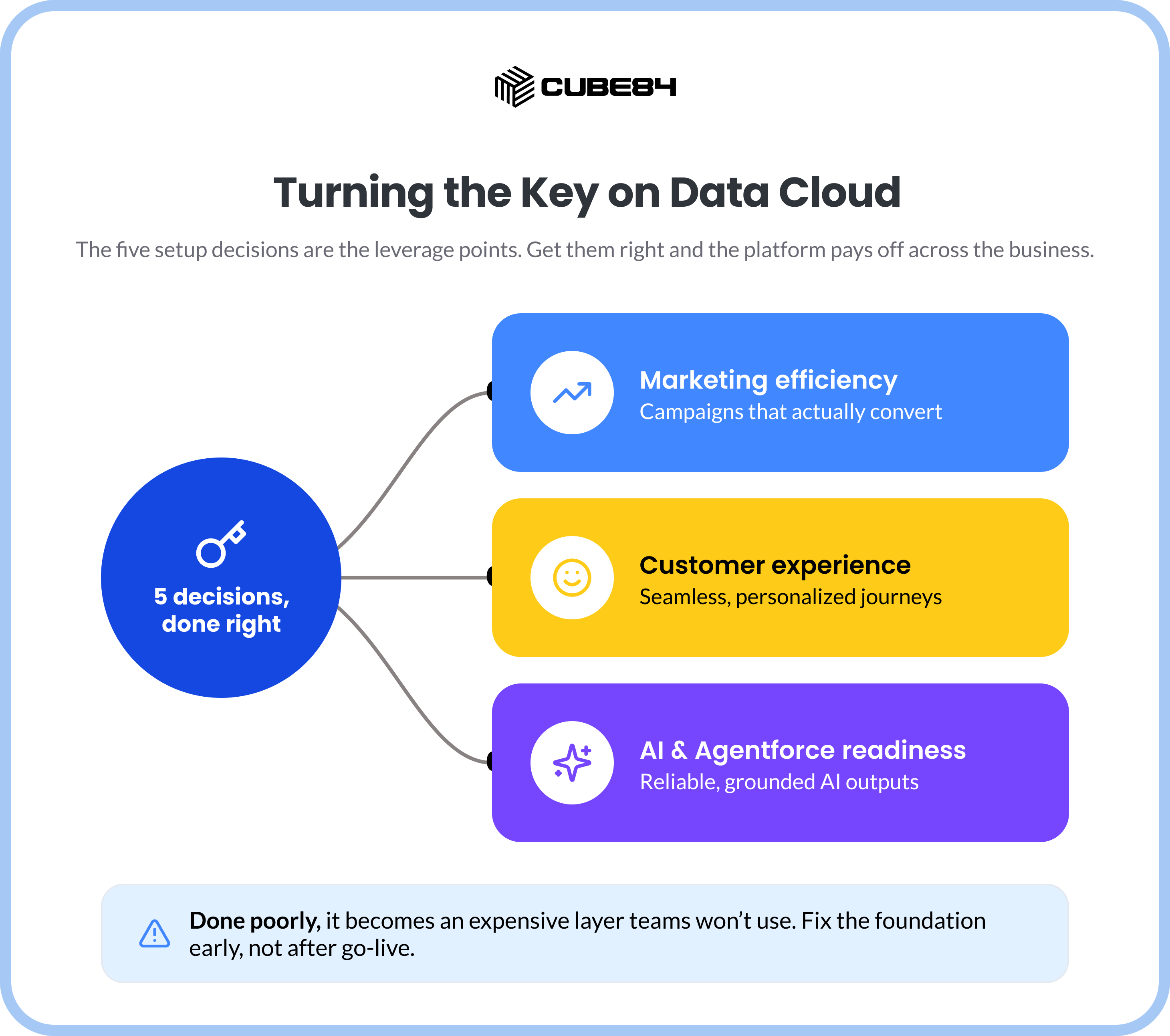
These five setup decisions are the critical leverage points of your entire project. Data Cloud changes how organizations operate on data. When done right, it drives measurable outcomes across marketing efficiency, customer experience, and AI readiness. When done poorly, it becomes an expensive layer that teams struggle to use.
Strong implementations are the ones where teams fix the foundation early instead of trying to repair things after go-live. If you are experiencing low adoption, rising costs, or unreliable segments, it is time to look under the hood. If you want to stop burning credits and get your data architecture right, we'd love to talk!