

Your Funders Each Require Their Own System. Consolidation Was Never Your Decision.
For providers running more than one funding stream
A case manager finishes an intake, then does it again. Same household, same answers, second system. Then a third, because the youth beds answer to a different agency than the shelter beds. Ask a provider carrying more than one funding stream how many times one family gets typed into a database before anyone is housed, and the answer is never once.
The advice that comes back is always the same word. Consolidate.
That advice reads the duplication as an integration failure, the kind of thing a bigger implementation budget could buy its way out of. Not every system a provider runs is equally replaceable, though, and sorting them by who holds the decision is what makes the advice usable.
Three Tiers of System Choice, and an Agency Controls Only One
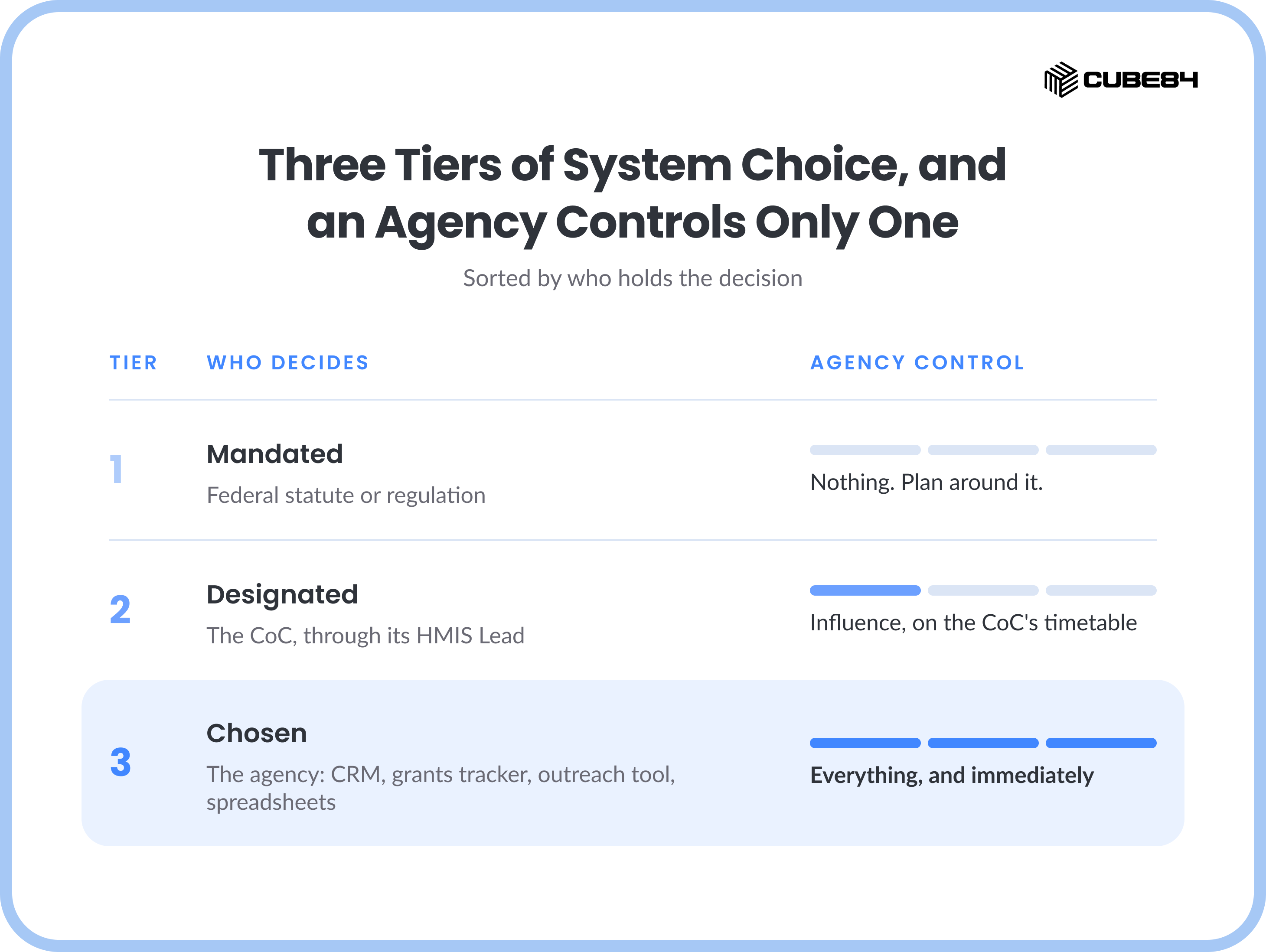
Three tiers of system choice, sorted by who holds the decision. Tiers one and two are drawn from 24 CFR 578.7(b)(1), 24 CFR 576.400(f), and HUD's HMIS Comparable Database Manual.
The consolidation conversation almost always aims at tier one and lands nowhere, which is why it recurs every year. Tier two is real but slow, moving at the speed of a governance body rather than a budget cycle. Tier three holds the decisions actually available, and telling the three apart is what this piece is for.
Nobody here defends double entry. Hours typed twice were meant for clients, and two records of one household disagree at audit rather than at entry. HUD wants what the sector wants, and the second goal of its Office of Special Needs Assistance Programs Data Strategy says so. The disagreement is about who holds the decision to end it.
Federal Rules Attach an HMIS to a Geography Rather Than to a Provider
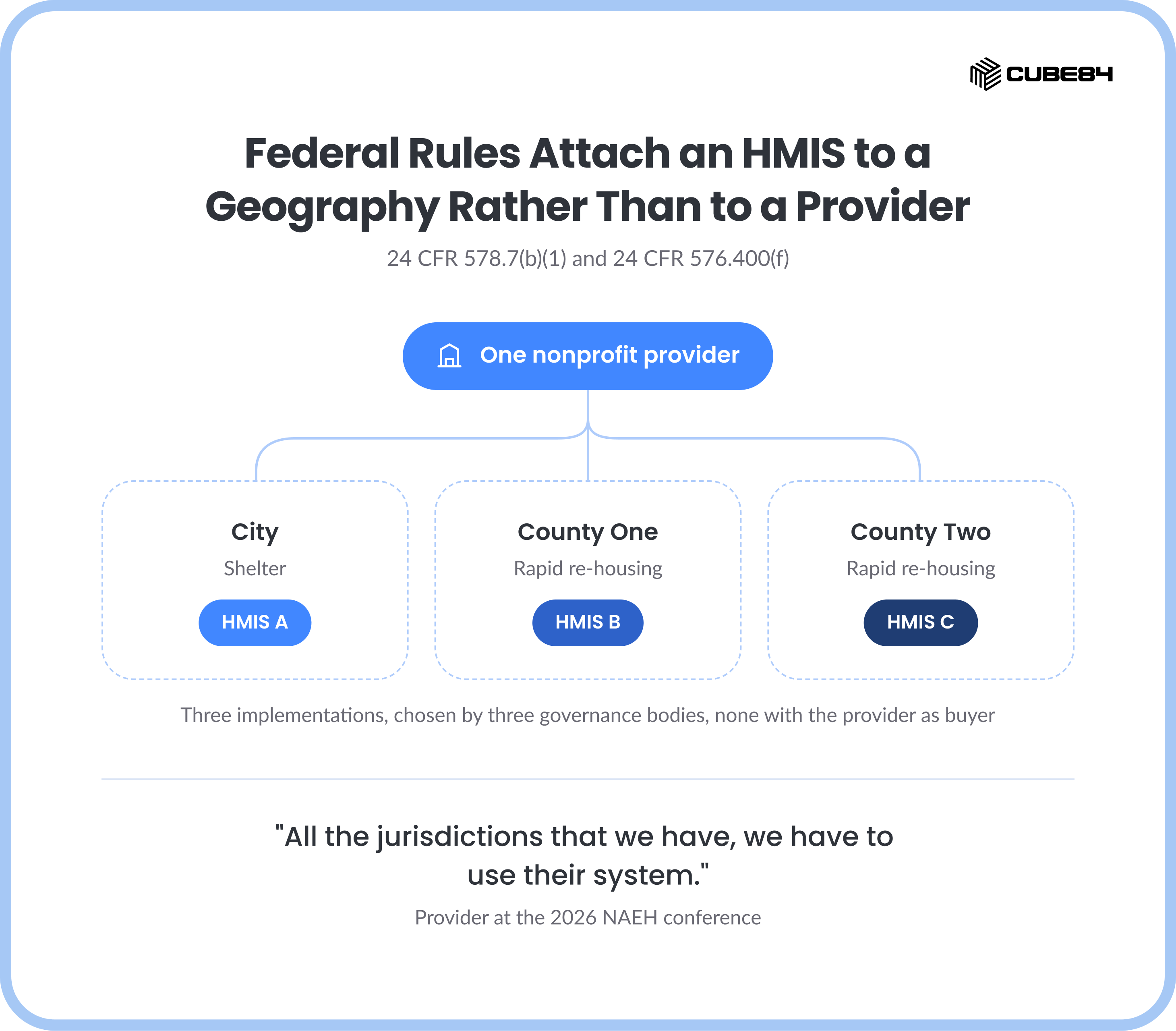
Two sentences of regulation set the count in tier one. Under 24 CFR 578.7(b)(1), a Continuum of Care must “Designate a single Homeless Management Information System (HMIS) for the geographic area.” Under 24 CFR 576.400(f), an Emergency Solutions Grants recipient must ensure that data on everyone served “are entered into the applicable community-wide HMIS in the area in which those persons and activities are located.”
Read together, the mechanism is plain. The product is chosen by the Continuum through its HMIS Lead, and the obligation to use it follows the geography of the service rather than the identity of the provider. A nonprofit running shelter in a city and rapid re-housing in two surrounding counties enters into three HMIS implementations chosen by three governance bodies, none of which it sat on as the buyer. A provider in exactly that position put it plainly at our 2026 National Alliance to End Homelessness booth, anonymized here as everywhere in this piece.
“All the jurisdictions that we have, we have to use their system.”
No procurement decision fixes that, because the agency was never the buyer.
A Victim Service Provider Keeps a Separate Database Because Federal Law Says So
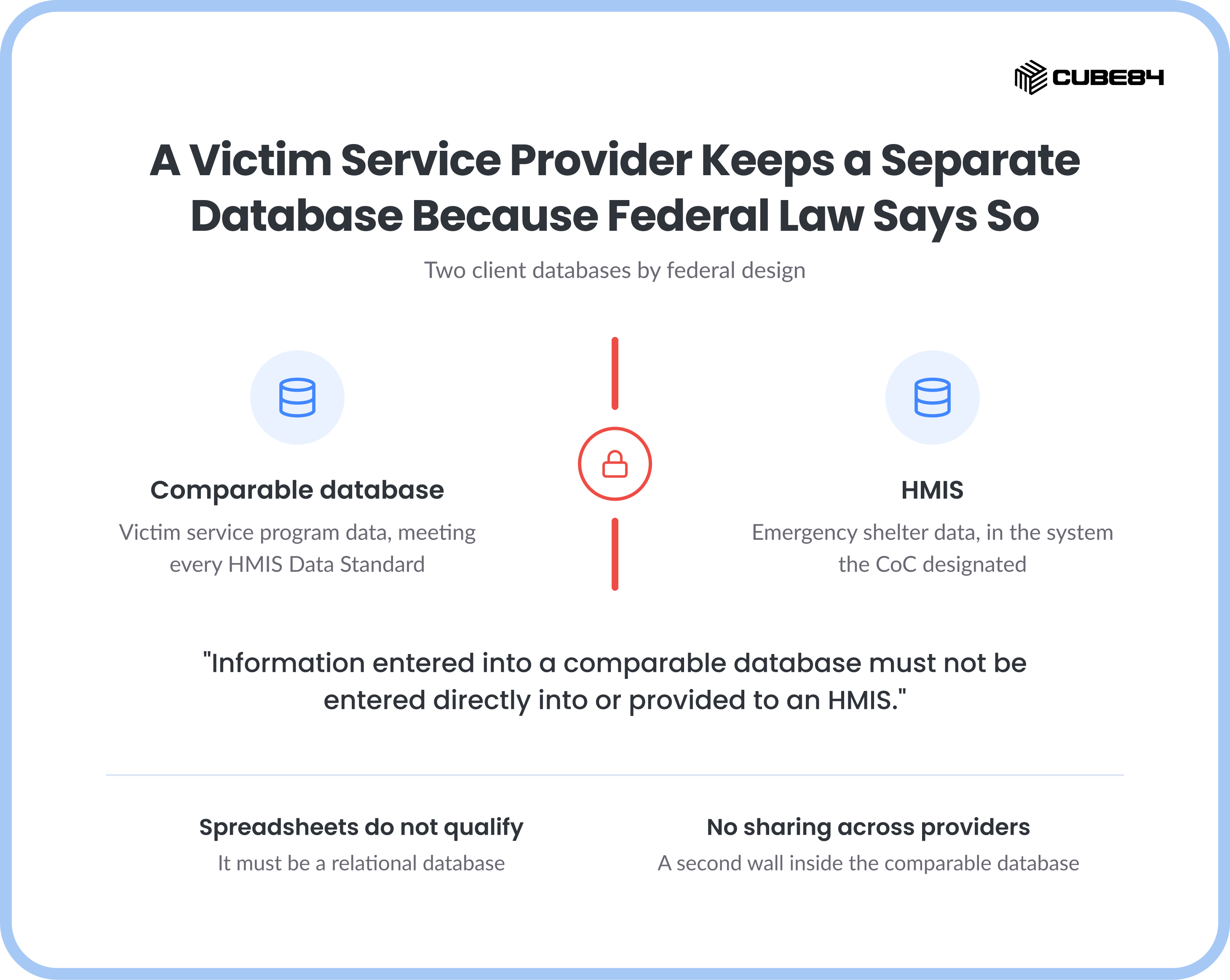
The second mandated case is narrower than it is usually described, and the narrowness is worth holding onto. The prohibition attaches to organizations that meet HUD's definition of a Victim Service Provider. It does not follow automatically from running a domestic violence program. For the organizations it does cover, HUD's Comparable Database Manual states it flatly: “VSPs are prohibited from entering data into HMIS.” The reason is the confidentiality language in the Violence Against Women Act and the Family Violence Prevention and Services Act, which that manual calls “strong, legally codified confidentiality provisions.”
A provider that qualifies runs a comparable database instead, defined by HUD as a relational database meeting every HMIS Data Standard, and the manual rules out the obvious shortcut by saying spreadsheets do not qualify. Then comes the sentence that decides the architecture, from 24 CFR 576.400(f): “Information entered into a comparable database must not be entered directly into or provided to an HMIS.” A second wall stands behind it, because under the Comparable Database Manual that implementation “may not allow for client information to be shared across multiple providers.”
So an agency that qualifies as a victim service provider and also runs an emergency shelter operates two client databases by federal design. For that data, an integration is a compliance question rather than a budget one, and what the vendor's API supports has no bearing on it.
Forty-Six Named Federal Funding Streams Can Land on One Project's Books
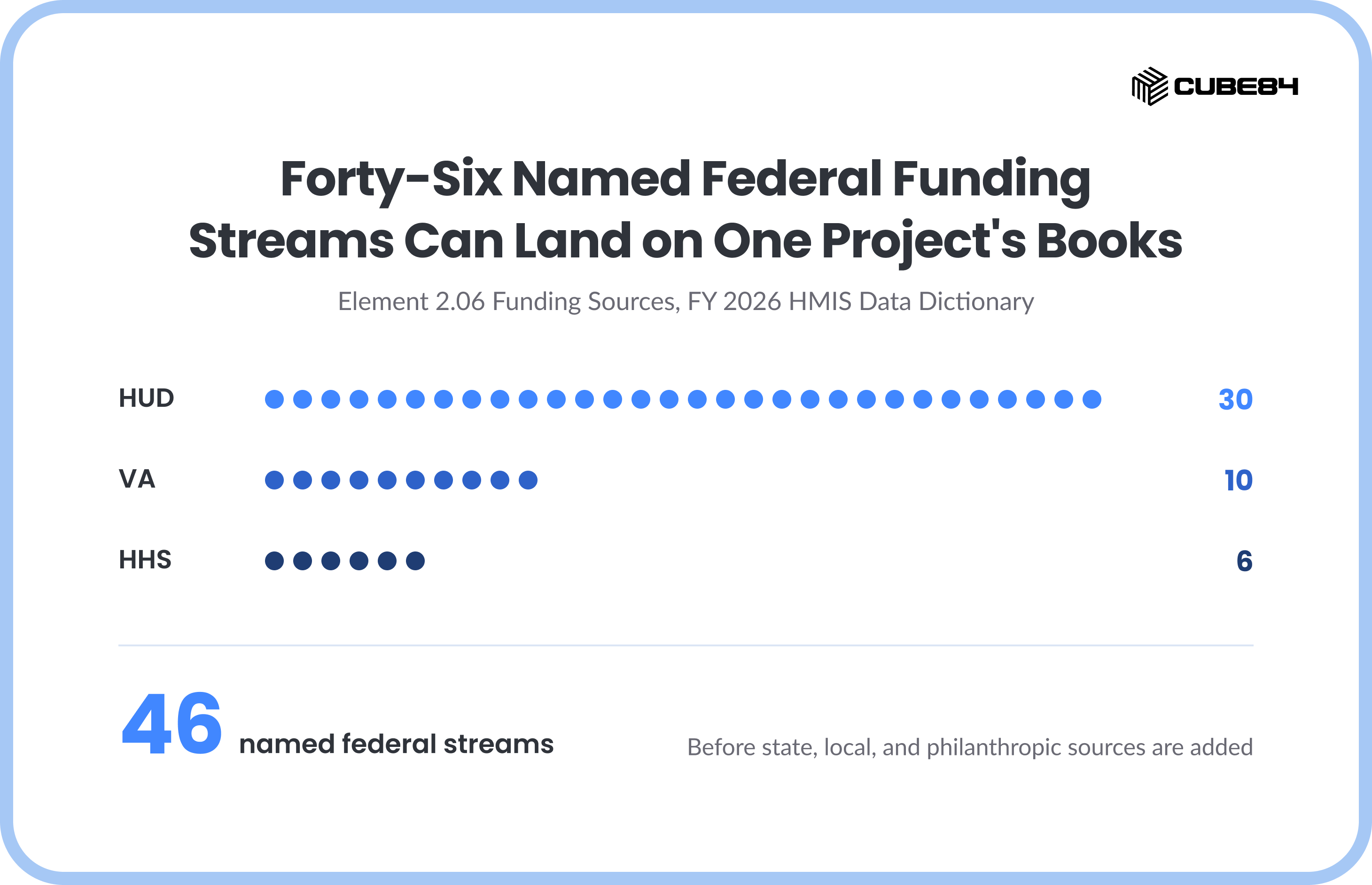
The plurality is not only geographic. Element 2.06 of the FY 2026 HMIS Data Dictionary lists the funders a project can record against. Set aside the two options retired for FY 2026, the N/A and the free-text catch-all, and 46 named federal streams remain, split 30 at HUD, 10 at the Department of Veterans Affairs, and 6 at Health and Human Services.
Named federal funding streams a single project may have to record. Counted from element 2.06 Funding Sources in the FY 2026 HMIS Data Dictionary, which lists 50 response options: two retired for FY 2026, one N/A, one free-text Local or Other Funding Source (Please Specify), and 46 named federal streams. Source: HUD, FY 2026 HMIS Data Dictionary, released October 2025. The preview renders these figures as a bar chart drawn to scale at 14 pixels per named stream.
Those 46 sit alongside the state, local, and philanthropic sources a housing nonprofit assembles to make a program viable, a separate stack with no HMIS obligation at all. The same dictionary makes the expectation explicit to vendors: an HMIS “must allow projects with multiple funder sources and multiple grants (with potentially different grant terms) from the same funding source to record and store all funding sources for the project.” HUD is describing a provider that has managed to stay funded.
Five Federal Funders, Forty Program Specific Elements, and No Single Intake Form That Fits
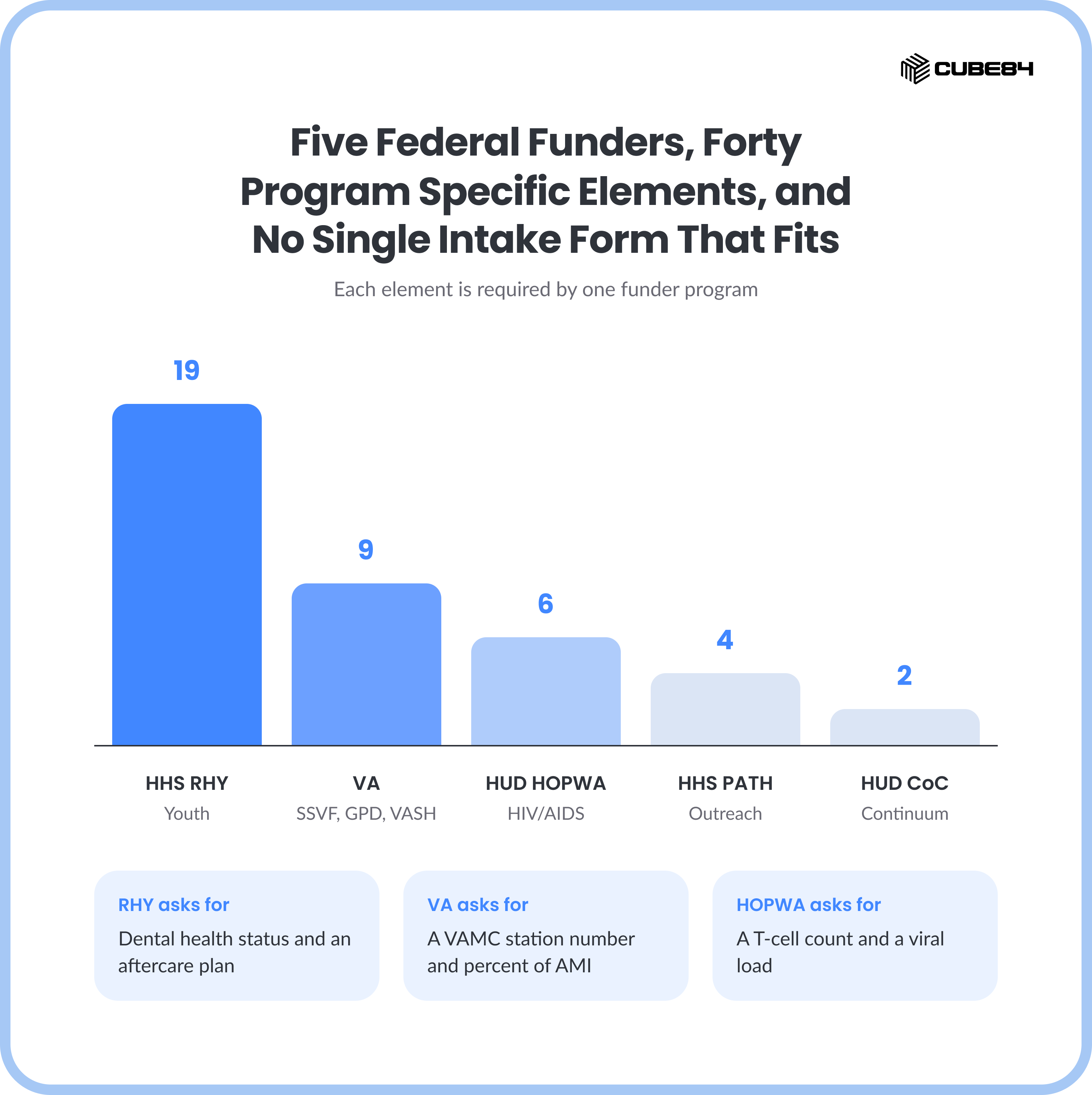
Suppose the geographic problem vanished and one system held everything. It would still answer to five different intake shapes. The Federal Partner Program Specific Data Elements section of the FY 2026 HMIS Data Dictionary carries 40 elements, each of them required by one funder program.
Program specific data elements, grouped by the funder program that requires each one. Counted by hand from the Federal Partner Program Specific Data Elements section of the FY 2026 HMIS Data Dictionary: HHS-RHY R1, R2 and R4 through R20; VA V1 through V4 and V6 through V10; HUD-HOPWA W1 through W6; HHS-PATH P1 through P4; HUD-CoC C2 and C3. Source: HUD, FY 2026 HMIS Data Dictionary. The preview renders these same figures as a bar chart drawn to scale at 20 pixels per element.
The distance between them is not cosmetic. The Runaway and Homeless Youth program asks for dental health status, whether the young person was formerly a ward of a juvenile justice system, and an aftercare plan. The Department of Veterans Affairs asks for a VAMC station number and a percentage of area median income. The Housing Opportunities for Persons With AIDS program asks for a T-cell count and a viral load. One intake form asking all 40 is usually a worse instrument than three forms asking only what each funder requires. The divergence lives in the requirements, so consolidating the container does little here.
The Same Client Record Has to Land in Four Separate Federal Front Doors
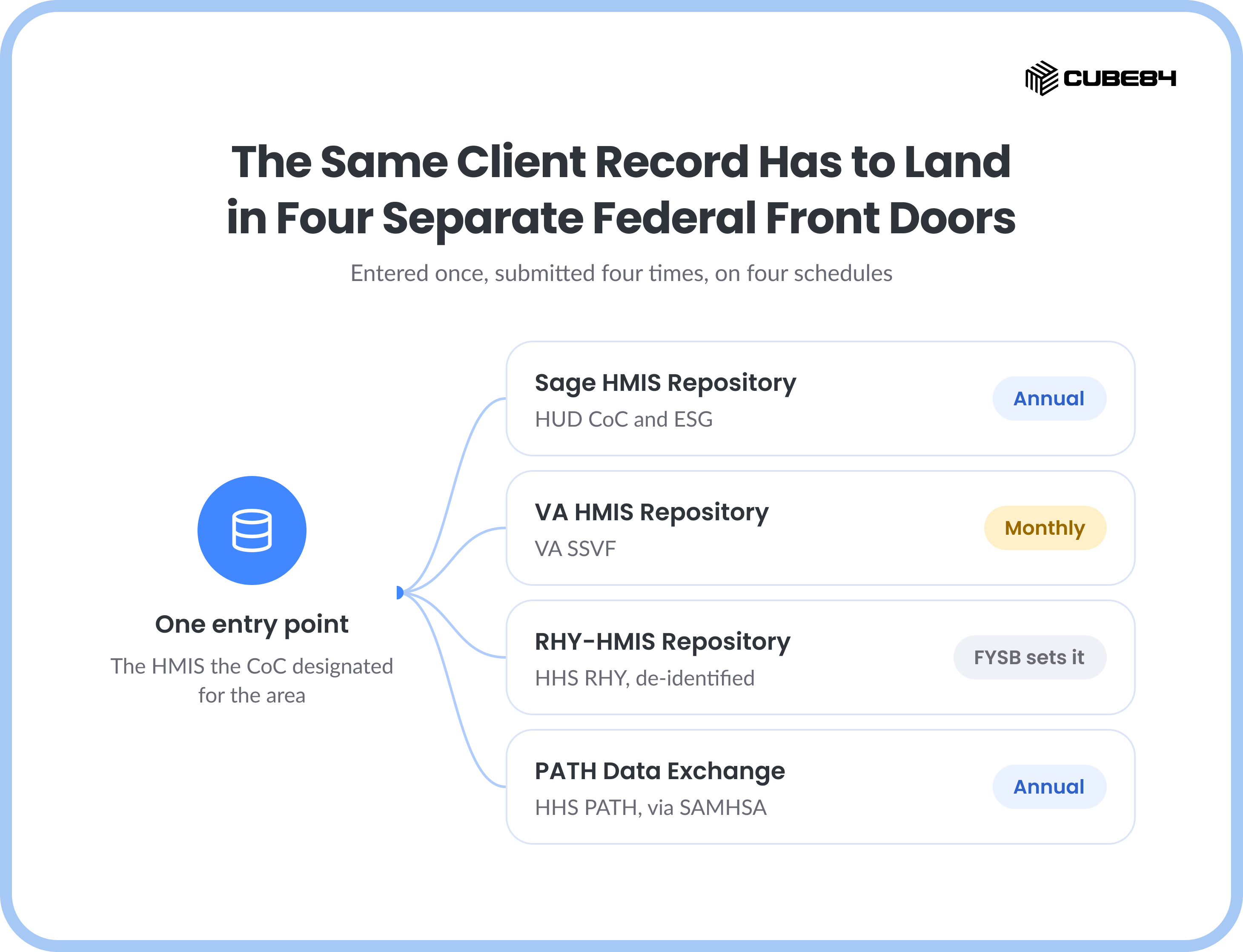
Data entered once still has to be submitted four times, to four agencies, on four schedules nobody reconciled with each other.
Four destinations for data entered in one place. Sources: HUD, Sage HMIS Reporting Repository; VA, SSVF HMIS and Data Reporting; HHS Family and Youth Services Bureau, RHY-HMIS Repository; and the PATH Data Exchange, which is open to PATH grantees and SAMHSA staff only.
The entry column is identical on every row and the destination column is different on every row, and the cadences do not line up either. One consolidated system does not collapse four submissions into one, because the four agencies never agreed to receive one.
The Strongest Case for Consolidation Says Integration Was Always the Real Ask
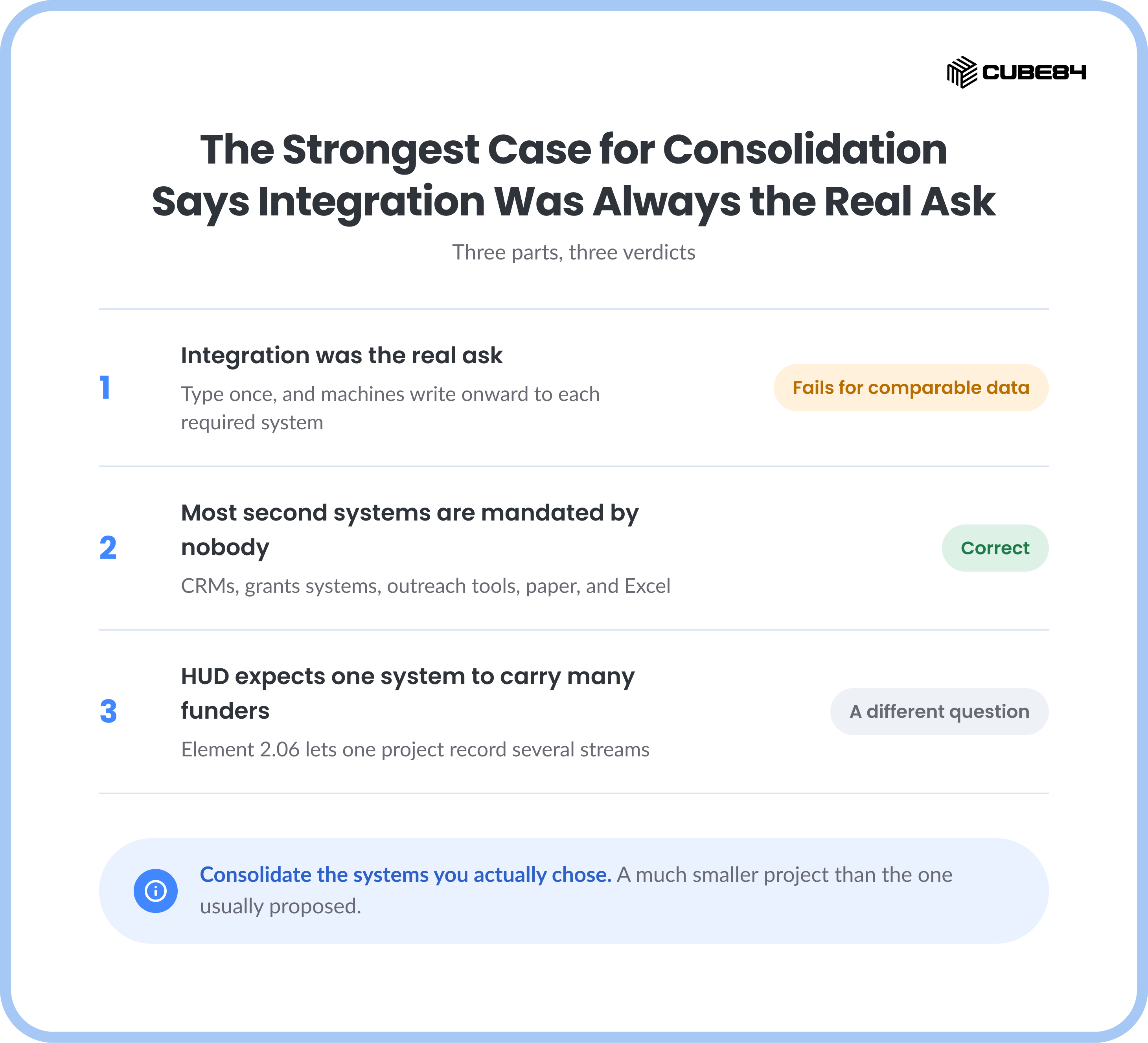
The best version of the opposing argument denies none of the above, and it has three parts. First, nobody asked to abolish the mandated systems. The ask was one place where staff type and machines write onward into each required system afterward, which is ordinary integration work that HMIS vendors already publish interfaces for. Second, most of the second systems in the field are mandated by nobody. Across our booth notes the second system was a CRM, a separate state HMIS instance, a grants system, a volunteer case-management tool, an outreach platform, a field survey tool, a low-code database, paper, and Excel. Roughly one case in fifteen involved a health record, which is the shape most people assume. Third, HUD's own dictionary anticipates one system carrying many funders, as quoted above.
The second point is correct, and it is the useful one. That accumulated layer genuinely is the agency's to consolidate. Conceding it relocates the advice rather than restoring it: the instruction becomes consolidate the systems you actually chose, a much smaller project than the one usually proposed.
The first point holds for most data and fails for some. Where the record is a comparable database, the write is forbidden whatever the interface supports, so an integration budget buys nothing there. Everywhere else the constraint is ordinary rather than legal: an integration needs a write permission in a system the agency does not own, which makes it a negotiation with an HMIS Lead on that Lead's timetable. The third point answers a different question. Element 2.06 lets one project inside one HMIS record several funding streams, which is real and useful. Section 578.7(b)(1) still hands the next county its own HMIS.
HUD Pays for a Data Warehouse Precisely Because Subrecipients Use Multiple Software Systems
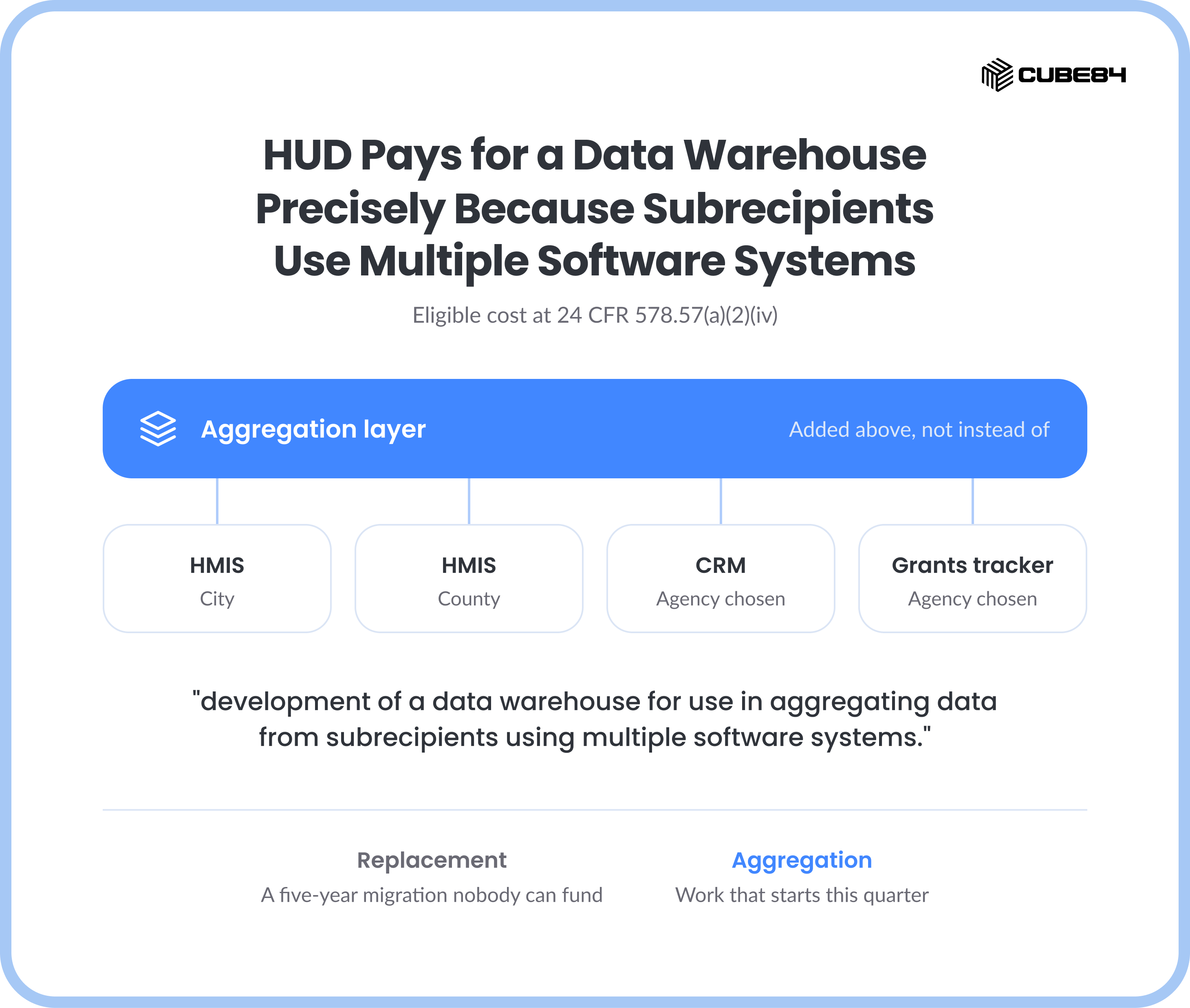
The most telling evidence sits in HUD's list of what Continuum of Care money may buy. Under 24 CFR 578.57(a)(2)(iv), an HMIS Lead may use those funds for “Integrating and warehousing data, including development of a data warehouse for use in aggregating data from subrecipients using multiple software systems.”
HUD wrote that clause knowing the systems would stay plural, and budgeted accordingly. The remedy in the regulation is aggregation rather than replacement, and aggregation is a layer added above the systems you are stuck with. That is the difference between a five-year migration nobody can fund and work that starts this quarter.
Tier Three Holds Two Decisions Worth Making on Purpose
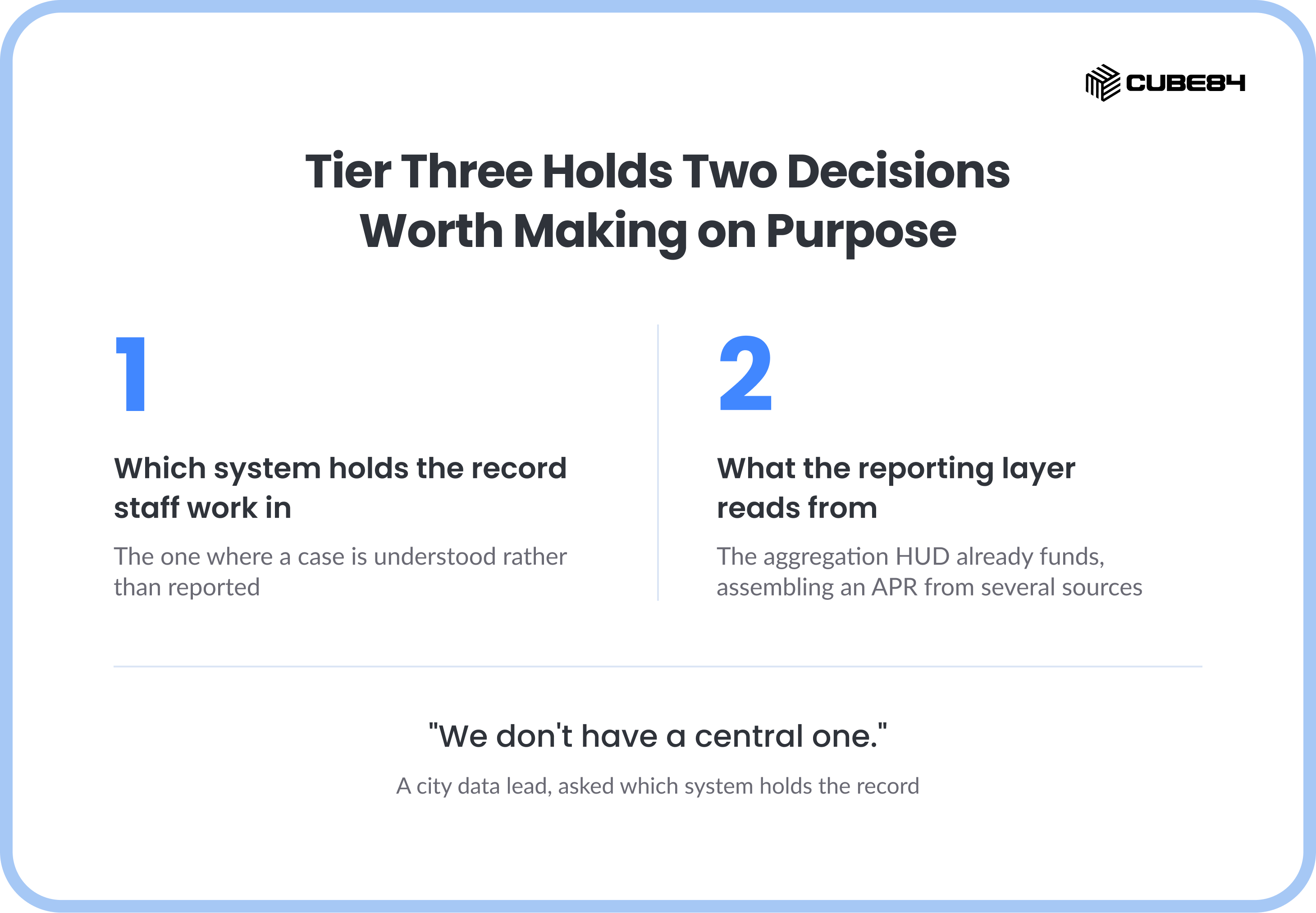
The first is which system holds the record staff work in, the one where a case is understood rather than reported. Plenty of agencies have never made that choice explicitly, which is how a city data lead answered the question at our booth with a flat “We don't have a central one.” The absence is the answer.
The second is what the reporting layer reads from, which is the aggregation HUD already funds, and settling it is what makes a reporting layer that assembles an APR from several source systems worth building rather than a workaround. Both decisions sit downstream of an argument we have made before, that most systems in this sector were built to report rather than built to run.
What to Ask a Vendor, and What to Stop Asking a CoC For
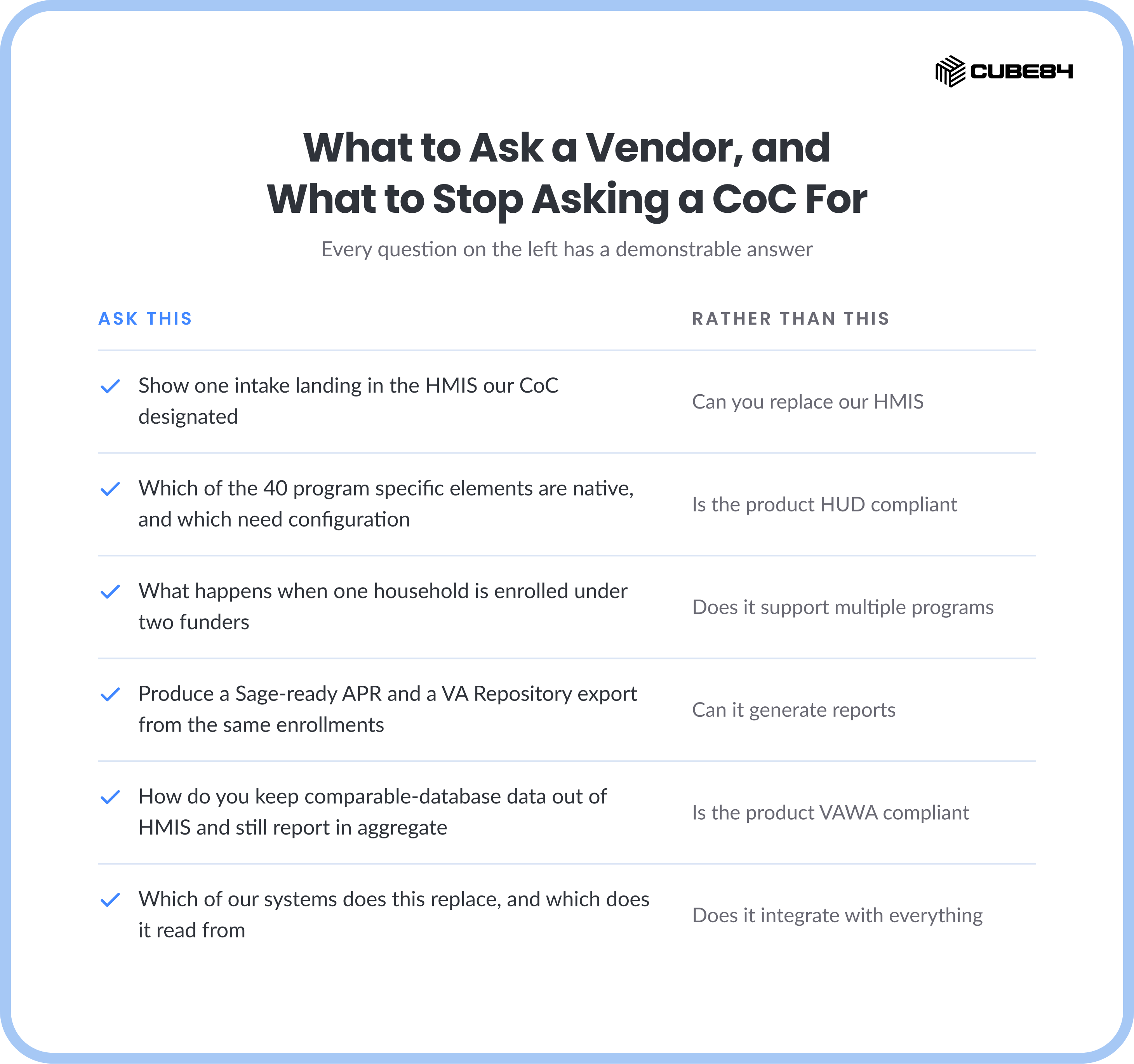
Every question on the left has a demonstrable answer, and a product that cannot do the thing cannot fake it. The ones on the right can all be answered yes by anyone. Notice what is absent: any request that a Continuum change the HMIS it designated, or that a funder accept another funder's report. Neither party has the authority to grant those, so asking spends the goodwill of people you need for a decade and changes nothing.
The honest target is one record staff type into, with a reporting layer that feeds each federal front door out of it. Understand who controls each system, consolidate what the organization controls, and architect around what it does not. The duplication left over is the duplication Congress and three federal departments put there, and carrying it deliberately is a different thing from carrying it by accident.
What These Numbers Rest On
Every count above was made by hand from the FY 2026 HMIS Data Dictionary, released October 2025 for reporting beginning October 1, 2025. The 40 is the Federal Partner Program Specific Data Elements section: HHS-RHY R1, R2 and R4 through R20; VA V1 through V4 and V6 through V10; HUD-HOPWA W1 through W6; HHS-PATH P1 through P4; HUD-CoC C2 and C3. The 46 is element 2.06, counted as the caption describes. Both counts were re-checked against the published Dictionary on 29 September 2026 and both were confirmed unchanged. Two element numbers are absent from the Federal Partner section and neither breaks that count: R3, Sexual Orientation, was retired for FY 2026 along with Gender 3.06, which the revision history records, and V5 was retired in an earlier year. Every regulation is quoted verbatim from the current text on eCFR, and every quotation from the Comparable Database Manual is verbatim from that document.
The field quotations come from CUBE84's own notes of conversations at our booth at the 2026 National Alliance to End Homelessness conference. Five distinct organizations described entry into a funder's or a jurisdiction's mandated system as a requirement rather than a preference. One of the five was identified from the content of the conversation rather than from anything naming the speaker, so four of the five are cleanly attributed. A conference booth is the most self-selected room in this sector, and five organizations describe that room rather than measuring the sector. No organization, county, city, state, or coalition is named anywhere above, which carries a real cost: a reader cannot audit a quotation whose speaker we have not identified. The regulatory evidence carries the argument on its own, and every citation for it opens in a browser.
Sources
HUD, FY 2026 HMIS Data Dictionary. Element 2.06 Funding Sources, and the Federal Partner Program Specific Data Elements section.
HUD, HMIS Comparable Database Manual. The prohibition on victim service providers entering data into HMIS, the definition of a comparable database, and the bar on sharing across providers.
24 CFR 576.400. Paragraph (f), participation in HMIS, including the sentence forbidding comparable-database data from reaching an HMIS.
24 CFR 578.7. Paragraph (b)(1), designating a single HMIS for the geographic area.
24 CFR 578.57. Paragraph (a)(2)(iv), eligible costs for aggregating data from subrecipients using multiple software systems.
Sage HMIS Reporting Repository. HUD's submission portal for the CoC APR and the ESG CAPER.
VA, SSVF HMIS and Data Reporting. The monthly client-level export to the VA Repository.
RHY-HMIS Repository. The HHS Family and Youth Services Bureau portal for de-identified extracts from HMIS.
CUBE84, 2026 Guide to Funding Programs That Support Affordable Housing. The federal, state, local, and philanthropic sources sitting alongside the 46 streams above.