

HMIS is a Person, Not a Platform
For CoC leadership and the RFP-writing layer
In some Continuums, the working knowledge of how the region's data fits together lives in one person's head rather than in the platform or in the documentation. Which report was built for which funder. Which export the monthly numbers depend on. Which users were trained on what, and when. When that person resigns, the software keeps running exactly as it did the week before, and the community loses most of what it could do with it.
We heard that happen at a conference booth last July, in two sentences. An analyst left, and the analyst who replaced him learned almost nothing from the one before. Nothing about the platform changed. What changed was that the region's ability to answer a question nobody had written down in advance now belonged to somebody who started last month.
One conversation is one conversation. Four or five of the roughly 80 to 90 organizations that came through the same booth described a data function that was one person. That is a small count from a self-selected room, so read it as evidence that the pattern exists rather than as a measure of how common it is. The argument below rests on what those visitors said and on what the federal cost rule already permits.
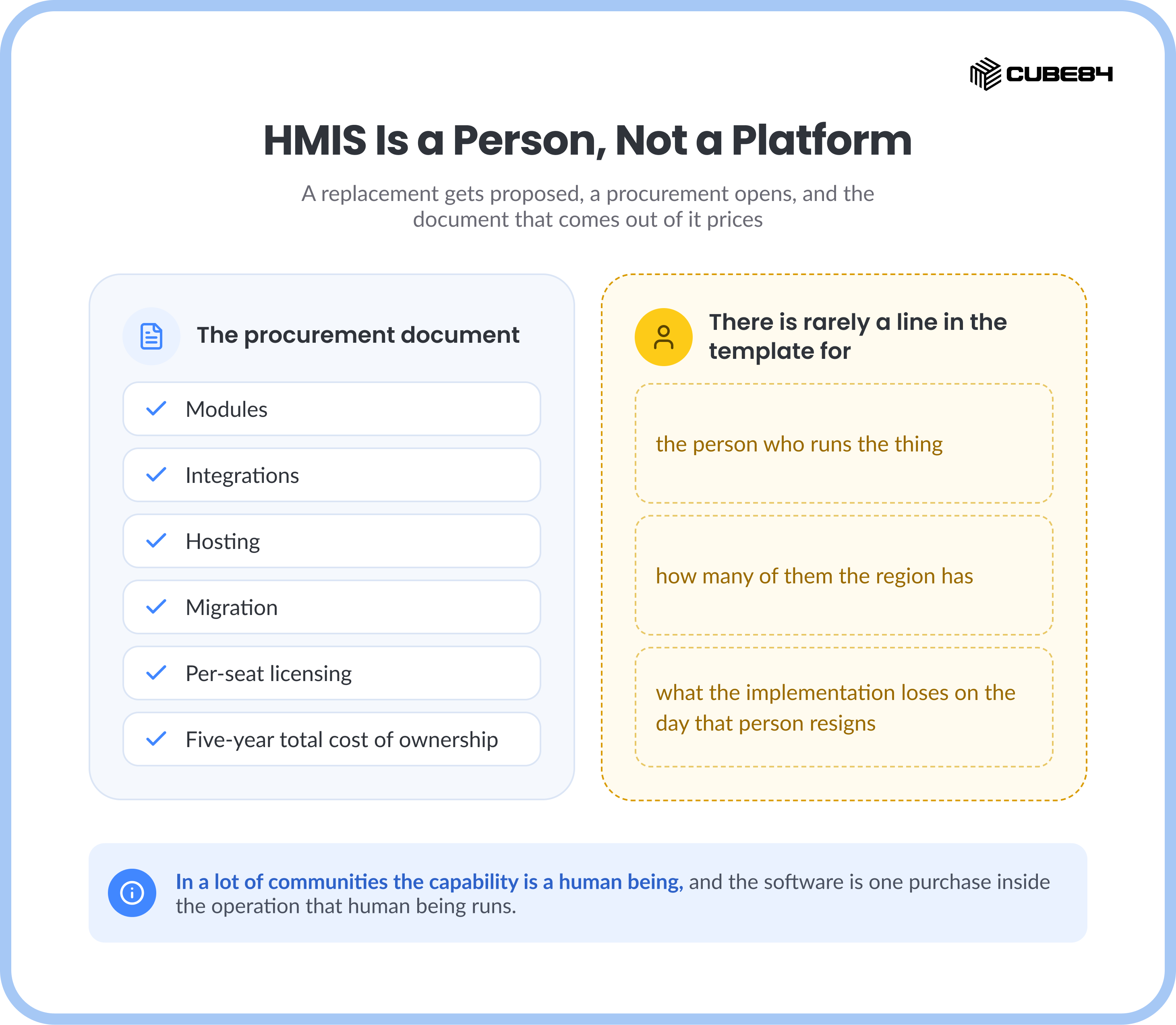
So when a Continuum concludes its HMIS is too slow, the evidence for that is usually real. A question asked in March comes back in May. Data quality flags accumulate between reporting cycles. A replacement gets proposed, a procurement opens, and the document that comes out of it prices modules, integrations, hosting, migration, per-seat licensing and five-year total cost of ownership. There is rarely a line in the template for the person who runs the thing, for how many of them the region has, or for what the implementation loses on the day that person resigns.
That gap is why we say the HMIS is a person rather than a platform. In a lot of communities the capability is a human being, and the software is one purchase inside the operation that human being runs. HUD's own cost rule has been saying something close to that for years.
HUD's Cost Rule Buys Hardware, Technical Support, Office Space and Six Kinds of Staff Time
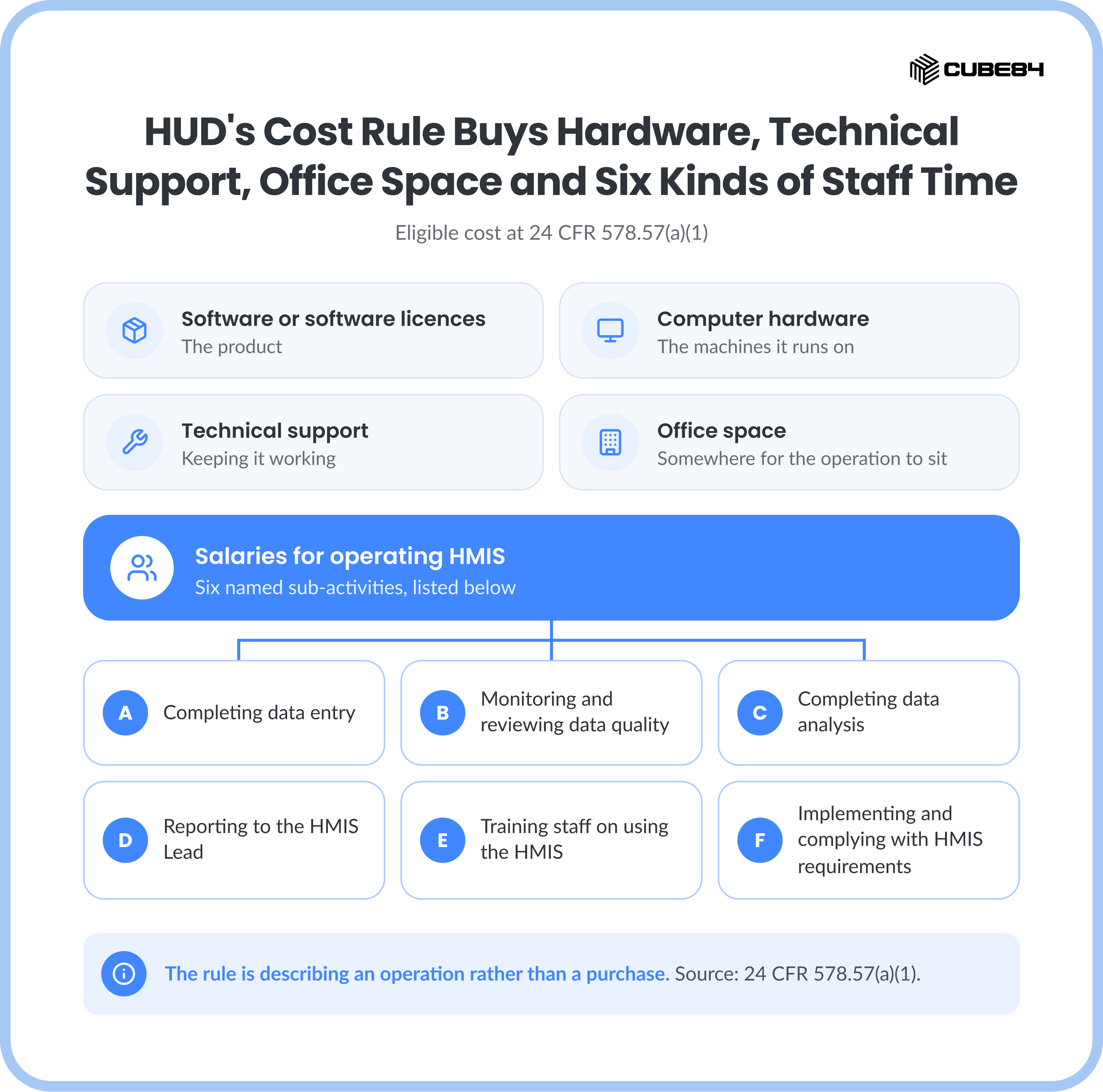
The federal rule governing what Continuum of Care Program money may buy for HMIS is 24 CFR 578.57. Read the eligible costs at paragraph (a)(1) as a list and the shape of the thing HUD is funding becomes plain. The grant may buy software or software licences. It may also buy computer hardware, technical support, office space and the rest of the apparatus an operation needs, and it may pay salaries for operating HMIS.
That salary line does not stop at the word salaries. It carries six lettered sub-activities: completing data entry, monitoring and reviewing data quality, completing data analysis, reporting to the HMIS Lead, training staff on using the HMIS, and implementing and complying with HMIS requirements.
The preview renders this as a diagram, with the salary line opening into its six lettered sub-activities. Source: 24 CFR 578.57(a)(1).
The rule is describing an operation rather than a purchase. Licences, hardware, support and premises are the apparatus, and the six lettered activities are the work, every one of which is something a named human being does on a Tuesday. HMIS leads know perfectly well that salaries are eligible. What usually limits the split is the size of the grant against everything else it has to cover, and that is a governance question with a number attached rather than a habit anybody should be scolded for.
So the useful move is to set the split deliberately, in front of the people who could change it, rather than letting the licence quote settle it by subtraction.
Federal Rule Requires One HMIS and One Lead Per Region, Whoever the Vendor Is
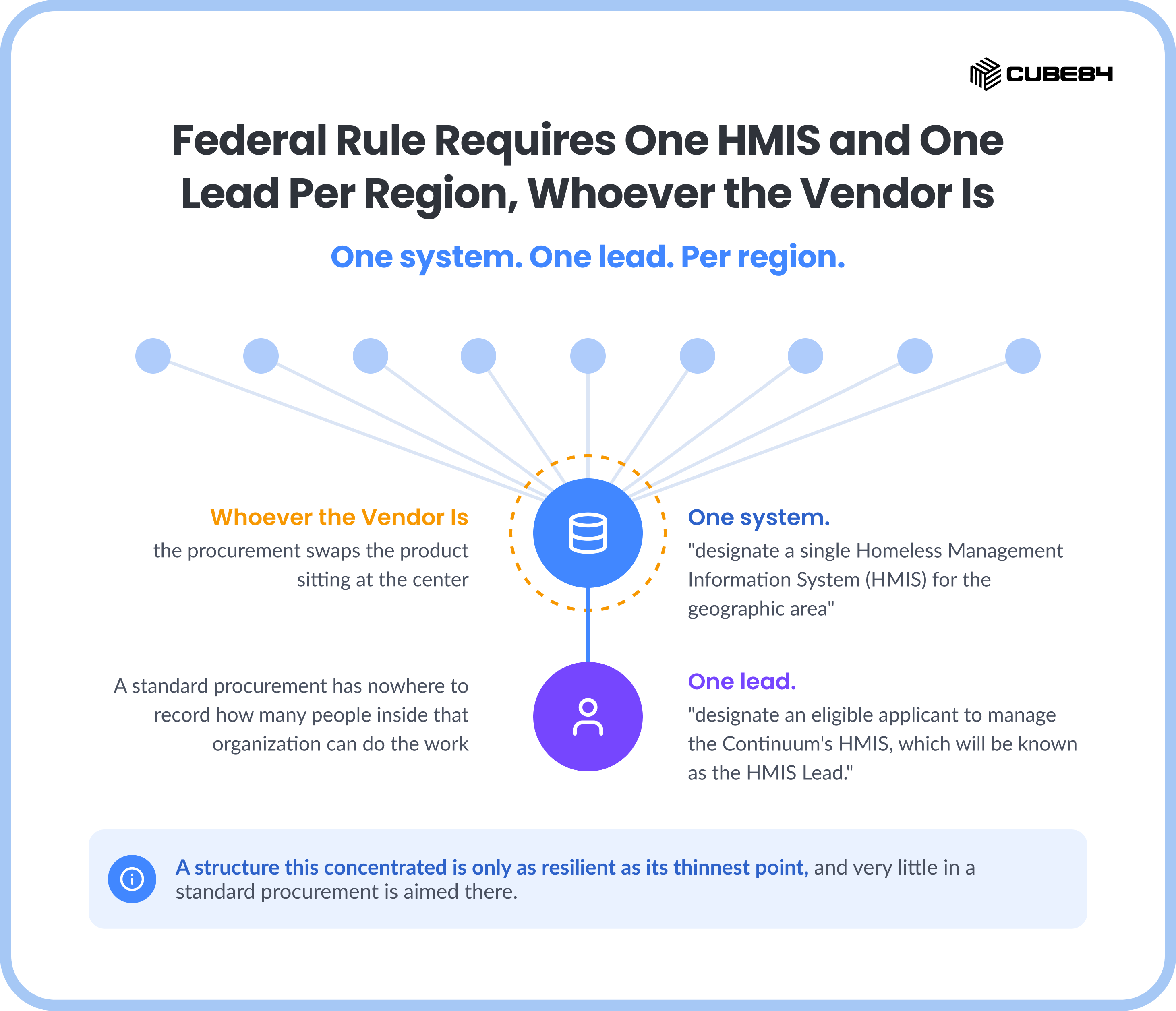
24 CFR 578.7(b) tells each Continuum to "designate a single Homeless Management Information System (HMIS) for the geographic area" and to "designate an eligible applicant to manage the Continuum's HMIS, which will be known as the HMIS Lead."
One system. One lead. Per region. Whatever else a replacement procurement changes, it does not change that, because the concentration is upstream of the vendor decision and survives it. The procurement swaps the product sitting at the center of a structure designed to funnel an entire region's data capability through a single organization, and a standard procurement has nowhere to record how many people inside that organization can do the work.
The regulation is sensible. A region running three HMIS instances has three versions of its own count, and HUD has good reason to forbid that. A structure this concentrated is only as resilient as its thinnest point, and very little in a standard procurement is aimed there.
One Analyst Resigned and the Next Analyst Learned Almost Nothing From the First
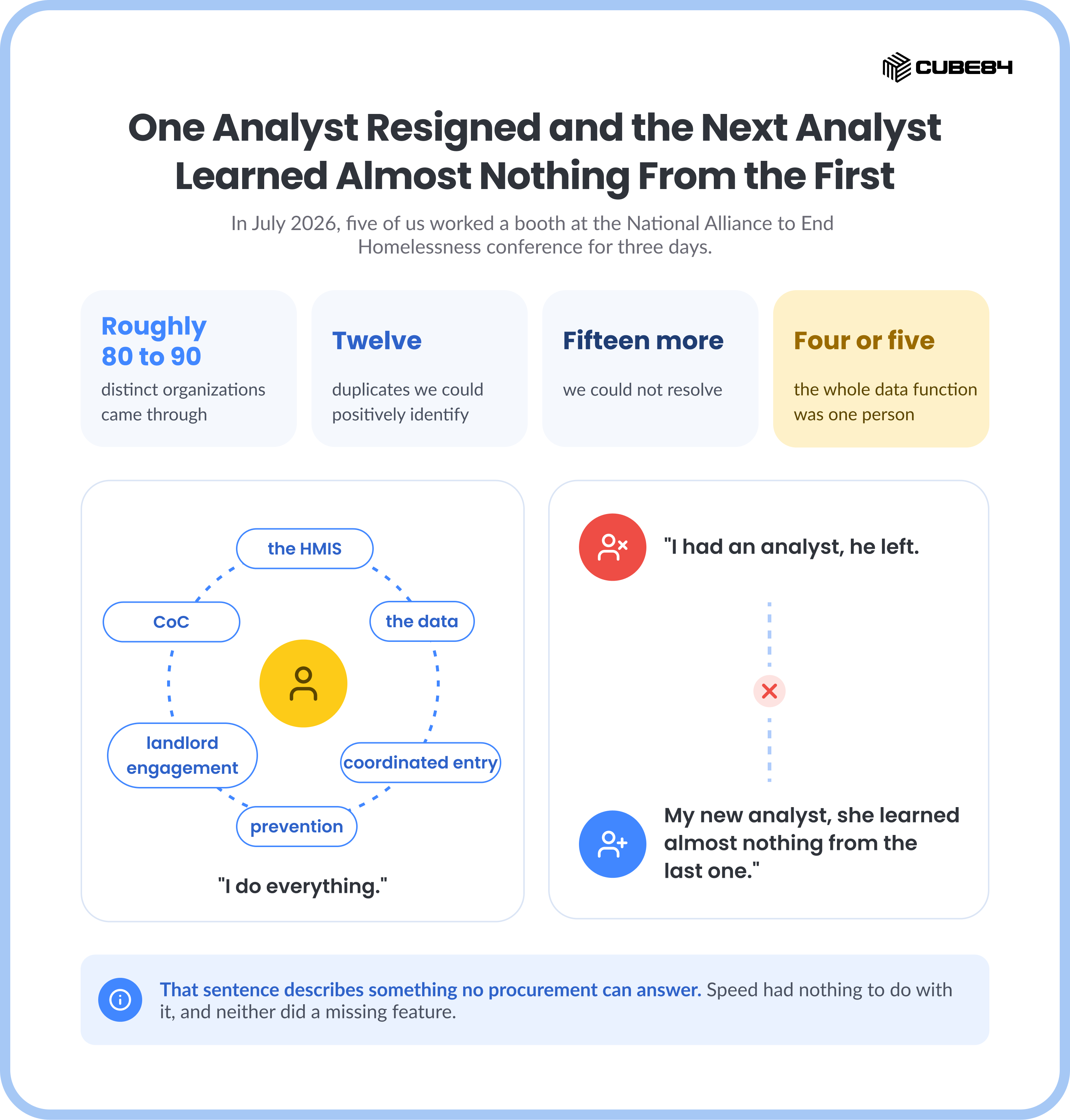
In July 2026, five of us worked a booth at the National Alliance to End Homelessness conference for three days. Roughly 80 to 90 distinct organizations came through, and roughly is the honest word: the same visitor often spoke to two or three of us, so we removed twelve duplicates we could positively identify and flagged fifteen more we could not resolve. In four or five of those organizations, the whole data function was one person.
I do everything. I do the HMIS, the data, coordinated entry, prevention, landlord engagement, CoC.
A booth is the most self-selected room in this sector, because nobody wanders into an HMIS vendor's table by accident, and the tally is our own, taken from our own booth notes, with no external source a reader can check it against. So the count is left here as an indication that the pattern exists rather than as a measurement of the sector, and nothing below leans on it. What one of those visitors said carries further, and it is the conversation this piece opened with, word for word.
I had an analyst, he left. My new analyst, she learned almost nothing from the last one.
That sentence describes something no procurement can answer. Speed had nothing to do with it, and neither did a missing feature. A region's working knowledge of its own data lived in one head and walked out with it, and a new platform arriving the following quarter would have made the year worse, because the migration would have been run by somebody who started last month.
The Case for Buying the Platform Is Stronger Than Most Critics Allow
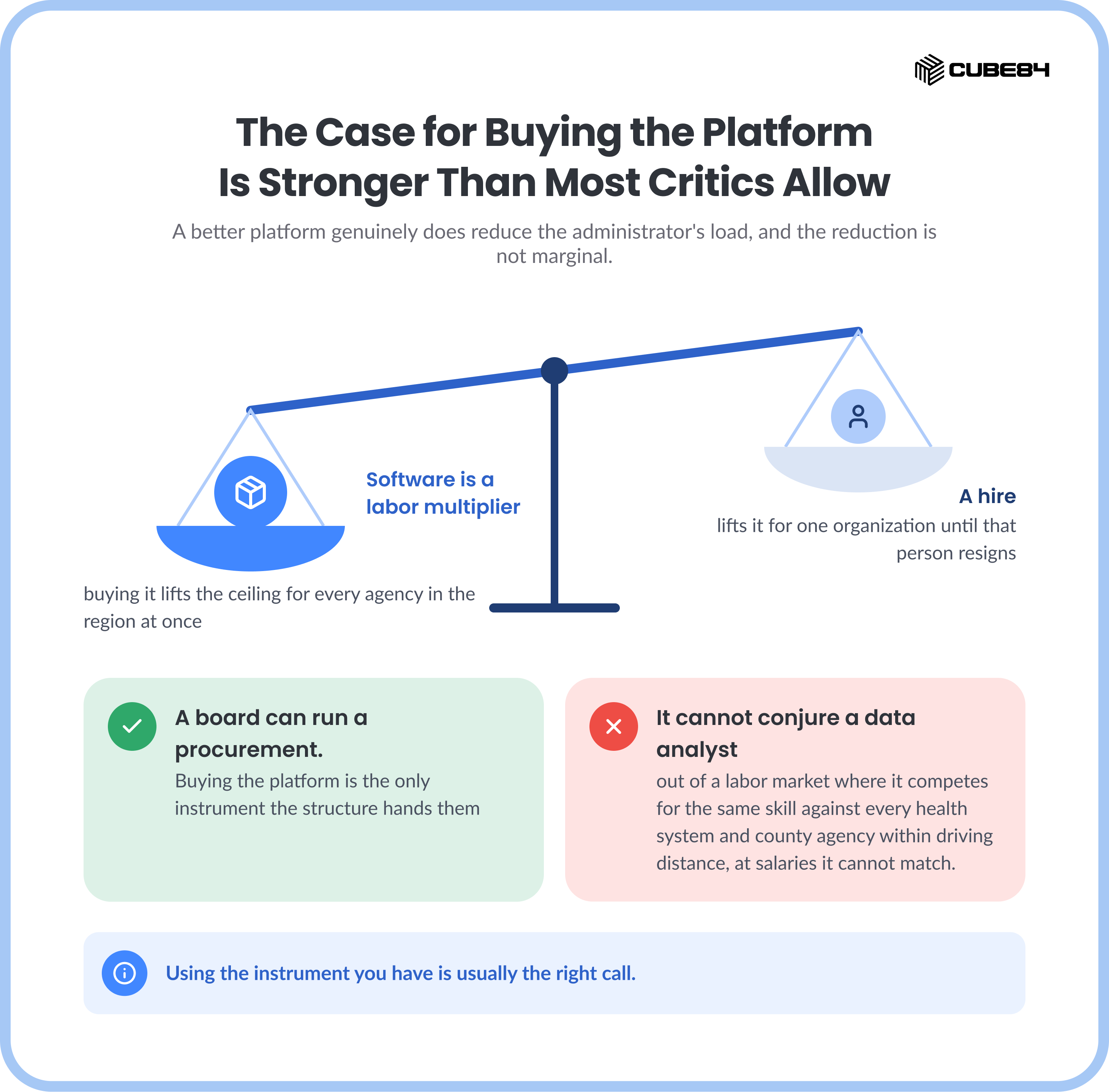
A better platform genuinely does reduce the administrator's load, and the reduction is not marginal. Every hour the incumbent system burns on an export-and-reconcile workaround is an hour the right product hands back. Software is a labor multiplier, so buying it lifts the ceiling for every agency in the region at once, while a hire lifts it for one organization until that person resigns. A recurring salary and a procured license are also different kinds of commitment, and a Continuum funded year to year has fair reason to prefer the one it can size in advance.
The governance version of the argument is stronger still. A board can run a procurement. It cannot conjure a data analyst out of a labor market where it competes for the same skill against every health system and county agency within driving distance, at salaries it cannot match. Telling that board its answer is staffing is telling it to pull a lever it does not hold. Buying the platform is the only instrument the structure hands them, and using the instrument you have is usually the right call.
A Multiplier Applied to One Person Is Still One Person
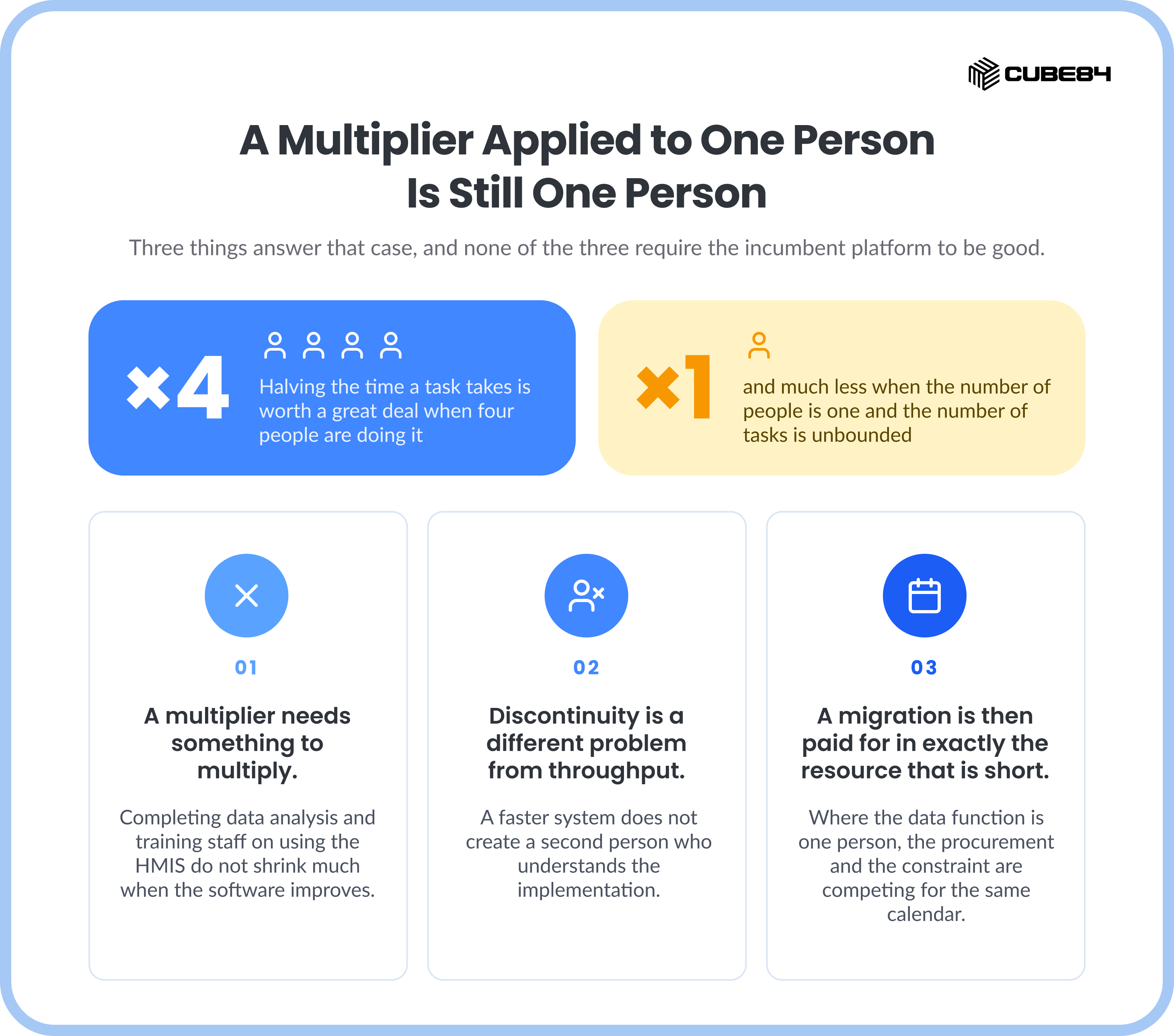
Three things answer that case, and none of the three require the incumbent platform to be good.
A multiplier needs something to multiply. Halving the time a task takes is worth a great deal when four people are doing it, and much less when the number of people is one and the number of tasks is unbounded. Two of the six activities HUD names under that salary line, completing data analysis and training staff on using the HMIS, do not shrink much when the software improves. They are the same work in a better window.
The failure the booth surfaced is discontinuity, and discontinuity is a different problem from throughput. A faster system does not create a second person who understands the implementation, and the absence of that second person is what turns one resignation into a lost year. No product roadmap addresses it, no reference call surfaces it, and no scoring rubric currently in circulation asks about it.
A migration is then paid for in exactly the resource that is short. The person who runs the current HMIS is the person who maps the fields, validates the export, rebuilds the reports, retrains the users and answers every question during parallel running. A replacement, whatever its long-run merits, spends a year of the scarce input before returning any of it. Where the data function is one person, the procurement and the constraint are competing for the same calendar.
None of this says the incumbent platform is fine. We have argued at length that most systems in this sector were built to report rather than to run, and that the reporting architecture is what turns every APR and CAPER cycle into a fire drill. Our own comparison of the major HMIS platforms reaches the same destination the opposing case does, that aligning the system a community already runs usually beats swapping it.
Four Ways to Build a Second Person Without Adding a Post
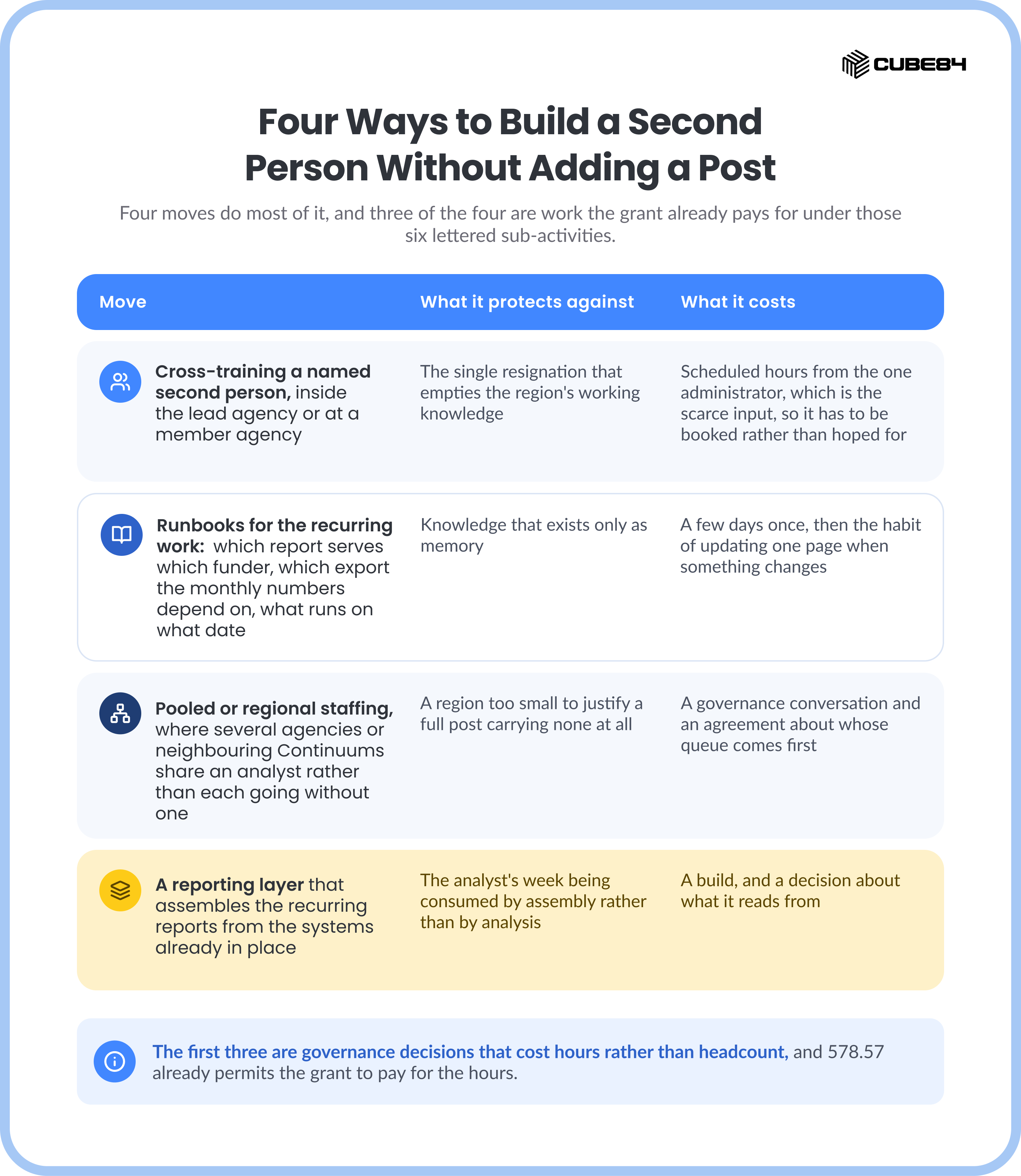
The strongest objection above is that a board cannot hire, and it is a fair one. So the question worth answering is what creates a second person's worth of continuity without a second salary. Four moves do most of it, and three of the four are work the grant already pays for under those six lettered sub-activities.
The first three are governance decisions that cost hours rather than headcount, and 578.57 already permits the grant to pay for the hours. The fourth is where a complementary layer earns its place: a reporting layer that assembles an APR from the systems a region already runs gives back the part of the analyst's week that is assembly, without asking anybody to swap the HMIS the Continuum designated.
Four Questions That Change What an HMIS RFP Can Find Out
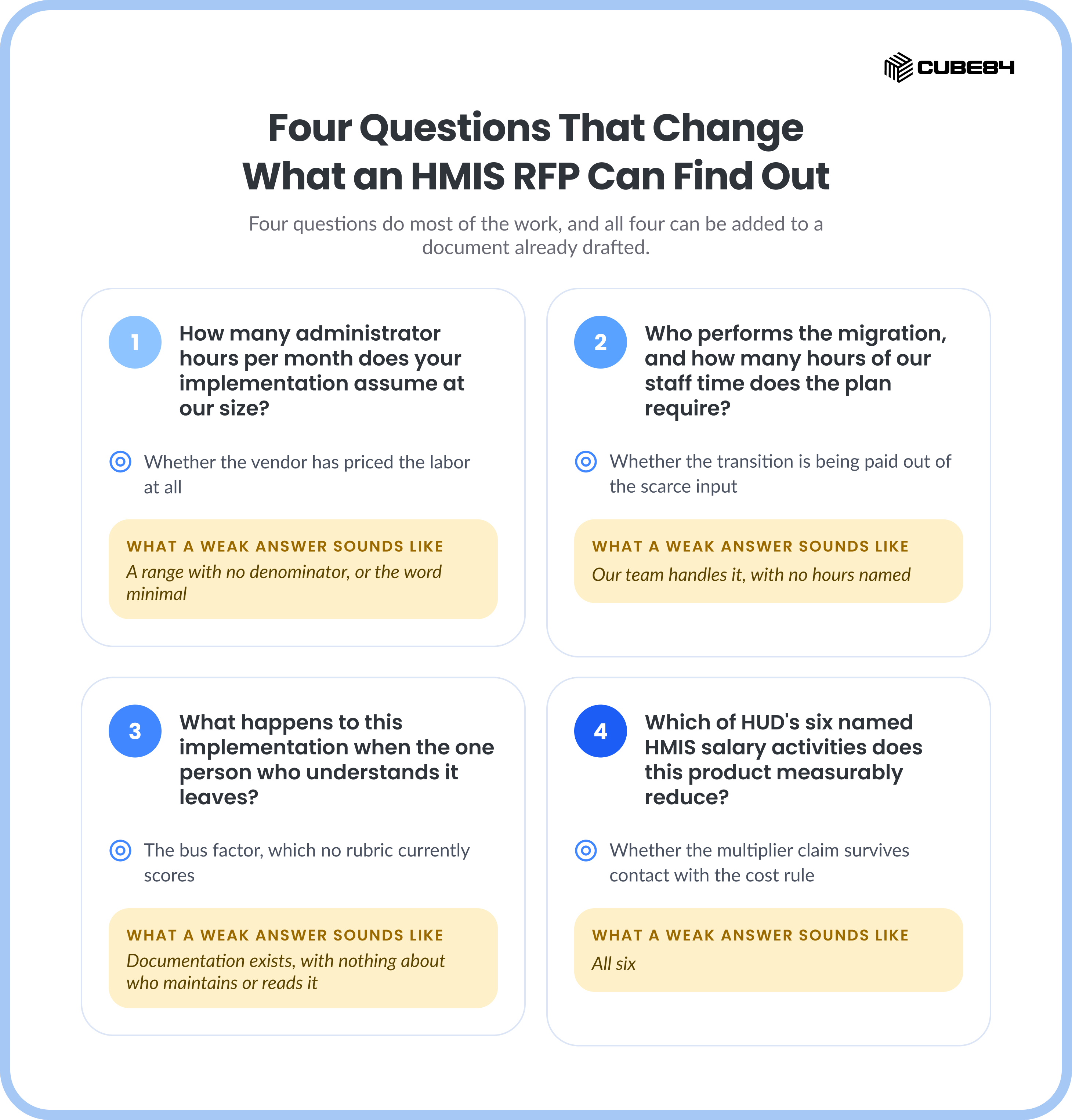
A CoC board and an RFP-writing team hold a procurement lever and mostly do not hold a hiring one, so the useful move is to make the procurement ask something the standard template does not. Four questions do most of the work, and all four can be added to a document already drafted.
The first question exists because vendor pricing is almost always expressed per seat and per module, which makes the administrator invisible in the total cost of ownership. Ask for the monthly administrator hours the implementation assumes at your scale and the number becomes comparable across bids, which is the only thing scoring needs.
The second matters more than the first, because migration cost is where an accurate five-year model and a fantasy diverge. A vendor claiming the transition is handled has either absorbed the work or moved it onto your staff, and the difference is measured in the hours of the one person who cannot be spared.
The third question rarely makes it into a written RFP, because it reads as an awkward thing to put in a document a vendor will see. Ask it anyway. Reference calls surface satisfaction and rarely surface fragility, so ask what the vendor has watched happen when a community's single administrator left mid-contract. Most vendors with real time in this sector have seen it at least once, and the ones who can describe what they did next are giving you something a reference call will not.
The fourth turns the cost rule into a scoring instrument. Read the six activities back to each bidder and make them claim reductions one at a time. Data entry and data quality monitoring plausibly shrink with better design. Analysis and training belong to a person regardless, and a bidder claiming otherwise has told you something useful about the rest of the response.
Ask How Many People in the Region Can Compose a Report Nobody Wrote in Advance
Nothing above says a Continuum should keep a platform it has outgrown. Some communities should replace theirs, and on the published evidence the case for doing it can be a strong one.
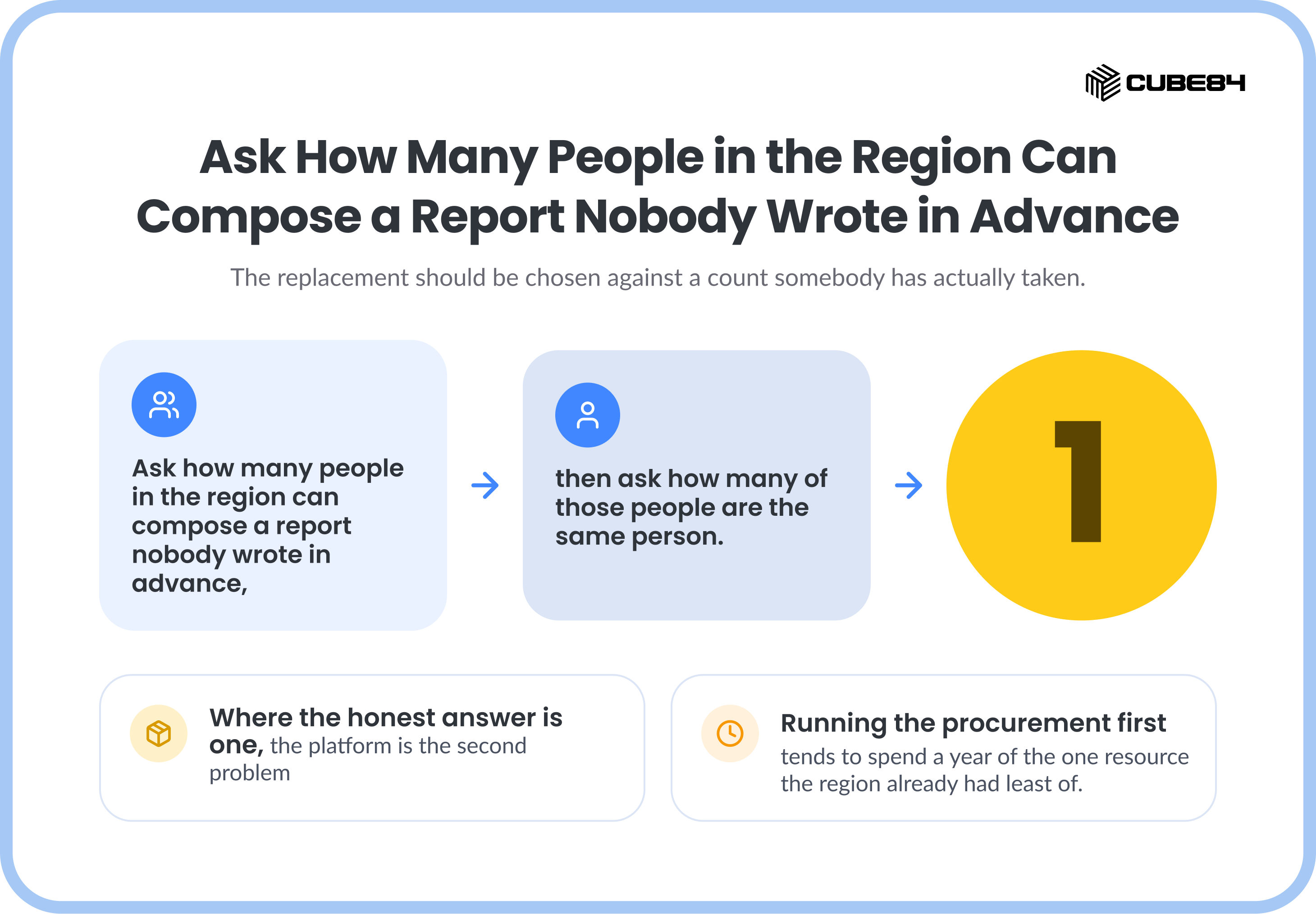
What the evidence does say is that the replacement should be chosen against a count somebody has actually taken. Ask how many people in the region can compose a report nobody wrote in advance, then ask how many of those people are the same person. Where the honest answer is one, the platform is the second problem, and running the procurement first tends to spend a year of the one resource the region already had least of.
Sources
24 CFR 578.57, eligible HMIS costs under the Continuum of Care Program. Paragraph (a)(1) carries the software licence line, computer hardware, technical support, office space, and salaries for operating HMIS with its six lettered sub-activities.
24 CFR 578.7(b), the Continuum's responsibility to designate a single HMIS for the geographic area and an HMIS Lead to manage it.
CUBE84's own review of its booth conversations, National Alliance to End Homelessness conference, July 2026. Roughly 80 to 90 distinct organizations, twelve duplicates removed and fifteen unresolved. Our own tally from a self-selected room, with no external source a reader can check it against. Every quotation is reproduced from our own notes with every person, employer, county, city, state and coalition removed.