

The Hidden Strain on Growing Salesforce Teams
Most teams start their Salesforce journey with a single admin. Someone who knows the platform well and can quickly jump in to fix things, set up dashboards, or handle user requests. In the beginning, that setup usually works just fine. But as the team grows, things start to change. More teams begin relying on Salesforce. More data comes in. More tools need to be connected. And more people start sending in requests. Suddenly, there’s simply too much for one person to realistically handle on their own.
At this point, it becomes important to stop and ask: Should we hire more in-house talent, or is it time to bring in outside support like Salesforce managed services?
In this blog, we’ll walk you through both options. You’ll get a clear understanding of what each one involves, how they compare, and how to figure out which option makes the most sense for your team right now. And if your decision process also includes evaluating temporary team extensions, this comparison of Salesforce managed services vs staff augmentation can help you think through that option as well.
Defining the Two Models Clearly
What is an In-House Salesforce Admin?
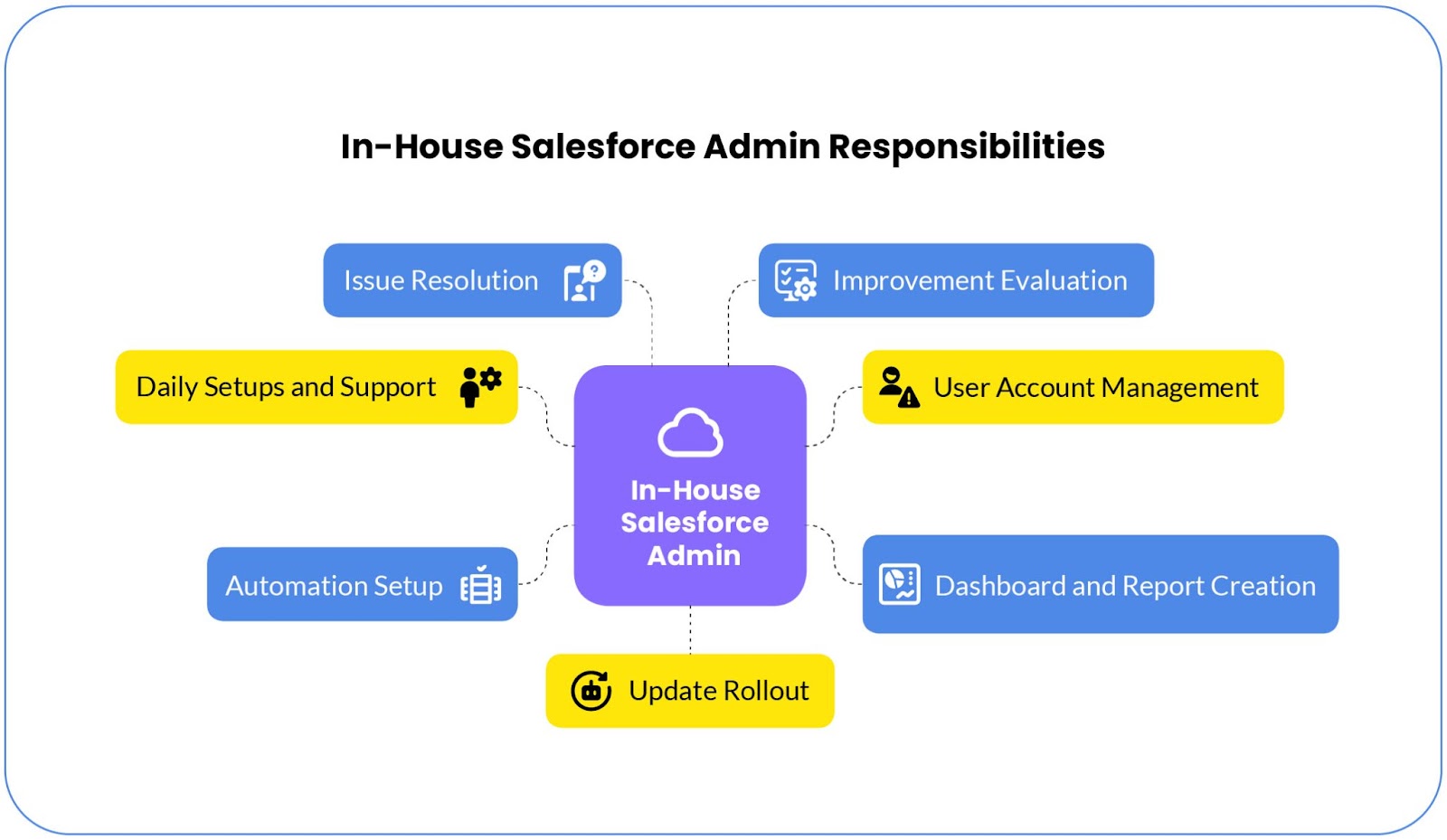
An in-house Salesforce admin is a full-time team member who looks after your Salesforce platform every day. Their job usually covers:
Handling Daily Setups and Support: They handle everyday Salesforce tasks, such as configurations, maintenance, and user support, working mostly within their existing knowledge.
Creating and managing user accounts: They make sure everyone on your team has the right access to Salesforce, depending on their role. If someone joins or leaves, the in-house admin sets them up or removes their access safely.
Building dashboards and reports: They help your team see the data that matters by creating visual dashboards or pulling reports that show sales performance, customer service stats, or campaign results.
Setting up automation for simple tasks: For example, sending a welcome email when a new lead comes in or assigning a case to the right person. These small automations save time and help things run more smoothly.
Answering user questions and fixing issues: If someone on your team is confused about how to do something or if a process isn’t working as expected, the admin is usually the first person they go to for help.
Responding to Requests as They Come: They usually react to problems, questions, and requests from the team as they pop up throughout the day.
Looking Over Suggested Improvements: When the business team wants new features or changes, your admin checks if they’re feasible and adds them to their list of things to do.
Rolling out small updates: They regularly make minor changes to the system, like adding a new field, updating a layout, or tweaking a workflow based on new business needs.
In-house admins are a great choice when your system is still fairly simple and your team needs someone who understands the day-to-day details of your business. However, as the team and system seek innovation, there is a need for proactive partners who show you all your options and possibilities. This is especially true when it comes to more advanced needs like integrating Salesforce with other tools, setting up CPQ, or managing multiple cloud-based products at the same time. These areas often require specialized knowledge or additional support.
What Are Salesforce Managed Services?
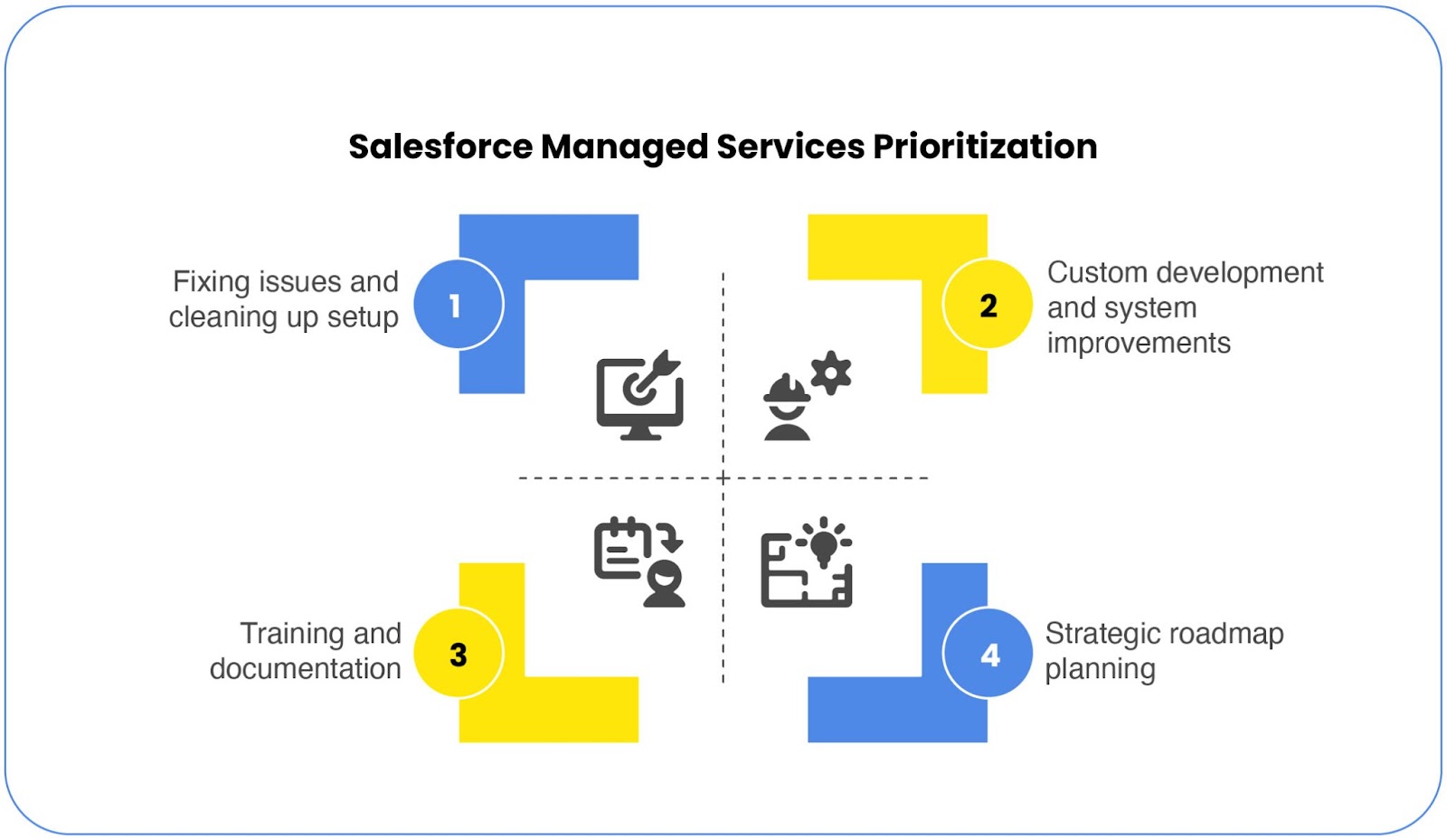
Working with a Salesforce managed services partner gives you access to a team of certified Salesforce experts. This includes developers, admins, architects, and consultants who support and improve your Salesforce system based on what your team needs. They own the outcome. A Salesforce managed services partner is committed to understanding the need, articulating the way forward, and taking charge to make sure the outcome is delivered and that the users are trained on adoption. Here’s how they do it:
Collaborating with leadership to create roadmaps: A Salesforce managed services partner works closely with your leaders to understand the organization’s vision and priorities. This helps create clear plans for Salesforce improvements and future projects that drive innovation and align with your goals.
Offering broad Salesforce and technology expertise: With deep knowledge across Salesforce products and related technologies, they guide your team on where to focus next as your organization grows.
Custom development and system improvements: They can build custom solutions when your team needs features or workflows that go beyond what Salesforce provides by default.
Fixing issues and cleaning up your setup: If your system has bugs, slow processes, or outdated features, they help troubleshoot the problem, clean things up, and make sure everything runs better.
Handling data tasks like migration or cleanup: They manage data-related work, such as moving information from other systems or cleaning up duplicates, to keep your data accurate and easy to use.
Creating reports and dashboards: They build dashboards and reports that give your team insights, track progress, understand performance, and make informed decisions.
Keeping up with Salesforce updates: Salesforce rolls out updates a few times a year. Managed services teams stay on top of these changes, guide you through what your team needs, and make sure your setup stays current without disrupting your work.
Providing advice on cost management: Drawing from experience across many clients, a Salesforce managed services partner helps control spending and make smart decisions about your Salesforce investment.
Planning for future improvements: They regularly review how your system is working and suggest ways to make it better. This includes planning new features or enhancements that align with your team’s goals.
Giving quick and accurate recommendations: Their wide expertise lets them suggest the best solutions for your needs without delay.
Supporting integrations with other tools: If your organization uses tools like SurveyMonkey, Zoom, and QuickBooks, managed services teams ensure that these tools are integrated into your Salesforce.
Bringing valuable industry-specific understanding: They use insights into your industry to customize Salesforce in ways that really fit your business challenges.
Training and documentation: They offer ongoing support and training so your team feels confident using Salesforce. They also provide clear documentation to help with any changes made.
Organizations can choose to work with a managed services team based on how much support they need. Some prefer to keep the team on standby with a set number of hours each month, while others bring them in part-time or even full-time for more consistent help. This flexibility is one of the biggest advantages of choosing managed services for Salesforce, as it allows you to have more or less support when you need it without hiring additional staff.
Salesforce Managed Services vs In-House Administrative: Direct Comparison
To help you decide what might work best for your organization, here’s a clear comparison of how each model supports different areas of your Salesforce needs.
Category | In-House Admin | Salesforce Managed Services |
Expertise | One person with working knowledge of the platform. Best suited for everyday tasks | A whole team with specialized Salesforce experts for admin, development, integrations, and system design |
Availability | Depends on their schedule, workload, and time off | Consistent support setup with quicker responses and backup resources when needed |
Scalability | Support capacity is limited to what they can manage alone | Flexible support that grows with your organization and adapts to changing business needs |
Strategic Support | Focused on day-to-day requests and routine maintenance | Includes regular planning, improvement suggestions, and long-term platform guidance |
Cost | Includes salary, benefits, training time, and risk of turnover | Predictable monthly cost with no hiring or onboarding required |
Continuity & Risk | Progress may slow if the admin is unavailable or decides to leave | Reliable delivery through shared knowledge and team-based execution |
Best Fit For | Smaller teams with steady state operations | Teams expecting growth or added complexity across products, users, or use cases. |
How to Decide: Questions Every Growing Team Should Ask
As your business grows, so do your Salesforce needs. What worked before might start to feel limiting. It’s times like these when the team needs to take a step back and ask what kind of support would actually help. Here are a few simple questions to help you determine what type of support might make things easier.
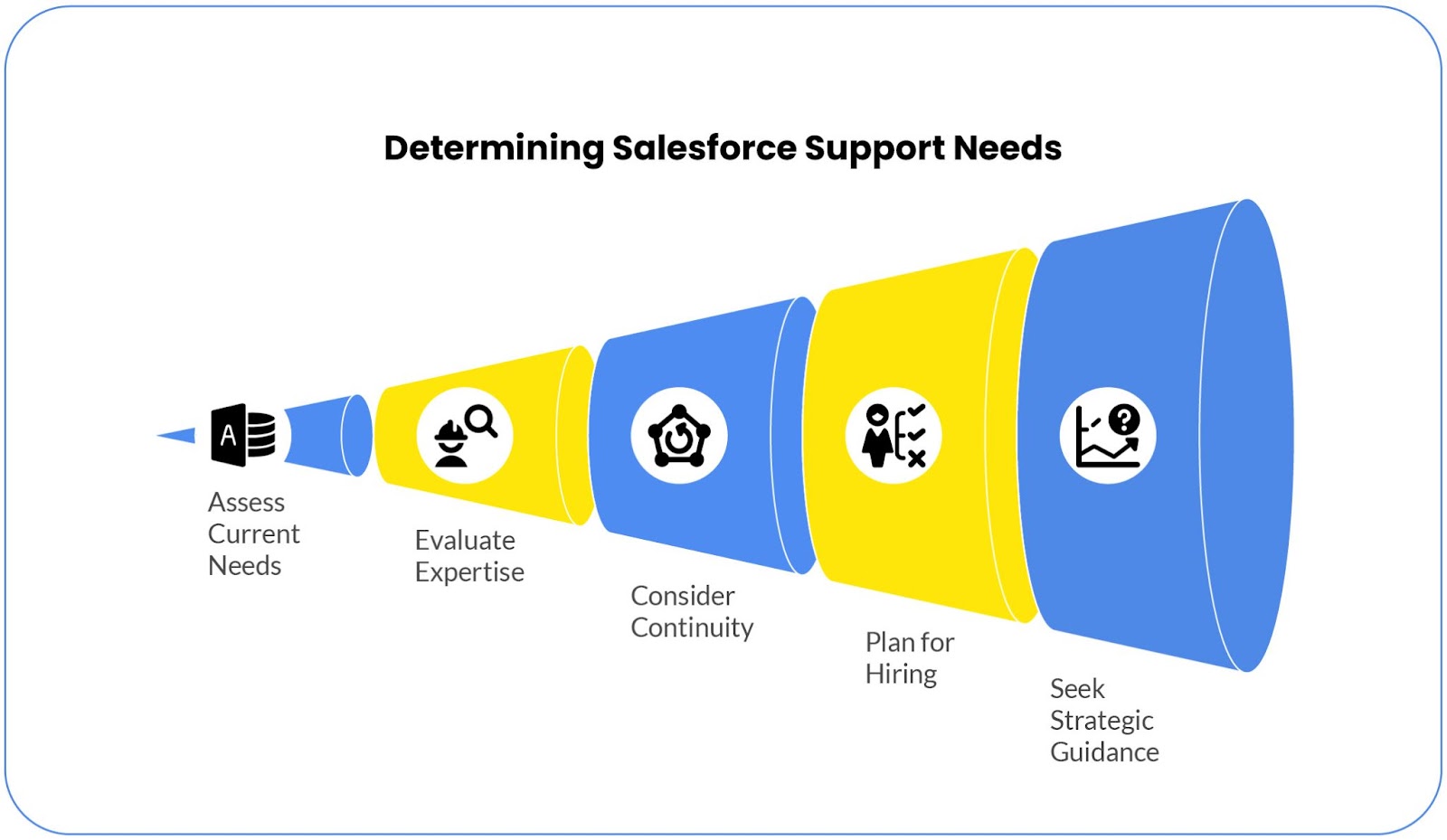
Are we mostly maintaining what we have, or are we planning to do more with Salesforce?
If your Salesforce setup just needs day-to-day support, an in-house admin might be enough. But if you're looking to introduce new features, improve workflows, or expand how different teams use Salesforce, you may need managed services for Salesforce that provide specific expertise to handle those advanced requirements.
Do we need help across different Salesforce products?
Different Salesforce clouds or products often need specialized knowledge. Not every admin has that level of experience or expertise, so it helps to know if your current support is equipped for what you want to build next.
What happens if our admin is unavailable or decides to move on?
Is there someone who can take over without disrupting your workflow? If not, the risk of delays or lost context becomes a genuine concern.
Can we keep hiring and training new people as our needs grow?
Hiring takes time. So does training. If your team is already stretched, bringing in new people might not be the fastest way to meet your goals.
Do we want strategic guidance on how Salesforce should be used and evolved, or do we already know exactly what we want?
This question helps you think about whether your organization needs ongoing advice and planning to shape Salesforce’s future use, or if you already have a clear plan and just need support to carry it out.In many growing teams, this is also where expected returns start to fall short, which is why we break this down further in our guide on why Salesforce ROI often falls short and how managed services help
Choosing the right Salesforce support can feel complicated. To make it easier, we’ve created a simple MSP calculator to help you estimate the best support level for your team as it grows.
Final Recommendation: Think Long-Term, Not Just Headcount
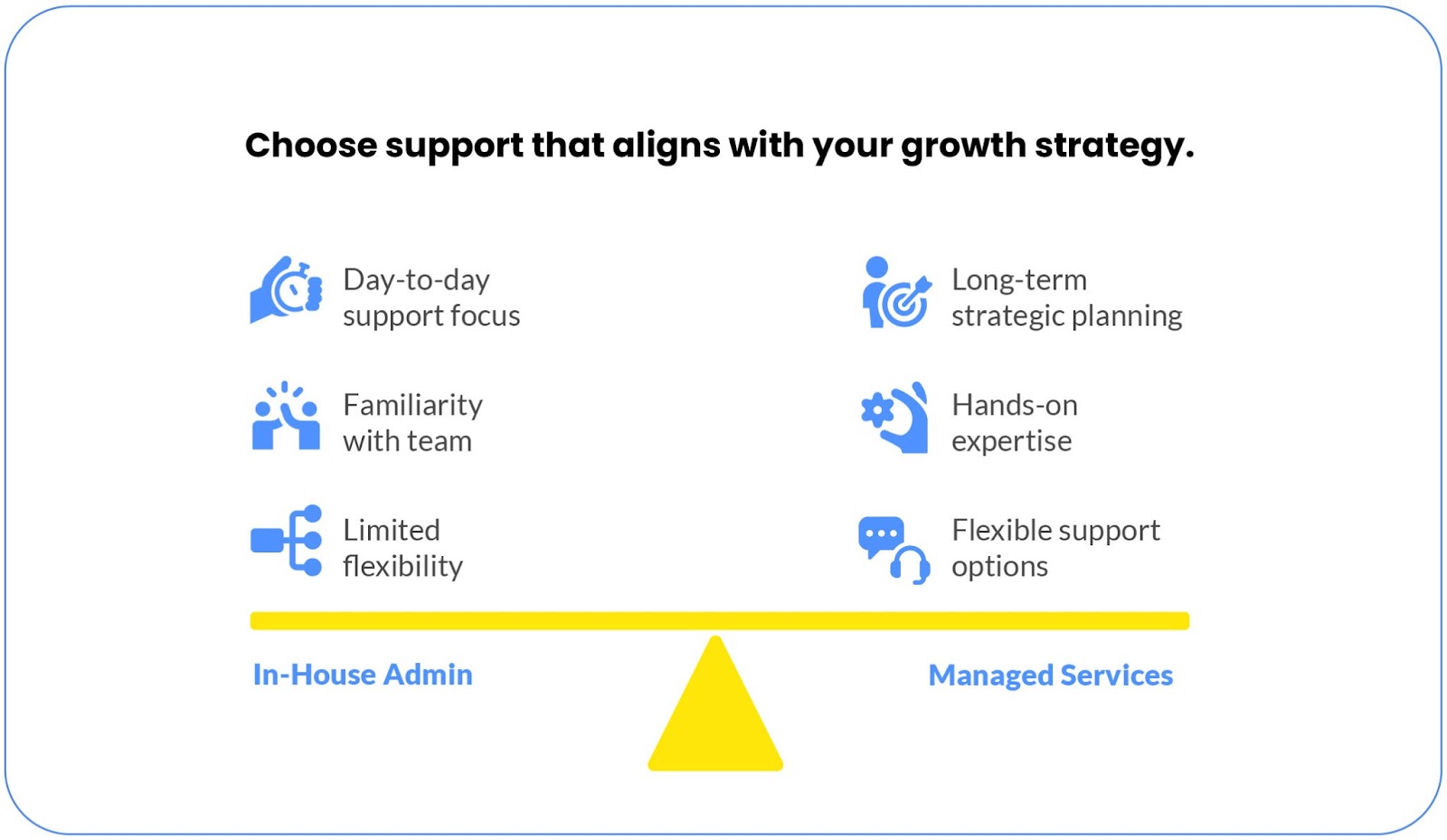
When it comes to Salesforce managed services vs in-house administrative support, both models have their strengths. An in-house admin knows your team, understands your workflows, and is often the first to respond when something needs attention. They offer essential day-to-day insight but usually focus more on keeping things running smoothly than on planning what comes next. The familiarity with your organization’s team and system is helpful, especially when your system is still fairly simple.
Managed services for Salesforce offer more than just flexible support. They bring hands-on expertise that helps your organization find better ways to use Salesforce, make the most of your investments, and adapt as your business changes. Whether you need help with select requirements (like integrations) or a long-term partnership, a Salesforce managed services partner works with you to drive innovation, optimize ROI on your investment, and keep your Salesforce running smoothly. This way, your team can focus more on growing the organization. Salesforce Managed Services is all about finding the kind of support that works for your team now and helps you be ready for whatever comes next.
Some organizations find that a hybrid model works best. They keep their in-house admin and bring in a managed services team to handle the work that’s harder to manage alone. This way, they get the familiarity of someone on-site and the extended support of a team that can bring in additional support when needed.
Whichever direction you choose, the goal is the same. The idea is to make Salesforce easier to manage and more useful to your team as you grow.
Let’s Talk About What Fits Your Growth
There’s no one-size-fits-all when it comes to managing Salesforce. What really matters is finding the kind of support that helps your team do great work without slowing things down. At CUBE84, we act as a Salesforce managed services partner that is built around your pace, your setup, and the way you want to grow.
Whether you’re looking for flexible help across teams or just want a smoother way to manage Salesforce, our Salesforce managed services are designed to make that easier. And if you'd like to talk through what might work best for you, you can always get in touch with us. We're happy to help you find a model that works.